![What are three-, four-, and six-line cables? | Different shapes, with continuing breakage concerns [OK Prostate Chip]](/img/a/T0578/eyecatch.svg)
This page is based on entries from "ok-lab's diary" (https://ok-lab.hatenablog.com/), the Japanese development diary written by Mr. Okada, founder of OK Lab, a small company in Japan (Okada Comfortable Life Laboratory). Only the entries about floating three-, four-, and six-line cable shapes are summarized here, in order of publication. Past prices and sizes are as written at the time. Current prices come from the official product list (retrieved September 4, 2026). Quotations are translated from Japanese.
Note: This page is a personal reading log by someone with no connection to the maker or the seller. It reflects the source entries as of their publication dates and makes no guarantee of accuracy or safety. The product is not a medical device; talk to a doctor about any health decision. Check the official site for current information. This page contains advertising.
In short
- The maker changed cable shapes to improve bending, but later entries still describe wire breakage.
- His later proposal made wire selection and replacement the customer's responsibility.
- No matching product can be confirmed on the current list.
About this product

The OK Prostate Chip is a small device that is placed in the urethra (the urine passage) so that it acts on the prostate; the maker sells it in several shapes, sizes and materials. It is made and sold by OK Lab (Okada Comfortable Life Laboratory), a small company in Japan, through its own online store, and prices are in Japanese yen (JPY).
The maker's development diary, "ok-lab's diary", is written in Japanese. This page is an English summary of it, and every quotation is translated. OK Lab ships internationally, so readers outside Japan can order (see "Buying from outside Japan" below).
Product names on this page are plain-English descriptions. The official Japanese product name is shown once in the product table so you can find the same item in the store.
Before you read: key terms
| Term | Plain-English meaning |
|---|---|
| Floating wire | A wire with room to slide inside a tube; Mr. Okada intended this movement to allow bending. |
| Parallel cable | Two cords joined side by side; they form the central support in these cable designs. |
| Three-line cable | Paired cords with one tube alongside them; the proposed arrangement was intended to bend and retain its shape. |
| Floating four-line cable | Paired cords with a wire-containing tube on either side; intended to hold bends in different directions. |
| Six-line cable | An earlier assembly with wires beside paired cords and additional cord coverings; intended to hold a bent shape. |
| Resin beads | Hardened resin pieces spaced along the cable; they join its components and determine its outer shape. |
| Epoxy resin | A hard coating used to cover the assembly and create sections that resist bending. |
| Metal fatigue | Mr. Okada describes wire damage associated with concentrated stress; he uses the term to explain breakage concerns. |
| Urethral sound | A rod-like device for the urine passage; these experimental versions were intended for prostate stimulation. |
| Sphincter | The diary does not explain this. |
What happens: floating wire cable shapes
The OK Prostate Chip is a small device placed in the urethra, the urine passage, to act on the prostate. These entries describe cables attached to chips and experimental rod-like devices built around related cable structures. A floating wire (a wire free to slide inside a surrounding tube) allows movement within the assembly. Mr. Okada intended these structures to bend in different directions and retain their shape, including when positioned inside the urethra.
Floating four-line cable could hold curves that earlier designs resisted
In an entry published in October 2022, Mr. Okada explained why earlier four-line and six-line cables resisted some curves. They could hold a bend, but bending favored one direction, making diagonal and spiral shapes difficult. The floating four-line cable placed loose wires inside tubes beside a parallel cable (two cords joined side by side).
According to Mr. Okada, separating the wires from the central cable allowed vertical, horizontal, and diagonal bending while preserving the chosen shape. He said a plain silicone tube tended to spring back, unlike his new assembly. Mr. Okada favored the floating design where a bent shape needed to stay in place.
(Source: ok-lab's diary, published October 2022)
https://ok-lab.hatenablog.com/entry/2022/10/15/123011
Floating four-line cable kept bending after its gaps became smaller
In another entry published in October 2022, Mr. Okada showed two custom floating four-line cables with a closely spaced, backbone-like outline. The hard sections sat almost together, while the floating wires allowed movement between them. He compared those flexible spaces to the cushioning gaps between bones in the spine.
Mr. Okada believed the reduced gaps had removed the concern about injuries from the wire; this was his assessment. He also thought the earlier six-line construction would not have bent with its sections so close together. The diary does not record how these two customers found their cables in use.
(Source: ok-lab's diary, published October 2022)
https://ok-lab.hatenablog.com/entry/2022/10/29/122854
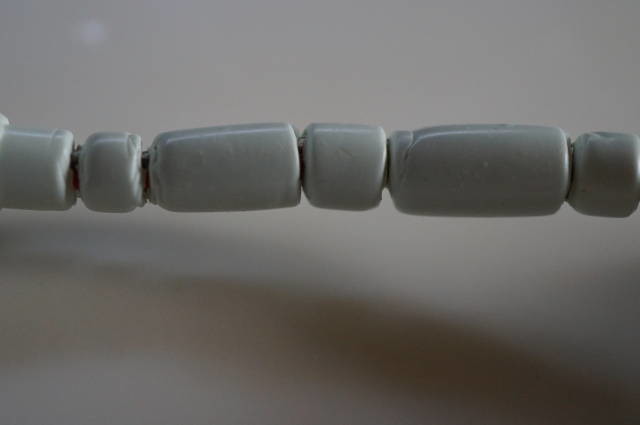
A floating four-line tip improved reach but left positioning unstable
In an entry published in December 2022, Mr. Okada described a urethral sound (a rod-like device) with a nearly rigid stainless-steel shaft. He reported that the previous week's prototype reached only the sphincter area; the diary does not explain that anatomical term. A revised prototype had approximately 5-6cm of floating four-line structure at its front, and he reported that it could reach the bladder.
However, Mr. Okada found that pressure near the prostate made its position unstable when the penis was held within the body. He described slack that required renewed attention after every urination, making flexibility a drawback as well as an advantage. The diary does not record a solution to that instability in this entry.
(Source: ok-lab's diary, published December 2022)
https://ok-lab.hatenablog.com/entry/2022/12/10/123048
Floating four-line construction later combined rigid lengths with flexible joints
In an entry published in December 2022, Mr. Okada proposed a urethral sound built around floating four-line structure throughout its length. Its cable base measured about 2mm across, with epoxy resin (a hard coating) bringing the finished diameter to about 5mm. Fully coated sections stayed rigid, while gaps in the coating formed flexible joints.
This layout addressed his complaint that a completely rigid shaft was inconvenient to keep positioned in the urethra. He also chose a ceramic tip because he expected its smooth surface to improve passage. Mr. Okada expressly said he had not yet tried this prototype himself.
(Source: ok-lab's diary, published December 2022)
https://ok-lab.hatenablog.com/entry/2022/12/17/122643
The maker's answer to floating wire cable shapes
Mr. Okada first tried to protect enclosed wires, then proposed replaceable wires with breakage treated as expected.
Floating four-line cable added protective layers without a safety guarantee
In an entry published in October 2022, Mr. Okada linked wire breakage to metal fatigue (damage associated with concentrated stress). He believed a wire free to slide inside its tube would experience less concentrated force and be less likely to fatigue. His design combined three barriers: resin gaps of about 1mm, thicker resin, and wires enclosed within tubes.
Mr. Okada expected these layers to make a broken wire less likely to reach the outer surface. He also thought the surrounding cords and tubes would limit extreme bends, reducing stress at a single point. Even so, Mr. Okada advised anyone with any concern about the design not to buy it.
(Source: ok-lab's diary, published October 2022)
https://ok-lab.hatenablog.com/entry/2022/10/15/123011
Floating four-line cable prices depended on length within stated limits
In an entry published in October 2022, floating four-line cable cost ¥6,000 (about $38 at ¥156 = $1, rate as of 2026-09-04) up to 10cm, excluding tax. Above 10cm, the price increased by ¥500 (about $3 at ¥156 = $1, rate as of 2026-09-04) per 1cm; the stated price for 20cm was ¥11,000 (about $70 at ¥156 = $1, rate as of 2026-09-04), excluding tax. The maximum length was 20cm, and the minimum was about 4cm, because the sealed ends required space.
The following two-line section could measure at most 7cm, and adding a thread behind the four-line section was free. Mr. Okada connected the price to careful construction for the intended positioning demands, and said the necessary soft cable was no longer obtainable. He considered this expensive construction wasteful when the only goal was easier positioning.
(Source: ok-lab's diary, published October 2022)
https://ok-lab.hatenablog.com/entry/2022/10/15/123011
Floating three-line cable shifted wire selection and replacement to customers
In an entry published in January 2023, Mr. Okada linked earlier four-line and six-line discontinuations to breakage and near-breakage reports. He stopped directly connecting wires to chips or cables, proposing plain tubes or tube-equipped cables for customer-selected wires instead. The proposed floating three-line cable combined paired cords with one side tube, measuring 2mm outside and 1mm inside.
Mr. Okada said this uneven arrangement bent freely, even with the stiffer paired cable made in Malaysia. His proposal made wire thickness, fitting, and timely replacement the customer's responsibility, on the assumption that wires would break. Mr. Okada warned that repeated extreme bending would inevitably cause breakage and require earlier replacement.
(Source: ok-lab's diary, published January 2023)
https://ok-lab.hatenablog.com/entry/2023/01/07/123115
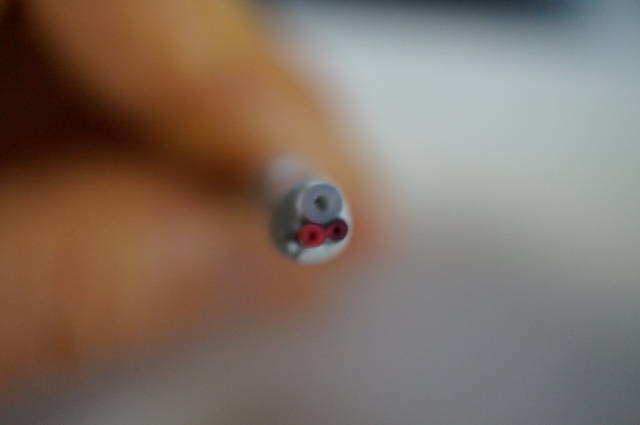
How floating wire cable shapes changed over time
| Published | What the diary said then |
|---|---|
| Aug 2022 | Larger, alternating resin beads changed the super six-line cable's outer shape. |
| Oct 2022 | Floating wires allowed curves that earlier cable structures resisted. |
| Oct 2022 | Closely spaced hard sections produced a backbone-like outline while retaining flexibility. |
| Dec 2022 | A flexible tip improved reported reach but introduced positioning instability. |
| Dec 2022 | A whole-length floating structure combined rigid coated sections with flexible joints. |
| Jan 2023 | A customer-managed wire proposal followed withdrawals prompted by breakage and near-breakage reports. |
The diary does not say what the current state is.
OK Prostate Chip products related to floating wire cable shapes
No current product is directly tied to this topic.
Common worries about floating wire cable shapes
The recorded requests concerned larger beads, better finishing, and an exception after the six-line withdrawal announcement.
"Could six-line cable have larger beads facing alternating directions?"
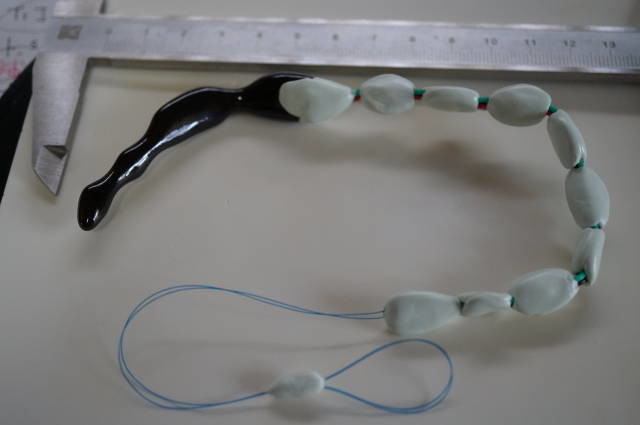
In an entry published in August 2022, a customer requested larger resin beads (hardened pieces joining the cable), alternating between upright and sideways positions. Mr. Okada made a six-line prototype with one bead per 15mm, replacing two beads over that length. The beads were approximately 10mm wide, 12mm long, and 5mm thick, with neighboring beads turned 90 degrees.
August 2022 prices excluded tax: ¥5,000 (about $32 at ¥156 = $1, rate as of 2026-09-04) up to 10cm, ¥7,500 (about $48 at ¥156 = $1, rate as of 2026-09-04) up to 15cm, and ¥10,000 (about $64 at ¥156 = $1, rate as of 2026-09-04) up to 20cm. The diary does not record how the customer found it in use. Mr. Okada cautioned that beads this large could be too demanding for his own urethra and those of other users.
(Source: ok-lab's diary, published August 2022)
https://ok-lab.hatenablog.com/entry/2022/08/20/122920
"Could better finishing have saved the six-line cable?"
In an entry published in October 2022, Mr. Okada relayed customer feedback opposing the announced six-line withdrawal. The customer considered the underlying cable well designed and suggested that more careful resin finishing could make withdrawal unnecessary.
Mr. Okada presented that feedback beside the new floating four-line design, rather than reporting an agreed repair to the old construction. The diary does not record whether that customer received a revised six-line cable.
(Source: ok-lab's diary, published October 2022)
https://ok-lab.hatenablog.com/entry/2022/10/15/123011
"Was six-line cable accepted after the withdrawal announcement?"
In an entry published in October 2022, a customer requested a super six-line cable after the six-line withdrawal announcement. The requested assembly specified a 20cm six-line section followed by a 20cm two-line section. Mr. Okada quoted ¥6,600 (about $42 at ¥156 = $1, rate as of 2026-09-04) for that cable assembly.
He accepted the request because the customer acknowledged the known problems and still wanted it. The diary does not record whether that order was completed or how the assembly performed.
(Source: ok-lab's diary, published October 2022)
https://ok-lab.hatenablog.com/entry/2022/10/15/123011
Buying from outside Japan

OK Lab ships internationally to countries covered by Japan Post's EMS courier service. Overseas orders are paid in advance by PayPal.
Each order carries a ¥400 (about $3 at ¥156 = $1, rate as of 2026-09-04) handling fee, and EMS shipping is charged on top. These terms come from OK Lab's official sales-terms page (written here as plain text, not a link: ok-lab.net/docs/law), checked on September 7, 2026; confirm them on the official store before you order, because they can change.
Summary of this article
| What you wanted to know | The answer |
|---|---|
| What is the main difference between these cables? | Their arrangements changed how they bent, held their shape, and enclosed their wires. |
| What is the base product? | A urethral device made by OK Lab in Japan, with prices stated in Japanese yen. |
| What does floating mean here? | The wire has room to move inside a surrounding tube. |
| What did the prototypes reveal? | Mr. Okada reported improved flexibility, but also positioning problems and limits to rigid designs. |
| How did the maker respond? | Protective construction was followed by a proposal assigning wire selection and replacement to customers. |
| When did these developments appear? | The supplied entries run from August 2022 through January 2023. |
| Is a current matching product listed? | No matching product can be confirmed on the current list. |
| What did customers ask about? | Larger alternating beads, improved finishing, and a cable request after the withdrawal announcement. |
| How are overseas purchases handled? | The stated terms require advance PayPal payment, a handling fee, and separate EMS shipping charges. |
Source: ok-lab's diary (Okada Comfortable Life Laboratory). The original entries are in Japanese; quotations on this page are translated. Photos and videos are on the original entries.
This article is a summary of the maker's development diary. The product is not a medical device and no result is guaranteed. If anything feels wrong or worries you, see a doctor. Prices, specifications and cautions change, so confirm the latest information on the official blog and the official site. Questions about ordering and shipping go to the seller.