![Will a hybrid lock-on keep my chip in place? | The maker says fit matters [OK Prostate Chip]](/img/a/T0566/eyecatch.svg)
This page is based on entries from "ok-lab's diary" (https://ok-lab.hatenablog.com/), the Japanese development diary written by Mr. Okada, founder of OK Lab, a small company in Japan (Okada Comfortable Life Laboratory). Only the entries about "hybrid lock-on" are summarized here, in order of publication. Past prices and sizes are as written at the time. Current prices come from the official product list (retrieved September 4, 2026). Quotations are translated from Japanese.
Note: This page is a personal reading log by someone with no connection to the maker or the seller. It reflects the source entries as of their publication dates and makes no guarantee of accuracy or safety. The product is not a medical device; talk to a doctor about any health decision. Check the official site for current information. This page contains advertising.
In short
A hybrid lock-on holds its shape more firmly, but early testing exposed fit and connection problems.
Mr. Okada proposed shorter, closely fitted designs and revised the thread connection.
The diary still records custom hybrid lock-on work in August 2026.
About this product

The OK Prostate Chip is a small device that is placed in the urethra (the urine passage) so that it acts on the prostate; the maker sells it in several shapes, sizes and materials. It is made and sold by OK Lab (Okada Comfortable Life Laboratory), a small company in Japan, through its own online store, and prices are in Japanese yen (JPY).
The maker's development diary, "ok-lab's diary", is written in Japanese. This page is an English summary of it, and every quotation is translated. OK Lab ships internationally, so readers outside Japan can order (see "Buying from outside Japan" below).
Product names on this page are plain-English descriptions. The official Japanese product name is shown once in the product table so you can find the same item in the store.
Before you read: key terms
| Term | Plain-English meaning |
|---|---|
| Urethra | The urine passage, where the diary describes placing the device. |
| Hybrid lock-on | A cable-and-wire attachment intended to help the chip remain in position. |
| Parallel cable | Joined cable strands forming the attachment's curved structure and containing its wire. |
| Shape-memory wire | Wire that returns toward its original shape, providing the attachment's spring-like behavior. |
| Chipless design | A soft wire-in-tube structure the maker compares with the hybrid for positioning and sensation. |
| Penile urethra | The urine passage within the penis; the location reached by an overly long prototype. |
| Epoxy | A hard-setting resin used at the thread connection in an early prototype. |
| Shape-memory horn | A wire extension intended to carry stimulation toward the chip, according to Mr. Okada. |
| Integrated stopper | An additional stop built into the junction between the chip and its cable attachment. |
| Sphincter | The boundary named in the discussion of inward chip movement. The diary does not explain this. |
What happens: hybrid lock-on problems
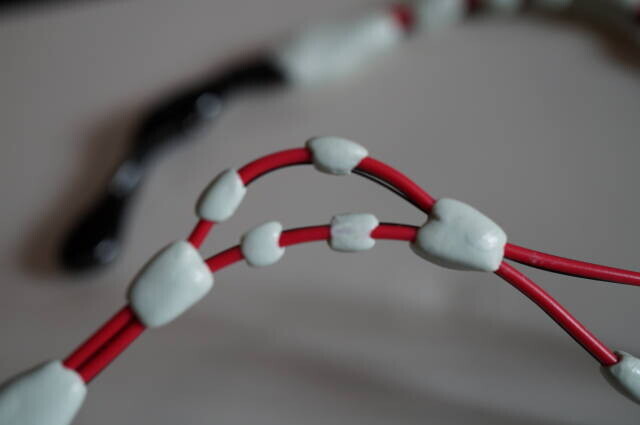
The OK Prostate Chip is a small device placed in the urethra (the urine passage) to act on the prostate. A hybrid lock-on combines parallel cable (joined cable strands) with shape-memory wire (wire that returns toward its original shape). It connects at the chip's rear and forms the structure intended to help it remain positioned within the urethra. Mr. Okada describes it as firmer than a chipless design (a soft wire-in-tube structure), while still able to bend.
Stainless-wire failures led Mr. Okada to propose the hybrid lock-on
In an entry published in February 2025, Mr. Okada described the failure of earlier cable-and-wire designs. Earlier parallel-cable versions with 0.3mm stainless-steel wire had all been discontinued after customers reported breakage.
The proposed hybrid instead used 0.3mm shape-memory wire, which he described as resistant to breaking during ordinary use. Mr. Okada proposed the hybrid to combine a defined shape with spring-like flexibility.
(Source: ok-lab's diary, published February 2025)
https://ok-lab.hatenablog.com/entry/2025/02/01/122912
Early hybrid lock-on testing exposed outward pressure and a painful connection
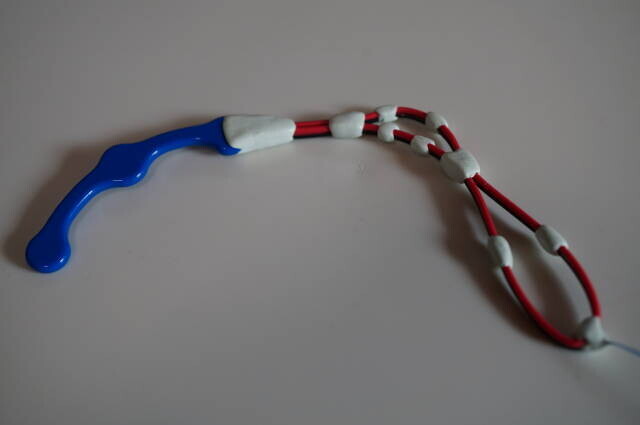
In entries published in February 2025, Mr. Okada described testing a ceramic double-twist chip with a hybrid lock-on. Its lock-on section measured 70mm or more and sometimes reached the penile urethra (the urine passage within the penis). He described the wire loop pressing outward there.
He traced the test's mild pain to nylon thread hardened into a point by epoxy (a hard-setting resin). The revised prototype covered the thread connection with rubber instead. Mr. Okada cautioned against prolonged placement in the penile urethra because the wire loop kept trying to expand.
(Source: ok-lab's diary, published February 2025)
https://ok-lab.hatenablog.com/entry/2025/02/01/122912
(Source: ok-lab's diary, published February 2025)
https://ok-lab.hatenablog.com/entry/2025/02/08/122932
Hybrid lock-on wire made a horn extension possible in March 2025
In an entry published in March 2025, Mr. Okada introduced a hybrid lock-on prototype with a shape-memory horn (a wire extension). He said the wire running throughout the hybrid made this connection possible. According to his account, the extension carried stimulation along the wire toward the chip.
He rejected the same attachment on ordinary cable-only lock-ons because he expected the cable to fail before the wire. Mr. Okada recommended horn lengths of 30mm, 40mm, or 50mm, with a stated maximum of 200mm.
(Source: ok-lab's diary, published March 2025)
https://ok-lab.hatenablog.com/entry/2025/03/22/122906
Combining hybrid lock-on options required repeated rebuilding before completion
In an entry published in May 2026, Mr. Okada described a customer request combining options from several previous prototypes. He wrote that uncertainty about making the integrated stopper led to repeated rebuilding.
A tube-covered extension also needed rebuilding because its design required thread and wire together, but he had omitted the thread. He reported finishing the product, but the diary does not record the customer's experience using it. For complex requests, OK Lab's March 2025 guidance was to describe the idea broadly so staff could ask for missing specifications.
(Source: ok-lab's diary, published May 2026)
https://ok-lab.hatenablog.com/entry/2026/05/23/122904
(Source: ok-lab's diary, published March 2025)
https://ok-lab.hatenablog.com/entry/2025/03/22/122906
A shell-covered hybrid lock-on introduced another custom combination in August 2026
In an entry published in August 2026, Mr. Okada presented his first hybrid lock-on request for a shell-covered chip. The customer specified an M-size four-point twist chip with an A-type 4cm hybrid connection.
The accompanying quotation listed the hybrid lock-on at ¥5,500 (about $35 at ¥156 = $1, rate as of 2026-09-04); it priced the base chip and shell work separately. The diary does not record how this custom build felt in use. Mr. Okada's previous proposal for this chip style had been an adjustable lock-on, a different connection option.
(Source: ok-lab's diary, published August 2026)
https://ok-lab.hatenablog.com/entry/2026/08/29/122931
The maker's answer to hybrid lock-on problems
Mr. Okada emphasized close fit, explained the wire construction, and proposed the hybrid for persistent inward movement.
Hybrid lock-on length guidance favored shorter designs with a close fit
In an entry published in February 2025, Mr. Okada said the whole hybrid behaved like a flexible solid rather than ordinary cable. He concluded that its shape needed to match the urethra's dimensions and curves closely. The quoted price was the chip price plus ¥5,000 (about $32 at ¥156 = $1, rate as of 2026-09-04) excluding tax, as published that month.
His stated constraint was a bend needing about 2cm, leaving too little room for the final loop in very short builds. He recommended about 4cm to 5cm; the same entry nevertheless declined requests for 4cm or less.
(Source: ok-lab's diary, published February 2025)
https://ok-lab.hatenablog.com/entry/2025/02/08/122932
Hybrid lock-on breakage claims rested on Mr. Okada's explanation of wire behavior
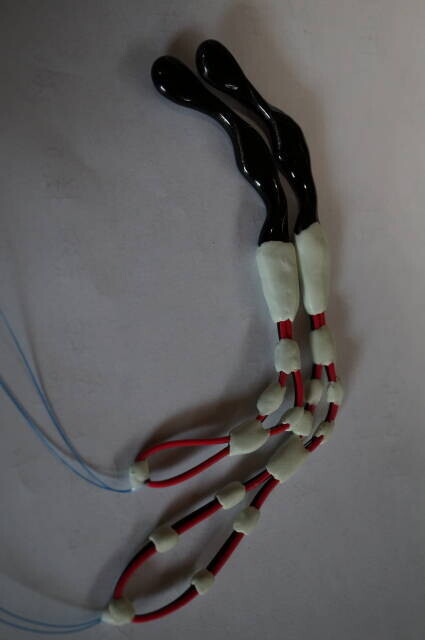
In an entry published in February 2025, Mr. Okada said the hybrid did not permanently deform its wire. He therefore said there was no concern about wire breakage.
The diary does not record a long-term durability result for that claim. His design allowed limited sliding between cable and wire instead of treating them as one rigidly bonded material. Mr. Okada cautioned that attempts to fasten these materials rigidly would eventually slip apart.
(Source: ok-lab's diary, published February 2025)
https://ok-lab.hatenablog.com/entry/2025/02/01/122912
(Source: ok-lab's diary, published February 2025)
https://ok-lab.hatenablog.com/entry/2025/02/08/122932
Mr. Okada proposed the hybrid lock-on for persistent inward chip movement
In an entry published in February 2025, a customer reported a broken wire and asked about chips moving farther inward. Staff offered a refund and first asked which models moved; the customer confirmed receiving the refund and said several designs had moved. Mr. Okada thought the customer's understanding of the intended position might explain some of the concern.
The diary does not record whether this customer later tried a hybrid. He said the hybrid loop expands when the assembly straightens, preventing passage beyond the sphincter (the boundary named in his explanation). For persistent inward movement, Mr. Okada therefore suggested the hybrid lock-on.
(Source: ok-lab's diary, published February 2025)
https://ok-lab.hatenablog.com/entry/2025/02/15/122943
How hybrid lock-on problems changed over time
| Published | What the diary said then |
|---|---|
| Feb 2025 | Shape-memory reinforcement aimed to restore the cable's shape after bending. |
| Feb 2025 | Shorter-prototype testing pleased Mr. Okada, but he stressed the brief test period. |
| Mar 2025 | The specification sheet listed recommended lock-on lengths of 40mm or 50mm. |
| Apr 2025 | Mr. Okada identified an enclosed wire loop as a workable cable–wire combination. |
| Mar 2026 | A proposed cable-and-wire arrangement raised concerns about unequal material strength. |
| Jul 2026 | Mr. Okada clarified that the similarly named spiral chipless design was a different product. |
OK Prostate Chip products related to hybrid lock-on problems
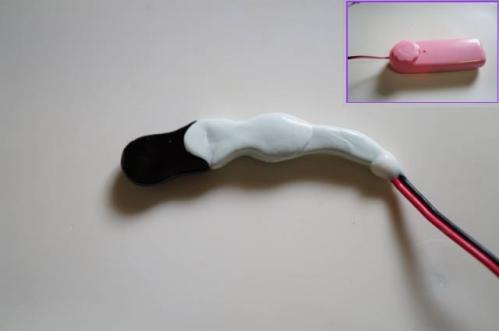
The current list includes the short ceramic vibrating chip requested in the April 2025 design discussion.
Products that appear in these entries
| Product (official name) | Price incl. tax | Relation to this topic |
|---|---|---|
| Short ceramic vibrating chip (OKプロステート核振チップ 陶器素材ショートタイプ) | ¥5,500 (about $35 at ¥156 = $1, rate as of 2026-09-04) | In April 2025, a customer requested this base product for a wire-assisted design; Mr. Okada developed a separate custom assembly. |
The short ceramic vibrating chip is listed in OK Lab's own online store.
(Source: ok-lab's diary, published April 2025)
https://ok-lab.hatenablog.com/entry/2025/04/26/122909

Products the diary mentioned as alternatives
The diary names no alternative.
The diary also describes hybrid prototypes, horn extensions, stopper combinations, shell-covered custom builds, and a separate spiral chipless design. No matching product can be confirmed on the current list.
Common worries about hybrid lock-on problems
Readers asked about different loop shapes, vibrating-chip connections, and the extra bulk of an integrated stopper.
"Can hybrid lock-on wire form a figure-eight loop?"
In an entry published in February 2025, a customer suggested a figure-eight shape for a soft chipless loop to change its sensation. Mr. Okada initially said he had not found a satisfactory way to make that requested shape.
He then observed that the wire inside the hybrid lock-on already resembled a figure eight, although it was not the requested tube-based loop. Mr. Okada asked that the original proposal remain on hold.
(Source: ok-lab's diary, published February 2025)
https://ok-lab.hatenablog.com/entry/2025/02/01/122912
"Can hybrid lock-on wire support a vibrating chip?"
In an entry published in April 2025, a customer requested a short ceramic vibrating chip with wire-assisted positioning. Staff initially said the proposed cable-and-wire combination would be difficult; the customer then accepted a different arrangement. Mr. Okada produced a separate prototype with a tube-covered wire loop and independently moving motor cable.
That was a different construction from the hybrid lock-on. The diary does not record how the customer found the completed prototype in use. Mr. Okada advised against assuming shape-memory wire could simply be attached alongside other materials.
(Source: ok-lab's diary, published April 2025)
https://ok-lab.hatenablog.com/entry/2025/04/26/122909
"Would an integrated stopper make my hybrid lock-on bulkier?"
In an entry published in October 2025, a customer requested a hybrid lock-on with an integrated stopper (a stop at the chip–cable junction). Staff warned that this junction would be much larger than the thread-only version. A double loop cost ¥4,400 (about $28 at ¥156 = $1, rate as of 2026-09-04), or ¥3,300 (about $21 at ¥156 = $1, rate as of 2026-09-04) without side reinforcement, a stated reduction of ¥1,100 (about $7 at ¥156 = $1, rate as of 2026-09-04).
The customer chose two 15mm loops without reinforcement, and Mr. Okada reported making the hybrid version. The diary does not record the customer's experience with the finished build. Staff advised confirming the larger size and the intended loop measurements before a quotation.
(Source: ok-lab's diary, published October 2025)
https://ok-lab.hatenablog.com/entry/2025/10/11/123003

Buying from outside Japan

OK Lab ships internationally to countries covered by Japan Post's EMS courier service. Overseas orders are paid in advance by PayPal. Each order carries a ¥400 (about $3 at ¥156 = $1, rate as of 2026-09-04) handling fee, and EMS shipping is charged on top. These terms come from OK Lab's official sales-terms page (written here as plain text, not a link: ok-lab.net/docs/law), checked on September 7, 2026; confirm them on the official store before you order, because they can change.
Summary of this article
| What you wanted to know | The answer |
|---|---|
| What is the short answer? | The maker's account emphasizes matching the hybrid's shape to the body. |
| What is the base product? | A small urethral device made and sold by OK Lab in Japan. |
| What do the terms mean? | The hybrid combines cable with shape-memory wire; a horn and stopper are additional structures. |
| What problems appeared? | Early testing exposed outward pressure and a painful thread connection; later custom combinations required rebuilding. |
| What did the maker propose? | Shorter dimensions, a revised connection, and the expanding loop for persistent inward movement. |
| What changed over time? | Specifications developed, material limitations remained, and similarly named designs required clarification. |
| What appears on the current list? | The related short ceramic vibrating chip; the custom hybrid assemblies have no confirmed match. |
| What did customers ask? | Whether different loop shapes, vibrating connections, and integrated stoppers were possible. |
| How do overseas orders work? | Advance PayPal payment, EMS shipping, and a separate handling fee under the stated sales terms. |
| What remains unknown? | Several entries do not record customer experience with the proposed or completed custom builds. |
Source: ok-lab's diary (Okada Comfortable Life Laboratory). The original entries are in Japanese; quotations on this page are translated. Photos and videos are on the original entries.
This article is a summary of the maker's development diary. The product is not a medical device and no result is guaranteed. If anything feels wrong or worries you, see a doctor. Prices, specifications and cautions change, so confirm the latest information on the official blog and the official site. Questions about ordering and shipping go to the seller.