![Can short chips form a flexible chain? | Flexible joints bring their own limits [OK Prostate Chip]](/img/a/T0564/eyecatch.svg)
This page is based on entries from "ok-lab's diary" (https://ok-lab.hatenablog.com/), the Japanese development diary written by Mr. Okada, founder of OK Lab, a small company in Japan (Okada Comfortable Life Laboratory). Only the entries about "flexible chains of short chips" are summarized here, in order of publication. Past prices and sizes are as written at the time. Current prices come from the official product list (retrieved September 4, 2026). Quotations are translated from Japanese.
Note: This page is a personal reading log by someone with no connection to the maker or the seller. It reflects the source entries as of their publication dates and makes no guarantee of accuracy or safety. The product is not a medical device; talk to a doctor about any health decision. Check the official site for current information. This page contains advertising.
In short
Short linked chips can bend, but the diary records overlap, discomfort, and connection durability concerns.
Mr. Okada explored reinforced connections, backup thread, and different materials, with limits on what he could make.
The current list confirms individual components, without confirming the historical custom chains described here.
If you see blood in your urine, even a small amount or for the first time, do not wait and see. See a urologist right away. If you suddenly cannot urinate, or the device cannot be removed, do not try to fix it yourself. Go to a medical facility, including emergency care, immediately.
About this product

The OK Prostate Chip is a small device that is placed in the urethra (the urine passage) so that it acts on the prostate; the maker sells it in several shapes, sizes and materials. It is made and sold by OK Lab (Okada Comfortable Life Laboratory), a small company in Japan, through its own online store, and prices are in Japanese yen (JPY). The maker's development diary, "ok-lab's diary", is written in Japanese. This page is an English summary of it, and every quotation is translated. OK Lab ships internationally, so readers outside Japan can order (see "Buying from outside Japan" below). Product names on this page are plain-English descriptions. The official Japanese product name is shown once in the product table so you can find the same item in the store.
Before you read: key terms
| Term | Plain-English meaning |
|---|---|
| Flexible chain | Several short chips joined together; the joints let the assembly bend. |
| Ring chip | A stainless-steel ring component used in linked assemblies and electrical prototypes. |
| Auxiliary chip | An additional chip behind the leading chip; screw-shaped versions feature in flexible chains. |
| Electrode | A component designed to carry electrical current; some diary prototypes use linked chips for this purpose. |
| Backup thread | Nylon running through the linked parts, added by the maker as a precaution against connection failure. |
| Sheathed-thread carrier | Thread enclosed in tubing, used to support the proposed screw-shaped chip chain. |
| SS, S, L, M | Size labels for selecting auxiliary chips in the September 2021 example; measurements are not given. |
What happens: flexible prostate chips

The OK Prostate Chip is a device placed in the urethra to act on the prostate. A flexible chain (several short chips joined together) bends at the connections between its pieces. The diary describes versions using metal, resin, or ceramic chips, with different ways of linking them. These chains occupy the urine passage, and Mr. Okada discusses their bending, overlap, and fit around the prostate.
Mr. Okada declined flexible prostate chips made from existing rounded tips
In an entry published in April 2018, a customer wanted unused chips converted into a two-chip section plus a 6-chip chain. Mr. Okada explained that leading chips had rounded tips, while the second chip’s flatter tip allowed a thread connection. He judged linking the customer’s rounded tips impossible or very difficult.
He also could not assess whether a six-chip chain outside the existing range could be used. Mr. Okada therefore refused the requested conversion, including as a custom order.
(Source: ok-lab's diary, published April 2018)
https://ok-lab.hatenablog.com/entry/20180414/1523697398
Short flexible prostate chips replaced an experimental stretching spring design
An entry published in March 2021 records Mr. Okada’s temporary withdrawal from stretching spring designs in favor of linked 10-20mm sections. He reported smooth bending without stretching, but had not tested removal after leaving his prototype in place for several days. The outside resin was about 0.7mm thicker than a thread-only connection because it enclosed a cable.
Extra resin on the side 180 degrees opposite was free, and individual lengths up to 39mm could be specified. Shorter chips did not receive a lower price. Mr. Okada cautioned that removal might be difficult; the supplied material does not record the promised removal test result.
(Source: ok-lab's diary, published March 2021)
https://ok-lab.hatenablog.com/entry/2021/03/13/130202
Flexible prostate chips could combine several auxiliary sizes in one chain
In a September 2021 entry, Mr. Okada proposed a modular chain with separately chosen auxiliary chips (additional pieces behind the leading chip). His example used SS first, S second and third, L fourth, and M fifth. These size labels identified the components; the passage does not give their measurements.
The proposal allowed different chip combinations and different distances between chips. Mr. Okada suggested choosing those distances to suit the individual’s anatomy.
(Source: ok-lab's diary, published September 2021)
https://ok-lab.hatenablog.com/entry/2021/09/25/125720
Mr. Okada reported overlap and occasional twinges with flexible prostate chips
An entry published in October 2021 describes Mr. Okada’s own chain, distinct from the example shown the previous week. He reported that the leading 3 chips partly overlapped in the prostate area.
He described their 45mm combined length bunching to 30mm or less, with each chip 15mm long. He also reported occasional sharp twinges that subsided, without knowing exactly what was happening inside.
(Source: ok-lab's diary, published October 2021)
https://ok-lab.hatenablog.com/entry/2021/10/02/125825
A reinforced ceramic connection entered service for flexible prostate chips
In an entry published in July 2022, Mr. Okada reported supplying reinforced rubber connections for the ceramic design (Sea Slug 5). Additional ceramic shapes intended for multi-chip chains were still awaiting manufacture.
He had ordered versions with tip holes and expected their availability later that month. These were Sea Slug 4, the short ceramic twist, and the medium-length ceramic cobra twist.
(Source: ok-lab's diary, published July 2022)
https://ok-lab.hatenablog.com/entry/2022/07/02/123119
The maker's answer to flexible prostate chips
Mr. Okada changed the connections and individual parts, while acknowledging strength, size, and manufacturing limits.
Flexible prostate chips gained backup thread because rubber strength was unproven
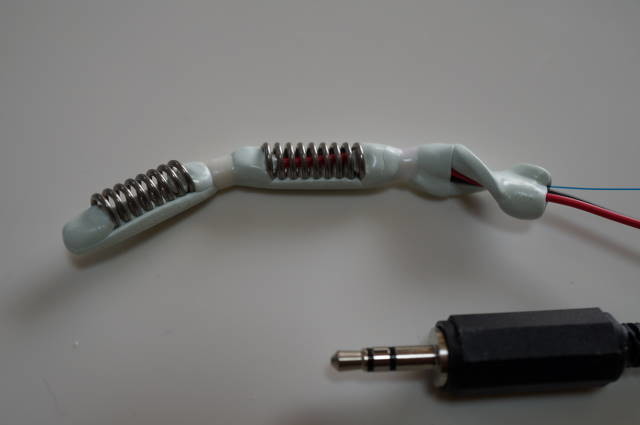
An entry published in January 2021 describes an electrode prototype (a device designed to carry electrical current). Its ring chips (stainless-steel ring components) were followed by a screw-shaped auxiliary chip. Mr. Okada added backup thread (nylon linking all 3 chips) because the rubber connections had no established strength record.
His estimate, excluding tax, priced each chip at ¥3,000 (about $19 at ¥156 = $1, rate as of 2026-09-04), each ring’s cable connection at ¥1,000 (about $6 at ¥156 = $1, rate as of 2026-09-04), and the electrical plug at ¥1,000 (about $6 at ¥156 = $1, rate as of 2026-09-04). The curved rubber connections were ¥1,000 (about $6 at ¥156 = $1, rate as of 2026-09-04) × 2, also excluding tax. Mr. Okada offered a free resin end piece instead of the plug when electrical operation was not wanted.
(Source: ok-lab's diary, published January 2021)
https://ok-lab.hatenablog.com/entry/2021/01/02/123619
Internal connections gave flexible prostate chips a minimum ring diameter
In a separate passage published in March 2021, a customer asked whether an inner support could reduce tissue pinching. Mr. Okada rejected several thin supports because he doubted their strength, then developed a prototype with one thicker internal support. He reported less pinching and electrical contact around the outside, but the diary does not record the customer’s response.
Internal connections required rings with an outside diameter of at least 5.6mm to hold enough resin. The additional internal-connection charge was ¥500 (about $3 at ¥156 = $1, rate as of 2026-09-04) per chip, excluding tax, above the ¥3,000 (about $19 at ¥156 = $1, rate as of 2026-09-04) chip price, also excluding tax. Mr. Okada favored short linked sections because he still considered bending the spring itself impractical.
(Source: ok-lab's diary, published March 2021)
https://ok-lab.hatenablog.com/entry/2021/03/13/130202
Mr. Okada favored flexible prostate chips with screw-shaped auxiliary pieces
In an entry published in May 2021, Mr. Okada singled out flexible chains of resin screw-shaped auxiliary chips for praise. He thought these chains seemed gentler on the urethra, while expressing reservations about recommending the separate titanium design discussed alongside them. His stronger recommendation in that entry was the flexible auxiliary-chip chain.
(Source: ok-lab's diary, published May 2021)
https://ok-lab.hatenablog.com/entry/2021/05/29/125928
If you see blood in your urine, even a small amount or for the first time, do not wait and see. See a urologist right away. If you suddenly cannot urinate, or the device cannot be removed, do not try to fix it yourself. Go to a medical facility, including emergency care, immediately.
How flexible prostate chips changed over time

| Published | What the diary said then |
|---|---|
| Apr 2018 | Existing rounded tips and uncertainty about use blocked a six-chip conversion. |
| Jan 2021 | Rubber-linked electrode prototype included nylon backup through every chip. |
| Mar 2021 | Development shifted from stretching springs to short sections that bent at their joints. |
| May 2021 | Mr. Okada particularly favored flexible screw-shaped auxiliary chains. |
| Sep 2021 | A modular proposal allowed different auxiliary-chip combinations and gaps. |
| Oct 2021 | Personal testing brought reports of overlapping chips and intermittent twinges. |
| Jun 2022 | Ceramic connection plans confronted tangling and rubber durability problems. |
| Jul 2022 | Reinforced ceramic connections entered supply; additional tip-hole designs remained pending. |
| Jun 2023 | A tightly spaced five-screw request met manufacturing and tip-shape limits. |
| Mar 2025 | A five-part electrode was considered feasible, but its joints would not conduct. |
OK Prostate Chip products related to flexible prostate chips

The current list includes components discussed in the diary, with prices separate from historical custom-build estimates.
Products that appear in these entries
| Product (official name) | Price incl. tax | Relation to this topic |
|---|---|---|
| Short stainless-steel ring chip (OKプロステートチップ ステンレスリング ショートタイプ) | ¥3,300 (about $21 at ¥156 = $1, rate as of 2026-09-04) | In January 2021, a customer’s question about this ring chip’s electrical potential helped prompt the flexible electrode prototype. |
| Screw-shaped auxiliary chip option (スクリュー型補助チップ追加オプション) | ¥3,300 (about $21 at ¥156 = $1, rate as of 2026-09-04) | In January 2021, this auxiliary part appeared in the request discussed before the flexible electrode prototype. |
| Resin screw-shaped auxiliary chip option (スクリュー型補助チップ追加オプション(生体適合樹脂)) | ¥3,300 (about $21 at ¥156 = $1, rate as of 2026-09-04) | In May 2021, Mr. Okada particularly favored flexible chains using this resin auxiliary part. |
(Source: ok-lab's diary, published January 2021)
https://ok-lab.hatenablog.com/entry/2021/01/02/123619
(Source: ok-lab's diary, published May 2021)
https://ok-lab.hatenablog.com/entry/2021/05/29/125928
Products the diary mentioned as alternatives
Custom ceramic combinations and the blue-chip chain:
No matching product can be confirmed on the current list.
(Source: ok-lab's diary, published June 2022)
https://ok-lab.hatenablog.com/entry/2022/06/25/123016
(Source: ok-lab's diary, published June 2023)
https://ok-lab.hatenablog.com/entry/2023/06/03/121955
Other historical custom chains and electrode prototypes
No matching product can be confirmed on the current list.
Common worries about flexible prostate chips
The recorded questions concern durability, close spacing, and whether flexible electrical designs can meet a customer’s requested shape.
"Can ceramic flexible prostate chips avoid tangling without losing durability?"
A June 2022 entry records a customer seeking a ceramic combination after reporting pain and traces of blood with older resin chips. Mr. Okada usually refused ceramic chains beyond Sea Slug 5, but accepted this request as an exception. He warned that thread connections could permit chip overlap or tangled thread, while rubber covers addressed overlap but raised durability problems.
He hoped a revised connection would last longer; no completed result for this customer is recorded. He also proposed the short ceramic twist or medium-length ceramic cobra twist as alternatives to a screw-shaped auxiliary chip. Those proposals involved new versions with tip holes, and Mr. Okada said their feasibility still depended on production trials.
(Source: ok-lab's diary, published June 2022)
https://ok-lab.hatenablog.com/entry/2022/06/25/123016
"Can flexible prostate chips have five closely spaced screw shapes?"
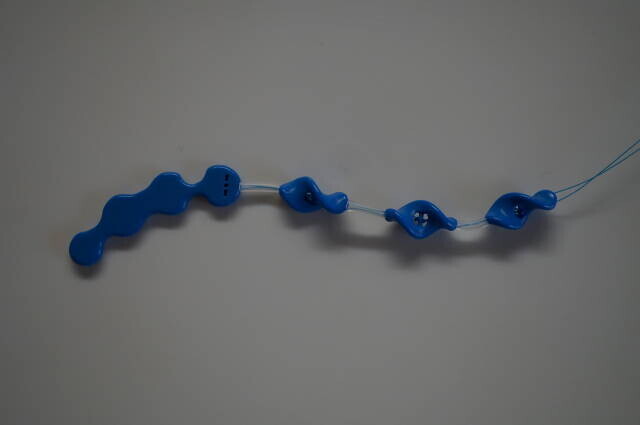
A June 2023 entry describes a request for 5 screw-shaped chips, 3mm apart, on a sheathed-thread carrier (thread enclosed in tubing). For this design, nicknamed Silico-Nylo-Metal, Mr. Okada initially doubted he could preserve five screw shapes, estimating gaps near 10mm would be needed. He nevertheless offered to attempt the build, with gaps of at least 5mm.
He could not reproduce the requested miniature screw-shaped tip, offering an existing tip or a ball approximately 5-6mm in diameter. The diary does not record whether the customer accepted either proposal. Mr. Okada instead favored a blue-chip five-screw chain, though he thought the requested carrier might be easier to advance.
(Source: ok-lab's diary, published June 2023)
https://ok-lab.hatenablog.com/entry/2023/06/03/121955
"Can flexible prostate chips conduct electricity across every connection?"
In an entry published in March 2025, a customer requested an electrode acting along a 15cm length and near the penis tip. After initially requesting consideration time, Mr. Okada rejected the proposed construction as beyond the company’s experience. He thought a 5-chip electrode based on the existing 2-chip arrangement was probably possible, but its connecting joints would not conduct electricity.
He considered either all five chips sharing one electrical connection, or the deeper 4 chips separated electrically from the final 1. The diary does not record a completed device or the customer’s decision. Mr. Okada requested a specific design showing the desired electrical arrangement before further consideration.
(Source: ok-lab's diary, published March 2025)
https://ok-lab.hatenablog.com/entry/2025/03/15/122925
Buying from outside Japan

OK Lab ships internationally to countries covered by Japan Post's EMS courier service. Overseas orders are paid in advance by PayPal. Each order carries a ¥400 (about $3 at ¥156 = $1, rate as of 2026-09-04) handling fee, and EMS shipping is charged on top. These terms come from OK Lab's official sales-terms page (written here as plain text, not a link: ok-lab.net/docs/law), checked on September 7, 2026; confirm them on the official store before you order, because they can change.
Summary of this article
| What you wanted to know | The answer |
|---|---|
| What is the short answer? | Linked short chips bend, but connection design brings limits and unresolved questions. |
| What is the product? | A urethral device made by OK Lab in Japan, sold in Japanese yen. |
| What do the terms mean? | A flexible chain links short pieces; electrodes are designed to carry current. |
| What happened in the diary? | Refused conversions led to prototypes, revised connections, and reports of discomfort. |
| What was the maker’s answer? | Backup thread, internal supports, and flexible auxiliary pieces addressed different design concerns. |
| What changed over time? | The diary moved from a refused six-chip conversion to considering five-part electrical designs. |
| Which related products are listed today? | The named ring chip and auxiliary options each cost ¥3,300 (about $21 at ¥156 = $1, rate as of 2026-09-04) including tax. |
| What worried customers? | Ceramic durability, closely spaced screw shapes, and electrical coverage across linked pieces. |
| How do overseas purchases work? | EMS shipping, advance PayPal payment, and a ¥400 (about $3 at ¥156 = $1, rate as of 2026-09-04) handling fee apply under the stated terms. |
Source: ok-lab's diary (Okada Comfortable Life Laboratory). The original entries are in Japanese; quotations on this page are translated. Photos and videos are on the original entries.
This article is a summary of the maker's development diary. The product is not a medical device and no result is guaranteed. If anything feels wrong or worries you, see a doctor. Prices, specifications and cautions change, so confirm the latest information on the official blog and the official site. Questions about ordering and shipping go to the seller.