![Why are prostate chip stoppers shaped differently? | Placement and attachment both matter [OK Prostate Chip]](/img/a/T0567/eyecatch.svg)
This page is based on entries from "ok-lab's diary" (https://ok-lab.hatenablog.com/), the Japanese development diary written by Mr. Okada, founder of OK Lab, a small company in Japan (Okada Comfortable Life Laboratory). Only the entries about stopper shapes—integrated, double-ended, and triangular—are summarized here, in order of publication. Past prices and sizes are as written at the time. Current prices come from the official product list (retrieved September 4, 2026). Quotations are translated from Japanese.
Note: This page is a personal reading log by someone with no connection to the maker or the seller. It reflects the source entries as of their publication dates and makes no guarantee of accuracy or safety. The product is not a medical device; talk to a doctor about any health decision. Check the official site for current information. This page contains advertising.
In short
- The diary describes stopper shapes intended to resist movement in both directions, alongside a report of bleeding.
- OK Lab changed ceramic rear attachments after a wire slipped from its fastening.
- Related base chips remain listed, including models priced at ¥4,400 (about $28 at ¥156 = $1, rate as of 2026-09-04) and ¥6,050 (about $39 at ¥156 = $1, rate as of 2026-09-04) including tax.
If you see blood in your urine, even a small amount or for the first time, do not wait and see. See a urologist right away.
If you suddenly cannot urinate, or the device cannot be removed, do not try to fix it yourself. Go to a medical facility, including emergency care, immediately.
About this product

The OK Prostate Chip is a small device that is placed in the urethra (the urine passage) so that it acts on the prostate; the maker sells it in several shapes, sizes and materials. It is made and sold by OK Lab (Okada Comfortable Life Laboratory), a small company in Japan, through its own online store, and prices are in Japanese yen (JPY). The maker's development diary, "ok-lab's diary", is written in Japanese. This page is an English summary of it, and every quotation is translated. OK Lab ships internationally, so readers outside Japan can order (see "Buying from outside Japan" below). Product names on this page are plain-English descriptions. The official Japanese product name is shown once in the product table so you can find the same item in the store.
Before you read: key terms
| Term | Plain-English meaning |
|---|---|
| Integrated stopper | An attachment fixed directly to a chip or auxiliary part, intended to restrict movement. |
| Double-ended stoppers | Loops at the chip’s front and rear, intended to restrain it from opposite ends. |
| Bulbar urethra | The area the diary places before the outer urethral sphincter, used as the rear stopper’s location. |
| Nitinol | Shape-memory alloy wire used for stopper loops that bend and recover their shape. |
| Figure-8 loops | Paired stopper loops shaped like an 8; the maker warned that loose loops could spread sideways. |
| Hybrid cable attachment | A chip-to-cable connection that accommodated an added stopper; its wider purpose is not explained. |
| Screw-shaped auxiliary chip | An additional screw-shaped part used as a carrier for an attached stopper. |
| Wire-only design | An assembly using wire loops instead of a solid chip, with loops intended to maintain its position. |
What happens: prostate chip stopper shapes
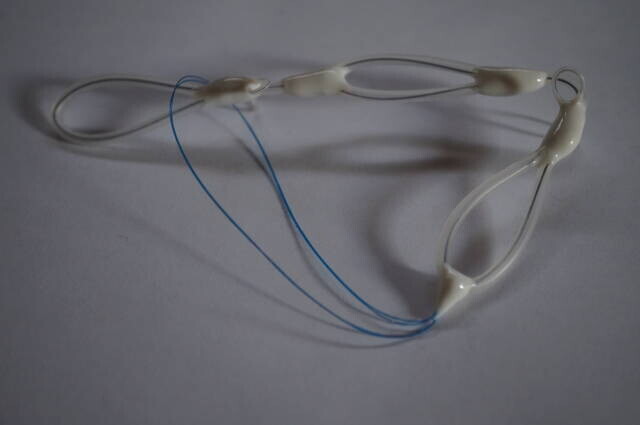
The OK Prostate Chip is a device placed in the urethra (the urine passage) to act on the prostate. An integrated stopper (an attachment fixed directly to the chip) is intended to limit movement, according to the diary. The rear version sits in the bulbar urethra (the area the diary places before the outer urethral sphincter). Mr. Okada also tested front and rear loops together to restrain the chip from both ends.
Integrated stoppers were designed to resist movement in both directions
In an entry published in October 2025, Mr. Okada says reports of chips entering the bladder had prompted development of a stopper. Earlier plate-shaped stoppers were connected by thread because they needed room to tilt. He writes that those plates resisted bladderward movement but could also transmit some outward force during urination.
Nitinol (shape-memory alloy wire) allowed a loop to bend in narrower spaces and recover its shape in wider ones. He described an integrated bulbar stopper as resisting both bladderward movement and movement toward the penis under urination pressure. Mr. Okada therefore favored attaching this flexible stopper directly against the chip’s rear.
(Source: ok-lab's diary, published October 2025)
https://ok-lab.hatenablog.com/entry/2025/10/04/122910
Double-ended stoppers added a front loop to the rear design
In October 2025, Mr. Okada also tested double-ended stoppers (loops at the chip’s front and rear). The prototype used a short SS chip under 30mm, with each stopper about 5–6mm away, giving an overall length around 40mm. He reported a strong sensation and believed the arrangement compressed the prostate lengthwise.
The front-and-rear work cost ¥5,000 (about $32 at ¥156 = $1, rate as of 2026-09-04) excluding tax, as published in October 2025. Single loops replaced the previous double loops, lowering the price. Mr. Okada specified reinforcement for ceramic chips with a front stopper.
(Source: ok-lab's diary, published October 2025)
https://ok-lab.hatenablog.com/entry/2025/10/04/122910
Integrated stoppers made the cable-connected custom chip bulkier than thread versions
In October 2025, a customer wanted an integrated stopper at a hybrid cable attachment (the chip-to-cable connection). They requested double loops, around 15mm, with reinforcement. OK Lab warned that the connection would be bulkier than the thread-based examples and clarified whether 15mm meant each loop.
The quoted double-loop work was ¥4,400 (about $28 at ¥156 = $1, rate as of 2026-09-04), or ¥3,300 (about $21 at ¥156 = $1, rate as of 2026-09-04) without side reinforcement. The customer chose 15mm for each loop without reinforcement, and Mr. Okada made that configuration. The diary does not record how it felt in use.
(Source: ok-lab's diary, published October 2025)
https://ok-lab.hatenablog.com/entry/2025/10/11/123003
Four-wing double-ended stoppers had bulkier joints than two-wing versions
In an entry published in November 2025, a customer wanted four wings at each end of a short SS chip. The request kept the previous wing size or made it larger. Mr. Okada had considered this design but postponed his own trial because he expected it to feel too demanding for him.
He made the requested assembly, but the diary does not record the customer’s experience afterward. Mr. Okada cautioned that its joining section would be larger than on the two-wing version.
(Source: ok-lab's diary, published November 2025)
https://ok-lab.hatenablog.com/entry/2025/11/22/122910
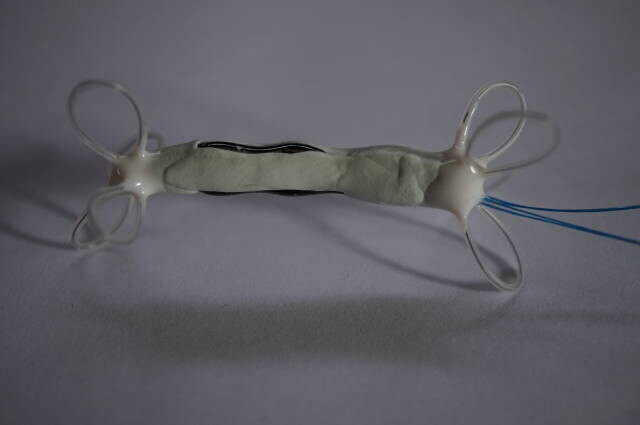
An integrated stopper’s protruding wire prompted a revised ceramic attachment
In November 2025, a customer reported first-time bleeding with an integrated stopper; a later inspection after boiling revealed protruding wire. The rear wire was tied through a hole and could slip under force; the front wire was bonded to the chip. Mr. Okada warned that thinner wire could escape tight bindings, making figure-8 loops (paired stopper loops) spread sideways and potentially cause injury.
OK Lab initially offered a refund and would consider withdrawal from sale if reports continued; the diary does not confirm payment. The same entry reports precautions for pending figure-8 orders and revised ceramic rear attachments, with wire bonded along the body, similar to front-side reinforcement. Mr. Okada asks customers to report any wire slippage.
(Source: ok-lab's diary, published November 2025)
https://ok-lab.hatenablog.com/entry/2025/11/29/122908
The maker's answer to prostate chip stopper shapes
The maker changed attachment methods and offered different configurations, while recording limits on construction and positioning.
Rear integrated stoppers received a corrected quote for October configurations
In the entry published on October 11, 2025, the rear-only integrated stopper was priced at ¥2,000 (about $13 at ¥156 = $1, rate as of 2026-09-04) excluding tax. This corrected the initial ¥3,000 (about $19 at ¥156 = $1, rate as of 2026-09-04) excluding tax quotation. At that point, OK Lab said ceramic and blue resin chips needed no additional reinforcement for rear-only attachment.
The rear hole provided the attachment point, while front-side versions still required reinforcement. Mr. Okada’s October specification therefore distinguished rear-only work from configurations that included a front stopper.
(Source: ok-lab's diary, published October 2025)
https://ok-lab.hatenablog.com/entry/2025/10/11/123003
Screw-mounted integrated stoppers required a suitable auxiliary part and connection
Another part of the October 2025 entry describes a stopper joined to a screw-shaped auxiliary chip (an additional screw-shaped part). This also joined the auxiliary part to the main chip through a bendable connection. The specified gap between those parts was 3–6mm.
The stopper work cost ¥2,000 (about $13 at ¥156 = $1, rate as of 2026-09-04) excluding tax, while joining the main chip and auxiliary part was free. OK Lab declined requests for that joint without the stopper, saying the thread-only structure could not support the intended rubber connection. Mr. Okada specified blue resin or stainless steel for the auxiliary part because the white resin version could not accommodate the wire.
(Source: ok-lab's diary, published October 2025)
https://ok-lab.hatenablog.com/entry/2025/10/11/123003
Continuous-wire stopper shapes still allowed outward movement during marked shrinkage
In November 2025, Mr. Okada described a continuous-wire structure intended to avoid the joins and severe bends used in earlier designs. Bare nitinol was standard because covering the complex loops with tubing was difficult. With wire up to 100 centimeters, the complete main-loop, sphincter-loop, and penis-tip-loop assembly cost ¥11,000 (about $70 at ¥156 = $1, rate as of 2026-09-04) excluding tax; the chip was extra.
His 0.15mm prototype had two stopper loops near the sphincter and three near the penis tip. He reported that marked penile shrinkage could force the arrangement out at the tip. Mr. Okada’s proposed remedy was a shorter interval between the two stopper groups.
(Source: ok-lab's diary, published November 2025)
https://ok-lab.hatenablog.com/entry/2025/11/15/122921
Double-ended stoppers on a wire-only assembly required room for its bend
An entry published in November 2025 describes a customer’s wire-only design (wire loops replacing a solid chip), with stoppers around its prostate loop. The customer specified a 5mm interval before the following loop. Mr. Okada explained that the bent section already occupied about 12mm, making the requested interval impossible.
The diary shows the completed assembly but provides no later account of its performance. Mr. Okada’s proposed alternative was an interval of about 15mm, allowing room for the bend.
(Source: ok-lab's diary, published November 2025)
https://ok-lab.hatenablog.com/entry/2025/11/22/122910
If you see blood in your urine, even a small amount or for the first time, do not wait and see. See a urologist right away.
If you suddenly cannot urinate, or the device cannot be removed, do not try to fix it yourself. Go to a medical facility, including emergency care, immediately.
How prostate chip stopper shapes changed over time
| Published | What the diary said then |
|---|---|
| Oct 2025 | Two embedded threads retained their chip connection independently of possible stopper-wire breakage. |
| Oct 2025 | Ceramic main chips were also possible in the integrated screw configuration. |
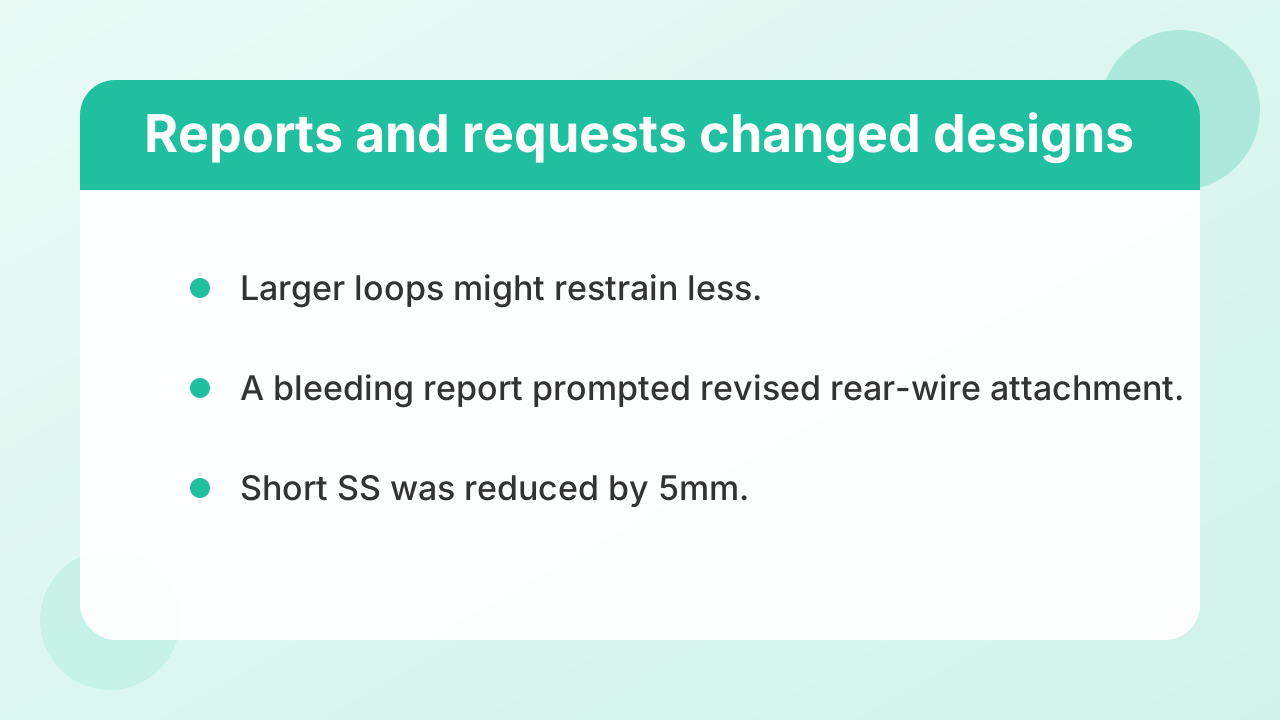
| Nov 2025 | Mr. Okada found 0.1mm wire gentler, but warned larger loops might restrain less. |
| Nov 2025 | Four-wing attachments had larger joining sections than two-wing versions. |
| Nov 2025 | A bleeding report prompted revised rear-wire attachment on ceramic chips. |
| Jan 2026 | Mr. Okada reported the first requested screw-mounted stopper immediately behind the main chip. |
| Apr 2026 | A clarified request gained a rear stopper, creating a double-ended configuration. |
| May 2026 | Short SS reduced by 5mm; larger four-wing work quoted at ¥5,500 (about $35 at ¥156 = $1, rate as of 2026-09-04) × 2. |
| Jun 2026 | A textured short twist request changed from SS to S. |
OK Prostate Chip products related to prostate chip stopper shapes
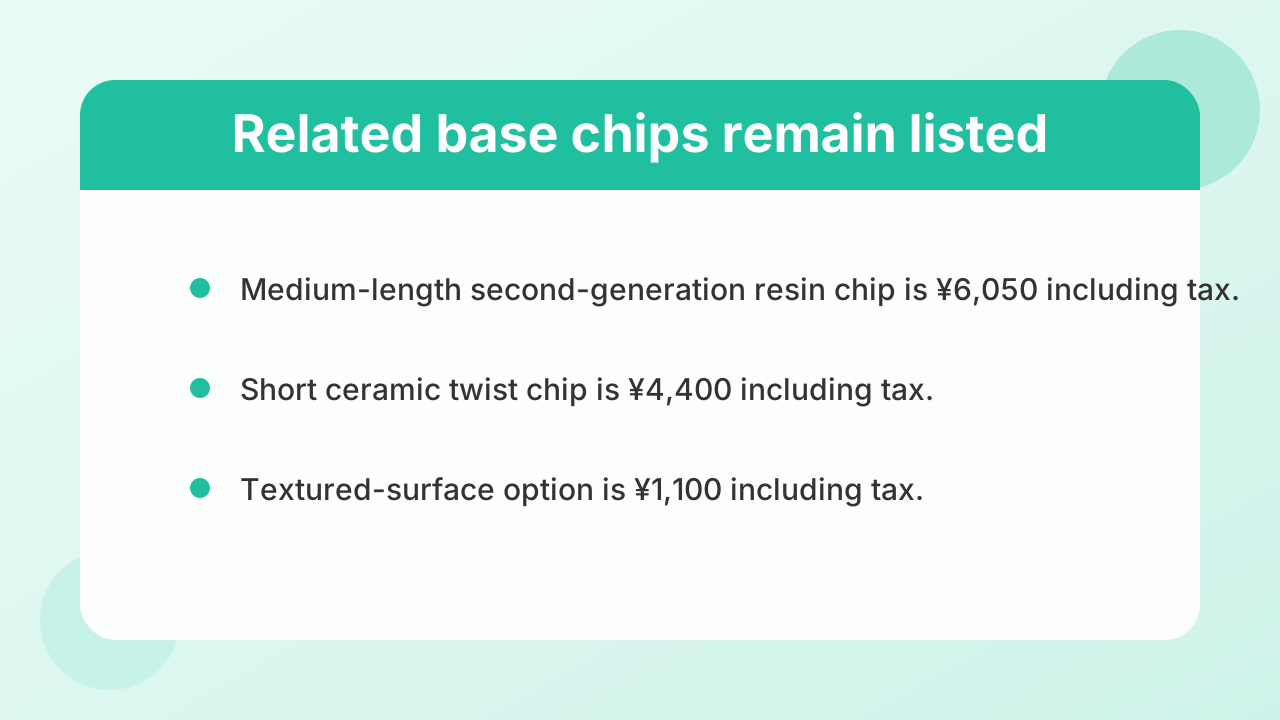
Related base chips and a surface option appear on the current list at the prices below.
Products that appear in these entries
| Product (official name) | Price incl. tax | Relation to this topic |
|---|---|---|
| Medium-length second-generation resin chip (OKプロステートチップ セミロングタイプ(第二世代生体適合樹脂)) | ¥6,050 (about $39 at ¥156 = $1, rate as of 2026-09-04) | In April 2026, a clarified request for this chip gained a rear stopper alongside its front stopper. |
| Short ceramic twist chip (OKプロステートチップ 陶器素材ショートタイプ ツイスト) | ¥4,400 (about $28 at ¥156 = $1, rate as of 2026-09-04) | In June 2026, a double-ended stopper configuration changed from SS to S to accommodate the requested texture. |
| Textured-surface option (イボ付きチップに変更オプション) | ¥1,100 (about $7 at ¥156 = $1, rate as of 2026-09-04) | In June 2026, OK Lab limited this option on the short ceramic twist chip to S. |
(Source: ok-lab's diary, published April 2026)
https://ok-lab.hatenablog.com/entry/2026/04/04/122916
(Source: ok-lab's diary, published April 2026)
https://ok-lab.hatenablog.com/entry/2026/04/11/122913
(Source: ok-lab's diary, published June 2026)
https://ok-lab.hatenablog.com/entry/2026/06/27/122906
Products the diary mentioned as alternatives
The diary names no alternative.
Historical custom stopper assemblies and the shortened SS build: No matching product can be confirmed on the current list.
Common worries about prostate chip stopper shapes
"Can integrated stoppers replace the older cage-shaped end piece?"
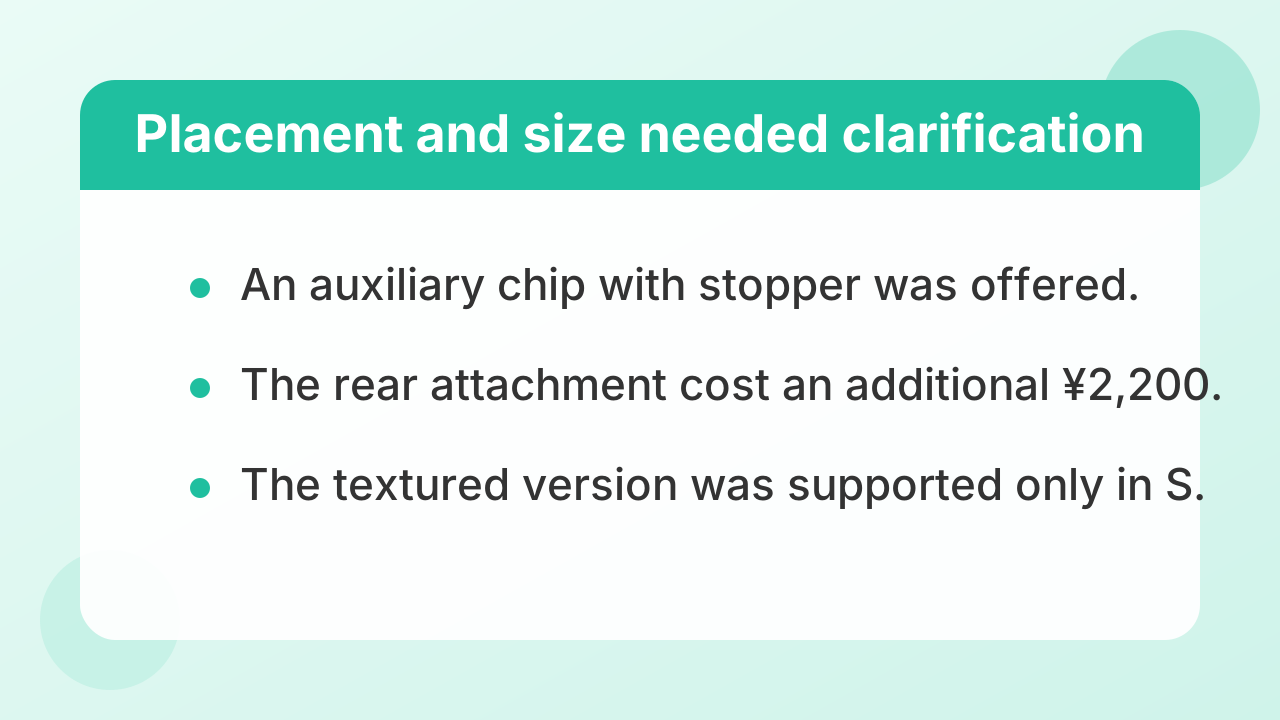
In October 2025, a customer requested the older cage-shaped end piece on a short chip with double-ended stoppers. OK Lab offered a replacement because the maker had largely forgotten how to make the cage. The replacement quote added ¥2,200 (about $14 at ¥156 = $1, rate as of 2026-09-04) to the screw-shaped auxiliary chip’s price.
The customer accepted and changed the specified thread length from 12 centimeters to 8 centimeters, measured to the screw’s tip. The diary does not record the replacement’s performance in use. OK Lab’s proposed substitute combined a screw-shaped auxiliary chip with an attached stopper.
(Source: ok-lab's diary, published October 2025)
https://ok-lab.hatenablog.com/entry/2025/10/11/123003
"Does an integrated stopper request mean the front or rear?"
In an entry published in April 2026, a customer’s order named a front stopper for a medium-length second-generation resin chip. The following entry explains that the customer had intended a rear stopper. OK Lab added the rear attachment, creating a double-ended configuration for an additional ¥2,200 (about $14 at ¥156 = $1, rate as of 2026-09-04).
The published resolution retained the front stopper and added the requested rear component. The diary does not record how this corrected configuration performed.
(Source: ok-lab's diary, published April 2026)
https://ok-lab.hatenablog.com/entry/2026/04/04/122916
(Source: ok-lab's diary, published April 2026)
https://ok-lab.hatenablog.com/entry/2026/04/11/122913
"Can double-ended stoppers come on a textured SS twist chip?"
In June 2026, a customer requested a short ceramic twist chip in SS, with texture, reinforcement, and stoppers at both ends. OK Lab replied that the textured version was supported only in S. The customer agreed to that size change.
The diary records the revised specification but no later report of comfort or positioning. For this requested combination, OK Lab directed the customer to the S version.
(Source: ok-lab's diary, published June 2026)
https://ok-lab.hatenablog.com/entry/2026/06/27/122906
Buying from outside Japan

OK Lab ships internationally to countries covered by Japan Post's EMS courier service. Overseas orders are paid in advance by PayPal. Each order carries a ¥400 (about $3 at ¥156 = $1, rate as of 2026-09-04) handling fee, and EMS shipping is charged on top. These terms come from OK Lab's official sales-terms page (written here as plain text, not a link: ok-lab.net/docs/law), checked on September 7, 2026; confirm them on the official store before you order, because they can change.
Summary of this article
| What you wanted to know | The answer |
|---|---|
| What is the main concern? | Stopper shapes were intended to control movement, but one report involved loose wire and bleeding. |
| What is the product? | A urethral device made and sold by OK Lab in Japan. |
| What do the shape names mean? | Integrated describes direct attachment; double-ended describes stoppers at the chip’s front and rear. |
| What happened in the reported cases? | Designs changed from flexible rear loops to double-ended, cable-connected, and four-wing arrangements. |
| What did the maker change? | Construction requirements, loop spacing, and ceramic rear-wire attachment changed across the entries. |
| How did the designs develop? | The diary records prototype changes, revised specifications, and customer-request corrections through June 2026. |
| What is currently listed? | Related base chips and the textured-surface option have current prices in the product table. |
| What details caused ordering problems? | Front versus rear placement and the textured short chip’s supported size needed clarification. |
| How can overseas readers order? | Through the company’s own online store, with advance PayPal payment and EMS shipping charges. |
| What is the overall answer? | Placement, loop shape, and fastening all mattered in the maker’s evolving designs. |
Source: ok-lab's diary (Okada Comfortable Life Laboratory). The original entries are in Japanese; quotations on this page are translated. Photos and videos are on the original entries.
This article is a summary of the maker's development diary. The product is not a medical device and no result is guaranteed. If anything feels wrong or worries you, see a doctor. Prices, specifications and cautions change, so confirm the latest information on the official blog and the official site. Questions about ordering and shipping go to the seller.