![How does a two-part prostate chip work? | Separate pieces have different jobs [OK Prostate Chip]](/img/a/T0562/eyecatch.svg)
This page is based on entries from "ok-lab's diary" (https://ok-lab.hatenablog.com/), the Japanese development diary written by Mr. Okada, founder of OK Lab, a small company in Japan (Okada Comfortable Life Laboratory). Only the entries about "two-part prostate chips: male and female components" are summarized here, in order of publication. Past prices and sizes are as written at the time. Current prices come from the official product list (retrieved September 4, 2026). Quotations are translated from Japanese.
Note: This page is a personal reading log by someone with no connection to the maker or the seller. It reflects the source entries as of their publication dates and makes no guarantee of accuracy or safety. The product is not a medical device; talk to a doctor about any health decision. Check the official site for current information. This page contains advertising.
In short
- The two-part prostate chip has a leading piece and a receiving piece, designed to work together.
- Mr. Okada offered this design for difficult passage, while later custom versions raised connection and durability concerns.
- The current list includes separate glass and resin leading chips, plus a resin receiving chip.
If you see blood in your urine, even a small amount or for the first time, do not wait and see. See a urologist right away. If you suddenly cannot urinate, or the device cannot be removed, do not try to fix it yourself. Go to a medical facility, including emergency care, immediately.
About this product
The OK Prostate Chip is a small device that is placed in the urethra (the urine passage) so that it acts on the prostate; the maker sells it in several shapes, sizes and materials. It is made and sold by OK Lab (Okada Comfortable Life Laboratory), a small company in Japan, through its own online store, and prices are in Japanese yen (JPY).
The maker's development diary, "ok-lab's diary", is written in Japanese. This page is an English summary of it, and every quotation is translated. OK Lab ships internationally, so readers outside Japan can order (see "Buying from outside Japan" below).
Product names on this page are plain-English descriptions. The official Japanese product name is shown once in the product table so you can find the same item in the store.
Before you read: key terms
| Term | Plain-English meaning |
|---|---|
| Urethra | The urine passage; the diary describes the chip and its supporting component as occupying this passage. |
| Male chip | The leading component of the separate design, intended to act toward the prostate. |
| Female chip | The receiving component, with a socket intended to support the leading component. |
| Safety tip | A named end component whose shape differs between the two pieces. The diary does not explain this. |
| Sphincter | The diary identifies this as a point customers struggled to pass. The diary does not explain this. |
| Electrode | An electrically active contact on a custom chip, intended to provide electrical stimulation. |
| Double-loop thread | Thread with a loop at each end, proposed to keep separate thread loops connected. |
What happens: two-part prostate chips
The OK Prostate Chip is a device placed in the urethra, intended by its maker to act on the prostate. The separate design divides it into a leading piece and a receiving piece, each with a different role. In the March 2018 concept, the receiving piece supports movement of the leading piece toward the prostate. A later experiment placed the receiving piece farther along the urinary passage, within the penis, while testing vibration.
The two-part prostate chip began with different leading and receiving pieces
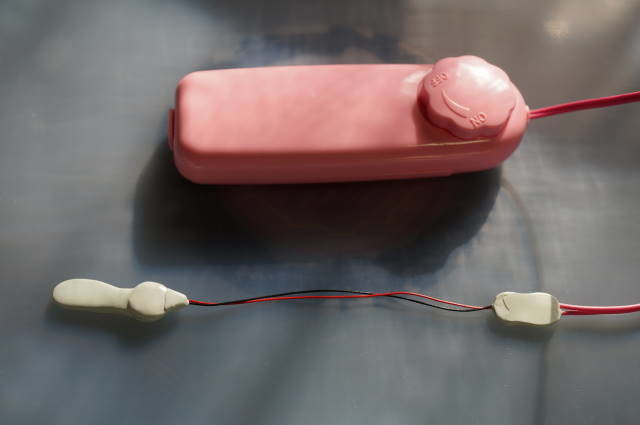
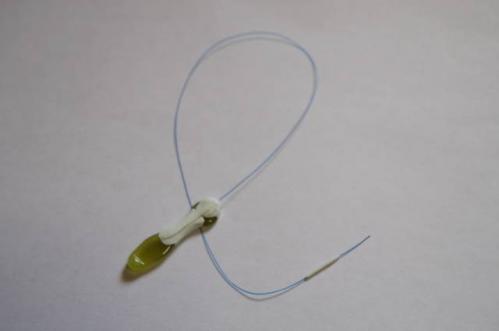
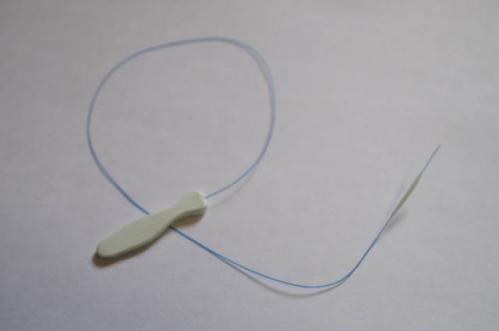
An entry published in March 2018 introduced the male chip (the leading piece) in resin and glass, alongside a resin female chip (the receiving piece). Both leading versions had a slender rod replacing the earlier safety tip (an end component whose purpose the diary does not explain). About 1 cm of thread extended beyond that rod.
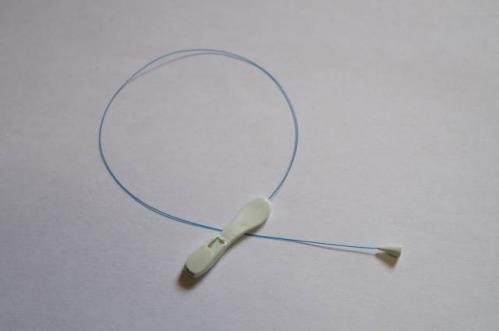
The receiving piece had a socket for the slender rod at the trailing end of the leading piece's thread. Its safety tip retained the earlier shape. Mr. Okada presented this arrangement as a way for the receiving piece to support the leading piece.
(Source: ok-lab's diary, published March 2018)
https://ok-lab.hatenablog.com/entry/20180317/1521275320
The two-part prostate chip became an option for customers struggling with passage
In an entry published in April 2018, Mr. Okada explained why he had originally offered linked chips. One purpose was to help beginners struggling to pass the sphincter (a structure the diary does not explain). He wrote that the separate design, launched that April, could now address that purpose.
The entry also distinguished this concern from a separate aim of reaching the bladder. It does not record a customer's result with the newly released separate design. For the passage difficulty described here, Mr. Okada offered the separate design as an alternative to linked chips.
(Source: ok-lab's diary, published April 2018)
https://ok-lab.hatenablog.com/entry/20180428/1524898558
A vibrating two-part prostate chip prototype lost contact between its pieces
In an entry published in December 2018, Mr. Okada described a vibrating receiving-piece prototype intended to work with a glass leading chip. He reported that vibration separated the pieces, preventing reliable vibration transfer to the leading chip. His own test covered only the receiving piece, whose sensation he described as very mild.
He reported that urination remained possible with that prototype in place, although its cable could become slightly wet. The attached battery box also made hot-water disinfection difficult. Mr. Okada said the original urethral design needed longer durability testing before release.
(Source: ok-lab's diary, published December 2018)
https://ok-lab.hatenablog.com/entry/20181215/1544857573
A custom two-part prostate chip proposal followed bleeding from a ring design
In an entry published in March 2021, a customer initially praised a custom stainless-steel ring chip's fit and stability. A follow-up from that customer reported bleeding during removal after two days in place. The customer then proposed a larger arrangement divided into separate assemblies.
Mr. Okada described that proposal as a more complex version of the male-and-female design. He said a section beginning with a stainless-steel ring could serve as the receiving component because thread could pass through its interior. Mr. Okada said an actual order would require a more detailed discussion.
(Source: ok-lab's diary, published March 2021)
https://ok-lab.hatenablog.com/entry/2021/03/13/130202
The maker's answer to two-part prostate chips
Mr. Okada's replies focused on whether the connections could meet each request, with limits involving spacing, cable strength and thread control.
A two-part prostate chip could not meet one customer's preferred electrode spacing

In an entry published in May 2019, a customer requested electrodes (electrical contacts) on separate chips after believing another custom design was unavailable. Mr. Okada said manufacture was possible if the receiving piece's internal connection carried nylon thread without an electrical cable. However, he said the separate arrangement would not suit the customer's preferred 2 mm electrode spacing.
He clarified that he had not refused further orders for the earlier custom chip with two electrodes. After that clarification, the customer withdrew the separate-piece request and proposed a linked resin design instead. Mr. Okada offered a custom chip with two electrodes spaced 2 mm apart if the customer supplied detailed requirements.
(Source: ok-lab's diary, published May 2019)
https://ok-lab.hatenablog.com/entry/2019/05/11/152432
Cable flexibility limited the proposed two-part prostate chip connection
The May 2019 entry also describes Mr. Okada's tests of a linked prototype using 1.2 mm parallel cable. He reported strain on the urethra when the cable section was shorter than 10 mm, because it did not bend adequately.
For the revised customer proposal, he thought a single cable might bend with a shorter gap, but still expected at least 5 mm. He also expected roughly 5 mm of resin covering at each chip-to-cable attachment, giving an estimated electrode separation of about 15 mm.
These were his manufacturing estimates for that custom request. Mr. Okada asked the customer to weigh close electrode spacing against durability and function.
(Source: ok-lab's diary, published May 2019)
https://ok-lab.hatenablog.com/entry/2019/05/11/152432
Shorter two-part prostate chip electrode gaps left cable durability uncertain
For a gap within 10 mm, the May 2019 reply considered thinner cable or electrode coverage overlapping the cable near the chip ends. Mr. Okada reported testing wire 0.6 mm in diameter in a vibration experiment, but doubted its strength between linked chips. The customer preferred wider electrode coverage, while accepting 15 mm separation if technical or safety limits required it.
Mr. Okada's final note on the customer's concept drawing said the proposed electrode gap appeared to be within 10 mm, but expressed concern about durability because the cable would be under strong force. The diary does not record a later durability result for that proposed design. His reply asked the customer to decide how much priority to give durability when specifying the gap.
(Source: ok-lab's diary, published May 2019)
https://ok-lab.hatenablog.com/entry/2019/05/11/152432
The custom two-part prostate chip needed control of both assemblies' threads
For the March 2021 design, assembly 2 needed an internal passage for assembly 1's thread, according to Mr. Okada. He said the assemblies could join and behave like one chip. He also warned that assembly 2 could push assembly 1's thread inward, making it difficult to find.
His proposed connection included double-loop thread (thread with a loop at each end) to keep the assemblies' thread loops together. The diary does not record whether this proposed assembly was completed. Mr. Okada requested further details before an actual order.
(Source: ok-lab's diary, published March 2021)
https://ok-lab.hatenablog.com/entry/2021/03/13/130202
If you see blood in your urine, even a small amount or for the first time, do not wait and see. See a urologist right away. If you suddenly cannot urinate, or the device cannot be removed, do not try to fix it yourself. Go to a medical facility, including emergency care, immediately.
How two-part prostate chips changed over time
| Published | What the diary said then |
|---|---|
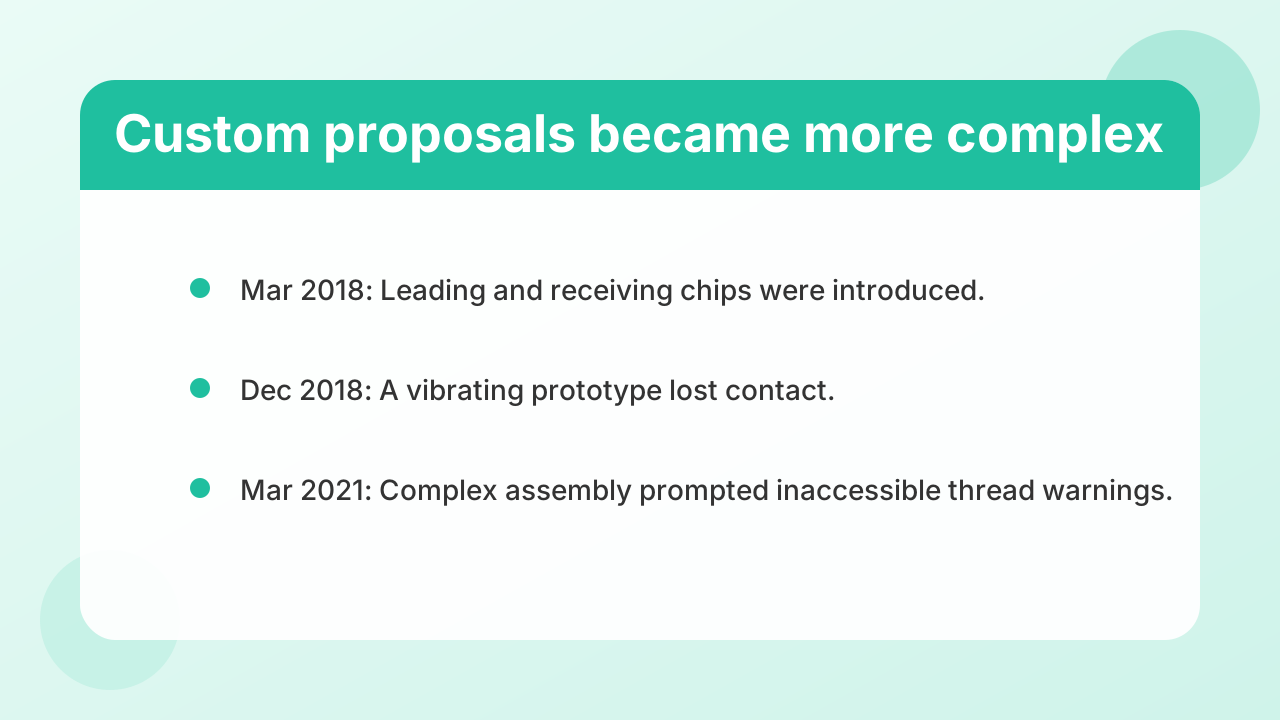
| Mar 2018 | The concept introduced leading chips and a receiving chip with different end shapes. |
| Apr 2018 | The separate design launched as an alternative for difficult passage. |
| Dec 2018 | A vibrating prototype lost contact; longer testing was needed before release. |
| May 2019 | A custom electrode request exposed limits involving spacing, flexibility and cable strength. |
| Mar 2021 | A more complex separate assembly prompted warnings about inaccessible thread. |
OK Prostate Chip products related to two-part prostate chips
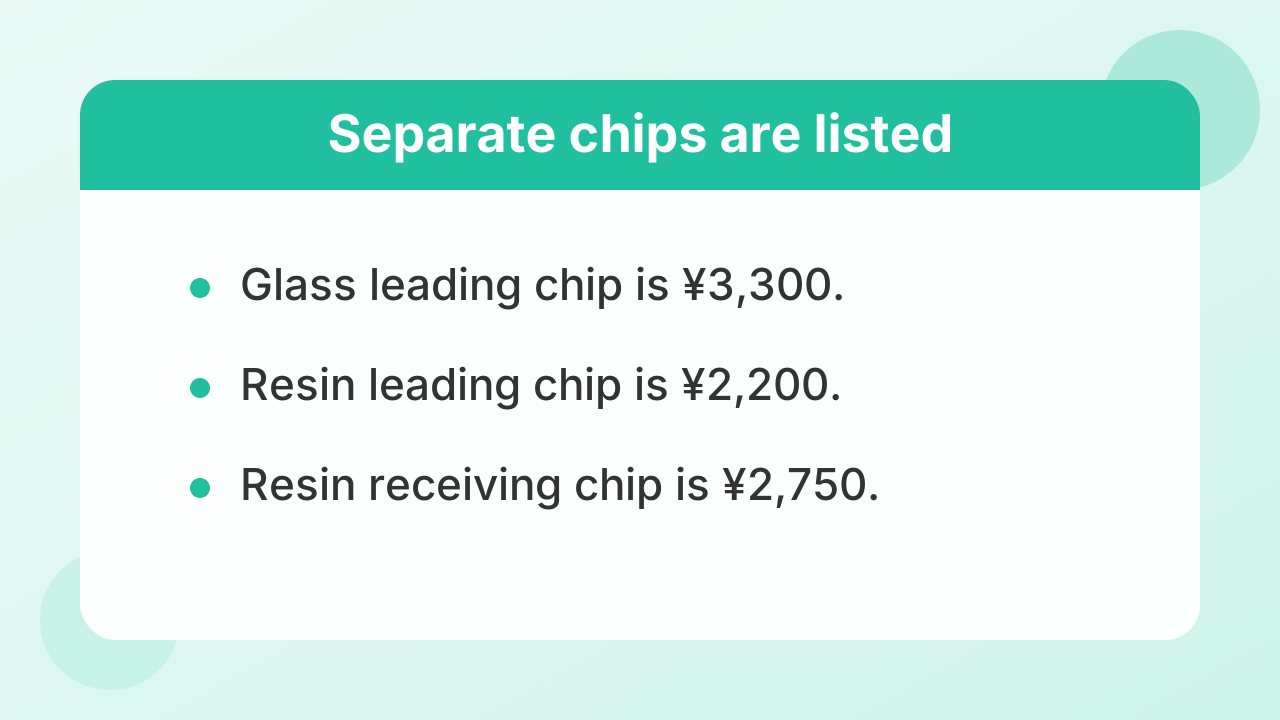
The current list contains the separate design's glass and resin leading pieces and its resin receiving piece.
Products that appear in these entries
| Product (official name) | Price incl. tax | Relation to this topic |
|---|---|---|
| Glass leading chip (OKプロステートチップ ガラス素材セパレートタイプ♂チップ) | ¥3,300 (about $21 at ¥156 = $1, rate as of 2026-09-04) | The March 2018 introduction described the glass leading component of the separate design. |
| Resin leading chip (OKプロステートチップ 樹脂素材セパレートタイプ♂チップ) | ¥2,200 (about $14 at ¥156 = $1, rate as of 2026-09-04) | The March 2018 introduction described the resin leading component of the separate design. |
| Resin receiving chip (OKプロステートチップ 樹脂素材セパレートタイプ♀チップ) | ¥2,750 (about $18 at ¥156 = $1, rate as of 2026-09-04) | The March 2018 introduction described its socket and unchanged safety-tip shape. |
The glass leading chip is listed in the company's own online store.
The resin leading chip is listed in the company's own online store.
The resin receiving chip is listed in the company's own online store.
(Source: ok-lab's diary, published March 2018)
https://ok-lab.hatenablog.com/entry/20180317/1521275320
Products the diary mentioned as alternatives
The diary names no alternative.
The entries also describe a vibrating prototype, custom electrode builds and a custom ring assembly. No matching product can be confirmed on the current list.
Common worries about two-part prostate chips
The recorded questions concern custom electrode dimensions, larger rings and gaps between linked sections.
"How large were the custom two-part prostate chip electrodes?"
In the May 2019 exchange, the customer proposed linked resin chips about 38 mm long and 10 mm wide. The request called for substantial electrode coverage, rather than specifying only the chips' overall size.
Mr. Okada asked whether the active electrode length should exceed 30 mm, or be around 25 mm or 20 mm. The diary does not record whether the requested design was completed or what its final active electrode length was. Mr. Okada requested a specific electrode length before settling the design.
(Source: ok-lab's diary, published May 2019)
https://ok-lab.hatenablog.com/entry/2019/05/11/152432
"Could the two-part prostate chip use larger stainless-steel rings?"
In the March 2021 exchange, the customer asked about 12 mm rings, with 11 mm rings as a fallback. The fallback request specified a resin-covered outside width of 15 mm. Mr. Okada proposed the 11 mm spring because batch purchasing made a rarely requested size impractical.
He also said reaching the requested outside width would require substantial resin coverage. The diary does not record how that proposed size felt in use. Mr. Okada asked whether the thicker covering was acceptable.
(Source: ok-lab's diary, published March 2021)
https://ok-lab.hatenablog.com/entry/2021/03/13/130202
"Could a two-part prostate chip have gapless linked sections?"
The March 2021 customer also proposed a continuous linked arrangement alongside the separate-assembly design. That proposal called for no gaps between its chip sections, while retaining some movement.
Mr. Okada replied that manufacture required gaps of at least about 5 mm. To fit the requested overall length, Mr. Okada proposed slightly shorter stainless-steel ring sections.
(Source: ok-lab's diary, published March 2021)
https://ok-lab.hatenablog.com/entry/2021/03/13/130202
Buying from outside Japan
OK Lab ships internationally to countries covered by Japan Post's EMS courier service. Overseas orders are paid in advance by PayPal. Each order carries a ¥400 (about $3 at ¥156 = $1, rate as of 2026-09-04) handling fee, and EMS shipping is charged on top. These terms come from OK Lab's official sales-terms page (written here as plain text, not a link: ok-lab.net/docs/law), checked on September 7, 2026; confirm them on the official store before you order, because they can change.
Summary of this article
| What you wanted to know | The answer |
|---|---|
| What is the main answer? | Separate pieces have different jobs; custom connections introduced additional limits. |
| What is the base product? | A urethral device made and sold by OK Lab in Japan. |
| What do the component names mean? | Male means the leading piece; female means the receiving piece in this design. |
| What did the cases reveal? | The original concept developed into experiments involving vibration, electrodes and ring assemblies. |
| What did Mr. Okada propose? | Different connections or custom designs, subject to spacing, durability and thread requirements. |
| What changed over time? | The diary moved from the 2018 concept to more complex custom proposals in 2021. |
| Which related products are listed today? | Glass and resin leading chips, plus a resin receiving chip. |
| What did customers ask? | They asked about electrode dimensions, ring sizes and connection gaps. |
| How do overseas orders work? | Advance PayPal payment, a ¥400 (about $3 at ¥156 = $1, rate as of 2026-09-04) handling fee, and additional Japan Post EMS shipping. |
Source: ok-lab's diary (Okada Comfortable Life Laboratory). The original entries are in Japanese; quotations on this page are translated. Photos and videos are on the original entries.
This article is a summary of the maker's development diary. The product is not a medical device and no result is guaranteed. If anything feels wrong or worries you, see a doctor. Prices, specifications and cautions change, so confirm the latest information on the official blog and the official site. Questions about ordering and shipping go to the seller.