![Can two prostate chips be linked together? | The maker warns about short thread links [OK Prostate Chip]](/img/a/T0559/eyecatch.svg)
This page is based on entries from "ok-lab's diary" (https://ok-lab.hatenablog.com/), the Japanese development diary written by Mr. Okada, founder of OK Lab, a small company in Japan (Okada Comfortable Life Laboratory). Only the entries about "two-thread and freely linked chip designs" are summarized here, in order of publication. Past prices and sizes are as written at the time. Current prices come from the official product list (retrieved September 4, 2026). Quotations are translated from Japanese.
Note: This page is a personal reading log by someone with no connection to the maker or the seller. It reflects the source entries as of their publication dates and makes no guarantee of accuracy or safety. The product is not a medical device; talk to a doctor about any health decision. Check the official site for current information. This page contains advertising.
In short
Staff reported overlapping chips and tangles that could not be undone inside the urethra.
The maker explored adjustable spacing, different connection materials, and custom designs, while staff continued to warn about risks.
The August 2026 trial was not offered as a standard product.
If you see blood in your urine, even a small amount or for the first time, do not wait and see. See a urologist right away. If you suddenly cannot urinate, or the device cannot be removed, do not try to fix it yourself. Go to a medical facility, including emergency care, immediately.
About this product

The OK Prostate Chip is a small device that is placed in the urethra (the urine passage) so that it acts on the prostate; the maker sells it in several shapes, sizes and materials. It is made and sold by OK Lab (Okada Comfortable Life Laboratory), a small company in Japan, through its own online store, and prices are in Japanese yen (JPY).
The maker's development diary, "ok-lab's diary", is written in Japanese. This page is an English summary of it, and every quotation is translated. OK Lab ships internationally, so readers outside Japan can order (see "Buying from outside Japan" below).
Product names on this page are plain-English descriptions. The official Japanese product name is shown once in the product table so you can find the same item in the store.
Before you read: key terms
| Term | Plain-English meaning |
|---|---|
| Urethra | The urine passage; the diary describes chip placement within this passage near the prostate. |
| Chip spacing | The gap between connected pieces; changing it was intended to alter their relative positions and comfort. |
| Two-thread design | Separate threads extend from the chip pieces; the March 2018 concept allowed the second piece to move independently. |
| Sphincter | The body structure beside the proposed joining section; the designs sought to reduce its burden. The diary does not explain this. |
| Epoxy resin | A coating material; it covered the joining section of the October 2019 design. |
| Screw-shaped auxiliary chip | An extra chip piece; the September 2021 proposal used it as a component in selectable combinations. |
| Blue thread connector | A separate component required for the August 2026 prototype; it formed part of the proposed two-thread connection. |
| 6-hole safety component | An optional safety part included in the September 2021 quotation. The diary does not explain this. |
What happens: linking two prostate chips
The OK Prostate Chip is a device placed in the urethra (the urine passage) to act on the prostate. Linking two prostate chips means connecting separate pieces whose spacing can vary with the design. The diary discusses links inside the urethra and threads extending outside the body. Mr. Okada explored these arrangements to change placement around the prostate while addressing fixed spacing and tangled threads.
Adjustable chip spacing was proposed to address conflicting comfort needs

In an entry published in March 2018, Mr. Okada wrote that the existing linked design required a specified gap between its pieces. He wrote that a short gap suited entry, while greater separation from the sphincter (the body structure beside the link) felt more comfortable afterward. His proposed two-thread design (separate threads extending from the pieces) made the second chip movable along the first chip's thread.
The aim was to preserve their connection while allowing their relative positions to change. Mr. Okada thought this could largely resolve thread tangling, but prototype work had only just begun. He asked customers to allow more time before the design became a product.
(Source: ok-lab's diary, published March 2018)
https://ok-lab.hatenablog.com/entry/20180312/1520844839
Ceramic linked chips prompted fresh testing after sales had been suspended
In an entry published in September 2019, Mr. Okada described ceramic prototypes with stainless steel thread only between the pieces. Holes in the ceramic made a close connection possible, and he felt the pair behaved like one bendable chip. He saw potential for custom long designs combining different chip shapes.
Mr. Okada wrote that exposed stainless steel outside the urethra could become awkward during extended wear. Sales of linked chips had been voluntarily suspended; he believed an internal stainless connection might resolve most earlier problems and announced renewed testing. For the part extending outside the urethra, Mr. Okada suggested nylon instead.
(Source: ok-lab's diary, published September 2019)
https://ok-lab.hatenablog.com/entry/2019/09/21/131939
The linked chip design offered different shapes, gaps, and planned prices
In an entry published in October 2019, the linked chip design (Rei chip) allowed separate choices of type and size for both pieces. Planned close, middle, and wide gaps were approximately 2mm, 5mm, and 8mm, respectively. Both pieces were 10mm shorter than their standard counterparts, with their end sections omitted.
Planned prices excluding tax were ¥6,000 (about $38 at ¥156 = $1, rate as of 2026-09-04) for short plus short, and ¥7,000 (about $45 at ¥156 = $1, rate as of 2026-09-04) for medium-length plus short. The awakening model plus short was ¥8,000, (about $51 at ¥156 = $1, rate as of 2026-09-04) while long plus short was ¥9,000, (about $58 at ¥156 = $1, rate as of 2026-09-04) also excluding tax. Mr. Okada wrote that his own wider spacing felt easier during extended wear.
(Source: ok-lab's diary, published October 2019)
https://ok-lab.hatenablog.com/entry/2019/10/26/145539
Free-link chips expanded the idea from paired pieces to selectable combinations
In an entry published in September 2021, Mr. Okada proposed a free-link design based on separately supplied pieces and individually chosen gaps. The concept distinguished a first piece supplied with thread from screw-shaped auxiliary chips (extra pieces for the linked design). He suggested having about 3 auxiliaries of each size to provide choices.
His illustrated example used size labels SS first, S second and third, L fourth, and M fifth. Mr. Okada proposed choosing the spacing around the individual customer's urethral dimensions.
(Source: ok-lab's diary, published September 2021)
https://ok-lab.hatenablog.com/entry/2021/09/25/125720
The maker's answer to linking two prostate chips
The maker changed connection materials and geometry, but the latest custom proposal still carried explicit reservations.
Two-thread chips made entirely with nylon were described as more flexible
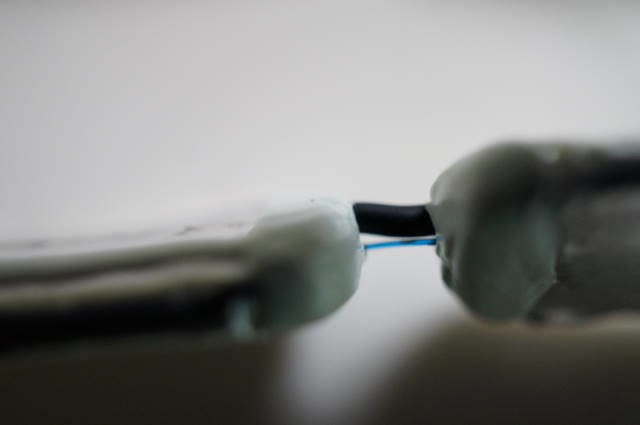
In an entry published in May 2019, Mr. Okada distinguished two nylon threads from a nylon thread paired with an electrical cable. He described the nylon pair as soft and freely bendable. For that pairing, he wrote that opposing tension between the threads was not something to worry about greatly.
(Source: ok-lab's diary, published May 2019)
https://ok-lab.hatenablog.com/entry/2019/05/18/150144
Rigid linked chips led Mr. Okada to cover the joining section
In an entry published in October 2019, Mr. Okada wrote that rigid links gradually burdened the sphincter during extended wear. He reported this with both stainless steel and nylon, prompting a change to a connection covered with epoxy resin (a coating material). The design used two 0.45mm wires, a separate nylon connection, and a thin resin covering.
Mr. Okada said the construction allowed a very narrow joining section while retaining strength. He acknowledged that strong force might crack the resin, while asserting that the connection itself would not break. He recommended a short second piece, with a medium-length custom piece possible when a curve was wanted.
(Source: ok-lab's diary, published October 2019)
https://ok-lab.hatenablog.com/entry/2019/10/26/145539
Custom linked chips required a blue connector and an additional charge
In an entry published in August 2026, Mr. Okada showed a trial connection using a blue thread connector (the required separate connecting component). He considered it potentially useful for existing two-chip users, but said it could not be sold as a standard product. The blue connector was essential; he said ceramic pieces were also acceptable if they had two-thread connections.
The connection charge was ¥1,000 (about $6 at ¥156 = $1, rate as of 2026-09-04) excluding tax, added to the usual selling price of the blue connector with threads attached. He said the arrangement allowed changing orientation, unlike the direction maintained by the wire-connected design. Mr. Okada suggested this trial version if the customer accepted the required blue connector.
(Source: ok-lab's diary, published August 2026)
https://ok-lab.hatenablog.com/entry/2026/08/22/122905
If you see blood in your urine, even a small amount or for the first time, do not wait and see. See a urologist right away. If you suddenly cannot urinate, or the device cannot be removed, do not try to fix it yourself. Go to a medical facility, including emergency care, immediately.
How linking two prostate chips changed over time
| Published | What the diary said then |
|---|---|
| Mar 2018 | Adjustable spacing was proposed to address conflicting requirements for entry and later comfort. |
| May 2019 | Adding nylon beside an electrical cable restricted bending and required a longer gap. |
| Sep 2019 | Stainless links prompted renewed ceramic testing after linked-chip sales had been suspended. |
| Oct 2019 | Resin-covered connections and selectable spacing followed concerns about rigid links. |
| Sep 2021 | A free-link proposal expanded choices through separately supplied pieces and variable gaps. |
| Aug 2026 | Staff accepted considering a risky custom request; the resulting prototype remained unsuitable for standard sale. |
OK Prostate Chip products related to linking two prostate chips
The current list includes the 6-hole safety component named in the September 2021 quotation.
Products that appear in these entries
| Product (official name) | Price incl. tax | Relation to this topic |
|---|---|---|
| 6-hole safety component (六穴方式オプションチップ(セーフティチップ)) | ¥1,100 (about $7 at ¥156 = $1, rate as of 2026-09-04) | In September 2021, Mr. Okada included this optional safety component in his quotation for a beginner's proposed free-link design. |
(Source: ok-lab's diary, published September 2021)
https://ok-lab.hatenablog.com/entry/2021/09/25/125720
Products the diary mentioned as alternatives
The diary names no alternative.
Historical custom designs and nicknames: the sliding two-thread concept, ceramic linked prototype, linked design (Rei chip), free-link arrangement, and blue thread connector with its prototype.
No matching product can be confirmed on the current list.
The August 2026 entry also explicitly described the earlier glass linked-chip design as discontinued. It did not offer the new prototype as a standard product.
(Source: ok-lab's diary, published August 2026)
https://ok-lab.hatenablog.com/entry/2026/08/22/122905
Common worries about linking two prostate chips
The reader exchanges cover a missing connection, a beginner's proposed purchase, and whether a risky custom request could proceed.
"Why was my two-thread chip missing its nylon connection?"
In an entry published in May 2019, a customer said their electrical linked chip lacked the nylon connection they had requested. Mr. Okada acknowledged his misunderstanding and remade it with nylon alongside the cable. The extra strand restricted bending in some directions, leaving the gap about 2mm longer than before.
Earlier parallel electrical wires had needed about 10mm; a single-wire connection could bend with a gap of about 3mm. The diary does not record how the remade chip felt in use. Mr. Okada believed the additional nylon substantially improved safety in this particular mixed-material connection.
(Source: ok-lab's diary, published May 2019)
https://ok-lab.hatenablog.com/entry/2019/05/18/150144
"What did a beginner's free-link chip proposal cost?"
In an entry published in September 2021, a beginner requested a short titanium chip, a price estimate, and a design unlikely to enter the bladder. Mr. Okada said titanium sales were expected no earlier than that year's end, and proposed resin pieces instead. His suggested SS, S, and L pieces were each 15mm long, with gaps of 10mm and 5mm.
Each chip was ¥3,000 (about $19 at ¥156 = $1, rate as of 2026-09-04) excluding tax; the quoted price for 3 was ¥9,000 (about $58 at ¥156 = $1, rate as of 2026-09-04) plus ¥500 (about $3 at ¥156 = $1, rate as of 2026-09-04) for thread. For 4 chips, the quote added ¥3,000 (about $19 at ¥156 = $1, rate as of 2026-09-04); a 6-hole safety component (an optional safety part) added ¥1,000 (about $6 at ¥156 = $1, rate as of 2026-09-04). Mr. Okada recommended his resin free-link design; the diary does not record whether the customer ordered it.
(Source: ok-lab's diary, published September 2021)
https://ok-lab.hatenablog.com/entry/2021/09/25/125720
"Could a risky thread-linked chip still be custom-made?"
In an entry published in August 2026, a customer requested two pieces joined by nylon across a gap of roughly 3–4mm. Staff reported earlier pieces folding together, with tangled threads that could not be freed inside the urethra; that short-link approach had been discontinued. They judged the new proposal high risk, explaining that the balancing-style design's stiffer wire connection reflected those earlier problems.
The customer acknowledged experiencing overlapping chips, both entering the bladder, and interference between threads during their own two-chip use. After the customer renewed the request, staff said a custom order was possible with the risks understood, but design work would take time. The diary does not record delivery or a subsequent report of use.
(Source: ok-lab's diary, published August 2026)
https://ok-lab.hatenablog.com/entry/2026/08/22/122905
Buying from outside Japan

OK Lab ships internationally to countries covered by Japan Post's EMS courier service. Overseas orders are paid in advance by PayPal.
Each order carries a ¥400 (about $3 at ¥156 = $1, rate as of 2026-09-04) handling fee, and EMS shipping is charged on top. These terms come from OK Lab's official sales-terms page (written here as plain text, not a link: ok-lab.net/docs/law), checked on September 7, 2026; confirm them on the official store before you order, because they can change.
Summary of this article
| What you wanted to know | The answer |
|---|---|
| What is the main concern? | Earlier short thread links allowed overlapping pieces and tangles that could not be undone internally. |
| What is the base product? | A urethral device made and sold by OK Lab in Japan. |
| What do the design terms mean? | They distinguish spacing, linking materials, and separate components with different roles. |
| What changed in the designs? | Proposals moved through adjustable spacing, ceramic links, covered connections, and separately selected pieces. |
| What was the maker's response? | Different connections were explored, with reservations about the latest custom arrangement. |
| How did the position develop over time? | Initial optimism was followed by design revisions and an explicit warning about short nylon links. |
| What current product appears here? | The optional 6-hole safety component is listed at ¥1,100 (about $7 at ¥156 = $1, rate as of 2026-09-04) including tax. |
| What did customers ask? | They asked about missing reinforcement, beginner choices and prices, and custom-order acceptance despite risks. |
| How can overseas readers buy? | Eligible destinations use EMS; advance PayPal payment, a ¥400 (about $3 at ¥156 = $1, rate as of 2026-09-04) handling fee, and separate shipping charges apply. |
Source: ok-lab's diary (Okada Comfortable Life Laboratory). The original entries are in Japanese; quotations on this page are translated. Photos and videos are on the original entries.
This article is a summary of the maker's development diary. The product is not a medical device and no result is guaranteed. If anything feels wrong or worries you, see a doctor. Prices, specifications and cautions change, so confirm the latest information on the official blog and the official site. Questions about ordering and shipping go to the seller.