![Will a flexible prostate chip feel easier? | The joint makes a difference [OK Prostate Chip]](/img/a/T0576/eyecatch.svg)
This page is based on entries from "ok-lab's diary" (https://ok-lab.hatenablog.com/), the Japanese development diary written by Mr. Okada, founder of OK Lab, a small company in Japan (Okada Comfortable Life Laboratory). Only the entries about "movable prostate chips" are summarized here, in order of publication. Past prices and sizes are as written at the time. Current prices come from the official product list (retrieved September 4, 2026). Quotations are translated from Japanese.
Note: This page is a personal reading log by someone with no connection to the maker or the seller. It reflects the source entries as of their publication dates and makes no guarantee of accuracy or safety. The product is not a medical device; talk to a doctor about any health decision. Check the official site for current information. This page contains advertising.
In short
- Early flexible prostate chips could still resist bending and prove difficult to remove.
- Mr. Okada developed softer joints and wire-supported connections in response to reported problems.
- The current list includes base products, but does not confirm the custom flexible assemblies described here.
If you see blood in your urine, even a small amount or for the first time, do not wait and see. See a urologist right away. If you suddenly cannot urinate, or the device cannot be removed, do not try to fix it yourself. Go to a medical facility, including emergency care, immediately.
About this product

The OK Prostate Chip is a small device that is placed in the urethra (the urine passage) so that it acts on the prostate; the maker sells it in several shapes, sizes and materials. It is made and sold by OK Lab (Okada Comfortable Life Laboratory), a small company in Japan, through its own online store, and prices are in Japanese yen (JPY). The maker's development diary, "ok-lab's diary", is written in Japanese. This page is an English summary of it, and every quotation is translated. OK Lab ships internationally, so readers outside Japan can order (see "Buying from outside Japan" below). Product names on this page are plain-English descriptions. The official Japanese product name is shown once in the product table so you can find the same item in the store.
Before you read: key terms
| Term | Plain-English meaning |
|---|---|
| Urethra | The urine passage, where the chip is placed to act on the prostate. |
| Movable joint | A bending connection between chip sections, intended to let their shape change. |
| Nitinol wire | Shape-memory wire used to support the flexible connection. |
| Wire reinforcement | Wire along ceramic sides, intended to keep broken pieces joined. |
| Apple stopper | An integrated resin stopper. Its stopping purpose: The diary does not explain this. |
| Apple pushing tool | A tool intended to advance a stopper; the entries discuss compatibility between versions. |
What happens: flexible prostate chips
The OK Prostate Chip is a small device placed in the urethra (the urine passage) to act on the prostate. A flexible version divides a ceramic chip into sections linked by a movable joint (a connection that bends). The joint contains nitinol wire (shape-memory wire) and a rubber covering, allowing limited movement between the sections. Mr. Okada developed it to follow the urethra's shape more readily than earlier rigid designs.
Connection failures led to reinforcement in the paired flexible prostate chip
In an entry published in January 2026, Mr. Okada revisited a customer's sharply bent paired ceramic design (Umiushi 5). Connection failures had led him to limit the older version to about 45 degrees. The revised joint used nitinol wire, which he claimed could keep the connection secure even if its rubber covering broke.
The published surcharge was ¥4,000 (about $26 at ¥156 = $1, rate as of 2026-09-04) excluding tax, or ¥3,000 (about $19 at ¥156 = $1, rate as of 2026-09-04) excluding tax without full wire reinforcement (wire intended to keep ceramic fragments joined). The cheaper option had wire covering only a short section beside each joint. Mr. Okada made full reinforcement the standard specification.
(Source: ok-lab's diary, published January 2026)
https://ok-lab.hatenablog.com/entry/2026/01/31/122917
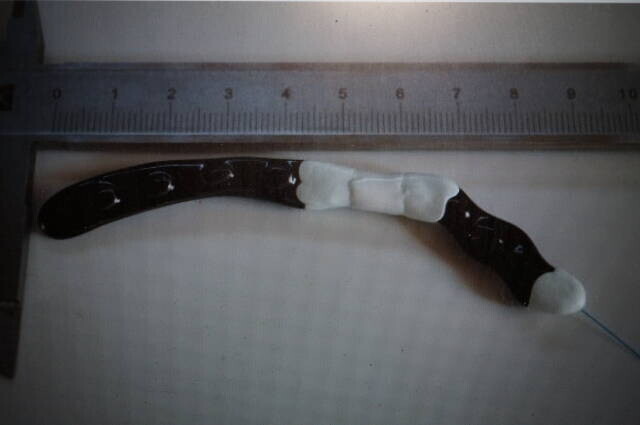
A flexible prostate chip stayed put but proved difficult to remove
In an entry published in February 2026, a customer reported a comfortable fit after difficult placement. They said the chip moved little once positioned, but removal also involved considerable resistance. They eventually removed it and reported almost no pain when urinating afterward.
Mr. Okada wrote that his own trials had not revealed these difficulties. He focused on the resistance described in the customer's account and responded by offering a joint that bent more easily.
(Source: ok-lab's diary, published February 2026)
https://ok-lab.hatenablog.com/entry/2026/02/07/122919
The flexible vibrating chip prompted concern about prolonged bladder vibration
In an entry published in February 2026, Mr. Okada introduced a wire-connected vibrating ceramic chip. He explained that its resin covering could be thinner because the wire connection provided the attachment. He also reported that vibration reached the ceramic section across the flexible joint.
In his informal comparison, the ceramic tip seemed to vibrate more strongly than the motor itself. Mr. Okada cautioned that prolonged vibration inside the bladder might be harmful.
(Source: ok-lab's diary, published February 2026)
https://ok-lab.hatenablog.com/entry/2026/02/14/121602
A twisted flexible prostate chip was prototyped despite the usual shape limits
In an entry published in March 2026, a customer requested a flexible version of the short twisted ceramic chip. Staff initially said the modification normally covered chips without twists or bumps. They then offered to attempt a prototype if the customer could accept a delay.
Mr. Okada wrote that he had received no reply, but completed a prototype anyway. He described the gently twisted shape as difficult to connect; the entry does not record the customer's experience with it. Mr. Okada said he was willing to consider difficult custom requests.
(Source: ok-lab's diary, published March 2026)
https://ok-lab.hatenablog.com/entry/2026/03/14/122910
The short flexible prostate chip felt milder but slipped more easily
In an entry published in March 2026, a customer compared the short SS flexible chip with their semi-long S version. They described the shorter chip as thinner, easier to position, and milder in sensation. However, they reported that it slipped out more easily during ejaculation and urination.
The customer found removal much easier and reported neither bleeding nor pain during urination afterward. Mr. Okada acknowledged their report that the central rubber section had not caused the discomfort they initially feared.
(Source: ok-lab's diary, published March 2026)
https://ok-lab.hatenablog.com/entry/2026/03/14/122910
The maker's answer to flexible prostate chips
Mr. Okada changed joint construction, offered different flexibility, and placed limits on compatible shapes and motors.
Flexible prostate chip modifications had shape limits and separate charges
The January 2026 entry listed bump-free short, semi-long, awakening, long, and double-twist ceramic chips (Rabuka) as suitable for flexible joints. Standard bends were about 30 to 45 degrees, with approximately 90 degrees available on request.
As published in January 2026, the modification surcharge was ¥4,000 (about $26 at ¥156 = $1, rate as of 2026-09-04) excluding tax for short and semi-long chips. For awakening, long, and double-twist chips, it was ¥5,000 (about $32 at ¥156 = $1, rate as of 2026-09-04) excluding tax. Mr. Okada put modification of the shaped ceramic design (Umiushi 4) on hold because he thought added length could undermine its original features.
(Source: ok-lab's diary, published January 2026)
https://ok-lab.hatenablog.com/entry/2026/01/17/122907
Raised resin edges addressed rubber contact in flexible prostate chips
In an entry published in January 2026, Mr. Okada recalled a customer seeking a long, slender chip who said silicone disagreed with their skin. He developed a semi-long S prototype with raised resin edges beside the approximately 5 mm silicone rubber section.
He hoped the resin would contact the urethral lining while keeping most of the rubber away from it. The diary does not record whether this resolved that customer's discomfort. Mr. Okada presented the design as a response to their concern about rubber contact.
(Source: ok-lab's diary, published January 2026)
https://ok-lab.hatenablog.com/entry/2026/01/24/122909
Thinner rubber made flexible prostate chips bend more readily
In an entry published in February 2026, Mr. Okada introduced a thinner rubber covering over tube-enclosed wire. He compared an earlier joint bending about 120 degrees with a prototype bending beyond 180 degrees. The easier-bending version had an approximately 15 mm gap, a 5 mm rubber section, and a resting bend of about 45 degrees.
He reported much easier placement and removal during his own trial of the new design. Mr. Okada offered it at the existing modification price, while noting considerably less pressure and stimulation despite broadly similar ability to stay positioned.
(Source: ok-lab's diary, published February 2026)
https://ok-lab.hatenablog.com/entry/2026/02/07/122919
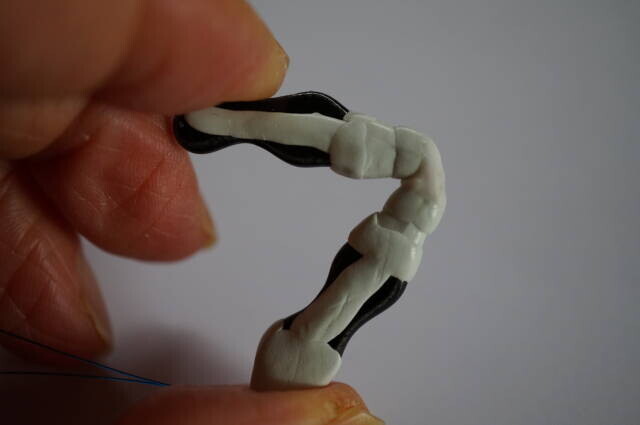
Flexible vibrating chips required ceramic sections and suitable motor sizes
In an entry published in February 2026, Mr. Okada limited flexible vibrating builds to ceramic chips with 8 mm or 10 mm motors. The standard ceramic section was 10 mm shorter than usual and included wire reinforcement. The proposed gap was approximately 15 mm to 30 mm, with a 5 mm connection or a more flexible 3 mm version.
Approximate bend choices were 45 degrees, 60 degrees, and 90 degrees. Published surcharges were ¥4,000 (about $26 at ¥156 = $1, rate as of 2026-09-04) excluding tax for short or semi-long chips, and ¥5,000 (about $32 at ¥156 = $1, rate as of 2026-09-04) excluding tax for awakening or long chips. Mr. Okada ruled out 6 mm motors because he doubted the security of their wire connection.
(Source: ok-lab's diary, published February 2026)
https://ok-lab.hatenablog.com/entry/2026/02/14/121602
If you see blood in your urine, even a small amount or for the first time, do not wait and see. See a urologist right away. If you suddenly cannot urinate, or the device cannot be removed, do not try to fix it yourself. Go to a medical facility, including emergency care, immediately.
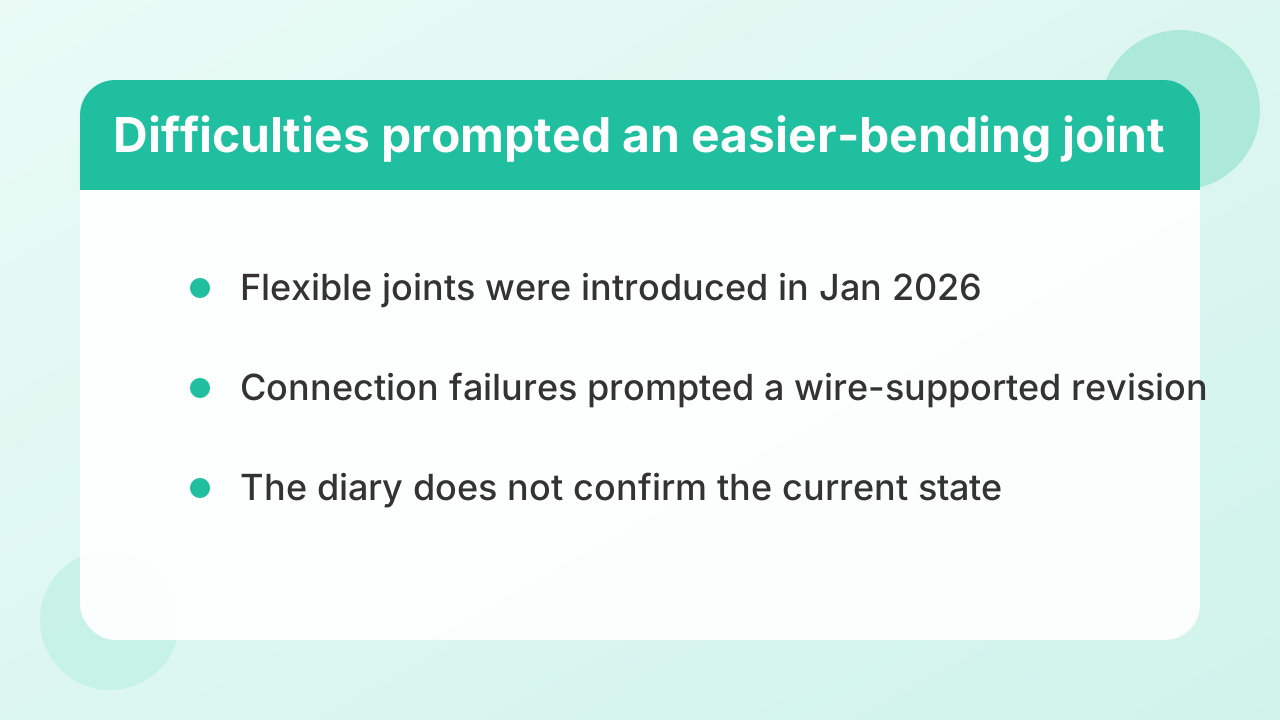
How flexible prostate chips changed over time
| Published | What the diary said then |
|---|---|
| Jan 2026 | Flexible joints introduced for selected ceramic shapes; one shaped design deferred. |
| Jan 2026 | Older nylon-core connection described as effectively discontinued. |
| Jan 2026 | Connection failures prompted a wire-supported revision of the paired ceramic design. |
| Feb 2026 | Customer difficulties prompted an easier-bending joint with milder pressure. |
| Feb 2026 | Flexible vibrating versions introduced with motor limits and a warning about prolonged bladder vibration. |
| Mar 2026 | A short twisted ceramic prototype succeeded despite the initial compatibility restriction. |
| Mar 2026 | A proposed stopper and pushing-tool combination remained uncertain because of added thickness. |
The diary does not say what the current state is.
OK Prostate Chip products related to flexible prostate chips
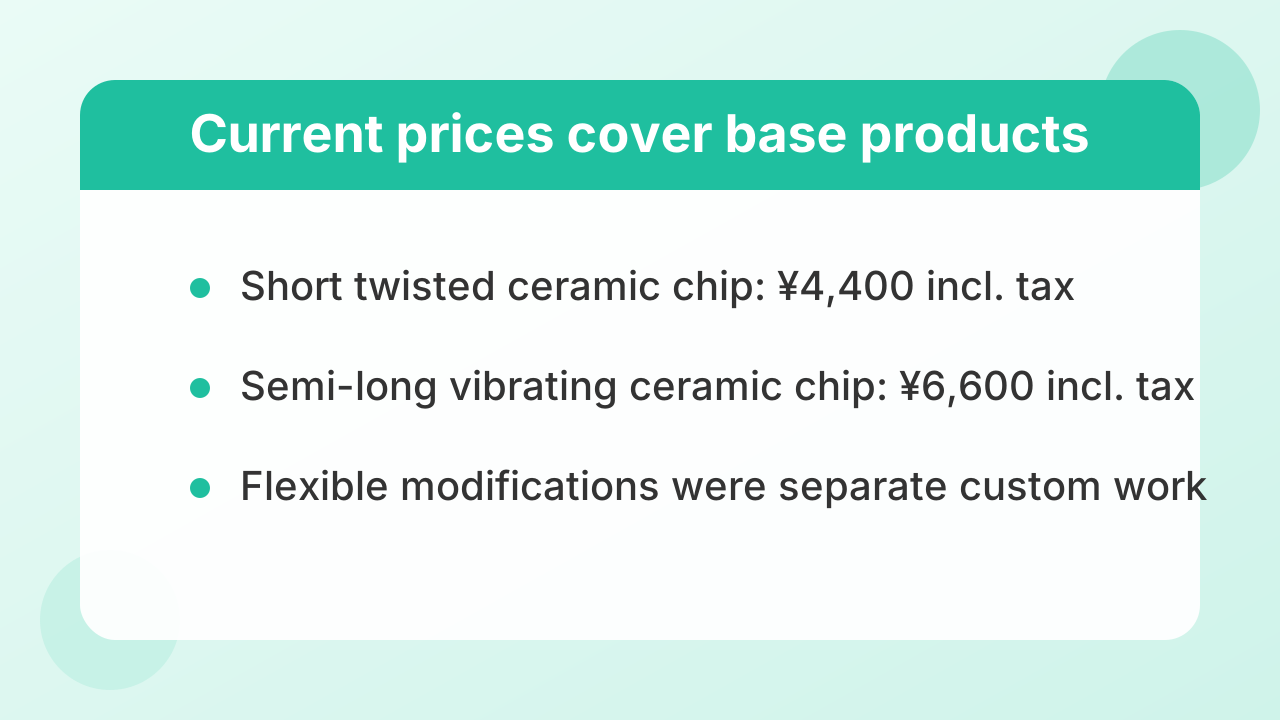
The current list confirms these base products; the diary's flexible modifications were separate custom work.
Products that appear in these entries
| Product (official name) | Price incl. tax | Relation to this topic |
|---|---|---|
| Short twisted ceramic chip (OKプロステートチップ 陶器素材ショートタイプ ツイスト) | ¥4,400 (about $28 at ¥156 = $1, rate as of 2026-09-04) | In March 2026, a request to modify this chip prompted the difficult but successful flexible-joint prototype. |
| Semi-long vibrating ceramic chip (OKプロステート核振チップ 陶器素材セミロングタイプ) | ¥6,600 (about $42 at ¥156 = $1, rate as of 2026-09-04) | In March 2026, a customer selected this base model for the flexible assembly discussed in the stopper compatibility exchange. |
(Source: ok-lab's diary, published March 2026)
https://ok-lab.hatenablog.com/entry/2026/03/14/122910
(Source: ok-lab's diary, published March 2026)
https://ok-lab.hatenablog.com/entry/2026/03/21/122906
Products the diary mentioned as alternatives
The diary names no alternative.
Custom flexible assemblies, shaped and paired ceramic designs, apple stopper accessories, and the wire-supported rear-connection prototype:
No matching product can be confirmed on the current list.
Common worries about flexible prostate chips
The reader questions concern older connections, custom shapes, and accessory compatibility.
"Can the older flexible prostate chip connection still be ordered?"
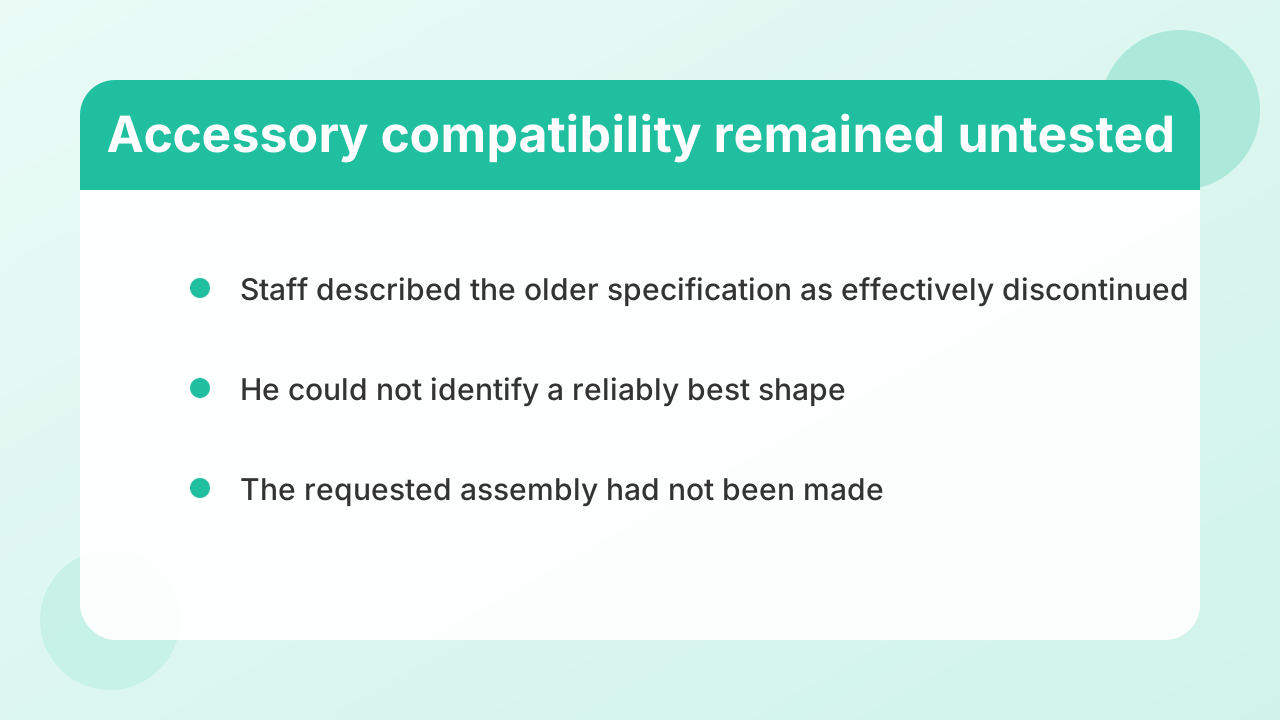
In an entry published in January 2026, a customer requested an older curved rear connection. Staff said its soft nylon core was unstable, its rubber peeled easily, and its angle was difficult to set. They described that specification as effectively discontinued.
Mr. Okada then produced a wire-supported prototype, with a published surcharge of ¥3,000 (about $19 at ¥156 = $1, rate as of 2026-09-04) excluding tax above the usual chip with a screw-shaped auxiliary piece. The diary does not record whether that customer's order was completed. Staff also offered a plain rubber-coated thread connection when no fixed angle was requested.
(Source: ok-lab's diary, published January 2026)
https://ok-lab.hatenablog.com/entry/2026/01/24/122909
"Can the maker choose my flexible vibrating chip's shape?"
In an entry published in February 2026, a customer asked Mr. Okada to select the components and shape for stimulation beside the bladder. Staff proposed the approximately 5 cm front section of the paired ceramic design, with a stronger bend.
Mr. Okada made the requested prototype but did not personally test the customer's item. The diary does not record how it felt in use. He cautioned that he could not identify a reliably best shape for that purpose.
(Source: ok-lab's diary, published February 2026)
https://ok-lab.hatenablog.com/entry/2026/02/21/122935
"Will apple stopper accessories fit a flexible vibrating chip?"
In an entry published in March 2026, a customer asked whether the Version 2 apple pushing tool suited an integrated resin stopper (apple stopper). Staff said the all-resin stopper was incompatible, but offered an additional rubber-resin end for ¥550 (about $4 at ¥156 = $1, rate as of 2026-09-04). They also proposed Version 3, with rubber on the tool, and the customer requested a revised quotation.
Mr. Okada then warned that the stopper's cable connection and Version 3 tool could make the assembly too thick. The requested assembly had not been made, so its compatibility remained untested. He suggested a rubber addition on the cable with Version 2, while admitting he could not identify a dependable choice.
(Source: ok-lab's diary, published March 2026)
https://ok-lab.hatenablog.com/entry/2026/03/21/122906
Buying from outside Japan

OK Lab ships internationally to countries covered by Japan Post's EMS courier service. Overseas orders are paid in advance by PayPal. Each order carries a ¥400 (about $3 at ¥156 = $1, rate as of 2026-09-04) handling fee, and EMS shipping is charged on top. These terms come from OK Lab's official sales-terms page (written here as plain text, not a link: ok-lab.net/docs/law), checked on September 7, 2026; confirm them on the official store before you order, because they can change.
Summary of this article
| What you wanted to know | The answer |
|---|---|
| In short: does flexibility help? | Reports differed; early joints could still resist movement. |
| About the product: who makes it? | OK Lab, a small company in Japan. |
| Key terms: what bends? | A rubber-covered wire connection between chip sections. |
| What happens: what did customers report? | Easier removal in one comparison, but less secure positioning. |
| The maker's answer: what changed? | Joint construction, flexibility, reinforcement, and compatibility limits. |
| Development over time: when did this happen? | The substantive changes summarized here appeared from January through March 2026. |
| Products: what do current prices cover? | Listed base products; custom flexible assemblies remain unconfirmed. |
| Common worries: are accessories interchangeable? | The March stopper exchange left compatibility uncertain. |
| Overseas buying: how are orders handled? | Advance PayPal payment, handling fee, and additional EMS shipping. |
| Overall answer: which joint is best? | The diary does not establish one best choice for every customer. |
Source: ok-lab's diary (Okada Comfortable Life Laboratory). The original entries are in Japanese; quotations on this page are translated. Photos and videos are on the original entries.
This article is a summary of the maker's development diary. The product is not a medical device and no result is guaranteed. If anything feels wrong or worries you, see a doctor. Prices, specifications and cautions change, so confirm the latest information on the official blog and the official site. Questions about ordering and shipping go to the seller.