![Can two prostate chips be used together? | Stacked and jointed designs have different limits [OK Prostate Chip]](/img/a/T0561/eyecatch.svg)
This page is based on entries from "ok-lab's diary" (https://ok-lab.hatenablog.com/), the Japanese development diary written by Mr. Okada, founder of OK Lab, a small company in Japan (Okada Comfortable Life Laboratory). Only the entries about "using two chips as one" are summarized here, in order of publication. Past prices and sizes are as written at the time. Current prices come from the official product list (retrieved September 4, 2026). Quotations are translated from Japanese.
This article is about using chips together, and summarizes their development, fit problems, and connection designs. It covers the maker's concerns, reader questions, current products, and buying from outside Japan.
Note: This page is a personal reading log by someone with no connection to the maker or the seller. It reflects the source entries as of their publication dates and makes no guarantee of accuracy or safety. The product is not a medical device; talk to a doctor about any health decision. Check the official site for current information. This page contains advertising.
In short
Joining two chips can add thickness or length, but the diary records fit problems and a bleeding incident.
The maker developed separate retrieval threads, reinforced connections and flexible joints for different designs.
Individual ceramic and resin chips remain listed; custom twin and dual assemblies need separate identification.
If you see blood in your urine, even a small amount or for the first time, do not wait and see. See a urologist right away.
If you suddenly cannot urinate, or the device cannot be removed, do not try to fix it yourself. Go to a medical facility, including emergency care, immediately.
About this product

The OK Prostate Chip is a small device that is placed in the urethra (the urine passage) so that it acts on the prostate; the maker sells it in several shapes, sizes and materials. It is made and sold by OK Lab (Okada Comfortable Life Laboratory), a small company in Japan, through its own online store, and prices are in Japanese yen (JPY). The maker's development diary, "ok-lab's diary", is written in Japanese. This page is an English summary of it, and every quotation is translated. OK Lab ships internationally, so readers outside Japan can order (see "Buying from outside Japan" below). Product names on this page are plain-English descriptions. The official Japanese product name is shown once in the product table so you can find the same item in the store.
Before you read: key terms
| Term | Plain-English meaning |
|---|---|
| Urethra | The urine passage, where the diary describes the chips being placed. |
| Twin chips | Two joined chip bodies; stacked versions were developed to increase thickness. |
| Resin | Material used to bond chip bodies and form supports around their connection. |
| Retrieval thread | A thread attached to a chip, intended to keep that chip recoverable if bonding resin cracks. |
| Electrode / electrode pad | Electrical contacts used for stimulation; the pad provides another contact in one configuration described by the maker. |
| Nitinol | The diary's shape-memory wire, used to connect ceramic bodies through flexible joints. |
| Four-joint connector | A flexible link between chip bodies, intended to let the combined assembly bend. |
| Chipless wire design | A directly wire-linked design used by Mr. Okada as a comparison for staying in place. |
What happens: using two prostate chips together
The OK Prostate Chip is a device placed in the urethra (the urine passage) to act on the prostate. Twin chips combine two chip bodies into one assembly, with stacked versions developed to add thickness. Bonding resin (material joining the chip bodies) sits between or around the stacked pieces. Later dual chips joined ceramic bodies through a flexible connector, placing the connection between chips intended to sit inside the urethra.
Curved twin chips raised concerns about fit before a customer outcome was known
In an entry published in August 2020, a customer asked about the double-twist ceramic chip. Mr. Okada proposed a curved twin, then became concerned about its sharp curve after making it.
The diary does not record whether the customer could fit it. Mr. Okada warned that failure to fit would not qualify for a return.
(Source: ok-lab's diary, published August 2020)
https://ok-lab.hatenablog.com/entry/2020/08/08/130037

Stacked ceramic twin chips added thickness and carried a separate processing charge
In an entry published in February 2021, Mr. Okada introduced stacked ceramic twins retaining the single chip's width and length. Thickness was twice the single chip's thickness plus about 1 mm, with a gap intended for urine passage.
Processing cost ¥1,000 (about $6 at ¥156 = $1, rate as of 2026-09-04), tax excluded, beyond the price of 2 single chips. His published short-chip example, all tax excluded, was ¥3,000 (about $19 at ¥156 = $1, rate as of 2026-09-04) × 2 + ¥1,000 (about $6 at ¥156 = $1, rate as of 2026-09-04) = ¥7,000 (about $45 at ¥156 = $1, rate as of 2026-09-04). He regarded cracking resin as a greater concern than separation at the ceramic bond.
(Source: ok-lab's diary, published February 2021)
https://ok-lab.hatenablog.com/entry/2021/02/20/130830
Ceramic twin chips drew praise before bleeding was reported
In an entry published in March 2021, a customer initially praised a sea-slug-shaped ceramic twin, version 2, and requested larger steel rings. A follow-up reported bleeding during removal after 2 days, with a thick ring digging into the urethra.
Mr. Okada proposed additional resin coverage and a combined arrangement for the proposed units' retrieval threads (threads intended for recovery). He warned that the leading unit's thread could otherwise become inaccessible. The diary does not record whether the proposed revisions solved the problem. Mr. Okada said an order would require further discussion.
(Source: ok-lab's diary, published March 2021)
https://ok-lab.hatenablog.com/entry/2021/03/13/130202
Stainless steel twin chips offered two forms of electrical stimulation
In an entry published in September 2023, Mr. Okada described stainless steel twins around 7–8 mm thick, usable as two electrodes (electrical contacts). Processing cost ¥1,000 (about $6 at ¥156 = $1, rate as of 2026-09-04), tax excluded, beyond the price of two single-electrode chips.
He described stimulation through both chip faces as stronger than a configuration involving one face and an electrode pad (another electrical contact). Mr. Okada presented the pad-based configuration as an alternative if the two-face version felt too intense.
(Source: ok-lab's diary, published September 2023)
https://ok-lab.hatenablog.com/entry/2023/09/02/122918
Bulky stainless steel twin chips prompted a request for closer contact
In an entry published in November 2023, a customer reported abandoning an earlier long stainless steel twin because fitting it was difficult. The customer wanted a close-contact pair in a preferred long shape.
Mr. Okada accepted this non-electrical proposal, explaining that it would double both thickness and weight. The diary does not record whether the replacement was easier to fit. Mr. Okada distinguished this proposal from electrical twins, which needed resin separating their contacts.
(Source: ok-lab's diary, published November 2023)
https://ok-lab.hatenablog.com/entry/2023/11/11/122638
Jointed dual chips connected ceramic bodies through a flexible wire link
In an entry published in January 2026, Mr. Okada introduced two ceramic bodies connected through one continuous nitinol (shape-memory wire) connection. A 4-joint connector (a flexible link between the bodies) allowed movement between them.
He described this as one chip with bending sections, allowing matching or different ceramic shapes. Mr. Okada suggested smaller ceramic combinations as potentially easier alternatives to the large prototypes.
(Source: ok-lab's diary, published January 2026)
https://ok-lab.hatenablog.com/entry/2026/01/10/122922
The maker's answer to using two prostate chips together
The maker addressed thread access, folding and joint strength through different connection designs.
Ceramic twin chips had separate retrieval threads for each half
In an entry published in February 2021, Mr. Okada specified separate threads for each ceramic half. A twin therefore had at least 2 threads; two per half meant 4.
He intended each half to retain its own retrieval connection if the resin cracked. Mr. Okada explicitly rejected one shared thread for the entire pair.
(Source: ok-lab's diary, published February 2021)
https://ok-lab.hatenablog.com/entry/2021/02/20/130830
Two connected chips raised concerns about folding inside the urethra
In an entry published in May 2021, a customer requested a short twisted ceramic chip joined to another thin ceramic piece by threads. Mr. Okada warned that thin pieces connected only by thread could fold over each other inside the urethra.
The diary does not record how the proposed arrangement felt in use. Mr. Okada asked for rubber coating on the connection because of that concern.
(Source: ok-lab's diary, published May 2021)
https://ok-lab.hatenablog.com/entry/2021/05/15/130037
Twin resin chips kept their spacing after staff explained the limits of bonding
In an entry published in December 2023, a customer requested stacked resin chips for more width. Staff initially noted that each body would have 2 separate threads, then accepted a jointed connection instead.
Staff described a usual resin gap of about 2 mm; direct contact meant weaker bonding and more resin bands. The customer chose spacing, and Mr. Okada reported a finished twin with openings intended to preserve urine passage. Staff favored close contact for a more unified shape, or spacing for thickness.
(Source: ok-lab's diary, published December 2023)
https://ok-lab.hatenablog.com/entry/2023/12/09/123055
Jointed dual chips came with a caution about slower bending
In an entry published in January 2026, Mr. Okada compared dual chips with his chipless wire design (his directly wire-linked comparison design). He thought dual chips stayed in place equally well, or slightly better, but found removal more time-consuming.
He attributed this difference to joints bending less readily under their resin covers. Mr. Okada quoted a minimum lead time of about 2 weeks, warning that heavier demand could lengthen it.
(Source: ok-lab's diary, published January 2026)
https://ok-lab.hatenablog.com/entry/2026/01/10/122922
If you see blood in your urine, even a small amount or for the first time, do not wait and see. See a urologist right away.
If you suddenly cannot urinate, or the device cannot be removed, do not try to fix it yourself. Go to a medical facility, including emergency care, immediately.
How using two prostate chips together changed over time
| Published | What the diary said then |
|---|---|
| Aug 2020 | A sharply curved twin raised fit concerns; failure to fit would not qualify for returns. |
| Feb 2021 | Ceramic stacking added thickness and a separately priced processing charge. |
| Mar 2021 | A customer reported bleeding associated with a thick steel ring on a twin assembly. |
| May 2021 | Possible folding of thin connected chips prompted a rubber-coating request. |
| Jun 2021 | Mr. Okada specified overlap limits for shifted ceramic pairs. |
| Jul 2021 | Titanium prototype halves joined so firmly that Mr. Okada struggled to separate them. |
| Sep 2023 | Stainless steel twins gained an electrical role. |
| Nov 2023 | A difficult-to-fit twin prompted a request for closely stacked steel bodies. |
| Dec 2023 | Staff explained resin spacing and the bonding tradeoff of direct contact. |
| Jan 2026 | Flexible four-joint connections enabled ceramic dual chips. |
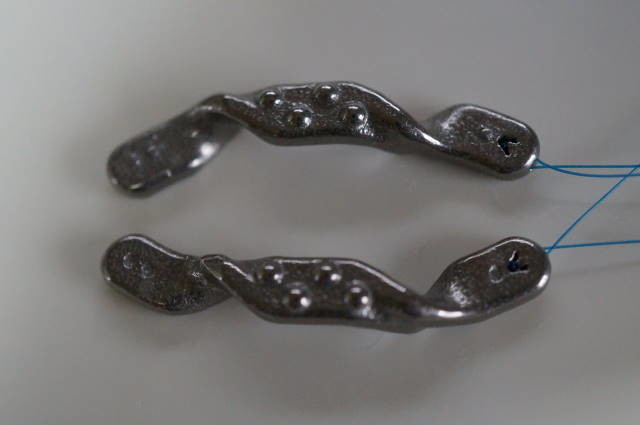
OK Prostate Chip products related to using two prostate chips together
The current list includes individual ceramic and resin chips discussed in these custom projects.
The chips featured in these entries
| Product (official name) | Price incl. tax | Relation to this topic |
|---|---|---|
| Short ceramic chip (OKプロステートチップ 陶器素材ショートタイプ) | ¥3,300 (about $21 at ¥156 = $1, rate as of 2026-09-04) | In February 2021, this chip provided the maker's example for calculating a custom ceramic twin's price. |
| Short twisted ceramic chip (OKプロステートチップ 陶器素材ショートタイプ ツイスト) | ¥4,400 (about $28 at ¥156 = $1, rate as of 2026-09-04) | In May 2021, this chip appeared in the thin-piece connection request that prompted a folding warning. |
| Resin chip (OKプロステートチップ 覚醒タイプ(生体適合樹脂)) | ¥8,800 (about $56 at ¥156 = $1, rate as of 2026-09-04) | In December 2023, a customer requested two of these chips as a stacked assembly with resin spacing. |
(Source: ok-lab's diary, published February 2021)
https://ok-lab.hatenablog.com/entry/2021/02/20/130830
(Source: ok-lab's diary, published May 2021)
https://ok-lab.hatenablog.com/entry/2021/05/15/130037
(Source: ok-lab's diary, published December 2023)
https://ok-lab.hatenablog.com/entry/2023/12/09/123055
Alternative chips mentioned in the diary
| Product (official name) | Price incl. tax | Relation to this topic |
|---|---|---|
| Semi-long ceramic chip (OKプロステートチップ 陶器素材セミロングタイプ) | ¥4,400 (about $28 at ¥156 = $1, rate as of 2026-09-04) | In January 2026, Mr. Okada suggested smaller combinations involving this chip as potentially easier alternatives to the large dual prototypes. |
(Source: ok-lab's diary, published January 2026)
https://ok-lab.hatenablog.com/entry/2026/01/10/122922
Custom twin and dual assemblies
No matching product can be confirmed on the current list.
In an entry published in January 2026, Mr. Okada said the old thread-connected glass pair had been discontinued because its threads tangled. The entry described that withdrawal as something that had happened previously.
(Source: ok-lab's diary, published January 2026)
https://ok-lab.hatenablog.com/entry/2026/01/10/122922
Common worries about using two prostate chips together
The reader questions concerned achievable size, acceptable overlap and the additional processing price.
"Can twin ceramic chips reach any requested thickness?"
In an entry published in February 2021, a customer sought a thicker sea-slug-shaped ceramic pair, version 2. Mr. Okada said his prototype method would produce about 10 mm at most.
He was reluctant to leave a 4 mm gap because of design and strength concerns. Mr. Okada offered to attempt that gap only if the customer insisted.
(Source: ok-lab's diary, published February 2021)
https://ok-lab.hatenablog.com/entry/2021/02/20/130830
"Can twin chips become wider as well as thicker?"
In an entry published in June 2021, a customer asked about shifted or mixed ceramic pairs. Mr. Okada clarified that his earlier criticism concerned appearance, not function.
He considered roughly 60% width overlap and 70% length overlap stable enough for bonding. Mr. Okada cautioned that insufficient overlap or an awkward end curve could rule out a proposed combination.
(Source: ok-lab's diary, published June 2021)
https://ok-lab.hatenablog.com/entry/2021/06/26/125926
"What was the processing cost for dual chips in January 2026?"
In an entry published in January 2026, a customer requested a dual assembly using matching slim double-twist ceramic chips. The quotation listed ¥6,600 (about $42 at ¥156 = $1, rate as of 2026-09-04) for each ceramic chip and ¥6,600 (about $42 at ¥156 = $1, rate as of 2026-09-04) for dual processing.
The entry also showed the completed assembly. The diary does not record how this customer's finished device felt in use.
(Source: ok-lab's diary, published January 2026)
https://ok-lab.hatenablog.com/entry/2026/01/24/122909
Buying from outside Japan

OK Lab ships internationally to countries covered by Japan Post's EMS courier service. Overseas orders are paid in advance by PayPal. Each order carries a ¥400 (about $3 at ¥156 = $1, rate as of 2026-09-04) handling fee, and EMS shipping is charged on top. These terms come from OK Lab's official sales-terms page (written here as plain text, not a link: ok-lab.net/docs/law), checked on September 7, 2026; confirm them on the official store before you order, because they can change.
Summary of this article
| What you wanted to know | The answer |
|---|---|
| What is the short answer? | Two-chip assemblies existed, with documented fit and connection problems. |
| What is the base product? | A urethral device made by OK Lab in Japan. |
| What do the terms mean? | Twins combine bodies; dual designs add a flexible connection between them. |
| What happened in the cases? | Added bulk brought fit difficulties, and one customer reported bleeding. |
| What did the maker change? | Thread arrangements, coating, resin spacing and joint construction. |
| How did designs develop? | The diary progressed from curved and stacked pairs to jointed ceramic assemblies. |
| What is listed today? | Individual chips appear in the current list; custom assemblies lack confirmed matching listings. |
| What did readers ask? | Whether larger dimensions were feasible and what processing cost. |
| How do overseas purchases work? | Advance PayPal payment, a ¥400 (about $3 at ¥156 = $1, rate as of 2026-09-04) handling fee and additional EMS shipping charges. |
Source: ok-lab's diary (Okada Comfortable Life Laboratory). The original entries are in Japanese; quotations on this page are translated. Photos and videos are on the original entries.
This article is a summary of the maker's development diary. The product is not a medical device and no result is guaranteed. If anything feels wrong or worries you, see a doctor. Prices, specifications and cautions change, so confirm the latest information on the official blog and the official site. Questions about ordering and shipping go to the seller.