![Can resin or ceramic double chips stay in place? | The diary records movement and connection problems [OK Prostate Chip]](/img/a/T0558/eyecatch.svg)
This page is based on entries from "ok-lab's diary" (https://ok-lab.hatenablog.com/), the Japanese development diary written by Mr. Okada, founder of OK Lab, a small company in Japan (Okada Comfortable Life Laboratory). Only the entries about "resin and ceramic double chips" are summarized here, in order of publication. Past prices and sizes are as written at the time. Current prices come from the official product list (retrieved September 4, 2026). Quotations are translated from Japanese.
Note: This page is a personal reading log by someone with no connection to the maker or the seller. It reflects the source entries as of their publication dates and makes no guarantee of accuracy or safety. The product is not a medical device; talk to a doctor about any health decision. Check the official site for current information. This page contains advertising.
In short
- Resin and ceramic double chips developed connection problems, including peeling attachments, overlapping bodies, and unwanted movement.
- Mr. Okada tried revised joints and custom designs, while continuing to report limitations.
- The current list includes a resin linked-chip model priced at ¥4,400 (about $28 at ¥156 = $1, rate as of 2026-09-04) including tax.
If you see blood in your urine, even a small amount or for the first time, do not wait and see. See a urologist right away. If you suddenly cannot urinate, or the device cannot be removed, do not try to fix it yourself. Go to a medical facility, including emergency care, immediately.
About this product

The OK Prostate Chip is a small device that is placed in the urethra (the urine passage) so that it acts on the prostate; the maker sells it in several shapes, sizes and materials. It is made and sold by OK Lab (Okada Comfortable Life Laboratory), a small company in Japan, through its own online store, and prices are in Japanese yen (JPY). The maker's development diary, "ok-lab's diary", is written in Japanese. This page is an English summary of it, and every quotation is translated. OK Lab ships internationally, so readers outside Japan can order (see "Buying from outside Japan" below). Product names on this page are plain-English descriptions. The official Japanese product name is shown once in the product table so you can find the same item in the store.
Before you read: key terms
| Term | Plain-English meaning |
|---|---|
| Urethra | The urine passage, where the maker places these devices. |
| Double chip | Two connected chip bodies, intended to form a linked assembly within the urethra. |
| Joint | The connection between chip bodies, holding them together with varying freedom to bend. |
| Electrode | A conducting surface added to a chip for electrical stimulation. |
| Parallel cable | A cable containing paired wires, used to connect some assemblies. |
| Shape-memory wire | Wire that returns toward its formed shape, used for flexible connections. |
| Internal passage | A tunnel through a chip, needed for the proposed internal connection. |
| Biocompatible resin | The maker's label for resin used in chip bodies and auxiliary parts. The diary does not explain this. |
What happens: double-chip connection problems
The OK Prostate Chip is a small device placed in the urethra to act on the prostate. Resin and ceramic double chips join two bodies, with a joint (the connection between them) and attached thread. The diary describes the first body at the prostate and the second farther along the urine passage. Its designs explore whether different materials, shapes, and connections can address breakage concerns, unwanted movement, and overlapping bodies.
Resin double chips began with a fixed gap and planned price
In an entry published in January 2018, a customer asked whether glass bodies could collide and break. Mr. Okada could not rule that out and announced a resin alternative. Its thread connection ran near each body's center; a 0 mm gap was impossible, and the gap was limited to 2 mm.
Mr. Okada attributed that limit to possible irritation from projecting thread. The planned price was ¥4,000 (about $26 at ¥156 = $1, rate as of 2026-09-04) excluding tax: resin bodies ¥1,000 (about $6 at ¥156 = $1, rate as of 2026-09-04) × 2, plus thread connections ¥1,000 (about $6 at ¥156 = $1, rate as of 2026-09-04) × 2. Mr. Okada recommended resin for short sessions.
(Source: ok-lab's diary, published January 2018)
https://ok-lab.hatenablog.com/entry/20180121/1516504265
Peeling resin attachments revealed double-chip connection problems and prompted repair offers
In an entry published in April 2018, a customer requested repair after a linked pair's resin attachment came away. The customer reported that this followed a few minutes in boiling water. OK Lab treated it as an initial defect and replaced the thread free of charge.
Two further peeling reports that week led him to suspect a structural problem with glass double chips. He also asked customers with damaged attachments to return their chips for thread replacement.
(Source: ok-lab's diary, published April 2018)
https://ok-lab.hatenablog.com/entry/20180428/1524898558
Ceramic double chips prompted a cautious return to custom connection work
In an entry published in June 2022, a customer requested a combined ceramic design with a rubber joint. Mr. Okada said ceramic bodies could theoretically form an unlimited chain, but thread connections risked overlap or tangling and rubber covers lacked durability. He had generally refused these custom connections but accepted this request as an exception.
He expected a revised joint to improve durability and announced plans to reopen the service. The diary does not record whether this customer's assembly was completed. Mr. Okada suggested short twisted ceramic bodies as alternatives to a screw-shaped auxiliary body behind the main chip.
(Source: ok-lab's diary, published June 2022)
https://ok-lab.hatenablog.com/entry/2022/06/25/123016
Ceramic double chips moved unexpectedly toward the bladder during flexible-wire testing
In an entry published in March 2024, Mr. Okada tested ceramic double chips joined by flexible wire made from nickel and titanium. He described smooth insertion but an unexpected shift of more than 3 cm toward the bladder with almost no force. The thin connection had much less resistance than his earlier rubber-covered design, in his view.
The 0.6 mm wire had a 2.5 mm tube covering because he was concerned about direct contact with the urethral lining. He said further strength tests would precede sales. Mr. Okada cautioned that such easy movement might make this design unsuitable for staying in one position.
(Source: ok-lab's diary, published March 2024)
https://ok-lab.hatenablog.com/entry/2024/03/16/123023
Revised ceramic double chips resisted coming out during Mr. Okada's testing
In an entry published in April 2024, Mr. Okada compared a new ceramic pair with an earlier prototype that had come out during urination. He reported that the pair came out less easily with a connection bent to about 90 degrees.
The price, excluding tax, was both chip prices plus ¥3,000 (about $19 at ¥156 = $1, rate as of 2026-09-04) for shape-memory wire (wire that returns toward its formed shape). A tube cover added ¥1,000 (about $6 at ¥156 = $1, rate as of 2026-09-04), also excluding tax. Mr. Okada offered only specified ceramic bodies for the second position, so the connection was not described as compatible with every chip.
(Source: ok-lab's diary, published April 2024)
https://ok-lab.hatenablog.com/entry/2024/04/20/122856
Ceramic double chips gained flexible joints with separate charges and production limits
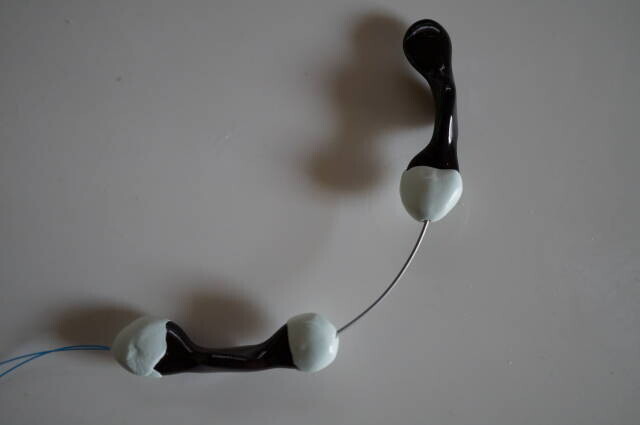
In an entry published in January 2026, Mr. Okada introduced ceramic pairs joined through 4 resin-covered flexible joints. He said bonding tests supported the connection and that different ceramic body shapes could be paired. The published surcharge was ¥6,000 (about $38 at ¥156 = $1, rate as of 2026-09-04) excluding tax, added to the two chip prices.
That covered ¥3,000 (about $19 at ¥156 = $1, rate as of 2026-09-04) for the section with 4 joints, ¥1,000 (about $6 at ¥156 = $1, rate as of 2026-09-04) for the first connection, and ¥2,000 (about $13 at ¥156 = $1, rate as of 2026-09-04) for the second, all excluding tax. He gave about 2 weeks as the shortest lead time and warned that demand could delay delivery.
(Source: ok-lab's diary, published January 2026)
https://ok-lab.hatenablog.com/entry/2026/01/10/122922
A promising ceramic double-chip prototype had no sales planned in February 2026
In an entry published in February 2026, Mr. Okada described a future ceramic prototype combining a twisted chip with a short ceramic chip. The assembly had both nylon thread and metal-wire connections.
Mr. Okada described its feel favorably. He stated that he had no plans to sell this prototype at that time.
(Source: ok-lab's diary, published February 2026)
https://ok-lab.hatenablog.com/entry/2026/02/28/122912
The maker's answer to double-chip connection problems
Mr. Okada responded with custom work, revised connections, and separate charges, while repeatedly reporting unresolved limits.
A resin second body remained available for custom glass double chips
In an entry published in April 2018, a customer proposed a glass first body paired with a resin second body after repeated attachment peeling. Mr. Okada replied that he had already tested a resin second body but had encountered problems during prolonged use. He had therefore dropped that standard offering, then agreed to this request as custom work.
The diary does not record whether this particular custom order was completed. Mr. Okada also offered thread replacement for the customer's peeling chip.
(Source: ok-lab's diary, published April 2018)
https://ok-lab.hatenablog.com/entry/20180428/1524898558
Ceramic double-chip connections required separate body preparation and joining charges
In an entry published in July 2022, Mr. Okada announced that ceramic bodies made for multiple connections had finished firing. These bodies cost the usual chip price plus ¥1,000 (about $6 at ¥156 = $1, rate as of 2026-09-04) excluding tax, reflecting the difficulty of making holes at both ends. The rubber connection between bodies carried a separate ¥1,000 (about $6 at ¥156 = $1, rate as of 2026-09-04) excluding tax labor charge.
He stated that any ceramic chip could serve as the leading body. For later positions, Mr. Okada offered only the specially prepared models listed in that entry.
(Source: ok-lab's diary, published July 2022)
https://ok-lab.hatenablog.com/entry/2022/07/23/123014
Resin double-chip electrodes returned with reinforced cables and optional covering costs
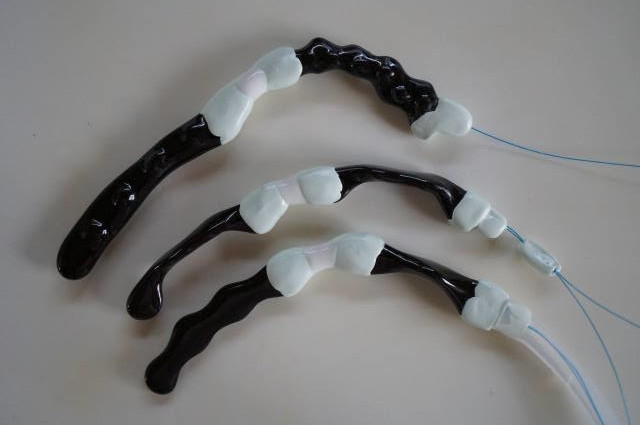
In an entry published in August 2024, Mr. Okada revisited resin double-chip electrodes (conducting surfaces for electrical stimulation) after earlier cable failures. He proposed paired cable wires reinforced with nylon thread, with optional resin covering between the bodies. The minimum published price was ¥10,000 (about $64 at ¥156 = $1, rate as of 2026-09-04) excluding tax.
Covering the gap added ¥1,000 (about $6 at ¥156 = $1, rate as of 2026-09-04); omitting the plug reduced the price by ¥1,000 (about $6 at ¥156 = $1, rate as of 2026-09-04), also excluding tax. He described bodies as narrow as about 7 mm, each up to 39 mm long, giving an assembly nearly 90 mm long. Mr. Okada suggested shorter bodies for beginners.
(Source: ok-lab's diary, published August 2024)
https://ok-lab.hatenablog.com/entry/2024/08/10/122913
If you see blood in your urine, even a small amount or for the first time, do not wait and see. See a urologist right away. If you suddenly cannot urinate, or the device cannot be removed, do not try to fix it yourself. Go to a medical facility, including emergency care, immediately.
How double-chip connection problems changed over time
| Published | What the diary said then |
|---|---|
| May 2018 | Rounded resin bodies required a revised thread attachment. |
| Aug 2018 | A tightly joined resin screw pair debuted as a custom twist design. |
| May 2019 | Electrodes were within 10 mm; durability of the cable remained uncertain. |
| Oct 2019 | Two 0.55 mm stainless-steel wires replaced nylon after unwanted rotation. |
| Jan 2020 | A parallel cable (paired wires) and nylon backup replaced the earlier connection. |
| Jul 2022 | Reinforced rubber connections had entered actual production for a ceramic linked design. |
| Apr 2024 | Connection lengths were offered at 3 cm, 4 cm, or 5 cm. |
| Aug 2024 | Resin-covered gaps were limited to 10 mm because longer coverings lacked consistent quality. |
| Jan 2026 | Dual assemblies targeted about 90 degrees; finished angles varied. |
| Feb 2026 | A ceramic prototype paired two 0.3 mm wires with a 150-degree bend. |
OK Prostate Chip products related to double-chip connection problems
The current list includes a resin linked-chip model and a screw auxiliary mentioned as an alternative.
Products that appear in these entries
| Product (official name) | Price incl. tax | Relation to this topic |
|---|---|---|
| Resin linked-chip model (OKプロステートチップ 樹脂素材2連結タイプ) | ¥4,400 (about $28 at ¥156 = $1, rate as of 2026-09-04) | The January 2018 entry announced a resin linked pair following a customer's concern about glass breakage. |
The resin linked-chip model is sold through OK Lab's own online store.
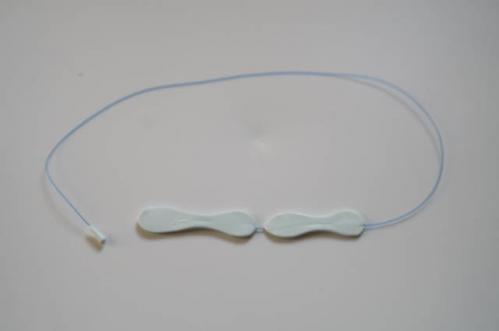
(Source: ok-lab's diary, published January 2018)
https://ok-lab.hatenablog.com/entry/20180121/1516504265
Products the diary mentioned as alternatives
| Product (official name) | Price incl. tax | Relation to this topic |
|---|---|---|
| Biocompatible resin screw auxiliary (スクリュー型補助チップ追加オプション(生体適合樹脂)) | ¥3,300 (about $21 at ¥156 = $1, rate as of 2026-09-04) | In October 2021, Mr. Okada suggested linked resin screw auxiliaries instead of glass or ceramic double chips. |
(Source: ok-lab's diary, published October 2021)
https://ok-lab.hatenablog.com/entry/2021/10/16/125843
Historical custom resin pairs, ceramic assemblies, double-electrode builds, and the February 2026 prototype:
No matching product can be confirmed on the current list.
Common worries about double-chip connection problems
The diary records questions about staying in place, manufacturing limits, and the risks of revised connections.
"Can ceramic double chips avoid coming out during urination?"
In an entry published in October 2021, a customer wanted a double chip less likely to come out during urination. Mr. Okada explained that glass and ceramic pairs could overlap and become impossible to remove. He said this risk had prompted their withdrawal from regular sales.
He offered custom ceramic pairs with a resin strip along the second body's center. The diary does not record whether this customer's request led to an order. Mr. Okada suggested linked screw auxiliaries made from biocompatible resin (the maker's material label).
(Source: ok-lab's diary, published October 2021)
https://ok-lab.hatenablog.com/entry/2021/10/16/125843
"Why were biocompatible resin double chips difficult to make?"
In an entry published in November 2021, a customer wanted a resin pair that would resist coming out during urination. The proposed arrangement included a chip acting as an anchor in the bladder. Mr. Okada explained that a 40–50 mm internal passage (a tunnel for the connection) was difficult to make.
He said the resin model (Zoro) posed additional difficulty because its internal passage was not straight. The diary does not record whether the requested pair was completed. Mr. Okada said he could not endorse the bladder-anchor idea or judge whether it would harm the bladder.
(Source: ok-lab's diary, published November 2021)
https://ok-lab.hatenablog.com/entry/2021/11/06/125812
"Would back-to-back double chips solve exposed-thread problems?"
In an entry published in August 2026, a customer asked whether the connection could face the opposite direction. Mr. Okada first found the reversed arrangement less useful, then proposed a back-to-back pair with four threads grouped together. He thought moving the thread to the connection might reduce injuries previously reported from thread projecting from a chip's end.
He said ceramic bodies could also be connected this way. The diary does not record a customer's experience of the resulting design. Mr. Okada warned that the entire assembly entering the bladder could fold at its joint, leaving the chips overlapping during retrieval.
(Source: ok-lab's diary, published August 2026)
https://ok-lab.hatenablog.com/entry/2026/08/29/122931
Buying from outside Japan

OK Lab ships internationally to countries covered by Japan Post's EMS courier service. Overseas orders are paid in advance by PayPal. Each order carries a ¥400 (about $3 at ¥156 = $1, rate as of 2026-09-04) handling fee, and EMS shipping is charged on top. These terms come from OK Lab's official sales-terms page (written here as plain text, not a link: ok-lab.net/docs/law), checked on September 7, 2026; confirm them on the official store before you order, because they can change.
Summary of this article
| What you wanted to know | The answer |
|---|---|
| Does joining chips resolve every problem? | The maker continued to report connection and movement problems. |
| What is the base product? | A device placed in the urine passage, made by OK Lab in Japan. |
| What does “joint” mean here? | The connection holding both bodies together. |
| What happened during development? | Tests revealed attachment failures and unwanted movement. |
| How did the maker respond? | Custom work, revised connections, repairs, and assembly charges. |
| Did construction stay the same? | Thread, cable, rubber, and wire connections changed. |
| What current price is confirmed? | The listed resin linked-chip model costs ¥4,400 (about $28 at ¥156 = $1, rate as of 2026-09-04) including tax. |
| Did the replies settle every concern? | Overlap risks and unanswered questions remained in the maker's replies. |
| How are overseas orders handled? | Advance PayPal payment, a ¥400 (about $3 at ¥156 = $1, rate as of 2026-09-04) handling fee, and additional EMS shipping. |
| What does this account establish? | Dated maker reports, customer questions, and product changes. |
Source: ok-lab's diary (Okada Comfortable Life Laboratory). The original entries are in Japanese; quotations on this page are translated. Photos and videos are on the original entries.
This article is a summary of the maker's development diary. The product is not a medical device and no result is guaranteed. If anything feels wrong or worries you, see a doctor. Prices, specifications and cautions change, so confirm the latest information on the official blog and the official site. Questions about ordering and shipping go to the seller.