![Can two chips get stuck together? | Tangling led to hospital treatment and discontinued designs [OK Prostate Chip]](/img/a/T0334/eyecatch.svg)
This page is based on entries from "ok-lab's diary" (https://ok-lab.hatenablog.com/), the Japanese development diary written by Mr. Okada, founder of OK Lab, a small company in Japan (Okada Comfortable Life Laboratory). Only the entries about "two-chip tangling, overlap, and discontinued sales" are summarized here, in order of publication. Past prices and sizes are as written at the time. Current prices come from the official product list (retrieved September 4, 2026). Quotations are translated from Japanese.
Note: This page is a personal reading log by someone with no connection to the maker or the seller. It reflects the source entries as of their publication dates and makes no guarantee of accuracy or safety. The product is not a medical device; talk to a doctor about any health decision. Check the official site for current information. This page contains advertising.
In short
- Linked chips have overlapped or tangled, sometimes requiring hospital removal.
- Mr. Okada changed lengths and connections, but acknowledged that thread-linked chips could still tangle.
- Older thread-linked designs were discontinued; an August 2026 custom proposal still carried an explicit warning.
If you see blood in your urine, even a small amount or for the first time, do not wait and see. See a urologist right away.
If you suddenly cannot urinate, or the device cannot be removed, do not try to fix it yourself. Go to a medical facility, including emergency care, immediately.
About this product

The OK Prostate Chip is a small device that is placed in the urethra (the urine passage) so that it acts on the prostate; the maker sells it in several shapes, sizes and materials. It is made and sold by OK Lab (Okada Comfortable Life Laboratory), a small company in Japan, through its own online store, and prices are in Japanese yen (JPY).
The maker's development diary, "ok-lab's diary", is written in Japanese. This page is an English summary of it, and every quotation is translated.
OK Lab ships internationally, so readers outside Japan can order (see "Buying from outside Japan" below). Product names on this page are plain-English descriptions. The official Japanese product name is shown once in the product table so you can find the same item in the store.
Before you read: key terms
| Term | Plain-English meaning |
|---|---|
| Linked chips | Two connected pieces intended to provide stimulation or help maintain the main chip's position. |
| Screw accessory | A screw-shaped additional chip; the diary discusses it as a retaining component behind the main chip. |
| Stopper | An additional component intended to limit movement, including movement toward the bladder; the diary says it is not a guarantee. |
| Cystoscope | A camera instrument used to examine the urinary tract during the reported hospital treatment. |
| Spring tube | A flexible tube between chips, intended to help a bent connection return toward its original shape. |
What happens: chip tangling
The OK Prostate Chip is a small device placed in the urethra, the urine passage, to act on the prostate. The linked versions discussed here combine a main chip with another component inside that passage, sometimes through a short thread connection. Mr. Okada describes the additional component as providing stimulation or helping maintain the main chip's position. The reports describe both overlapping pieces and thread caught between them.
Suspected chip tangling prompted hospital removal and longer front sections
In an entry published in March 2018, a customer reported that linked chips had tangled near the prostate and required hospital removal. Mr. Okada suspected that the front chip had turned 180 degrees, but the anonymous report did not establish the mechanism.
He decided that future front sections would measure at least 30 mm, replacing the previous 25–28 mm length. Mr. Okada cautioned that individual differences meant even a 30 mm chip might reverse.
(Source: ok-lab's diary, published March 2018)
https://ok-lab.hatenablog.com/entry/20180310/1520672565
Separate threads did not prevent chip overlap with a medium-length model
In an entry published in July 2018, a customer reported pairing a separate rear chip with a medium-length main chip. Mr. Okada had expressed reservations about the requested combination but had allowed that cautious testing might be possible.
The pieces folded together, and the customer could not retrieve them through the separate component's thread; the pair eventually came out still folded. Mr. Okada acknowledged that the separate component could rotate and urged caution.
(Source: ok-lab's diary, published July 2018)
https://ok-lab.hatenablog.com/entry/20180707/1530947332
Chip overlap brought warnings before discontinued sales were documented
In an entry published in October 2018, Mr. Okada warned that older linked chips with space between them could fold together inside a condom. He advised against using those older designs in that arrangement.
In an entry published in March 2019, a repair request prompted him to confirm that earlier linked chips had been discontinued because of problems. He also changed the repaired pair's connection gap to about 3 mm, believing its previous zero-gap construction had placed excessive leverage on the connection.
(Source: ok-lab's diary, published October 2018)
https://ok-lab.hatenablog.com/entry/20181027/1540618195
(Source: ok-lab's diary, published March 2019)
https://ok-lab.hatenablog.com/entry/2019/03/23/173222
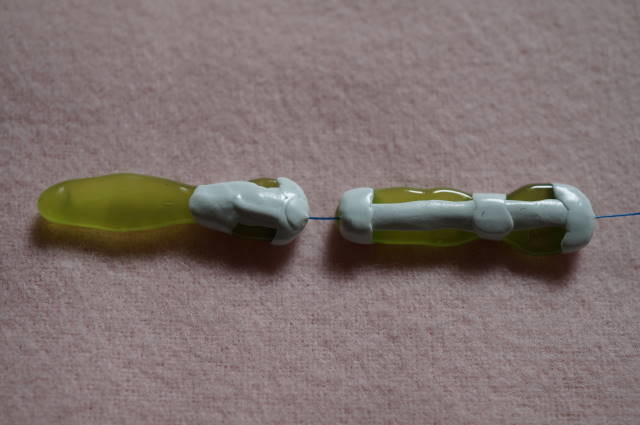
Suspected chip tangling delayed a ceramic pair's exit for days
In an entry published in May 2020, a customer reported that a short ceramic twist chip and screw accessory would not come out. They suspected bladder entry and asked whether thread could have caught between the pieces. Mr. Okada initially offered reassurance, then urged prompt medical care when the next morning brought no improvement.
Several days later, the customer reported that the device passed during urination. Mr. Okada suspected tangled thread could draw the pair into a V shape, preventing passage through the bladder outlet. He considered a single chip with a stopper the safest combination, while acknowledging that the stopper offered no guarantee.
(Source: ok-lab's diary, published May 2020)
https://ok-lab.hatenablog.com/entry/2020/05/02/131505
Chip overlap trapped a short resin model for five days
In an entry published in August 2022, a short resin chip and its accessory remained stuck together for 5 days. Hospital treatment involved a cystoscope (a camera instrument used to examine the urinary tract). The customer reported an insured treatment charge of about ¥8,000 (about $51 at ¥156 = $1, rate as of 2026-09-04), followed by minor bleeding and pain.
In a September 2022 follow-up, the customer believed the main chip had not reversed, although no doctor had confirmed this. Mr. Okada accepted that explanation and warned against force when the passage resisted movement.
(Source: ok-lab's diary, published August 2022)
https://ok-lab.hatenablog.com/entry/2022/08/20/122920
(Source: ok-lab's diary, published September 2022)
https://ok-lab.hatenablog.com/entry/2022/09/17/123057
A separate chip tangling report included a confirmed reversal
A different entry published in August 2022 described emergency treatment after a small resin chip (Zoro) and screw accessory became stuck. According to the customer, the doctor confirmed a 180-degree reversal. Removal took 20 minutes, and the customer's insured share was approximately ¥23,000 (about $147 at ¥156 = $1, rate as of 2026-09-04).
The customer decided to stop using chips. Mr. Okada considered stopping screw-accessory sales or limiting connections to 0 mm, then chose to develop a different connection.
(Source: ok-lab's diary, published August 2022)
https://ok-lab.hatenablog.com/entry/2022/08/27/123001
A zero-gap connection did not rule out suspected chip tangling
In an entry published in January 2023, a long resin chip (Long Zoro) with a large screw accessory became stuck despite a 0 mm gap. Attempts to retrieve it caused pain and bleeding.
It later passed during urination the day before a booked hospital appointment; the customer reported fever afterward, followed by recovery. Mr. Okada suspected that the accessory had tilted and become trapped by tangled thread, rather than confirming complete overlap.
(Source: ok-lab's diary, published January 2023)
https://ok-lab.hatenablog.com/entry/2023/01/07/123115
Ceramic chip tangling required treatment with equipment for urinary stones
In an entry published in August 2023, a customer reported that a doctor found the ceramic main chip and accessory overlapping, with tangled thread. The ceramic device was broken apart and removed using equipment intended for urinary stones.
The reported total was ¥59,000 (about $378 at ¥156 = $1, rate as of 2026-09-04) plus consultation fees; the diary does not record the subsequent follow-up examination's result. Mr. Okada suggested seeking a second opinion about this treatment if bladder incision was proposed.
(Source: ok-lab's diary, published August 2023)
https://ok-lab.hatenablog.com/entry/2023/08/05/122956
The maker's answer to chip tangling
Mr. Okada explored firmer connections, but later replies still acknowledged overlap and tangling risks.
Steel connections were tested to reduce ceramic chip tangling
In an entry published in September 2019, Mr. Okada began testing ceramic pairs with stainless-steel thread only between the chips. He described the result as behaving more like one flexible chip and hoped it would address earlier linked-chip problems.
The entry records testing toward a possible return of linked models, rather than a confirmed release. For the external thread, Mr. Okada favored nylon because exposed stainless steel had proved uncomfortable during longer use.
(Source: ok-lab's diary, published September 2019)
https://ok-lab.hatenablog.com/entry/2019/09/21/131939

A spring tube targeted chip overlap without making folding impossible
In an entry published in August 2022, Mr. Okada introduced a spring tube (a flexible connector intended to restore the pair's alignment). He reported that the connection returned toward its original shape after bending, but acknowledged that force could still fold the chips together.
The trial modification carried no additional charge and was offered on request for 2–6 mm gaps. Mr. Okada did not recommend longer gaps because the tube might not function properly as a spring.
(Source: ok-lab's diary, published August 2022)
https://ok-lab.hatenablog.com/entry/2022/08/27/123001
A jointed ceramic design offered another approach to chip tangling
In an entry published in January 2026, Mr. Okada presented ceramic pairs joined through a wire-supported connector with 4 flexible joints. The intended bend was about 90 degrees, with variation between handmade examples.
The published price was the two chips' prices plus ¥6,000, (about $38 at ¥156 = $1, rate as of 2026-09-04) tax excluded, with a shortest expected lead time of about 2 weeks. Mr. Okada suggested that combinations of shorter ceramic chips might be easier to use.
(Source: ok-lab's diary, published January 2026)
https://ok-lab.hatenablog.com/entry/2026/01/10/122922
If you see blood in your urine, even a small amount or for the first time, do not wait and see. See a urologist right away.
If you suddenly cannot urinate, or the device cannot be removed, do not try to fix it yourself. Go to a medical facility, including emergency care, immediately.
How chip tangling changed over time
| Published | What the diary said then |
|---|---|
| Mar 2018 | A dedicated external stopper was planned at ¥500, (about $3 at ¥156 = $1, rate as of 2026-09-04) tax excluded. |
| Jul 2018 | Mr. Okada claimed a zero-length connection prevented complete folding. |
| Mar 2019 | Earlier linked-chip sales were confirmed discontinued because of problems. |
| May 2019 | A 1.2 mm cable prototype needed at least 10 mm to bend smoothly. |
| Oct 2020 | Overlapping spring chips prompted rubber coating over the connecting thread. |
| Jun 2022 | A stronger connection prompted plans to accept more ceramic linking requests. |
| Dec 2023 | Reports of rubber-joint breakage prompted gentler connection angles. |
| Jan 2026 | A connector with 4 flexible joints joined ceramic pairs. |
| Aug 2026 | Staff reaffirmed abandonment of short thread-linked designs, then considered an acknowledged-risk custom request. |
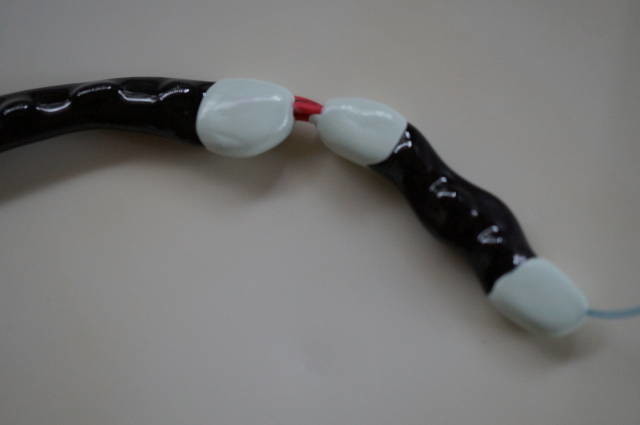
OK Prostate Chip products related to chip tangling

The current list includes products involved in past tangling reports.
Products that appear in these entries
| Product (official name) | Price incl. tax | Relation to this topic |
|---|---|---|
| Short ceramic twist chip (OKプロステートチップ 陶器素材ショートタイプ ツイスト) | ¥4,400 (about $28 at ¥156 = $1, rate as of 2026-09-04) | The May 2020 customer reported this chip becoming stuck with a screw accessory. |
| Screw accessory option (スクリュー型補助チップ追加オプション) | ¥3,300 (about $21 at ¥156 = $1, rate as of 2026-09-04) | The May 2020 report identifies this option as the accessory attached to the ceramic chip. |
(Source: ok-lab's diary, published May 2020)
https://ok-lab.hatenablog.com/entry/2020/05/02/131505
Products the diary mentioned as alternatives
The May 2020 reply favored a single chip with a stopper, but did not identify a specific stopper model. No matching product can be confirmed on the current list.
(Source: ok-lab's diary, published May 2020)
https://ok-lab.hatenablog.com/entry/2020/05/02/131505
Older thread-linked glass designs were explicitly described as discontinued in January 2026. The supplied product list nevertheless retains linked-chip names without connection specifications.
For the repaired older pair and the later custom jointed combinations, no matching product can be confirmed on the current list.
(Source: ok-lab's diary, published January 2026)
https://ok-lab.hatenablog.com/entry/2026/01/10/122922
Common worries about chip tangling

The diary records tradeoffs and individual outcomes, without establishing a connection that eliminates tangling.
"Can two chips stuck together reach the urethral opening?"
In an entry published in December 2022, a customer asked this after a 4-point twist chip and enlarged screw accessory became stuck. Mr. Okada suspected tangled thread had drawn the pair into a V shape.
A urology clinic removed the device, and the customer reported a treatment charge of ¥1,760 (about $11 at ¥156 = $1, rate as of 2026-09-04) under Japanese public health insurance. The customer subsequently reported recovery. Mr. Okada had advised medical assessment because the customer's proposed attempt at dealing with the connection raised injury concerns.
(Source: ok-lab's diary, published December 2022)
https://ok-lab.hatenablog.com/entry/2022/12/24/122944
"Does a 0 mm gap prevent chip tangling?"
In an entry published in May 2023, a customer asked whether zero spacing or a spring-supported connection would avoid the reported problems. Staff said direct-store orders then included resilient material between the pieces. They ranked tangling likelihood from lower to higher as no screw accessory, 0 mm spacing, then a spaced accessory with resilient material.
Their ranking for bladder entry ran in the opposite direction. Mr. Okada explained that nylon stretches under force, so even a 0 mm connection could bend 180 degrees. The reply asked the customer to weigh the competing risks rather than offering a guaranteed configuration.
(Source: ok-lab's diary, published May 2023)
https://ok-lab.hatenablog.com/entry/2023/05/27/122912
"Were linked chips discontinued, or could someone still request them?"
In an entry published in August 2026, a customer requested a short thread connection between chips. Staff explained that this earlier approach had been abandoned after folding and tangling incidents, and judged the proposal risky. After the customer acknowledged those risks, staff agreed to consider a custom build.
Mr. Okada proposed a connection using a blue safety component, with an additional ¥1,000, (about $6 at ¥156 = $1, rate as of 2026-09-04) tax excluded, above its usual threaded selling price. The diary does not record whether the order was completed. In a later August 2026 follow-up, Mr. Okada warned that the proposed rear-to-rear arrangement could fold together if the whole device entered the bladder.
(Source: ok-lab's diary, published August 2026)
https://ok-lab.hatenablog.com/entry/2026/08/22/122905
(Source: ok-lab's diary, published August 2026)
https://ok-lab.hatenablog.com/entry/2026/08/29/122931
Buying from outside Japan

OK Lab ships internationally to countries covered by Japan Post's EMS courier service. Overseas orders are paid in advance by PayPal. Each order carries a ¥400 (about $3 at ¥156 = $1, rate as of 2026-09-04) handling fee, and EMS shipping is charged on top. These terms come from OK Lab's official sales-terms page (written here as plain text, not a link: ok-lab.net/docs/law), checked on September 7, 2026; confirm them on the official store before you order, because they can change.
Summary of this article
| What you wanted to know | The answer |
|---|---|
| What is the short answer? | Overlap and tangling have led to hospital treatment and discontinued designs. |
| What is the product? | A small urethral device made and sold by OK Lab in Japan. |
| What do the terms mean? | Linked chips have connected parts; accessories and stoppers serve different retaining roles. |
| What happened to customers? | Reports include spontaneous passage, hospital removal, and treatment involving ceramic fragmentation. |
| What did the maker change? | Lengths, connecting materials, spring support, and jointed designs. |
| How did the explanation develop? | Early assurances were followed by further problems and revised connections. |
| Which current products appear here? | The listed ceramic twist chip and screw accessory appear in the May 2020 case. |
| Does zero spacing remove the worry? | Mr. Okada acknowledged that nylon can stretch and a zero-gap pair can bend. |
| How do overseas orders work? | Advance PayPal payment, a ¥400 (about $3 at ¥156 = $1, rate as of 2026-09-04) handling fee, and additional EMS shipping. |
Source: ok-lab's diary (Okada Comfortable Life Laboratory). The original entries are in Japanese; quotations on this page are translated. Photos and videos are on the original entries.
This article is a summary of the maker's development diary. The product is not a medical device and no result is guaranteed. If anything feels wrong or worries you, see a doctor. Prices, specifications and cautions change, so confirm the latest information on the official blog and the official site. Questions about ordering and shipping go to the seller.