![Will a urologist help if my chip is stuck? | Some clinics refer patients elsewhere [OK Prostate Chip]](/img/a/T0331/eyecatch.svg)
This page is based on entries from "ok-lab's diary" (https://ok-lab.hatenablog.com/), the Japanese development diary written by Mr. Okada, founder of OK Lab, a small company in Japan (Okada Comfortable Life Laboratory). Only the entries about "urologist visits, treatment refusals, and costs" are summarized here, in order of publication. Past prices and sizes are as written at the time. Current prices come from the official product list (retrieved September 4, 2026). Quotations are translated from Japanese.
Note: This page is a personal reading log by someone with no connection to the maker or the seller. It reflects the source entries as of their publication dates and makes no guarantee of accuracy or safety. The product is not a medical device; talk to a doctor about any health decision. Check the official site for current information. This page contains advertising.
In short
Some clinics referred chip-removal cases elsewhere, while others treated them locally.
Mr. Okada advised seeking a hospital with urology services and emergency facilities.
The February 2025 report records successful removal and a warning that the hospital would refuse a repeat visit.
If you see blood in your urine, even a small amount or for the first time, do not wait and see. See a urologist right away. If you suddenly cannot urinate, or the device cannot be removed, do not try to fix it yourself. Go to a medical facility, including emergency care, immediately.
About this product
The OK Prostate Chip is a small device that is placed in the urethra (the urine passage) so that it acts on the prostate; the maker sells it in several shapes, sizes and materials. It is made and sold by OK Lab (Okada Comfortable Life Laboratory), a small company in Japan, through its own online store, and prices are in Japanese yen (JPY). The maker's development diary, "ok-lab's diary", is written in Japanese. This page is an English summary of it, and every quotation is translated. OK Lab ships internationally, so readers outside Japan can order (see "Buying from outside Japan" below). Product names on this page are plain-English descriptions. The official Japanese product name is shown once in the product table so you can find the same item in the store.
Before you read: key terms
| Term | Plain-English meaning |
|---|---|
| Urethra | The urine passage; the chip sits inside it near the prostate. |
| Urologist | The doctor consulted in these reports for urinary symptoms or retained devices. The diary does not explain this specialty further. |
| Retrieval thread | A thread attached to the chip for removal; reports describe it breaking or disappearing inside. |
| Cystoscope | A bladder-viewing instrument used during examination or treatment; the reports distinguish viewing equipment from equipment suitable for removal. |
| Forceps | A grasping instrument doctors used to retrieve retained objects. |
| Bladder washout | Flushing described in the ceramic-chip case to clear remaining fragments. |
| National Health Insurance | The Japanese public health insurance named in the December 2022 report as covering the customer's treatment. |
| General anesthesia | The diary does not explain this. The June 2024 customer received it during hospital removal. |
| Stopper | An attached part intended to limit inward movement; the diary records failures to prevent bladder entry. |
What happens: urologist visits and chip removal costs
The OK Prostate Chip is a small device placed in the urethra near the prostate, according to the maker's description. This topic concerns medical visits after discomfort, injury, or a chip becoming trapped in the urine passage or bladder. Customers sought examination or removal, sometimes after a retrieval thread (the thread attached for removal) broke or disappeared inside. Their reports describe different clinic capabilities, referrals to other facilities, and separate charges for the care received.
A urologist visit required different equipment after a glass chip broke
In an entry published in February 2019, a customer sought examination after a glass chip emerged with its tip missing. The first clinic lacked a rigid cystoscope (a metal bladder-viewing instrument) and directed the customer to a larger hospital.
Another clinic had that equipment, but its preliminary scan found no foreign object. Later examination found no fragment, yet showed extensive damage to the bladder lining. The fragment's eventual passage was the customer's interpretation; it was never recovered. Mr. Okada shared the account as a caution for other users.
(Source: ok-lab's diary, published February 2019)
https://ok-lab.hatenablog.com/entry/2019/02/02/153358
Calls about a stuck chip ended without either clinic appointment
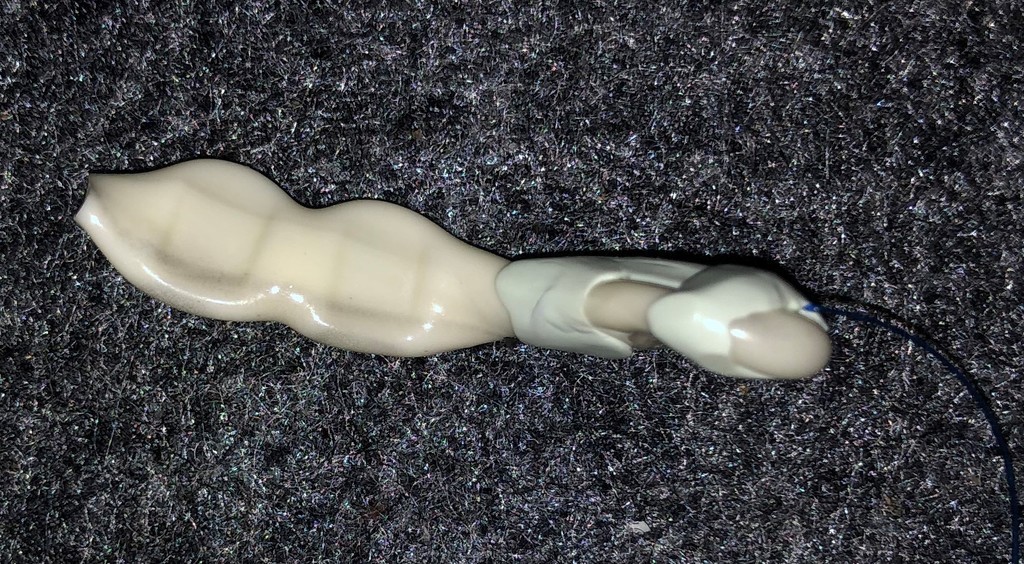
In an entry published in April 2019, a customer reported a broken thread that left the leading resin chip inside. After urinary difficulty and bleeding, the customer called 2 clinics, felt treated with suspicion, and abandoned attempts to arrange a visit.
The chip was recovered outside medical care five and a half days after the thread broke. The customer requested an additional thread, and Mr. Okada supplied a separate replacement with two threads instead of repairing the returned chip. No matching product can be confirmed on the current list.
(Source: ok-lab's diary, published April 2019)
https://ok-lab.hatenablog.com/entry/2019/04/27/153239
A stuck chip required hospital treatment when local clinics lacked tools
In an entry published in August 2022, a customer sought treatment for overlapping chips that could not be removed. 2 local urology clinics had viewing equipment but lacked forceps (grasping instruments), so they recommended a larger facility.
A large urology hospital removed the chips; the customer said the doctor did not scold them. The treatment was classified as surgery and cost about ¥8,000 (about $51 at ¥156 = $1, rate as of 2026-09-04) with insurance, with infection medicine and pain relief prescribed. The customer reported damaged urethral lining and a warning about possible changes in urination after healing. Mr. Okada cautions users about the risks of connected chips.
(Source: ok-lab's diary, published August 2022)
https://ok-lab.hatenablog.com/entry/2022/08/20/122920
A clinic referral led to ceramic fragmentation and several treatment charges
In an entry published in August 2023, a clinic said it could not remove a trapped ceramic chip and referred the customer elsewhere. The report describes fragmentation and removal, followed by five bladder washouts (flushing to clear remaining fragments).
Reported charges were ¥48,000 (about $307 at ¥156 = $1, rate as of 2026-09-04) for fragmentation and removal, plus ¥2,200 (about $14 at ¥156 = $1, rate as of 2026-09-04) × 5 for washouts. The customer stated a total of ¥59,000 (about $378 at ¥156 = $1, rate as of 2026-09-04) plus consultation fees, and reported bleeding during the washouts. The diary does not record the result of the planned follow-up examination. Mr. Okada suggests asking another doctor about fragmentation if an incision into the bladder is proposed.
(Source: ok-lab's diary, published August 2023)
https://ok-lab.hatenablog.com/entry/2023/08/05/122956
A clinic refusal preceded successful treatment at a university hospital
In an entry published in October 2023, a customer reported that a chip had entered the bladder and would not come out. A private clinic did not provide treatment and referred the customer to a university hospital. Treatment there succeeded, but the diary does not identify the method used. Mr. Okada urges caution when sharing this report.
(Source: ok-lab's diary, published October 2023)
https://ok-lab.hatenablog.com/entry/2023/10/14/122718
A small clinic completed chip removal despite initially discussing hospital referral
In an entry published in March 2024, a customer described seeking removal at a small local urology clinic. The doctor initially discussed referral to a general hospital because the device was unfamiliar.
The clinic nevertheless completed thread retrieval and chip removal in under 30 minutes, costing ¥27,000 (about $173 at ¥156 = $1, rate as of 2026-09-04). According to the customer, removal caused neither injury nor snagging, and the doctor praised the device on that basis. Mr. Okada writes that he would discuss treatment directly with a local doctor if he faced a similar problem.
(Source: ok-lab's diary, published March 2024)
https://ok-lab.hatenablog.com/entry/2024/03/02/123027
Chip removal costs included hospital admission in the confirmed follow-up
An entry published in May 2024 described a retained stainless-steel chip made by another company. OK Lab staff expected medical removal might be straightforward, but the follow-up published in June 2024 documented hospital admission.
The customer reported admission on the consultation day, general anesthesia (the diary does not explain this), and a stay of two nights and three days. The reported cost was ¥110,000 (about $704 at ¥156 = $1, rate as of 2026-09-04) with insurance, and the customer said the recorded diagnosis was narrowing of the urethra. Mr. Okada acknowledged that he could not judge why this treatment was chosen. He advises discussing treatment preferences with the doctor.
(Source: ok-lab's diary, published May 2024)
https://ok-lab.hatenablog.com/entry/2024/05/25/122919
(Source: ok-lab's diary, published June 2024)
https://ok-lab.hatenablog.com/entry/2024/06/01/123036
Successful chip removal came with a warning against returning for treatment
In an entry published in February 2025, a customer sought help after a chip and its 35cm retrieval thread disappeared inside. OK Lab staff advised following the doctor's treatment plan and providing a photograph showing the device's structure.
Removal succeeded, costing ¥25,000 (about $160 at ¥156 = $1, rate as of 2026-09-04) for surgery and about ¥35,000 (about $224 at ¥156 = $1, rate as of 2026-09-04) including scans, the initial consultation, and medicines. However, the hospital said it did not normally remove foreign objects and would refuse a repeat visit. The customer reported infection after injuries and bleeding during removal, followed by mild fever and exhaustion. Mr. Okada cautions that a stopper (a movement-limiting part) cannot guarantee protection against a chip entering the bladder.
(Source: ok-lab's diary, published February 2025)
https://ok-lab.hatenablog.com/entry/2025/02/22/122939
The maker's answer to urologist visits and chip removal costs
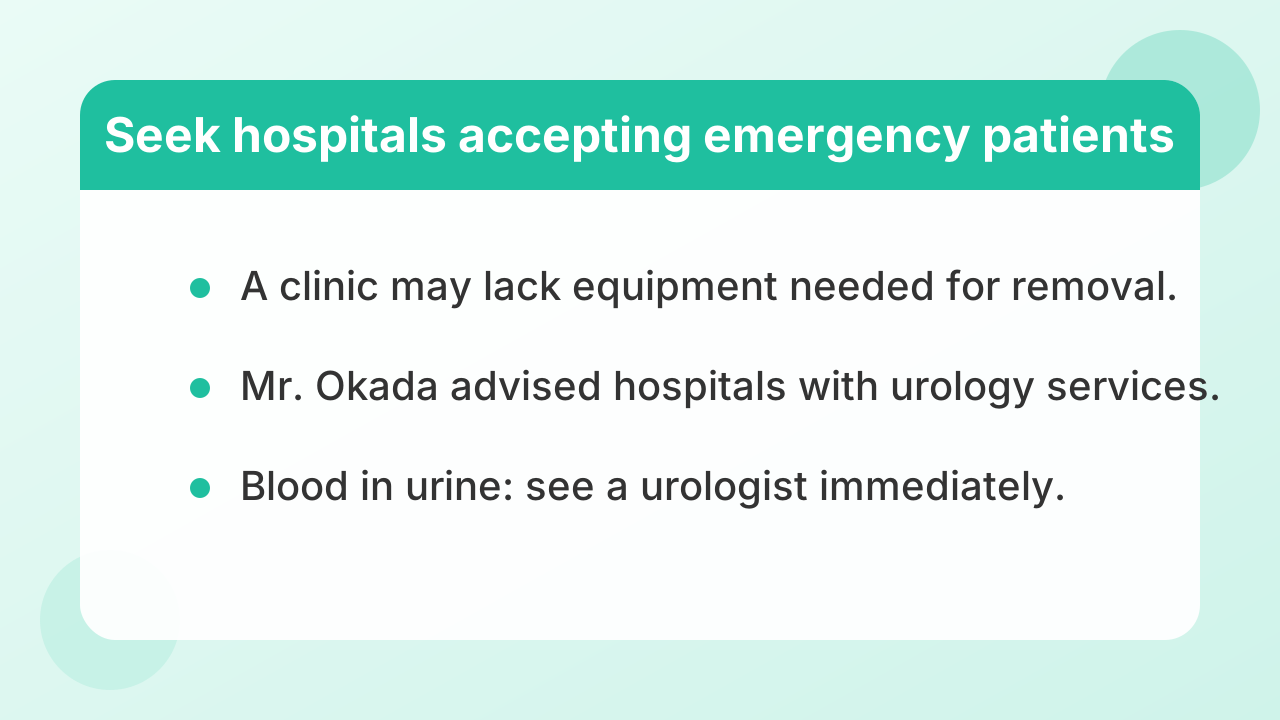
Mr. Okada's advice includes accepting medical care and recognizing that a clinic may lack the equipment needed for removal.
A urologist visit brought a warning against rough ceramic chips
In an entry published in June 2019, Mr. Okada described seeking care after testing a rough ceramic chip. He reported a diagnosis of urethral injury after developing a fever of 37.5°C. According to his account, the doctor examined the chip and repeatedly said it was dangerous and should be abandoned.
Mr. Okada continued describing its appeal but also acknowledged the injury risk. No matching product can be confirmed on the current list. His closing warning asks others not to imitate that experiment.
(Source: ok-lab's diary, published June 2019)
https://ok-lab.hatenablog.com/entry/2019/06/15/144142
The maker's urologist guidance excluded people unable to seek care
In an entry published in July 2021, Mr. Okada published draft instructions containing warnings about who should avoid the product. One warning concerned people unable to visit a urologist when they noticed urinary abnormalities. A separate warning addressed people already receiving medical treatment or experiencing physical problems. For those situations, the draft advises consultation with a doctor.
(Source: ok-lab's diary, published July 2021)
https://ok-lab.hatenablog.com/entry/2021/07/24/125923
The maker's stuck chip guidance pointed toward hospitals accepting emergencies
A separate part of the instructions published in July 2021 discussed obtaining hospital help for a retained chip. Mr. Okada wrote that private practitioners generally would not agree to removal. He described hospitals with bladder-viewing equipment as places where a retained object could be located during treatment. His advice was to seek a hospital with urology services large enough to accept emergency patients.
(Source: ok-lab's diary, published July 2021)
https://ok-lab.hatenablog.com/entry/2021/07/24/125923
If you see blood in your urine, even a small amount or for the first time, do not wait and see. See a urologist right away. If you suddenly cannot urinate, or the device cannot be removed, do not try to fix it yourself. Go to a medical facility, including emergency care, immediately.
How urologist visits and chip removal costs changed over time
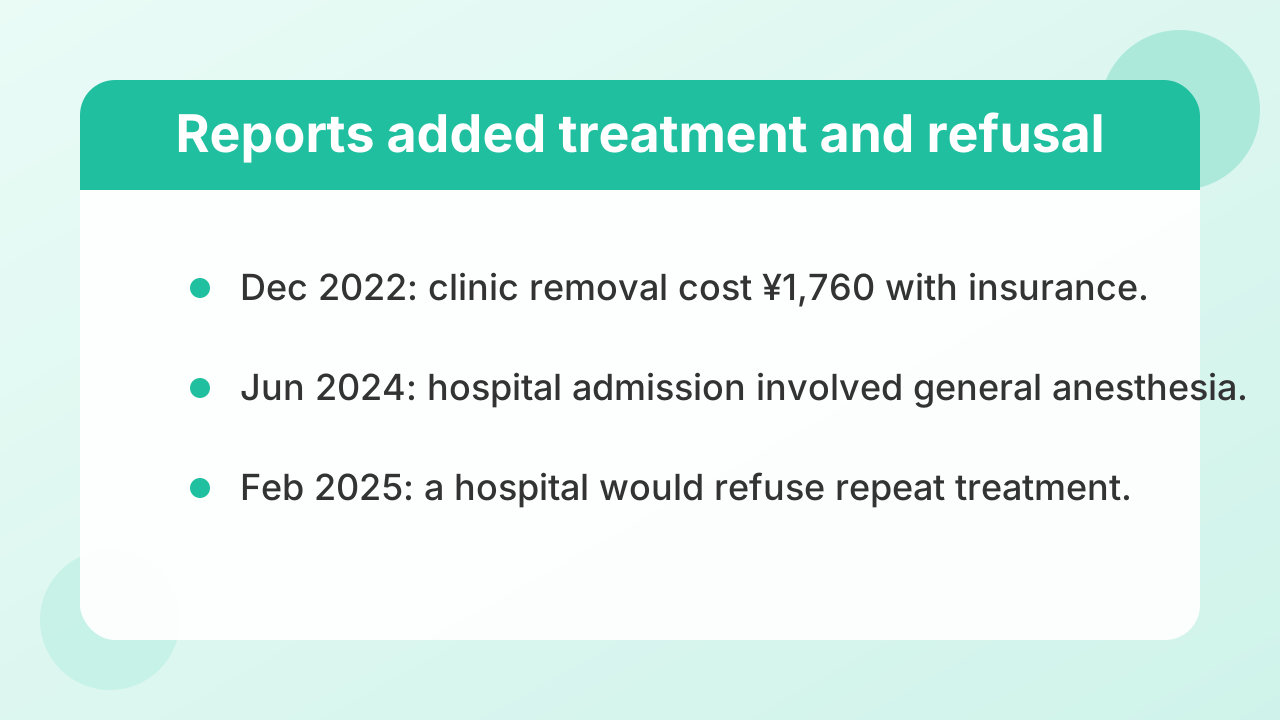
| Published | What the diary said then |
|---|---|
| Feb 2019 | A clinic lacked the rigid viewing instrument it said treatment required. |
| Apr 2019 | Suspicious telephone responses discouraged a customer from arranging clinic care. |
| Jun 2019 | A doctor warned against a rough ceramic chip after diagnosing injury. |
| Aug 2020 | Mr. Okada estimated a first consultation with medicine would cost within ¥3,000 (about $19 at ¥156 = $1, rate as of 2026-09-04). |
| Jul 2021 | Removal guidance directed users toward hospitals accepting emergency patients. |
| Aug 2022 | Local clinics lacked grasping instruments despite having viewing equipment. |
| Dec 2022 | A first-visit clinic removal cost ¥1,760 (about $11 at ¥156 = $1, rate as of 2026-09-04) under the customer's Japanese public health insurance. |
| Aug 2023 | Ceramic fragmentation and washouts brought reported charges of ¥59,000 (about $378 at ¥156 = $1, rate as of 2026-09-04) plus consultation fees. |
| Jun 2024 | A confirmed hospital admission involved general anesthesia and ¥110,000 (about $704 at ¥156 = $1, rate as of 2026-09-04) with insurance. |
| Feb 2025 | A hospital completed removal but warned it would refuse another such visit. |
The diary does not say what the current state is.
OK Prostate Chip products related to urologist visits and chip removal costs
No current product is directly tied to this topic.
Common worries about urologist visits and chip removal costs
The reader questions concern embarrassment, treatment expense, urinary problems, and whether the maker can help with a retained device.
"Will a urologist visit be embarrassing or expensive?"
In an entry published in August 2020, a customer wanted advice about urinary discomfort while avoiding an embarrassing or inconvenient visit. Mr. Okada compared a urology visit to an ordinary medical consultation.
He estimated that a first visit, including medicine, would cost within ¥3,000 (about $19 at ¥156 = $1, rate as of 2026-09-04). That was his estimate for the symptoms being discussed, rather than a recorded bill for removing a chip. The diary does not record whether this customer subsequently received a diagnosis. Mr. Okada encourages a urologist visit instead of continued worry.
(Source: ok-lab's diary, published August 2020)
https://ok-lab.hatenablog.com/entry/2020/08/08/130037
"Has anyone reported being unable to urinate after chip use?"
In an entry published in May 2022, a customer living in the United States asked whether similar urinary problems had been reported. The customer described being unable to urinate for 3–4 hours, sometimes about 10 hours, after use.
Medical expense and difficulty explaining the situation had discouraged a visit. Mr. Okada said he had not experienced this problem himself; the diary records no medical diagnosis or later clinical outcome. His reply invited other users to share similar experiences.
(Source: ok-lab's diary, published May 2022)
https://ok-lab.hatenablog.com/entry/2022/05/21/124217
"Can OK Lab help when a chip cannot be removed?"
In an entry published in December 2022, a customer asked about altering a connection because a custom chip could not be removed. Staff expressed concern about injury from that idea; a clinic subsequently removed the device without the proposed alteration. The customer reported minor injury, a week of medicine for infection, recovery, and ¥1,760 (about $11 at ¥156 = $1, rate as of 2026-09-04) in treatment costs under Japan's public National Health Insurance.
The customer had researched clinics offering surgery and brought photographs and a similar device to explain the problem. No matching product can be confirmed on the current list. OK Lab staff advised medical assessment as the safer option.
(Source: ok-lab's diary, published December 2022)
https://ok-lab.hatenablog.com/entry/2022/12/24/122944
Buying from outside Japan
OK Lab ships internationally to countries covered by Japan Post's EMS courier service. Overseas orders are paid in advance by PayPal. Each order carries a ¥400 (about $3 at ¥156 = $1, rate as of 2026-09-04) handling fee, and EMS shipping is charged on top. These terms come from OK Lab's official sales-terms page (written here as plain text, not a link: ok-lab.net/docs/law), checked on September 7, 2026; confirm them on the official store before you order, because they can change.
Summary of this article
| What you wanted to know | The answer |
|---|---|
| What is the immediate concern? | The reports include retained chips, urinary difficulty, bleeding, and clinic referrals. |
| What is this product? | A urethral device made by OK Lab in Japan; prices use Japanese yen. |
| What do the medical terms mean? | Viewing instruments examine inside the body; grasping instruments retrieve retained objects. |
| What happened at medical facilities? | Some clinics treated customers; others referred them to better-equipped hospitals. |
| What did the maker advise? | Medical consultation and access to hospitals able to handle retained devices. |
| What changed over time? | Later reports added local clinic treatment, hospital admission, and refusal of repeat treatment. |
| Is a current product tied to this question? | No current product is directly tied to this topic. |
| What worried customers? | Embarrassment, bills, difficulty urinating, and getting help when a chip remained inside. |
| How does overseas ordering work? | Advance PayPal payment, a ¥400 (about $3 at ¥156 = $1, rate as of 2026-09-04) handling fee, and additional EMS shipping. |
Source: ok-lab's diary (Okada Comfortable Life Laboratory). The original entries are in Japanese; quotations on this page are translated. Photos and videos are on the original entries.
This article is a summary of the maker's development diary. The product is not a medical device and no result is guaranteed. If anything feels wrong or worries you, see a doctor. Prices, specifications and cautions change, so confirm the latest information on the official blog and the official site. Questions about ordering and shipping go to the seller.