![Could a chip damage my bladder or require surgery? | Both risks appear in the diary [OK Prostate Chip]](/img/a/T0325/eyecatch.svg)
This page is based on entries from "ok-lab's diary" (https://ok-lab.hatenablog.com/), the Japanese development diary written by Mr. Okada, founder of OK Lab, a small company in Japan (Okada Comfortable Life Laboratory). Only the entries about "bladder damage and open surgery risk" are summarized here, in order of publication. Past prices and sizes are as written at the time. Current prices come from the official product list (retrieved September 4, 2026). Quotations are translated from Japanese.
Note: This page is a personal reading log by someone with no connection to the maker or the seller. It reflects the source entries as of their publication dates and makes no guarantee of accuracy or safety. The product is not a medical device; talk to a doctor about any health decision. Check the official site for current information. This page contains advertising.
In short
The diary records bladder injuries and warnings that chip removal could require open surgery.
Mr. Okada warns about damaged cables, glass breakage, force, and products he cannot recommend.
May 2026's report describes successful hospital removal and a clear final examination.
If you see blood in your urine, even a small amount or for the first time, do not wait and see. See a urologist right away.
If you suddenly cannot urinate, or the device cannot be removed, do not try to fix it yourself. Go to a medical facility, including emergency care, immediately.
About this product
The OK Prostate Chip is a small device that is placed in the urethra (the urine passage) so that it acts on the prostate; the maker sells it in several shapes, sizes and materials. It is made and sold by OK Lab (Okada Comfortable Life Laboratory), a small company in Japan, through its own online store, and prices are in Japanese yen (JPY).
The maker's development diary, "ok-lab's diary", is written in Japanese. This page is an English summary of it, and every quotation is translated. OK Lab ships internationally, so readers outside Japan can order (see "Buying from outside Japan" below).
Product names on this page are plain-English descriptions. The official Japanese product name is shown once in the product table so you can find the same item in the store.
Before you read: key terms
| Term | Plain-English meaning |
|---|---|
| Urethra | The urine passage; the device sits within it to act on the prostate. |
| Bladder perforation | A hole through the bladder wall; the term describes an injury feared in these reports. |
| Open surgery | An operation through the abdomen, discussed here as a way to reach and remove trapped objects. |
| Urinary catheter | A tube used for drainage or introducing fluid; the diary discusses it in hospital care. |
| Milking | The maker's name for moving a chip through pressure outside the body. |
| External urethral sphincter | A muscle ring described as gripping chips; its normal function is not explained. |
| Retrieval thread | A thread attached to the chip, intended to help recover it. |
| Endoscopy | Using an internal viewing instrument to locate objects and help remove them. |
| General anesthesia | Used for some hospital operations. The diary does not explain this. |
| Resin | Material used for chip bodies and thread attachments; its composition is not explained. |
| Forceps | Gripping instruments used to grasp objects or attached threads. |
| Stopper | A part intended to limit movement of a chip or its thread. |
What happens: bladder damage from a chip
The OK Prostate Chip is a small device placed in the urethra to act on the prostate. This worry concerns a chip or broken fragment reaching the bladder, where the diary describes injuries and difficult removals. Entries discuss bladder perforation (a hole through the bladder wall) as a possible injury, rather than recording a confirmed perforation from these chips. Open surgery (an operation through the abdomen) appears as a possible way to reach trapped objects.
Early claims about bladder damage applied to a particular placement method
An October 2017 entry discussed urinary catheters (tubes used for drainage or introducing fluid). Mr. Okada said excessive depth could injure the bladder, citing information received during hospitalization.
His discussion concerned milking (his term for moving a chip through pressure outside the body). He claimed fingers could not reach the external urethral sphincter (a muscle ring around the urethra). He therefore claimed this method would not send the chip into the bladder. Mr. Okada cautioned that no system could guarantee freedom from infection.
(Source: ok-lab's diary, published October 2017)
https://ok-lab.hatenablog.com/entry/20171010/1507618022
A coiled electrical cord required emergency open surgery, according to the diary
An October 2017 entry reproduced a news report about an electrical extension cord. Nearly 1 m of cord had entered a patient's urinary tract, followed by abdominal pain and blood in the urine. Imaging reportedly showed the cord coiled inside the bladder, preventing easy removal. The report described emergency open surgery.
(Source: ok-lab's diary, published October 2017)
https://ok-lab.hatenablog.com/entry/20171026/1508989298
A thick curved chip needed endoscopy after becoming stuck in the bladder
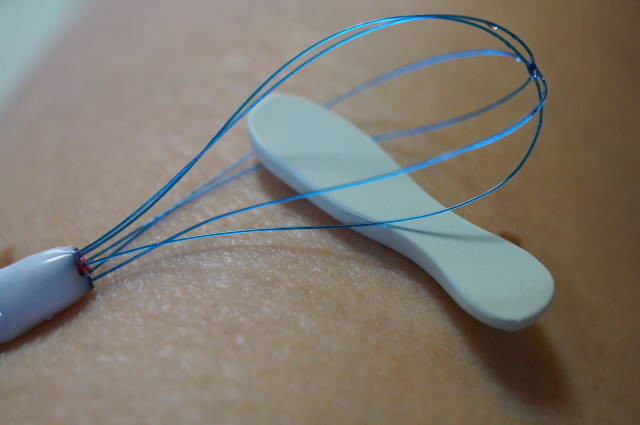
In a case published in January 2019, a curved chip entered the bladder after a stopper (a movement-limiting part) was poorly positioned. The chip had sections over 10 mm wide. The customer underwent endoscopy (treatment using an internal viewing instrument) after no spontaneous passage.
The customer warned that suitable equipment and clinicians could be difficult to find, leaving open surgery a possibility. Mr. Okada reported that clinicians recovered it by gripping its attached thread with forceps (gripping instruments). He emphasized an accessible retrieval thread (the thread attached for recovery) as a precaution.
(Source: ok-lab's diary, published January 2019)
https://ok-lab.hatenablog.com/entry/2019/01/26/152042
A double-twist chip stuck in the bladder required medical removal
In an April 2022 entry, a customer could not recover a double-twist ceramic chip despite earlier successful recoveries. The customer described bleeding, leakage, and intense sensations of incomplete emptying. A clinician reportedly found it lying to one side of the bladder, misaligned with the urethra.
The doctor warned that endoscopy would not necessarily make removal easy and that open surgery might be needed. The chip was removed without reported open surgery; the customer reported costs of about ¥8,000 (about $51 at ¥156 = $1, rate as of 2026-09-04), including antibiotics. Mr. Okada questioned internal stoppers for people whose stoppers passed the muscle ring easily, favoring an external stopper instead.
(Source: ok-lab's diary, published April 2022)
https://ok-lab.hatenablog.com/entry/2022/04/02/123050
A broken ceramic chip prompted conflicting plans for open surgery
A March 2024 entry reported successful removal of a broken ceramic chip at the fifth hospital. Mr. Okada described the fragment as approximately 25 mm long, 10 mm wide, and 5 mm thick. Earlier hospitals reportedly proposed open surgery or a special operation under general anesthesia (not explained in the diary).
The eventual removal used forceps. Mr. Okada acknowledged that his own attempted retrieval prototype was not ready for safe use. He said the experience strengthened his commitment to preventing chips from entering the bladder.
(Source: ok-lab's diary, published March 2024)
https://ok-lab.hatenablog.com/entry/2024/03/23/122837
Hospital removal of a chip stuck inside ended with clear follow-up findings
In an entry published in May 2026, a customer visiting from outside Japan reported hospital removal of a chip from the bladder. Treatment involved lower-body anesthesia through a spinal injection, about 30 minutes of surgery, and 2 nights and 3 days in hospital. Doctors reportedly discussed laser cutting if removal proved difficult, with abdominal access if the bladder wall was injured.
The customer reported temporary breathing difficulty and painful catheter drainage overnight afterward. The customer received 1 week of antibiotics; a follow-up reported a clear final examination. Mr. Okada expressed relief at the successful removal.
(Source: ok-lab's diary, published May 2026)
https://ok-lab.hatenablog.com/entry/2026/05/30/122914
The maker's answer to bladder damage from a chip
Mr. Okada acknowledged limitations in his proposed safeguards alongside restrictions and warnings.
Bladder damage concerns led Mr. Okada to withhold a product
In October 2017, Mr. Okada wrote that a product he had tested had no planned release. He considered its potential to injure the urethra or bladder unacceptable. His stated policy was that products capable of injuring the bladder should not be sold.
(Source: ok-lab's diary, published October 2017)
https://ok-lab.hatenablog.com/entry/20171022/1508644866
An old recovery proposal included a warning about bladder damage
In March 2018, Mr. Okada described a straw-based approach to a trapped chip. He warned that excessive air could reach and inflate the bladder. He added that further inflation might cause it to rupture. The entry also named urological care when recovery failed.
(Source: ok-lab's diary, published March 2018)
https://ok-lab.hatenablog.com/entry/20180304/1520151387
Stronger thread attachments raised a different concern about bladder damage
In May 2018, Mr. Okada proposed reinforcing thread attachments with instant adhesive. The published additional charge was ¥1,000 (about $6 at ¥156 = $1, rate as of 2026-09-04) excluding tax.
He warned that force applied to a large trapped chip could seriously injure the bladder or urethra. In his view, a thread attachment that released under excessive force might provide some protection. He therefore cautioned that reinforcement could introduce another injury risk by preventing that release.
(Source: ok-lab's diary, published May 2018)
https://ok-lab.hatenablog.com/entry/20180513/1526181573
Cable damage left a chip stuck after repeated repair failures
In an entry published in November 2020, Mr. Okada described a custom chip whose silicone covering had repeatedly peeled away despite repairs. The customer used it with the covering missing; its wire broke, and the chip entered the bladder. Clinicians reportedly could not grip it, and another attempt under general anesthesia was planned, with open surgery a possibility.
An update dated November 15 reported that the customer recovered the chip independently the day after publication. The diary does not record the planned operation taking place. Mr. Okada warned against using cables with exposed wires, which he said would inevitably break through repeated stress or corrosion.
(Source: ok-lab's diary, published November 2020)
https://ok-lab.hatenablog.com/entry/2020/11/14/131426
The retrieval prototype for a chip stuck inside remained untested
In July 2021, Mr. Okada introduced a prototype for capturing slippery bladder objects. It used 6 threads, but he explicitly said no insertion test in the bladder had occurred. He proposed custom orders only, with no general retail release planned.
Mr. Okada believed visual guidance through endoscopy would help a clinician use it. He cautioned that recovery without that view would be difficult because the gripping position could not be seen.
(Source: ok-lab's diary, published July 2021)
https://ok-lab.hatenablog.com/entry/2021/07/31/125702
If you see blood in your urine, even a small amount or for the first time, do not wait and see. See a urologist right away.
If you suddenly cannot urinate, or the device cannot be removed, do not try to fix it yourself. Go to a medical facility, including emergency care, immediately.
How bladder damage from a chip changed over time
| Published | What the diary said then |
|---|---|
| Oct 2017 | A tested product was withheld over injury concerns. |
| Mar 2018 | An air-based recovery proposal included a possible bladder rupture warning. |
| Apr 2018 | A modified long chip remained inside painfully before passing. |
| May 2018 | Stronger thread attachment raised concerns about force-related injury. |
| Jan 2019 | A thick curved chip required endoscopic removal. |
| Nov 2020 | Cable failure prompted an explicit warning against exposed wires. |
| Apr 2022 | Sideways positioning complicated recovery despite an attached stopper. |
| Mar 2024 | A ceramic fragment was removed after hospitals proposed different approaches. |
| Jun 2024 | A follow-up confirmed hospitalization and general anesthesia for endoscopic removal. |
| May 2026 | A later hospital removal ended with a clear final examination. |
OK Prostate Chip products related to bladder damage from a chip
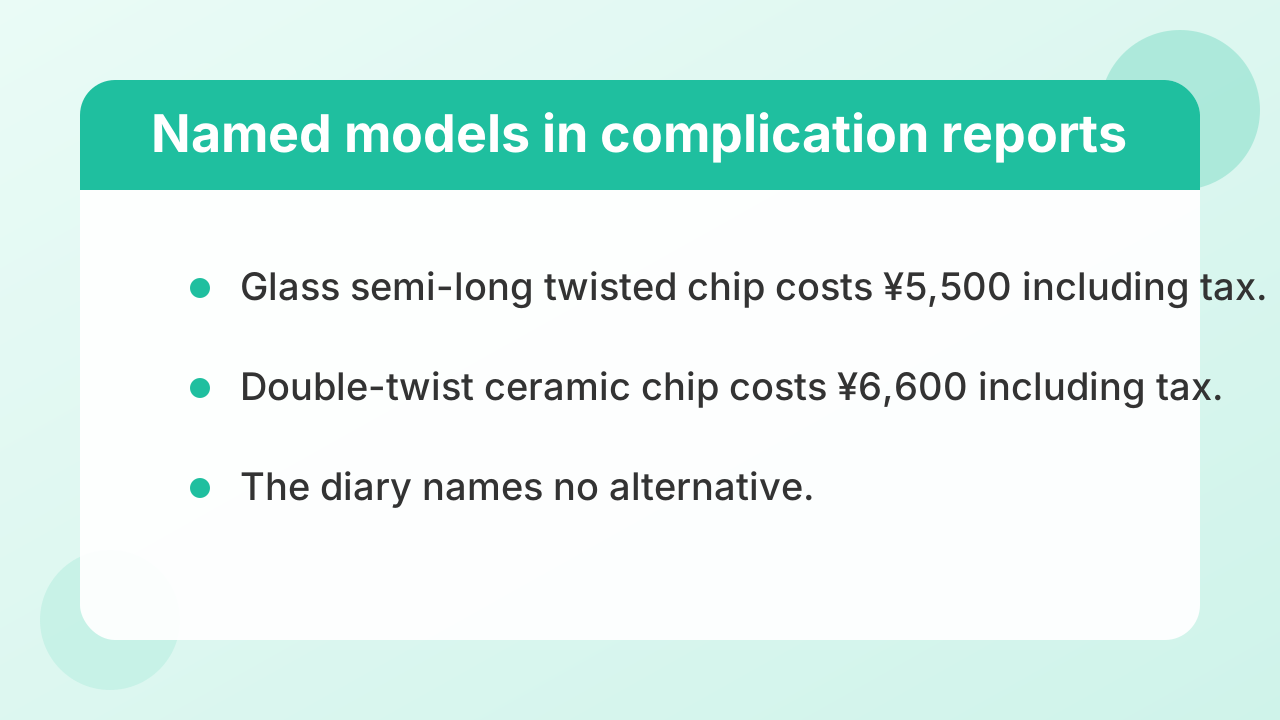
The current list includes named models involved in complication reports.
Products that appear in these entries
| Product (official name) | Price incl. tax | Relation to this topic |
|---|---|---|
| Glass semi-long twisted chip (OKプロステートチップ ガラス素材セミロングタイプ コブラツイスト) | ¥5,500 (about $35 at ¥156 = $1, rate as of 2026-09-04) | A January 2019 customer reported this model breaking and requested a replacement choice. |
| Double-twist ceramic chip (OKプロステートチップ 陶器素材覚醒タイプ ダブルツイスト(ラブカチップ)) | ¥6,600 (about $42 at ¥156 = $1, rate as of 2026-09-04) | An April 2022 customer required medical removal of this model from the bladder. |
(Source: ok-lab's diary, published January 2019)
https://ok-lab.hatenablog.com/entry/2019/01/26/152042
(Source: ok-lab's diary, published April 2022)
https://ok-lab.hatenablog.com/entry/2022/04/02/123050
Products the diary mentioned as alternatives
The diary names no alternative.
Historical builds: modified long chip, curved chip, custom cable chip, reinforced attachment, and retrieval prototype.
No matching product can be confirmed on the current list.
Common worries about bladder damage from a chip
Customers sought help with product choices, attachment materials, and complications.
"Will the maker disclose resin details after a chip gets stuck?"
An April 2018 entry shared a modified long chip accident and the customer's question about the maker's resin (attachment material). An adhesive connection had failed, leaving the chip inside the bladder with dull pain during urination until it passed after 1 week. The customer feared bladder perforation; no perforation diagnosis was reported.
Mr. Okada acknowledged the danger but declined to identify the resin, citing advice about protecting manufacturing knowledge. The customer also reported dark deposits, wondering whether these might precede stone formation. Mr. Okada advised against buying long chips without accepting that hospital treatment might become necessary.
(Source: ok-lab's diary, published April 2018)
https://ok-lab.hatenablog.com/entry/20180407/1523090115
"Can I change my order after bladder damage from a chip?"
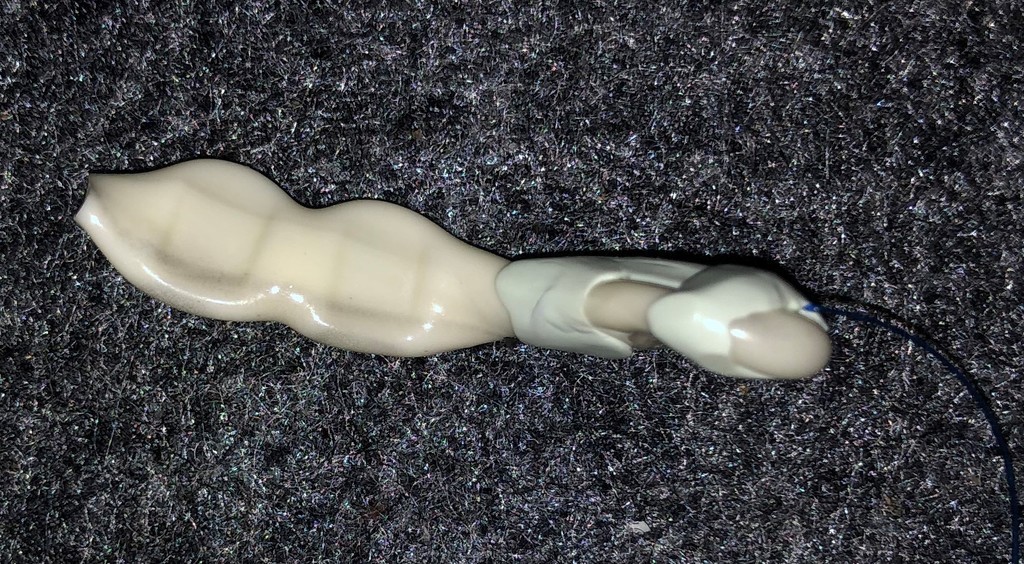
In an entry published in January 2019, a customer requested a plain glass chip after a semi-long twisted glass chip broke internally. February 2019's follow-up identified the broken chip as 42 mm, with 24 cm thread, and described its sharp tip.
The customer sought care after 1 week; a later bladder examination found extensive lining damage but no remaining fragment. The customer presumed unnoticed passage and feared perforation despite reporting no blood in the urine. The diary does not record whether the requested order change was completed. Mr. Okada apologized and suggested resin chips for people worried about glass breakage.
(Source: ok-lab's diary, published January 2019)
https://ok-lab.hatenablog.com/entry/2019/01/26/152042
(Source: ok-lab's diary, published February 2019)
https://ok-lab.hatenablog.com/entry/2019/02/02/153358
"Can you help with another maker's chip stuck inside?"
In an entry published in May 2024, a customer requested advice after another company's stainless steel chip lost its thread connection. Staff initially suggested spontaneous passage might occur; the customer subsequently reported hospital removal by endoscopy. The chip measured 10 mm wide and 30 mm long, and doctors had discussed an incision if necessary.
The confirmed follow-up, published in June 2024, reported general anesthesia, 2 nights and 3 days in hospital, and ¥110,000 (about $704 at ¥156 = $1, rate as of 2026-09-04) with insurance applied. Mr. Okada said this was the first hospitalization for endoscopic chip removal reported to him. He offered information about a doctor previously identified by a customer, subject to that customer's permission, while declining to judge which treatment was right.
(Source: ok-lab's diary, published May 2024)
https://ok-lab.hatenablog.com/entry/2024/05/25/122919
(Source: ok-lab's diary, published June 2024)
https://ok-lab.hatenablog.com/entry/2024/06/01/123036
Buying from outside Japan
OK Lab ships internationally to countries covered by Japan Post's EMS courier service. Overseas orders are paid in advance by PayPal. Each order carries a ¥400 (about $3 at ¥156 = $1, rate as of 2026-09-04) handling fee, and EMS shipping is charged on top. These terms come from OK Lab's official sales-terms page (written here as plain text, not a link: ok-lab.net/docs/law), checked on September 7, 2026; confirm them on the official store before you order, because they can change.
Summary of this article
| What you wanted to know | The answer |
|---|---|
| What is the main worry? | The diary records bladder injuries and warnings about possible open surgery. |
| What is this product? | A urethral device from OK Lab in Japan. |
| What do the key terms mean? | Perforation concerns bladder wall damage; endoscopy and open surgery concern hospital investigation or treatment. |
| What happened in the cases? | Broken, detached, or trapped objects led to painful symptoms and sometimes hospital removal. |
| What did the maker propose? | Restrictions, warnings, and proposed safeguards with limitations. |
| What changed over time? | Later reports added difficult removals, hospitalization, and follow-up outcomes. |
| Which current products appear? | Glass semi-long twisted and double-twist ceramic models, both in complication reports. |
| What did customers ask? | About attachment resin, changing an order after injury, and help with another company's trapped chip. |
| How does overseas buying work? | Advance PayPal payment, a ¥400 (about $3 at ¥156 = $1, rate as of 2026-09-04) handling fee, and EMS postage. |
Source: ok-lab's diary (Okada Comfortable Life Laboratory). The original entries are in Japanese; quotations on this page are translated. Photos and videos are on the original entries.
This article is a summary of the maker's development diary. The product is not a medical device and no result is guaranteed. If anything feels wrong or worries you, see a doctor. Prices, specifications and cautions change, so confirm the latest information on the official blog and the official site. Questions about ordering and shipping go to the seller.