![Has My Chip Entered the Bladder? | Lost Sensation Cannot Confirm Its Position [OK Prostate Chip]](/img/a/T0328/eyecatch.svg)
This page is based on entries from "ok-lab's diary" (https://ok-lab.hatenablog.com/), the Japanese development diary written by Mr. Okada, founder of OK Lab, a small company in Japan (Okada Comfortable Life Laboratory). Only the entries about "recognizing bladder entry when sensation disappears" are summarized here, in order of publication. Past prices and sizes are as written at the time. Current prices come from the official product list (retrieved September 4, 2026). Quotations are translated from Japanese.
Note: This page is a personal reading log by someone with no connection to the maker or the seller. It reflects the source entries as of their publication dates and makes no guarantee of accuracy or safety. The product is not a medical device; talk to a doctor about any health decision. Check the official site for current information. This page contains advertising.
In short
Diary reports describe chips entering the bladder with little warning or a sudden loss of sensation.
Mr. Okada discusses thread length and stoppers, but his replies cannot confirm an individual chip's position.
The latest supplied reply, published in August 2026, still describes position as an estimate.
If you see blood in your urine, even a small amount or for the first time, do not wait and see. See a urologist right away.
If you suddenly cannot urinate, or the device cannot be removed, do not try to fix it yourself. Go to a medical facility, including emergency care, immediately.
About this product

The OK Prostate Chip is a small device that is placed in the urethra (the urine passage) so that it acts on the prostate; the maker sells it in several shapes, sizes and materials. It is made and sold by OK Lab (Okada Comfortable Life Laboratory), a small company in Japan, through its own online store, and prices are in Japanese yen (JPY). The maker's development diary, "ok-lab's diary", is written in Japanese. This page is an English summary of it, and every quotation is translated. OK Lab ships internationally, so readers outside Japan can order (see "Buying from outside Japan" below). Product names on this page are plain-English descriptions. The official Japanese product name is shown once in the product table so you can find the same item in the store.
Before you read: key terms
| Term | Plain-English meaning |
|---|---|
| Urethra | The urine passage; the chip occupies this passage to act on the prostate. |
| Prostate | The intended target of stimulation. The diary does not explain its bodily function. |
| Bladder | The urine-holding organ; the destination described in the bladder-entry reports. |
| Internal urethral sphincter | The prostate–bladder muscle boundary in Mr. Okada's account; a reference for interpreting sensations. |
| External urethral sphincter | The first muscle barrier in his account; a reference for estimating position. |
| Stopper | An extra part intended to limit movement of the chip or thread. |
| Screw-shaped auxiliary chip | An attached support part discussed as a possible way to limit migration. |
| Cystoscope | An instrument used for examination and removal in the hospital reports. |
| CT | A hospital test named in the May 2025 report. The diary does not explain this. |
What happens: signs a chip has entered the bladder
The OK Prostate Chip is a urethral device intended to stimulate the prostate. The diary uses bladder entry to describe a chip moving farther inward than its intended position around the prostate. This topic concerns recognizing that movement, especially when the device seems to disappear from awareness. Mr. Okada discusses changes in sensation, remaining thread and attached parts as clues, while reporting uncertainty about individual cases.
A disappearing chip left its bladder position uncertain in February 2018
In an entry published in February 2018, a customer outside Japan described a single-chip glass model ordered in a 20cm version. Its thread vanished, sensation stopped, and the customer wondered whether it had entered the bladder.
The device subsequently passed during urination. Mr. Okada could not tell whether it had merely crossed a muscle barrier or entered the bladder completely. He proposed a stopper to limit how much thread could disappear.
(Source: ok-lab's diary, published February 2018)
https://ok-lab.hatenablog.com/entry/20180224/1519457027
A reversed long chip strengthened the maker's warning about unnoticed bladder entry
In an entry published in May 2018, Mr. Okada described an extra-large long chip recovered facing the opposite direction. The customer had mistaken the problem for a snag; forceful pulling tore away the thread with surrounding resin.
The chip was eventually recovered after several days. Mr. Okada interpreted its 180-degree reversal as evidence that the whole device had entered the bladder. His warning was that sudden loss of sensation could signal complete bladder entry without obvious pain.
(Source: ok-lab's diary, published May 2018)
https://ok-lab.hatenablog.com/entry/20180505/1525509161
Returning sensation did not rule out a chip in the bladder
A separate entry published in May 2018 described a custom medium-length chip whose thread detached. The customer temporarily lost awareness of the device, then felt it again.
Hospital examination later found the chip in the bladder. The report corrected the customer's earlier interpretation of the returning sensation. The device was removed, the customer reported recovery, and Mr. Okada declined further comment.
(Source: ok-lab's diary, published May 2018)
https://ok-lab.hatenablog.com/entry/20180511/1526036007
The curved tail offered another clue to lost chip position
In an entry published in March 2019, Mr. Okada described the curved tail of the version 2 vibrating chip. He wrote that this tail remained externally noticeable after the main body crossed the muscle barrier.
He associated complete loss of that touch sensation with bladder entry. He presented this as a design-specific clue.
(Source: ok-lab's diary, published March 2019)
https://ok-lab.hatenablog.com/entry/2019/03/23/173222
Disappearing resistance and thread raised concern about bladder entry during use
In an entry published in September 2020, a customer described a short twisted ceramic chip with a screw-shaped auxiliary chip. Pain and resistance disappeared, while almost all the exposed thread vanished.
The customer suspected bladder entry and also reported severe pain during urination and some bleeding. Mr. Okada discussed differences in sensation, but the diary does not record a medically confirmed position. His reply also considered adding a stopper possible.
(Source: ok-lab's diary, published September 2020)
https://ok-lab.hatenablog.com/entry/2020/09/19/123115
A chip that disappeared overnight required hospital removal from the bladder
In an entry published in December 2021, a customer woke without the usual awareness of a fully internal custom device. OK Lab initially doubted that the rear attachment had also entered the bladder.
The customer later reported hospital confirmation that the entire assembly was inside. Removal with a cystoscope (the instrument used during the hospital procedure) took about 10 minutes and cost more than ¥30,000 (about $192 at ¥156 = $1, rate as of 2026-09-04). OK Lab's replies also identified medical care as a safer option.
(Source: ok-lab's diary, published December 2021)
https://ok-lab.hatenablog.com/entry/2021/12/25/123556
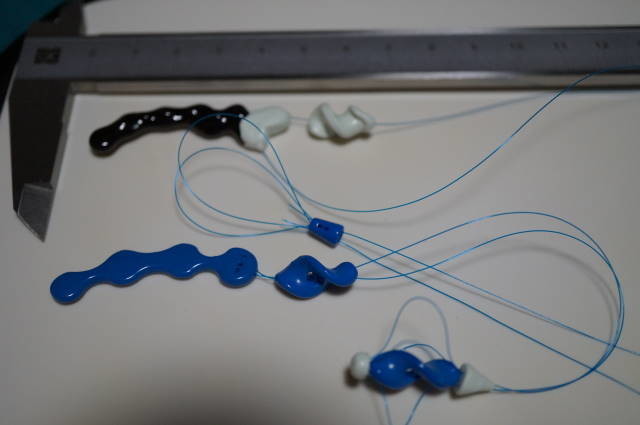
Unnoticed bladder entry prompted an S-shaped curve in the completed design
In an entry published in August 2024, a customer asked about an entirely internal version of a long arc-shaped chip. Mr. Okada linked his concern to tests in which similar curved devices advanced farther without noticeable sensation.
He said this finding had prompted the reverse curve in his completed S-shaped design (Alien). He was reluctant to provide the requested entirely internal version without external control.
(Source: ok-lab's diary, published August 2024)
https://ok-lab.hatenablog.com/entry/2024/08/17/122842
The maker's answer to signs a chip has entered the bladder
Mr. Okada's proposed position clues remained estimates throughout the later replies.
Disappearing thread prompted concern about bladder entry in January 2019
In an entry published in January 2019, a customer asked why standing caused the remaining thread to disappear. Mr. Okada thought 5cm of inward movement probably indicated bladder entry.
The diary does not record whether the suggested changes resolved this customer's problem. His reply favored a longer thread and discussed stopper options.
(Source: ok-lab's diary, published January 2019)
https://ok-lab.hatenablog.com/entry/20190112/1547275441
An unfindable attachment became another proposed clue to chip position
In an entry published in May 2021, a customer asked whether unusual urinary sensations meant the device had entered the bladder. Mr. Okada's answer assumed a 3-4 cm gap between the main chip and an attached stopper or screw-shaped auxiliary chip.
He thought an unfindable attachment in that arrangement could mean the tip had entered the bladder. The diary does not record a confirmed position. He presented the attachment as a possible clue to location.
(Source: ok-lab's diary, published May 2021)
https://ok-lab.hatenablog.com/entry/2021/05/29/125928
Lost chip sensation alone could not settle the question by November 2022
An entry published in November 2022 answered a customer whose initial sharp sensation had faded. Mr. Okada wrote that sensation alone could not establish bladder entry, although a small chip might become unnoticeable after entering completely.
His thread comparison used the external urethral sphincter (the first muscle barrier in his explanation) as its reference. He associated 5cm or more of further movement with likely bladder entry. His answer proposed remaining thread length as another clue.
(Source: ok-lab's diary, published November 2022)
https://ok-lab.hatenablog.com/entry/2022/11/05/122757
Resistance to removal still left chip position uncertain in August 2026
In an entry published in August 2026, a customer asked whether resistance to removal meant correct placement. Mr. Okada said both correct placement and complete bladder entry could produce resistance.
His estimates began at initial sphincter contact: about 50mm farther suggested the prostate area, while 100mm suggested likely bladder entry. These were his estimates; the entry did not establish this customer's position. His answer again favored remaining thread length as a clue.
(Source: ok-lab's diary, published August 2026)
https://ok-lab.hatenablog.com/entry/2026/08/08/122906
If you see blood in your urine, even a small amount or for the first time, do not wait and see. See a urologist right away.
If you suddenly cannot urinate, or the device cannot be removed, do not try to fix it yourself. Go to a medical facility, including emergency care, immediately.
How signs a chip has entered the bladder changed over time
| Published | What the diary said then |
|---|---|
| Apr 2019 | Mr. Okada reported barely noticing a detached prototype tip pass during urination. |
| Apr 2021 | Mr. Okada suggested weak response to prostate stimulation as another possible explanation if the chip had been easily removed; the material does not record whether it was. |
| Nov 2021 | Mr. Okada declined to endorse deliberate bladder placement because its effects were uncertain. |
| Dec 2021 | Mr. Okada said an internal stopper could cross the muscle barrier and lose its function. |
| Feb 2022 | Mr. Okada discouraged bladder vibration after describing entry with barely noticeable resistance. |
| Mar 2024 | Mr. Okada reported unnoticed slow movement as sensations faded during his own tests. |
| May 2025 | A customer's gap between opening and stopper changed from 5cm to 0cm overnight. |
OK Prostate Chip products related to signs a chip has entered the bladder
Current listings include chips involved in reports and stoppers discussed as possible safeguards.
Products that appear in these entries
| Product (official name) | Price incl. tax | Relation to this topic |
|---|---|---|
| Single-chip glass model (OKプロステートチップ ガラス素材1チップタイプ) | ¥3,300 (about $21 at ¥156 = $1, rate as of 2026-09-04) | The February 2018 customer reported losing awareness of a single-chip glass model. |
| Cross-jointed resin model (OKプロステートチップ 樹脂素材クロスジョイント連結タイプ) | ¥4,400 (about $28 at ¥156 = $1, rate as of 2026-09-04) | The March 2019 customer lost track of its thread and asked about medical help. |
| Short twisted ceramic chip (OKプロステートチップ 陶器素材ショートタイプ ツイスト) | ¥4,400 (about $28 at ¥156 = $1, rate as of 2026-09-04) | The September 2020 customer reported disappearing resistance and thread while using this chip. |
| Screw-shaped auxiliary chip option (スクリュー型補助チップ追加オプション) | ¥3,300 (about $21 at ¥156 = $1, rate as of 2026-09-04) | The September 2020 report involved this attachment alongside the short twisted ceramic chip. |
(Source: ok-lab's diary, published February 2018)
https://ok-lab.hatenablog.com/entry/20180224/1519457027
(Source: ok-lab's diary, published March 2019)
https://ok-lab.hatenablog.com/entry/2019/03/23/173222
(Source: ok-lab's diary, published September 2020)
https://ok-lab.hatenablog.com/entry/2020/09/19/123115
Products the diary mentioned as alternatives
| Product (official name) | Price incl. tax | Relation to this topic |
|---|---|---|
| Thread-retention stopper (OKプロステートチップ用糸飲み込み防止ストッパーチップ) | ¥550 (about $4 at ¥156 = $1, rate as of 2026-09-04) | In March 2019, OK Lab suggested this external stopper to keep thread outside during bladder entry. |
| Three-hole external stopper (三穴方式オプションチップ(亀頭外側ストッパーチップ)) | ¥1,100 (about $7 at ¥156 = $1, rate as of 2026-09-04) | In March 2019, OK Lab named this other external option for preventing the thread from disappearing. |
| Three-hole sphincter stopper (三穴方式オプションチップ(括約筋ストッパーチップ)) | ¥1,650 (about $11 at ¥156 = $1, rate as of 2026-09-04) | In March 2019, OK Lab distinguished this option as intended to limit the chip's inward movement. |
(Source: ok-lab's diary, published March 2019)
https://ok-lab.hatenablog.com/entry/2019/03/23/173222
Historical custom builds, the version 2 vibrating chip and S-shaped design: No matching product can be confirmed on the current list.
Common worries about signs a chip has entered the bladder
The replies address lost sensation, vanished thread and hospital care with varying certainty.
"Does a sharp feeling mean my chip entered the bladder?"
In an entry published in January 2019, a customer asked what a brief piercing feeling followed by little awareness meant. Mr. Okada associated it with the internal urethral sphincter (the muscle boundary he describes between prostate and bladder).
He suspected further movement meant bladder entry. The diary does not record a later outcome for this question. He suggested a sphincter stopper.
(Source: ok-lab's diary, published January 2019)
https://ok-lab.hatenablog.com/entry/20190112/1547275441
"Does a disappearing chip mean medical help is needed?"
In an entry published in March 2019, a cross-jointed resin chip customer could no longer find the thread's end and asked about medical help. Mr. Okada thought inability to feel the chip externally meant at least half had entered the bladder.
The customer later reported that the device had passed during urination. OK Lab then suggested external thread stoppers and an internal stopper serving a different purpose.
(Source: ok-lab's diary, published March 2019)
https://ok-lab.hatenablog.com/entry/2019/03/23/173222
"Does losing chip sensation mean a larger model would help?"
In an entry published in January 2020, a customer asked about buying a longer model after losing sensation with a homemade device. Mr. Okada suspected bladder entry and linked dull pain during removal to passage through the internal muscle boundary.
He said a larger chip could also migrate. The diary does not record a subsequent purchase or medical finding. He favored a sphincter stopper and mentioned possible benefit from a screw-shaped auxiliary chip.
(Source: ok-lab's diary, published January 2020)
https://ok-lab.hatenablog.com/entry/2020/01/04/155235
"What happened when a wire-only chip disappeared completely?"
In an entry published in May 2025, a customer sought help locating a custom wire-only device. The maker's initial reply assumed part remained accessible, but later information showed that its thread had also vanished. Mr. Okada estimated the supplied thread was about 25cm long.
The customer reported complete bladder entry and hospital removal by cystoscope after CT (an unexplained hospital test) and urine testing. The visit, including waiting, lasted about 5 hours and cost ¥34,000 (about $218 at ¥156 = $1, rate as of 2026-09-04). Once deeper migration was suspected, OK Lab's reply directed the customer toward medical care.
(Source: ok-lab's diary, published May 2025)
https://ok-lab.hatenablog.com/entry/2025/05/03/122907

Buying from outside Japan

OK Lab ships internationally to countries covered by Japan Post's EMS courier service. Overseas orders are paid in advance by PayPal. Each order carries a ¥400 (about $3 at ¥156 = $1, rate as of 2026-09-04) handling fee, and EMS shipping is charged on top. These terms come from OK Lab's official sales-terms page (written here as plain text, not a link: ok-lab.net/docs/law), checked on September 7, 2026; confirm them on the official store before you order, because they can change.
Summary of this article
| What you wanted to know | The answer |
|---|---|
| What is the main concern? | The diary describes unnoticed bladder entry and uncertainty about interpreting sensation. |
| What is this product? | A urethral device made by OK Lab in Japan; prices are in JPY. |
| What do the key terms mean? | Thread, stoppers and muscle boundaries appear in the maker's explanations of position. |
| What happened in the reports? | Some devices passed; other cases ended in hospital removal. |
| What was the maker's answer? | He discussed thread and attachment clues without confirming each customer's position. |
| What changed over time? | Reports added uncertain sensations, stopper limitations and unnoticed movement during sleep. |
| Which current products are related? | The tables identify reported chips and the stopper options named in the diary. |
| What did customers ask? | Whether lost sensation, a vanished thread or removal resistance meant bladder entry. |
| How do overseas orders work? | Advance PayPal payment, a ¥400 (about $3 at ¥156 = $1, rate as of 2026-09-04) handling fee and additional EMS shipping apply. |
Source: ok-lab's diary (Okada Comfortable Life Laboratory). The original entries are in Japanese; quotations on this page are translated. Photos and videos are on the original entries.
This article is a summary of the maker's development diary. The product is not a medical device and no result is guaranteed. If anything feels wrong or worries you, see a doctor. Prices, specifications and cautions change, so confirm the latest information on the official blog and the official site. Questions about ordering and shipping go to the seller.