![Prostate chip stuck inside? | Hospital removal may be needed [OK Prostate Chip]](/img/a/T0330/eyecatch.svg)
This page is based on entries from "ok-lab's diary" (https://ok-lab.hatenablog.com/), the Japanese development diary written by Mr. Okada, founder of OK Lab, a small company in Japan (Okada Comfortable Life Laboratory). Only the entries about "hospital removal of a stuck chip" are summarized here, in order of publication. Past prices and sizes are as written at the time. Current prices come from the official product list (retrieved September 4, 2026). Quotations are translated from Japanese.
Note: This page is a personal reading log by someone with no connection to the maker or the seller. It reflects the source entries as of their publication dates and makes no guarantee of accuracy or safety. The product is not a medical device; talk to a doctor about any health decision. Check the official site for current information. This page contains advertising.
In short
Stuck chips have required hospital removal, sometimes with admission and anesthesia.
The maker emphasizes retrieval-thread security, damaged-cable warnings, and the limits of stoppers.
The May 2026 hospital report records successful removal and a clear final checkup.
If you see blood in your urine, even a small amount or for the first time, do not wait and see. See a urologist right away. If you suddenly cannot urinate, or the device cannot be removed, do not try to fix it yourself. Go to a medical facility, including emergency care, immediately.
About this product

The OK Prostate Chip is a small device that is placed in the urethra (the urine passage) so that it acts on the prostate; the maker sells it in several shapes, sizes and materials. It is made and sold by OK Lab (Okada Comfortable Life Laboratory), a small company in Japan, through its own online store, and prices are in Japanese yen (JPY). The maker's development diary, "ok-lab's diary", is written in Japanese. This page is an English summary of it, and every quotation is translated. OK Lab ships internationally, so readers outside Japan can order (see "Buying from outside Japan" below). Product names on this page are plain-English descriptions. The official Japanese product name is shown once in the product table so you can find the same item in the store.
Before you read: key terms
| Term | Plain-English meaning |
|---|---|
| Urethra | The urine passage; the diary describes chips becoming stuck there. |
| Retrieval thread | A thread attached to a chip, intended to help retrieve it. |
| Auxiliary chip | An additional chip connected to the main chip; screw-shaped versions were also intended to resist inward movement. |
| Stopper | An added part intended to limit inward movement; the diary records failures. |
| Endoscope / cystoscope | Viewing instruments used inside the urinary tract during examinations and chip removal. |
| Forceps | Grasping instruments used by clinicians during removal. |
| General anesthesia | Used during the June 2024 hospital operation. The diary does not explain this. |
| Shape-memory wire | Wire that returns toward its original shape; used in reinforcement and flexible designs. |
| Epoxy resin | A coating material used over the wire-reinforced ceramic prototype. |
What happens: prostate chip removal
The OK Prostate Chip is a small device placed in the urethra to act on the prostate. Hospital removal concerns a chip, attached part, or broken fragment that the customer could not retrieve. These reports describe objects remaining in the urine passage or entering the bladder, with treatment intended to remove the retained object. Attached threads and stoppers feature repeatedly, including cases where they detached, moved inward, or failed to prevent trouble.
Hospital removal followed a tangled pair of chips in March 2018
In an entry published in March 2018, a customer reported hospital removal after two connected chips became tangled near the prostate. Mr. Okada called this his first such report; further clinical details were unavailable.
He changed future paired designs to a leading chip at least 30 mm long. Mr. Okada cautioned that even this length might still allow the chip to turn.
(Source: ok-lab's diary, published March 2018)
https://ok-lab.hatenablog.com/entry/20180310/1520672565
A slippery surface complicated hospital removal after the thread detached
An entry published in May 2018 described bleeding after about an hour with a 41 mm custom medium-length chip. Its retrieval thread (the attached thread intended for removal) detached, and the chip was later found in the bladder.
Hospital forceps (grasping instruments) repeatedly slipped, with 6-7 unsuccessful grips before removal succeeded. The customer reported recovery after the procedure. Mr. Okada published the account without adding advice.
(Source: ok-lab's diary, published May 2018)
https://ok-lab.hatenablog.com/entry/20180511/1526036007
A stuck chip fragment passed before examination revealed widespread bladder injury
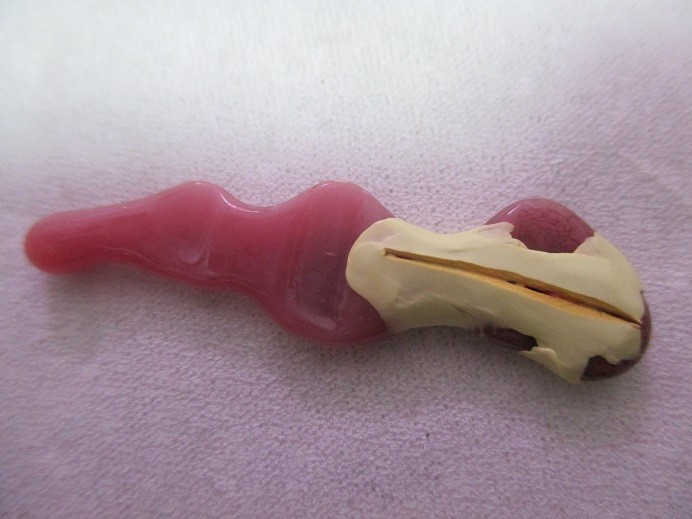
In an entry published in January 2019, a customer requested a different product after a twisted, medium-length glass chip broke internally. The fragment entered the bladder and passed after about 1 week, but a cystoscope examination (an internal viewing examination) found widespread bladder-lining injury.
Mr. Okada apologized; the diary does not record whether the requested replacement was supplied. For customers worried about glass breakage, he suggested resin instead.
(Source: ok-lab's diary, published January 2019)
https://ok-lab.hatenablog.com/entry/2019/01/26/152042
An oversized curved chip required hospital removal after stopper failure
A separate customer in the January 2019 entry reported that a curved chip entered the bladder after a stopper-positioning problem. Its thickest parts exceeded 10 mm, and hospital removal used an endoscope (an internal viewing instrument).
Mr. Okada reported that its attached thread gave the clinician something easier to grasp. He emphasized the importance of the thread remaining outside the body.
(Source: ok-lab's diary, published January 2019)
https://ok-lab.hatenablog.com/entry/2019/01/26/152042
An attached stopper failed to prevent a stuck chip during sleep
An entry published in April 2022 described a double-twist ceramic chip entering the bladder during sleep despite an attached stopper. The customer reported bloody urine, leakage, and an intense feeling that the bladder had not emptied.
Medical treatment removed the chip, with reported costs of about ¥8,000 (about $51 at ¥156 = $1, rate as of 2026-09-04). Mr. Okada questioned internal stoppers for people whose bodies readily allowed them to pass inward.
(Source: ok-lab's diary, published April 2022)
https://ok-lab.hatenablog.com/entry/2022/04/02/123050
Overlapping resin parts made hospital removal difficult without confirmed reversal
An entry published in August 2022 described a short M resin chip becoming stuck with its auxiliary chip (a connected additional chip). Hospital treatment separated the tightly overlapping parts so that the auxiliary chip could be removed.
Treatment cost about ¥8,000 (about $51 at ¥156 = $1, rate as of 2026-09-04) with insurance; the customer reported injury to the urethral lining. In a September 2022 follow-up, the customer interpreted the camera image as overlap without reversal. Mr. Okada warned against force when the device would not move.
(Source: ok-lab's diary, published August 2022)
https://ok-lab.hatenablog.com/entry/2022/08/20/122920
(Source: ok-lab's diary, published September 2022)
https://ok-lab.hatenablog.com/entry/2022/09/17/123057
A different stuck chip had turned completely around inside
Another entry published in August 2022 described hospital removal of a 37 mm S-size resin chip. The customer reported that the doctor confirmed a 180-degree reversal.
Removal took 20 minutes from the start of the endoscopic procedure and cost about ¥23,000 (about $147 at ¥156 = $1, rate as of 2026-09-04). The customer decided to stop using chips; Mr. Okada discussed improving the attachment design.
(Source: ok-lab's diary, published August 2022)
https://ok-lab.hatenablog.com/entry/2022/08/27/123001
Hospital removal required breaking an overlapping ceramic chip into fragments
In an entry published in August 2023, overlapping ceramic parts could not pass through the bladder outlet. Clinicians used stone-treatment equipment to fragment the ceramic chip and removed larger pieces with a cystoscope.
Reported charges were ¥48,000 (about $307 at ¥156 = $1, rate as of 2026-09-04) for fragmentation and removal, plus ¥2,200 (about $14 at ¥156 = $1, rate as of 2026-09-04) × 5 for bladder washing. The stated total was ¥59,000 (about $378 at ¥156 = $1, rate as of 2026-09-04) plus consultation fees. Mr. Okada suggested seeking another medical opinion when an incision was proposed.
(Source: ok-lab's diary, published August 2023)
https://ok-lab.hatenablog.com/entry/2023/08/05/122956
Hospital removal of another company's chip required an inpatient stay
An entry published in May 2024 described a stainless-steel chip from another company becoming stuck after its thread broke. A June 2024 follow-up confirmed admission on the consultation day.
Removal involved general anesthesia (not explained in the diary), 2 nights and 3 days in hospital, and ¥110,000 (about $704 at ¥156 = $1, rate as of 2026-09-04) with insurance. Mr. Okada emphasized that OK Lab could provide information but could not judge which hospital treatment was correct.
(Source: ok-lab's diary, published May 2024)
https://ok-lab.hatenablog.com/entry/2024/05/25/122919
(Source: ok-lab's diary, published June 2024)
https://ok-lab.hatenablog.com/entry/2024/06/01/123036
Hospital removal was also reported by a customer outside Japan
An entry published in June 2025 described a customer outside Japan; the country was not given. Their chip (Sea Slug version 4) moved inward during sleep after they had shortened its connecting cord by 4 cm.
Hospital treatment followed after a day of worsening urinary difficulty and frequency. The customer's account did not specify the technique; Mr. Okada could only speculate.
(Source: ok-lab's diary, published June 2025)
https://ok-lab.hatenablog.com/entry/2025/06/14/122936
The latest hospital removal report ended with a clear examination
An entry published in May 2026 reported successful removal during a two-night, three-day hospital stay. The customer described lower-body anesthesia through a spinal injection and an operation lasting about 30 minutes.
They reported temporary breathing difficulty and substantial discomfort afterward. A further message confirmed that the final examination found no problems.
(Source: ok-lab's diary, published May 2026)
https://ok-lab.hatenablog.com/entry/2026/05/30/122914
The maker's answer to prostate chip removal

The maker's responses addressed thread access, damaged cables, and breakage, while later cases continued to require hospital care.
An accessible thread mattered in the maker's stuck chip response
In an entry published in May 2020, Mr. Okada stressed that an external thread end made dealing with a retained chip easier. His reply covered both customer retrieval and treatment by a urologist.
He also suspected that thread tangling between connected chips could hold them in a V shape. His recommendation emphasized preventing the thread end from disappearing inside.
(Source: ok-lab's diary, published May 2020)
https://ok-lab.hatenablog.com/entry/2020/05/02/131505
Failed cable repairs preceded a stuck chip and planned surgery
An entry published in November 2020 described a cable covering that peeled away after 2 repairs. The exposed cable later broke, leaving the chip in the bladder; an initial hospital attempt could not grasp it.
Another attempt under general anesthesia was planned, with an incision discussed as a possibility. An update dated November 15 reported that the customer retrieved it without that planned procedure. Mr. Okada warned against using cables with exposed conductors.
(Source: ok-lab's diary, published November 2020)
https://ok-lab.hatenablog.com/entry/2020/11/14/131426
A reinforced prototype targeted fragments that could complicate chip removal
An entry published in June 2025 described a ceramic prototype with 0.2 mm shape-memory wire (wire that recovers its shape) on both sides. Epoxy resin (a coating material) covered the reinforcement, which Mr. Okada intended to keep broken portions connected.
The published reinforcement charge was the usual ceramic-chip price plus ¥2,000, (about $13 at ¥156 = $1, rate as of 2026-09-04) excluding tax. Mr. Okada cautioned that the reinforced ceramic could still crack.
(Source: ok-lab's diary, published June 2025)
https://ok-lab.hatenablog.com/entry/2025/06/07/122954
If you see blood in your urine, even a small amount or for the first time, do not wait and see. See a urologist right away. If you suddenly cannot urinate, or the device cannot be removed, do not try to fix it yourself. Go to a medical facility, including emergency care, immediately.
How prostate chip removal changed over time

| Published | What the diary said then |
|---|---|
| Mar 2018 | First hospital-removal report prompted longer leading chips. |
| Jan 2019 | Passing a broken fragment had not prevented bladder injury. |
| Nov 2020 | Failed cable repairs prompted an exposed-conductor warning. |
| Jul 2021 | A retrieval prototype had not undergone bladder testing; routine sale was not planned. |
| Aug 2022 | A doctor reportedly confirmed complete chip reversal. |
| Mar 2024 | A local urology clinic completed removal for ¥27,000 (about $173 at ¥156 = $1, rate as of 2026-09-04). |
| Jun 2024 | A follow-up confirmed inpatient removal under general anesthesia. |
| Jun 2025 | Wire reinforcement aimed to keep broken ceramic portions connected. |
| May 2026 | The latest supplied hospital case ended with a clear final examination. |
OK Prostate Chip products related to prostate chip removal

The current list includes products involved in these reports.
Products that appear in these entries
| Product (official name) | Price incl. tax | Relation to this topic |
|---|---|---|
| Twisted medium-length glass chip (OKプロステートチップ ガラス素材セミロングタイプ コブラツイスト) | ¥5,500 (about $35 at ¥156 = $1, rate as of 2026-09-04) | January 2019: breakage was followed by examination showing bladder injury. |
| Short twisted ceramic chip (OKプロステートチップ 陶器素材ショートタイプ ツイスト) | ¥4,400 (about $28 at ¥156 = $1, rate as of 2026-09-04) | May 2020: a customer sought help when this chip would not come out. |
| Screw-shaped auxiliary chip (スクリュー型補助チップ追加オプション) | ¥3,300 (about $21 at ¥156 = $1, rate as of 2026-09-04) | May 2020: this option accompanied the customer's stuck ceramic chip. |
| Double-twist ceramic chip (OKプロステートチップ 陶器素材覚醒タイプ ダブルツイスト(ラブカチップ)) | ¥6,600 (about $42 at ¥156 = $1, rate as of 2026-09-04) | April 2022: this model required medical removal despite a stopper. |
| Short resin chip (OKプロステートチップ ショートタイプ(生体適合樹脂)) | ¥4,400 (about $28 at ¥156 = $1, rate as of 2026-09-04) | August 2022: the M chip overlapped with an auxiliary chip. |
| Resin chip (OKプロステートチップ 凶悪ゾロ(生体適合樹脂)) | ¥5,500 (about $35 at ¥156 = $1, rate as of 2026-09-04) | August 2022: the S chip reportedly reversed inside the urethra. |
| Long four-point-twist ceramic chip (OKプロステートチップ 陶器素材ロングタイプ 4点ツイスト) | ¥7,700 (about $49 at ¥156 = $1, rate as of 2026-09-04) | March 2024: this chip entered the bladder with an L stopper. |
| Six-hole internal stopper (六穴方式オプションチップ(括約筋ストッパーチップ)) | ¥2,200 (about $14 at ¥156 = $1, rate as of 2026-09-04) | March 2024: this stopper accompanied the ceramic chip requiring removal. |
(Source: ok-lab's diary, published January 2019)
https://ok-lab.hatenablog.com/entry/2019/01/26/152042
(Source: ok-lab's diary, published May 2020)
https://ok-lab.hatenablog.com/entry/2020/05/02/131505
(Source: ok-lab's diary, published April 2022)
https://ok-lab.hatenablog.com/entry/2022/04/02/123050
(Source: ok-lab's diary, published August 2022)
https://ok-lab.hatenablog.com/entry/2022/08/20/122920
(Source: ok-lab's diary, published August 2022)
https://ok-lab.hatenablog.com/entry/2022/08/27/123001
(Source: ok-lab's diary, published March 2024)
https://ok-lab.hatenablog.com/entry/2024/03/02/123027
Products the diary mentioned as alternatives
The diary names no alternative.
Historical configurations: the custom medium-length chip, repaired cable model, oversized curved chip, December 2021 assembly, version 4 chip (Sea Slug), and wire-reinforced prototype.
No matching product can be confirmed on the current list.
Common worries about prostate chip removal
Readers asked about uncertain outcomes, difficult insertion, and whether larger stoppers would help.
"Could a stuck chip mean the connected parts are tangled?"
An entry published in May 2020 contained this concern from a short ceramic-chip customer. Mr. Okada considered tangling possible, initially anticipated release, then changed his reply to favor prompt urology care when the problem persisted.
A later message reported that the chip came out, but it was lost, preventing inspection of its condition. Mr. Okada also cautioned that screw-shaped auxiliary chips would not prevent inward movement for everyone.
(Source: ok-lab's diary, published May 2020)
https://ok-lab.hatenablog.com/entry/2020/05/02/131505
"Can a chip get stuck after being difficult to insert?"
In an entry published in December 2021, a customer doubted that a difficult-to-insert custom chip could have entered the bladder. OK Lab's staff considered inward movement possible; subsequent hospital treatment confirmed that the assembly had entered.
The customer reported removal in about 10 minutes, costs above ¥30,000 (about $192 at ¥156 = $1, rate as of 2026-09-04), and a sample device helping the doctor understand the shape. Staff advised medical assessment.
(Source: ok-lab's diary, published December 2021)
https://ok-lab.hatenablog.com/entry/2021/12/25/123556
"Would a bigger stopper prevent another stuck chip?"
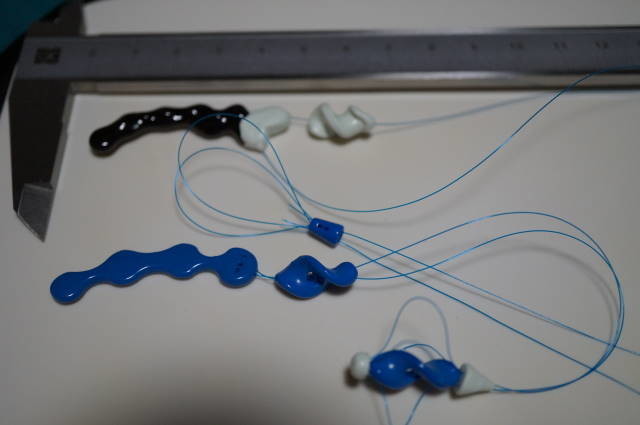
An entry published in March 2024 raised this question after a long ceramic chip and L stopper entered the bladder. Mr. Okada thought standard L stoppers offered almost no protection for someone who could accommodate a 15 mm screw-shaped auxiliary chip.
He offered a larger custom stopper rather than claiming the standard size would work. His proposed response was a customer-specified custom size.
(Source: ok-lab's diary, published March 2024)
https://ok-lab.hatenablog.com/entry/2024/03/02/123027
Buying from outside Japan

OK Lab ships internationally to countries covered by Japan Post's EMS courier service. Overseas orders are paid in advance by PayPal. Each order carries a ¥400 (about $3 at ¥156 = $1, rate as of 2026-09-04) handling fee, and EMS shipping is charged on top. These terms come from OK Lab's official sales-terms page (written here as plain text, not a link: ok-lab.net/docs/law), checked on September 7, 2026; confirm them on the official store before you order, because they can change.
Summary of this article
| What you wanted to know | The answer |
|---|---|
| In short | Retained chips have required urgent assessment and hospital treatment. |
| About the product | A small urethral device made by OK Lab in Japan. |
| Key terms | Threads, stoppers, scopes, and forceps recur throughout. |
| What happened | Overlap, reversal, detachment, and breakage led to different clinical outcomes. |
| The maker's answer | Thread security, cable warnings, and reinforcement addressed different problems. |
| Changes over time | Reports continued through May 2026 despite earlier design responses. |
| Related products | Current prices are listed; historical configurations remain unconfirmed. |
| Common worries | Difficult insertion did not prevent inward movement. |
| Buying internationally | Advance PayPal payment, EMS shipping, and a ¥400 (about $3 at ¥156 = $1, rate as of 2026-09-04) handling fee apply. |
Source: ok-lab's diary (Okada Comfortable Life Laboratory). The original entries are in Japanese; quotations on this page are translated. Photos and videos are on the original entries.
This article is a summary of the maker's development diary. The product is not a medical device and no result is guaranteed. If anything feels wrong or worries you, see a doctor. Prices, specifications and cautions change, so confirm the latest information on the official blog and the official site. Questions about ordering and shipping go to the seller.