![Can a broken thread leave the chip stuck? | Yes, hospital removal has been reported [OK Prostate Chip]](/img/a/T0332/eyecatch.svg)
This page is based on entries from "ok-lab's diary" (https://ok-lab.hatenablog.com/), the Japanese development diary written by Mr. Okada, founder of OK Lab, a small company in Japan (Okada Comfortable Life Laboratory). Only the entries about "chip stuck after thread breakage or detachment" are summarized here, in order of publication. Past prices and sizes are as written at the time. Current prices come from the official product list (retrieved September 4, 2026). Quotations are translated from Japanese.
Note: This page is a personal reading log by someone with no connection to the maker or the seller. It reflects the source entries as of their publication dates and makes no guarantee of accuracy or safety. The product is not a medical device; talk to a doctor about any health decision. Check the official site for current information. This page contains advertising.
In short
- Broken or detached threads have left chips inside, sometimes requiring hospital removal.
- The maker changed attachments, offered two threads, and later proposed protected wire-and-thread extensions.
- The latest supplied report, published in March 2026, records a stuck chip without a removal outcome.
If you see blood in your urine, even a small amount or for the first time, do not wait and see. See a urologist right away. If you suddenly cannot urinate, or the device cannot be removed, do not try to fix it yourself. Go to a medical facility, including emergency care, immediately.
About this product
The OK Prostate Chip is a small device that is placed in the urethra (the urine passage) so that it acts on the prostate; the maker sells it in several shapes, sizes and materials.
It is made and sold by OK Lab (Okada Comfortable Life Laboratory), a small company in Japan, through its own online store, and prices are in Japanese yen (JPY). The maker's development diary, "ok-lab's diary", is written in Japanese. This page is an English summary of it, and every quotation is translated.
OK Lab ships internationally, so readers outside Japan can order (see "Buying from outside Japan" below). Product names on this page are plain-English descriptions. The official Japanese product name is shown once in the product table so you can find the same item in the store.
Before you read: key terms
| Term | Plain-English meaning |
|---|---|
| Urethra | The urine passage; the chip sits inside it near the prostate. |
| Retrieval thread | Nylon line attached to the chip, intended to provide a connection for removal. |
| Silicone | The earlier material connecting retrieval threads to glass chips. |
| Epoxy resin | Material used to secure or cover thread attachments on these chips. |
| Linked chips | Two chips connected by thread, intended to position their separate parts together. |
| Loop attachment | Thread secured around a chip, intended to prevent complete detachment. |
| Endoscope and forceps | Hospital instruments used to locate and grasp retained chips during removal. |
| General anesthesia | Reported as part of hospital removal. The diary does not explain this. |
| Double-tube tail | A retrieval extension with nested tubes covering two threads, proposed to resist breakage. |
What happens: chip stuck after thread breaks
The OK Prostate Chip is a small device placed inside the urethra to act on the prostate. A retrieval thread (the line connecting the chip to the outside) is intended to help with removal. These entries distinguish thread breakage from a thread pulling free or its covering coming away. In linked chips (two chips joined by thread), a failed connection can leave the front chip inside while the other comes out.
A modified long chip remained inside for one week after thread detachment
In an entry published in April 2018, a customer described modifying a standard long chip to connect another chip. The attachment failed, leaving the long chip in the bladder for 1 week, with dull pain during urination.
The customer reported its eventual passage and dark deposits around the glass-resin boundary. Mr. Okada responded by warning that long-chip buyers needed to accept the possibility of hospital treatment.
(Source: ok-lab's diary, published April 2018)
https://ok-lab.hatenablog.com/entry/20180407/1523090115
One long chip emerged reversed after thread detachment during attempted removal
In an entry published in May 2018, Mr. Okada described a customer's unusually large long chip becoming trapped. The customer thought it was caught somewhere and reported forceful pulling, after which the thread and resin detached.
Several days later, the chip was recovered facing the opposite direction, a reported rotation of 180 degrees. Mr. Okada interpreted this as evidence that the entire chip had entered the bladder.
(Source: ok-lab's diary, published May 2018)
https://ok-lab.hatenablog.com/entry/20180505/1525509161
A newly delivered custom chip needed hospital removal after thread detachment
An entry published in May 2018 reported a newly delivered custom chip's thread pulling free with resin attached. The customer said the force felt comparable to removing their usual long chip; Mr. Okada suspected incomplete resin hardening.
The next day's entry identifies the same customer's custom semi-long chip and confirms removal from the bladder at a general hospital. Doctors used an endoscope and forceps (instruments used to locate and grasp the chip), but its slippery surface made removal difficult.
The customer reported feeling well afterward. Mr. Okada published the follow-up without further comment.
(Source: ok-lab's diary, published May 2018)
https://ok-lab.hatenablog.com/entry/20180510/1525959878
(Source: ok-lab's diary, published May 2018)
https://ok-lab.hatenablog.com/entry/20180511/1526036007
Repeated thread detachment prompted replacement of previously repaired linked resin chips
In an entry published in March 2019, a customer requested another repair after the front chip's thread detached. Mr. Okada recognized earlier repairs and worried that further coating would make the chip thicker.
He offered a replacement for the repair charge, explaining that its shape would differ. The customer accepted and requested a front chip 5 mm longer; the diary does not record its subsequent performance.
(Source: ok-lab's diary, published March 2019)
https://ok-lab.hatenablog.com/entry/2019/03/16/165528
Broken thread left one short chip inside for five and a half days
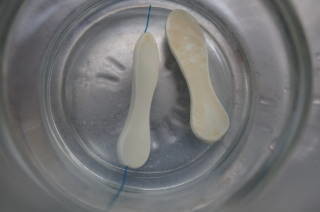
An entry published in April 2019 reported a 35 mm resin front chip remaining inside after the connection between linked chips broke. Staff initially expected it to pass naturally, while Mr. Okada later advised medical consultation for discomfort.
A confirmed follow-up that month reported 5½ days of retention, with blood in urine, difficult urination, and pain. The customer eventually recovered the chip and requested a second thread.
Mr. Okada found thread remaining inside the returned chip, supporting breakage rather than pullout. He supplied a separate replacement with two threads.
(Source: ok-lab's diary, published April 2019)
https://ok-lab.hatenablog.com/entry/2019/04/20/144337
(Source: ok-lab's diary, published April 2019)
https://ok-lab.hatenablog.com/entry/2019/04/27/153239
Another company's stainless-steel chip required hospital removal after thread breakage
In an entry published in May 2024, a customer sought help after another company's stainless-steel chip became stuck following thread breakage. Staff expected possible natural passage, but the customer reported that it did not pass and moved beyond the surrounding muscle.
The hospital removed it with an endoscope. The confirmed June 2024 follow-up reports same-day admission, general anesthesia (not explained in the diary), and a stay of 2 nights and 3 days.
The customer reported a cost of ¥110,000 (about $704 at ¥156 = $1, rate as of 2026-09-04) with insurance applied. Mr. Okada acknowledged that he could not judge which hospital treatment was appropriate.
(Source: ok-lab's diary, published May 2024)
https://ok-lab.hatenablog.com/entry/2024/05/25/122919
(Source: ok-lab's diary, published June 2024)
https://ok-lab.hatenablog.com/entry/2024/06/01/123036
The latest broken thread report leaves one blue chip's outcome unknown
In an entry published in March 2026, a customer reported that a blue chip with enlarged ends remained at the prostate after its thread broke. Mr. Okada speculated that its enlarged ends held it in place.
His reply offered reassurance about continued retention and awaited further news. The diary does not record whether this chip was removed.
(Source: ok-lab's diary, published March 2026)
https://ok-lab.hatenablog.com/entry/2026/03/28/122908
The maker's answer to chip stuck after thread breaks
The maker changed both the attachment and the retrieval connection, while acknowledging limits in successive designs.
Epoxy replaced silicone after thread detachment during early long-chip testing
An entry published in January 2018 describes replacing silicone (the earlier attachment material) with epoxy resin (material securing the thread). He reported that earlier silicone connections could release the thread under strong force.
Mr. Okada believed the newer attachment would hold unless the thread was damaged, but acknowledged unexpected breakage remained possible. He discouraged inexperienced buyers from choosing the long chip.
(Source: ok-lab's diary, published January 2018)
https://ok-lab.hatenablog.com/entry/20180111/1515662782
Thicker coatings addressed thread detachment but did not eliminate resin failure
In an entry published in February 2018, Mr. Okada reported 2 peeling-attachment cases involving linked chips. He attributed them to reverse loading during movement of the connected chips.
He described thicker coatings on outgoing products but acknowledged that the resin could still break. His proposed remedy for affected January shipments was replacement after photographic confirmation, without promising repeated replacements.
(Source: ok-lab's diary, published February 2018)
https://ok-lab.hatenablog.com/entry/20180214/1518601774
Thread detachment prompted a temporary sales pause while causes remained unconfirmed
An entry published on May 10, 2018, temporarily suspended sales of long and linked chips pending comparative hardening tests. Orders for custom chips with extreme narrow sections were also suspended.
Mr. Okada associated the recent failures with low room temperatures and high humidity delaying hardening. His later May explanation identified epoxy brittleness as the main problem, compounded by incomplete hardening.
(Source: ok-lab's diary, published May 2018)
https://ok-lab.hatenablog.com/entry/20180510/1525959878
(Source: ok-lab's diary, published May 2018)
https://ok-lab.hatenablog.com/entry/20180513/1526181573
Loop attachments targeted complete thread detachment while peeling remained unresolved
An entry published in May 2018 announced loop attachments (threads secured around the chip) for shipments from May 24, 2018. Packaging also changed to distinguish the revised connection.
Mr. Okada believed this addressed complete detachment, while explicitly leaving resin peeling unresolved. He offered returns and refunds for unrevised items shipped from May 10–23, 2018. For a customer worried about peeling on a semi-long glass chip, he proposed a return and refund.
(Source: ok-lab's diary, published May 2018)
https://ok-lab.hatenablog.com/entry/20180524/1527153380
A peeling thread attachment prompted reinforcement after an initially limited repair reply
In an entry published in February 2019, a customer asked for repair or replacement after repeated attachment damage. Mr. Okada initially said rebuilding might lead to the same problem and suggested self-repair.
He then reconsidered and developed reinforcement using another resin alongside epoxy. He invited feedback on its durability before deciding whether to offer the reinforced version.
(Source: ok-lab's diary, published February 2019)
https://ok-lab.hatenablog.com/entry/2019/02/02/153358
Two threads became an order option after further broken thread reports
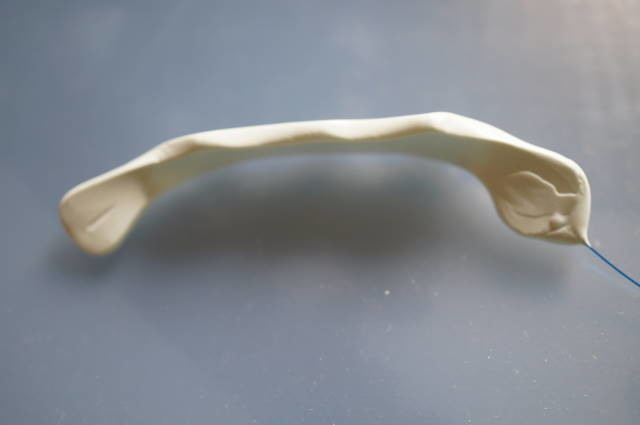
An entry published in April 2019 announced two-thread support for orders from April 27, 2019, following breakage reports. The vibrating-chip range was excluded.
Existing work already in production would not automatically receive the change. The diary directed customers seeking the option to state that preference in their order notes.
(Source: ok-lab's diary, published April 2019)
https://ok-lab.hatenablog.com/entry/2019/04/27/153239
If you see blood in your urine, even a small amount or for the first time, do not wait and see. See a urologist right away. If you suddenly cannot urinate, or the device cannot be removed, do not try to fix it yourself. Go to a medical facility, including emergency care, immediately.
How chip stuck after thread breaks changed over time
| Published | What the diary said then |
|---|---|
| Jan 2018 | Linked short-chip versions and long model: planned ¥6,000 (about $38 at ¥156 = $1, rate as of 2026-09-04) each, tax excluded. |
| May 2018 | Embedded threads gained catches after pullout reports. |
| Jun 2018 | One tested glass attachment held despite near-total loss of its resin covering. |
| Jul 2018 | Mr. Okada reported anti-pullout changes for resin and twisted chips. |
| Aug 2019 | Aluminum reinforcement was announced; exposed metal on a ceramic chip prompted repair. |
| Nov 2019 | Rear-center thread exits allowed 0 mm spacing between connected chips. |
| Jun 2021 | A designer rejected an end-to-end loop because breakage could cause rotation. |
| Jul 2021 | The manual included thread-condition checks and cautions against self-repair. |
| Jun 2024 | Double-tube tail (protected retrieval extension): two threads within 2 mm and 4 mm tubes. |
| Jul 2025 | Mr. Okada favored a 1 mm tube containing thread and wire over exposed threads. |
OK Prostate Chip products related to chip stuck after thread breaks
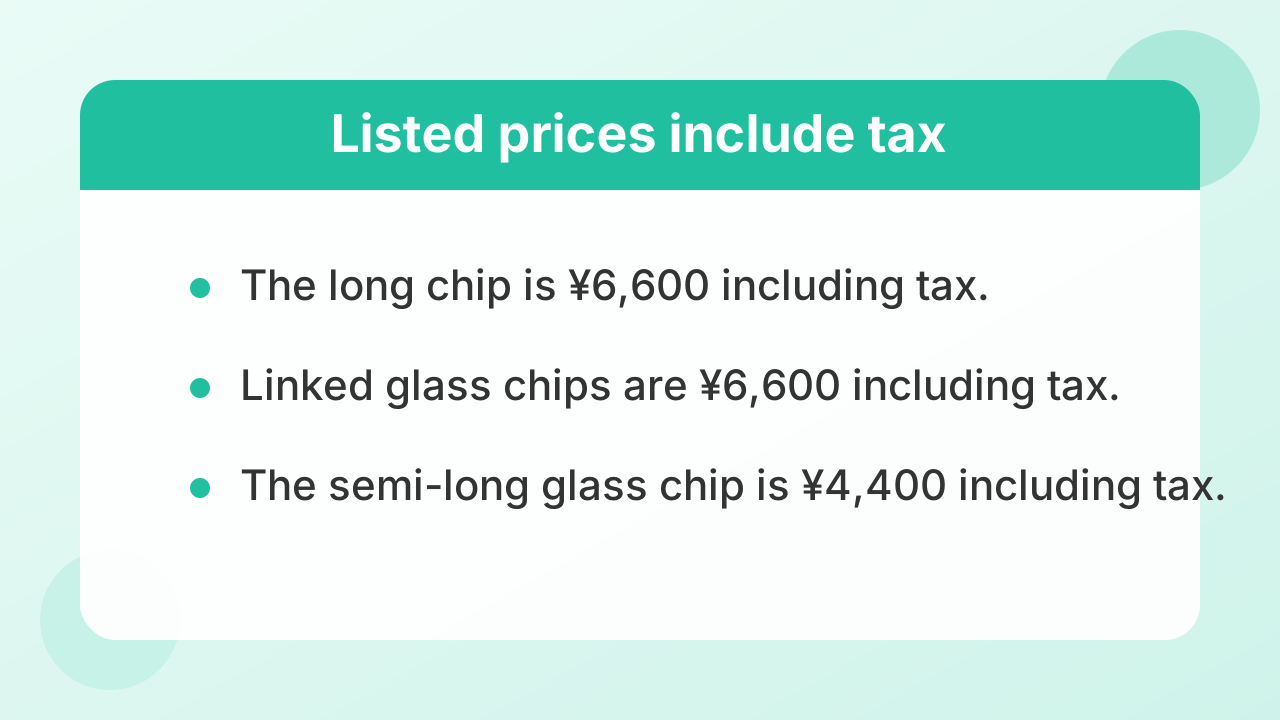
The current list includes models discussed in historical attachment reports; those reports do not establish present-day attachment specifications.
Products that appear in these entries
| Product (official name) | Price incl. tax | Relation to this topic |
|---|---|---|
| Long chip (OKプロステートチップ ロングタイプ) | ¥6,600 (about $42 at ¥156 = $1, rate as of 2026-09-04) | January 2018 discussed its attachment change and risks during development. |
| Linked glass chips (OKプロステートチップ ガラス素材2連結タイプ) | ¥6,600 (about $42 at ¥156 = $1, rate as of 2026-09-04) | February 2018 reported peeling at their thread connections. |
| Semi-long glass chip (OKプロステートチップ ガラス素材セミロングタイプ) | ¥4,400 (about $28 at ¥156 = $1, rate as of 2026-09-04) | May 2018 described a customer's peeling attachment and refund offer. |
(Source: ok-lab's diary, published January 2018)
https://ok-lab.hatenablog.com/entry/20180111/1515662782
(Source: ok-lab's diary, published February 2018)
https://ok-lab.hatenablog.com/entry/20180214/1518601774
(Source: ok-lab's diary, published May 2018)
https://ok-lab.hatenablog.com/entry/20180524/1527153380
Products the diary mentioned as alternatives
The diary names no alternative.
Custom builds and older repaired chips; the blue chip with enlarged ends; threadless and protected-extension designs:
No matching product can be confirmed on the current list.
Common worries about chip stuck after thread breaks
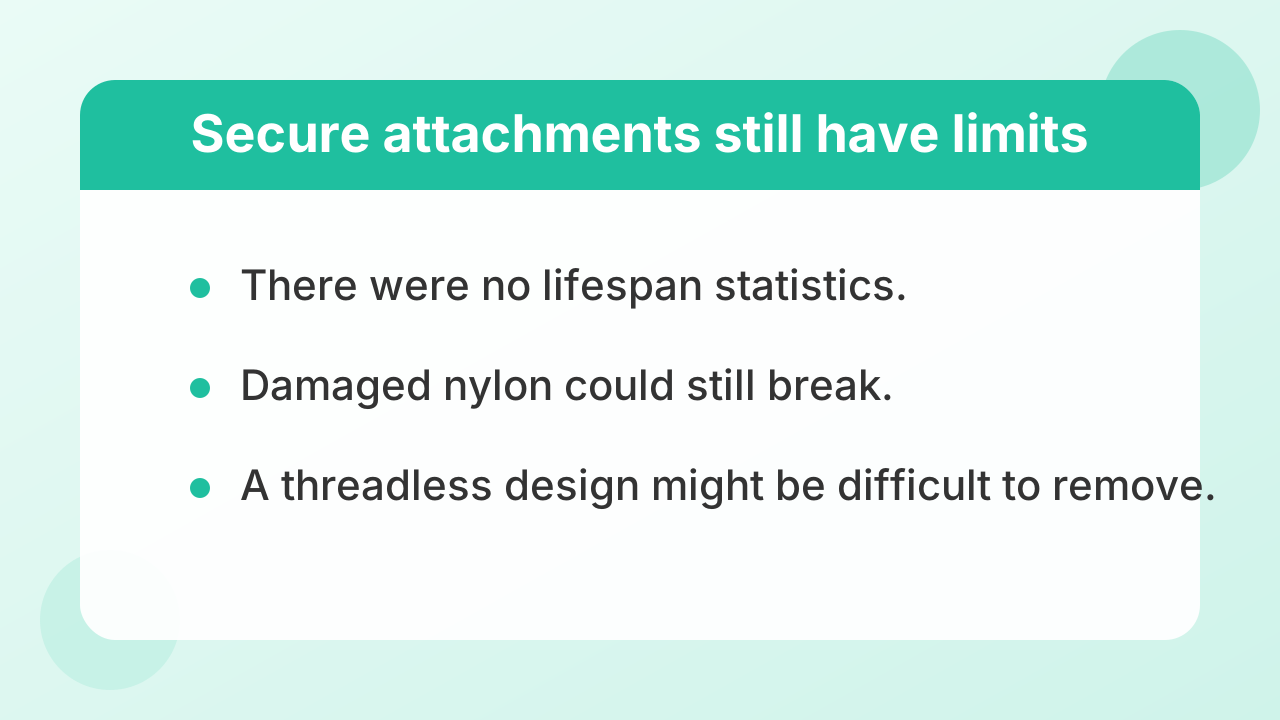
The diary distinguishes attachment strength, thread damage, and the practical limits of proposed alternatives.
"Does thread detachment mean linked resin chips have a known lifespan?"
In an entry published in March 2019, a reader asked about service life and frequent attachment failures. Mr. Okada said there were no lifespan statistics.
He explained that ordinary sales of linked chips had stopped because leverage between the chips could overload their connection, although custom requests continued. He advised gentle handling and acknowledged that few repair requests did not prove durability.
(Source: ok-lab's diary, published March 2019)
https://ok-lab.hatenablog.com/entry/2019/03/23/173222
"Can ceramic attachments prevent a broken thread?"
In an entry published in August 2020, a reader asked whether the ceramic chip's thread depended only on adhesive. Mr. Okada explained that it was secured through a hole beneath the resin.
He considered attachment failure unlikely but acknowledged that damaged nylon could still break. For this concern, he suggested two threads.
(Source: ok-lab's diary, published August 2020)
https://ok-lab.hatenablog.com/entry/2020/08/01/124144
"Could threadless designs prevent a chip stuck after thread breaks?"
In an entry published in April 2025, a newcomer asked about detachment, disappearing threads, and possible hospital treatment. Staff first requested narrower questions and addressed conventional solid chips.
Mr. Okada then proposed a flexible wire-and-tube design without a separate solid chip or retrieval thread. He considered it safer but acknowledged that someone might still be unable to remove it. He presented that threadless design as another choice; the diary does not record what this reader bought or experienced.
(Source: ok-lab's diary, published April 2025)
https://ok-lab.hatenablog.com/entry/2025/04/05/122932
Buying from outside Japan
OK Lab ships internationally to countries covered by Japan Post's EMS courier service. Overseas orders are paid in advance by PayPal. Each order carries a ¥400 (about $3 at ¥156 = $1, rate as of 2026-09-04) handling fee, and EMS shipping is charged on top. These terms come from OK Lab's official sales-terms page (written here as plain text, not a link: ok-lab.net/docs/law), checked on September 7, 2026; confirm them on the official store before you order, because they can change.
Summary of this article
| What you wanted to know | The answer |
|---|---|
| In short: can a chip remain inside? | Yes; the diary includes hospital removals and an unresolved report. |
| About the product: what is it? | A Japanese device placed in the urethra to act on the prostate. |
| Key terms: what can fail? | The nylon thread, its attachment, or the covering around that attachment. |
| What happens after failure? | Reported outcomes include retention, bleeding, eventual recovery, and hospital treatment. |
| The maker's answer: what changed? | Attachment materials, coatings, loops, and optional second threads changed over time. |
| Changes over time: was development finished? | Later entries continued discussing reinforcement and protected connections. |
| Related products: what do listed models cost? | The listed models cost ¥4,400 (about $28 at ¥156 = $1, rate as of 2026-09-04) or ¥6,600, (about $42 at ¥156 = $1, rate as of 2026-09-04) including tax. |
| Common worries: is stronger attachment enough? | Mr. Okada distinguished secure attachment from damage to the thread itself. |
| Buying abroad: how are orders handled? | Advance PayPal payment, ¥400 (about $3 at ¥156 = $1, rate as of 2026-09-04) handling, and additional Japan Post EMS shipping. |
Source: ok-lab's diary (Okada Comfortable Life Laboratory). The original entries are in Japanese; quotations on this page are translated. Photos and videos are on the original entries.
This article is a summary of the maker's development diary. The product is not a medical device and no result is guaranteed. If anything feels wrong or worries you, see a doctor. Prices, specifications and cautions change, so confirm the latest information on the official blog and the official site. Questions about ordering and shipping go to the seller.