![My retrieval thread has disappeared | Some cases needed hospital removal [OK Prostate Chip]](/img/a/T0333/eyecatch.svg)
This page is based on entries from "ok-lab's diary" (https://ok-lab.hatenablog.com/), the Japanese development diary written by Mr. Okada, founder of OK Lab (Okada Comfortable Life Laboratory). Only the entries about "disappearing retrieval threads" are summarized here, in order of publication. Past prices and sizes are as written at the time. Current prices come from the official product list (retrieved September 4, 2026). Quotations are translated from Japanese.
Note: This page is a personal reading log by someone with no connection to the maker or the seller. It reflects the source entries as of their publication dates and makes no guarantee of accuracy or safety. The product is not a medical device; talk to a doctor about any health decision. Check the official site for current information. This page contains advertising.
In short
- Customer reports include vanished thread ends, bladder entry, and hospital removal.
- OK Lab, a small company in Japan, has proposed extra thread and stoppers, without guaranteeing prevention.
- The August 2026 single-thread specification adds spare length beyond the safety tip, except at the maximum length.
If you see blood in your urine, even a small amount or for the first time, do not wait and see. See a urologist right away.
If you suddenly cannot urinate, or the device cannot be removed, do not try to fix it yourself. Go to a medical facility, including emergency care, immediately.
About this product

The OK Prostate Chip is a small device that is placed in the urethra (the urine passage) so that it acts on the prostate; the maker sells it in several shapes, sizes and materials. It is made and sold by OK Lab (Okada Comfortable Life Laboratory), a small company in Japan, through its own online store, and prices are in Japanese yen (JPY).
The maker's development diary, "ok-lab's diary", is written in Japanese. This page is an English summary of it, and every quotation is translated. OK Lab ships internationally, so readers outside Japan can order (see "Buying from outside Japan" below).
Product names on this page are plain-English descriptions. The official Japanese product name is shown once in the product table so you can find the same item in the store.
Before you read: key terms
| Term | Plain-English meaning |
|---|---|
| Urethra | The urine passage, also occupied by the chip and thread. |
| Retrieval thread | A line attached to the chip for removal. |
| Safety tip | A thread attachment intended to remain outside as an accessible end. |
| External stopper | An outside part intended to keep the thread accessible. |
| Sphincter stopper | An internal part intended to resist movement toward the bladder. |
| Helper chip | An additional chip intended to assist movement or retention. |
| Cystoscopy | A bladder examination used to investigate injury or assist removal. |
| Chipless design | A silicone-covered wire device serving the solid chip's general purpose. |
What happens: disappearing retrieval threads
The OK Prostate Chip is a small urethral device intended to stimulate the prostate. A retrieval thread (a line attached for removal) runs from the chip toward the opening at the penis tip. The safety tip (a small piece on that thread) is intended to remain outside, according to the diary. These reports concern that end disappearing inside, sometimes together with the stopper or the entire device.
A disappearing thread left the maker uncertain about bladder entry
A February 2018 entry reports sudden disappearance of a 20 cm thread for a customer outside Japan. The single-chip glass model also became impossible to feel, but it soon passed during urination. Mr. Okada could not establish whether the whole chip had entered the bladder. He suggested that a stopper at the opening might help prevent the thread from disappearing.
(Source: ok-lab's diary, published February 2018)
https://ok-lab.hatenablog.com/entry/20180224/1519457027
Lost thread followed a reported half-turn inside the urethra
A May 2018 entry records a single-chip glass customer's request for a longer thread. The customer reported a half-turn in the curved urethra, followed by disappearance of the safety tip. The thread was inaccessible, and urination did not release the chip; the customer eventually recovered it. Mr. Okada said this was his first report of such rotation and offered thread replacement for ¥1,080 (about $7 at ¥156 = $1, rate as of 2026-09-04), as published that month.
(Source: ok-lab's diary, published May 2018)
https://ok-lab.hatenablog.com/entry/20180505/1525509161
A disappearing thread accompanied bladder entry without noticeable initial pain
A separate report published in May 2018 described an unusually large chip entering the bladder completely, without noticeable pain at entry. The customer later experienced pain near the end of urination, and the chip eventually passed tip-first. Mr. Okada warned that sudden disappearance of sensation could reflect the chip moving into the bladder.
(Source: ok-lab's diary, published May 2018)
https://ok-lab.hatenablog.com/entry/20180505/1525509161
Lost thread preceded discovery of a broken glass tip
A February 2019 entry reports complete loss of the 24 cm thread on a 42 mm twisted semi-long glass chip. Ejaculation did not release it; it later passed during urination with its front bump broken off.
Cystoscopy (an internal bladder examination) found no remaining object but substantial injury to the bladder lining. The missing fragment was never recovered, and the customer reported no visible blood in the urine. Mr. Okada apologized and shared the account as a warning.
(Source: ok-lab's diary, published February 2019)
https://ok-lab.hatenablog.com/entry/2019/02/02/153358
A lost thread required surgery after both protective parts failed
A February 2025 entry reports loss of the entire 35 cm thread on a linked chip (sea-slug version 5). The L-size mesh stopper went inward; the external stopper (a part intended to retain the thread outside) detached. Hospital removal succeeded; the reported surgery charge was ¥25,000 (about $160 at ¥156 = $1, rate as of 2026-09-04), with total costs of about ¥35,000 (about $224 at ¥156 = $1, rate as of 2026-09-04).
The customer reported infection following removal injuries. Staff offered no reliable self-retrieval method and advised following the doctor's plan.
(Source: ok-lab's diary, published February 2025)
https://ok-lab.hatenablog.com/entry/2025/02/22/122939
Disappearing thread also occurred with a flexible wire device
A May 2025 entry describes a trapped chipless design (a silicone-covered wire device replacing the solid chip). Mr. Okada initially assumed a routine retrieval problem, then learned that the attached thread, longer than 20 cm, had also disappeared. The customer reported hospital removal by cystoscopy after the device and thread entered the bladder.
The visit took about 5 hours, including waiting and examinations, and cost ¥34,000 (about $218 at ¥156 = $1, rate as of 2026-09-04). Once the unexpectedly deep position became apparent, Mr. Okada advised a urology visit.
(Source: ok-lab's diary, published May 2025)
https://ok-lab.hatenablog.com/entry/2025/05/03/122907

A lost retrieval cord during sleep led to hospital treatment
A June 2025 entry describes a customer outside Japan whose chip (sea-slug version 4) entered the bladder during sleep. Its entire cord had disappeared inside, and the customer's attempts at retrieval failed. Worsening difficulty urinating and frequent urges led to hospital removal through a procedure described as requiring no incision. Mr. Okada did not establish how retrieval was performed.
(Source: ok-lab's diary, published June 2025)
https://ok-lab.hatenablog.com/entry/2025/06/14/122936
A disappearing thread carried an external stopper inward during sleeve use
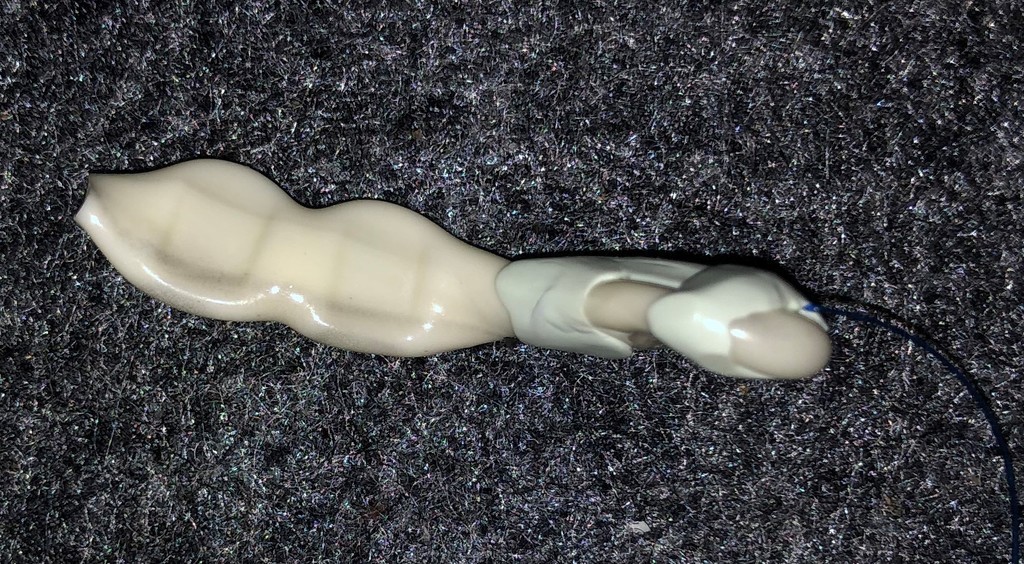
An April 2026 entry reports stopper loss during use with TENGA EGG, a masturbation sleeve. The device was a long ceramic chip with four twists. The stopper went inward by 1–2 cm and was recovered; the customer blamed a thread length with almost no spare allowance. Mr. Okada acknowledged that sleeve use could also draw an external stopper inside.
(Source: ok-lab's diary, published April 2026)
https://ok-lab.hatenablog.com/entry/2026/04/18/122906
The maker's answer to disappearing retrieval threads

The maker proposed longer threads and retaining parts, while later reports exposed their limits.
Disappearing threads prompted requests beyond the former maximum length
A January 2018 entry reports that an extended short chip's maximum 25 cm thread was insufficient for a customer. The safety tip moved inside despite the customer's original length estimate. Mr. Okada's published response allowed requests longer than 25 cm through the order's notes field.
(Source: ok-lab's diary, published January 2018)
https://ok-lab.hatenablog.com/entry/20180118/1516263011
Disappearing threads brought an early warning about prolonged use
A May 2018 entry warned against use lasting beyond one night because of possible bladder entry. Mr. Okada discussed stoppers for inward movement exceeding 25 cm. He advised enough spare thread to keep the safety tip accessible.
(Source: ok-lab's diary, published May 2018)
https://ok-lab.hatenablog.com/entry/20180505/1525509161
Lost thread concerns led to an optional end loop
An August 2019 entry describes a customer's request for a loop beyond the safety tip. Mr. Okada made the requested loop and began accepting orders. The published maximum was 27 cm, excluding a loop measuring about 3 cm when extended. He presented the loop as an aid to retrieval if the thread disappeared.
(Source: ok-lab's diary, published August 2019)
https://ok-lab.hatenablog.com/entry/2019/08/17/132641
Retrieval thread tangling could obstruct removal despite an accessible end
A May 2020 entry describes retention of a twisted short ceramic chip with a screw-shaped helper chip (an additional part). Mr. Okada emphasized external thread access and suspected that tangling between the 2 chips could create a V shape under tension. When retention continued the following morning, he urged a prompt urology visit.
Days later, the customer reported that the device had passed, but it was lost before inspection. For recurrence prevention, Mr. Okada favored a single chip with a sphincter stopper (a part intended to resist bladderward movement), without guaranteeing prevention.
(Source: ok-lab's diary, published May 2020)
https://ok-lab.hatenablog.com/entry/2020/05/02/131505
Disappearing threads during erection prompted another warning about component position
An August 2021 entry reports that erection drew a semi-long chip customer's helper chip completely inside. After recovery, the frightened customer asked about a longer thread. Mr. Okada confirmed replacement was possible and suspected erection could drive a fully internal chip toward the bladder. His prevention advice concerned the stopper or helper remaining outside the sphincter (the urine-control muscle).
(Source: ok-lab's diary, published August 2021)
https://ok-lab.hatenablog.com/entry/2021/08/28/125823
Disappearing threads prompted extra length beyond the standard safety tip
An August 2026 entry announced changes to the standard single-thread safety-tip specification. The change added 5–10 cm of thread beyond the safety tip. Mr. Okada's stated purpose was to retain accessible thread if the tip went inside.
At the maximum 35 cm length, the tip would remain at the end. The standard tip remained free; an additional tip cost ¥500 (about $3 at ¥156 = $1, rate as of 2026-09-04) excluding tax, as published in August 2026. Mr. Okada also suggested that additional tips could help indicate changes in position.
(Source: ok-lab's diary, published August 2026)
https://ok-lab.hatenablog.com/entry/2026/08/15/122912
If you see blood in your urine, even a small amount or for the first time, do not wait and see. See a urologist right away.
If you suddenly cannot urinate, or the device cannot be removed, do not try to fix it yourself. Go to a medical facility, including emergency care, immediately.
How disappearing retrieval threads changed over time

| Published | What the diary said then |
|---|---|
| Jan 2018 | Requests beyond the former thread-length maximum became possible. |
| Feb 2018 | Sudden thread disappearance raised uncertainty about complete bladder entry. |
| May 2018 | Separate reports described rotation and apparently painless entry into the bladder. |
| Aug 2019 | End loops became an order option. |
| May 2020 | Suspected tangling complicated removal despite an accessible thread. |
| Aug 2021 | Erection prompted warnings about the intended position of helper parts. |
| Feb 2025 | Mesh and external stoppers failed in a hospital-removal case. |
| May 2025 | A flexible wire device also required hospital removal. |
| Apr 2026 | Sleeve use accompanied inward movement of an external stopper. |
| Aug 2026 | The standard single-thread specification gained spare length beyond the safety tip. |
OK Prostate Chip products related to disappearing retrieval threads
The current list includes products involved in incidents and stoppers named for prevention.
Products that appear in these entries
| Product (official name) | Price incl. tax | Relation to this topic |
|---|---|---|
| Single-chip glass model (OKプロステートチップ ガラス素材1チップタイプ) | ¥3,300 (about $21 at ¥156 = $1, rate as of 2026-09-04) | The May 2018 rotation report involved its inaccessible thread. |
| Twisted semi-long glass chip (OKプロステートチップ ガラス素材セミロングタイプ コブラツイスト) | ¥5,500 (about $35 at ¥156 = $1, rate as of 2026-09-04) | The February 2019 report involved thread loss and breakage. |
| Jointed resin chip (OKプロステートチップ 樹脂素材クロスジョイント連結タイプ) | ¥4,400 (about $28 at ¥156 = $1, rate as of 2026-09-04) | The March 2019 report involved its hidden thread end. |
| Twisted short ceramic chip (OKプロステートチップ 陶器素材ショートタイプ ツイスト) | ¥4,400 (about $28 at ¥156 = $1, rate as of 2026-09-04) | This was retained in the May 2020 report. |
| Screw-shaped helper option (スクリュー型補助チップ追加オプション) | ¥3,300 (about $21 at ¥156 = $1, rate as of 2026-09-04) | The May 2020 report implicated it in suspected tangling. |
| Long ceramic chip with four twists (OKプロステートチップ 陶器素材ロングタイプ 4点ツイスト) | ¥7,700 (about $49 at ¥156 = $1, rate as of 2026-09-04) | Its stopper disappeared during sleeve use in the April 2026 report. |
(Source: ok-lab's diary, published May 2018)
https://ok-lab.hatenablog.com/entry/20180505/1525509161
(Source: ok-lab's diary, published February 2019)
https://ok-lab.hatenablog.com/entry/2019/02/02/153358
(Source: ok-lab's diary, published March 2019)
https://ok-lab.hatenablog.com/entry/2019/03/23/173222
(Source: ok-lab's diary, published May 2020)
https://ok-lab.hatenablog.com/entry/2020/05/02/131505
(Source: ok-lab's diary, published April 2026)
https://ok-lab.hatenablog.com/entry/2026/04/18/122906
Products the diary mentioned as alternatives
| Product (official name) | Price incl. tax | Relation to this topic |
|---|---|---|
| Thread-retaining stopper (OKプロステートチップ用糸飲み込み防止ストッパーチップ) | ¥550 (about $4 at ¥156 = $1, rate as of 2026-09-04) | March 2019 staff advice named this to prevent thread disappearance. |
| Three-hole external stopper (三穴方式オプションチップ(亀頭外側ストッパーチップ)) | ¥1,100 (about $7 at ¥156 = $1, rate as of 2026-09-04) | March 2019 staff advice named this for external thread retention following the jointed-chip incident. |
| Three-hole sphincter stopper (三穴方式オプションチップ(括約筋ストッパーチップ)) | ¥1,650 (about $11 at ¥156 = $1, rate as of 2026-09-04) | March 2019 staff advice proposed this for bladder-entry prevention, beyond external thread retention. |
(Source: ok-lab's diary, published March 2019)
https://ok-lab.hatenablog.com/entry/2019/03/23/173222
Extended short chip, unusually large chip, end-loop customization, sea-slug versions, mesh stopper, and chipless builds:
No matching product can be confirmed on the current list.
Common worries about disappearing retrieval threads

Readers asked about jointed chips, replacement threads, and whether removing the thread would remove the risk.
"Can lost retrieval threads trap jointed chips?"
A March 2019 entry records a jointed resin chip customer's question about medical removal after the thread end disappeared. Mr. Okada warned that the joint could fold inside the bladder and prevent passage. The customer later reported that the device had passed. Staff then distinguished external thread retention from the separate goal of preventing bladder entry, and suggested stoppers for those purposes.
(Source: ok-lab's diary, published March 2019)
https://ok-lab.hatenablog.com/entry/2019/03/23/173222
"Can a longer retrieval thread replace one that disappears?"
A February 2020 entry describes a 25 cm thread becoming too short during erection, with discomfort from the safety tip. The customer asked about replacement with approximately 30 cm of thread. The diary does not record whether replacement was completed. Mr. Okada offered the service for ¥1,000 (about $6 at ¥156 = $1, rate as of 2026-09-04) excluding tax, with additional charges if attached helper parts also required replacement.
(Source: ok-lab's diary, published February 2020)
https://ok-lab.hatenablog.com/entry/2020/02/01/151232
"Would a thread-free design prevent retrieval thread problems?"
An April 2025 entry records a reader's concerns about thread disappearance or detachment. Staff initially directed the reader to existing information, then answered a narrower follow-up.
Mr. Okada acknowledged that conventional solid chips could still become impossible to retrieve if the thread failed. The diary does not record whether this reader bought a device. Mr. Okada proposed the chipless design as an alternative, while acknowledging that some users might still need medical removal.
(Source: ok-lab's diary, published April 2025)
https://ok-lab.hatenablog.com/entry/2025/04/05/122932
Buying from outside Japan

OK Lab ships internationally to countries covered by Japan Post's EMS courier service. Overseas orders are paid in advance by PayPal. Each order carries a ¥400 (about $3 at ¥156 = $1, rate as of 2026-09-04) handling fee, and EMS shipping is charged on top. These terms come from OK Lab's official sales-terms page (written here as plain text, not a link: ok-lab.net/docs/law), checked on September 7, 2026; confirm them on the official store before you order, because they can change.
Summary of this article
| What you wanted to know | The answer |
|---|---|
| What is the worry? | Thread loss can precede hospital removal. |
| What is the product? | A urethral device made in Japan. |
| What are the parts for? | Thread access and control of movement. |
| What did cases show? | Stoppers and thread can disappear together. |
| What did the maker suggest? | Longer threads, loops, and retaining parts. |
| What changed? | Warnings and thread specifications evolved. |
| What costs apply today? | The tables show tax-inclusive yen prices. |
| What did readers ask? | About hidden threads, replacements, and thread-free designs. |
| Can overseas customers order? | EMS and advance PayPal payment are specified. |
| What remains uncertain? | Prevention is not guaranteed. |
Source: ok-lab's diary (Okada Comfortable Life Laboratory). The original entries are in Japanese; quotations on this page are translated. Photos and videos are on the original entries.
This article is a summary of the maker's development diary. The product is not a medical device and no result is guaranteed. If anything feels wrong or worries you, see a doctor. Prices, specifications and cautions change, so confirm the latest information on the official blog and the official site. Questions about ordering and shipping go to the seller.