![My prostate chip won't come out | Immediate medical care is needed [OK Prostate Chip]](/img/a/T0327/eyecatch.svg)
This page is based on entries from "ok-lab's diary" (https://ok-lab.hatenablog.com/), the Japanese development diary written by Mr. Okada, founder of OK Lab, a small company in Japan (Okada Comfortable Life Laboratory). Only the entries about "a chip that won't come out" are summarized here, in order of publication. Past prices and sizes are as written at the time. Current prices come from the official product list (retrieved September 4, 2026). Quotations are translated from Japanese.
Note: This page is a personal reading log by someone with no connection to the maker or the seller. It reflects the source entries as of their publication dates and makes no guarantee of accuracy or safety. The product is not a medical device; talk to a doctor about any health decision. Check the official site for current information. This page contains advertising.
In short
A stuck chip can involve lost threads, rotation, or overlapping parts; the diary repeatedly records hospital removal.
The maker changed designs and proposed safeguards, but later reports still describe devices that could not be removed.
The current list includes related chips and stoppers; the April 2026 case has no recorded removal outcome.
If you see blood in your urine, even a small amount or for the first time, do not wait and see. See a urologist right away. If you suddenly cannot urinate, or the device cannot be removed, do not try to fix it yourself. Go to a medical facility, including emergency care, immediately.
About this product

The OK Prostate Chip is a small device that is placed in the urethra (the urine passage) so that it acts on the prostate; the maker sells it in several shapes, sizes and materials. It is made and sold by OK Lab (Okada Comfortable Life Laboratory), a small company in Japan, through its own online store, and prices are in Japanese yen (JPY).
The maker's development diary, "ok-lab's diary", is written in Japanese. This page is an English summary of it, and every quotation is translated. OK Lab ships internationally, so readers outside Japan can order (see "Buying from outside Japan" below).
Product names on this page are plain-English descriptions. The official Japanese product name is shown once in the product table so you can find the same item in the store.
Before you read: key terms
| Term | Plain-English meaning |
|---|---|
| Urethra | The urine passage; the chip occupies part of it near the prostate. |
| Retrieval thread | A thread attached to the chip, intended for removal. |
| Sphincter | A muscle controlling urine flow; the diary discusses chips caught near these muscles. |
| External stopper | A part outside the penis intended to keep the thread outside. |
| Sphincter stopper | An internal part intended to limit movement toward the bladder. |
| Screw-shaped auxiliary chip | An added chip serving as a bendable rear end, according to Mr. Okada. |
| Endoscope | A camera instrument used to examine internal structures and guide hospital treatment. |
| Epoxy resin | A material used for coatings and bonding thread to a chip. |
| Elastomer | A soft, bendable material tested for flexible chip bodies. |
What happens: stuck chip problems
The OK Prostate Chip is a small device placed in the urethra near the prostate for stimulation. Its retrieval thread (a thread attached for removal) connects the internal chip to an end outside the body. These entries describe occasions when that connection failed, disappeared inside, or remained accessible while the chip would not move. The reported problems involve the urethra and bladder, including twisted connections and chips caught together.
Knots may explain why you cannot remove a urethral cord
In an entry published in October 2017, Mr. Okada considered why a cord might become trapped inside the bladder. He suggested that cords could tangle as the bladder contracted, increasing friction between them. He also warned that an actual knot could prevent removal; the entry does not establish how that case ended.
(Source: ok-lab's diary, published October 2017)
https://ok-lab.hatenablog.com/entry/20171027/1509077491
Stuck chip testing gave Mr. Okada two frightening experiences
In an entry published in January 2018, Mr. Okada described 2 occasions when a long chip became stuck during his tests. He linked these incidents to earlier thread attachments that could detach, and reported eventual release without hospital treatment. The long chip's shape and length also worried him. He discouraged beginners and intermediate users from buying it, warning that prolonged use could damage a sphincter (a muscle controlling urine flow).
(Source: ok-lab's diary, published January 2018)
https://ok-lab.hatenablog.com/entry/20180111/1515662782
Stuck chip reports ended reliance on one fixed size
In an entry published in February 2018, a customer reported that a chip's rear end measured 10 mm or more. It had gone in but would not come out. Mr. Okada sent a replacement in the requested size; the diary does not describe how the original chip was recovered. He acknowledged that one fixed size could not suit everyone and invited size requests.
(Source: ok-lab's diary, published February 2018)
https://ok-lab.hatenablog.com/entry/20180221/1519195742
A stuck chip prototype stopped plans for hollow models
In an entry published in February 2018, Mr. Okada reported difficult removal during tests of hollow chips. He suspected their outer surfaces had dried and stuck to the urethral wall, with enough resistance to threaten the thread attachment. A medical examination found no abnormality, but his doctor rejected the suggestion that this proved the chip safe. Mr. Okada withheld the hollow design from sale while the drying problem remained unresolved.
(Source: ok-lab's diary, published February 2018)
https://ok-lab.hatenablog.com/entry/20180228/1519809422
A stuck chip report brought the first confirmed hospital removal
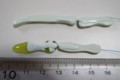
In an entry published in March 2018, a customer reported that linked chips had tangled near the prostate and required hospital removal. Mr. Okada said this was the first such hospital report he had received. He proposed lengthening the front chip from approximately 25–28 mm to 30 mm or more, suspecting rotation. He cautioned that even 30 mm might still allow rotation, depending on the person.
(Source: ok-lab's diary, published March 2018)
https://ok-lab.hatenablog.com/entry/20180310/1520672565
A stuck chip with detached thread required difficult hospital treatment
In an entry published in May 2018, a customer reported a detached thread on a custom 41 mm chip. The chip reached the bladder, with worsening pain and blood in the urine before hospital treatment. Hospital removal involved an endoscope (an internal viewing instrument) and medical grasping instruments; the customer's reported charge was approximately ¥29,000 (about $186 at ¥156 = $1, rate as of 2026-09-04). The customer later reported recovery, while Mr. Okada explicitly declined to add his own comments.
(Source: ok-lab's diary, published May 2018)
https://ok-lab.hatenablog.com/entry/20180511/1526036007
A stuck chip remained sideways despite an internal stopper
In an entry published in April 2022, a customer reported that a double-twist ceramic chip had entered the bladder despite an internal stopper. A scan showed it toward the bladder's right side, away from alignment with the urine passage. Initial hospital treatment failed, but subsequent removal succeeded; the reported cost was approximately ¥8,000 (about $51 at ¥156 = $1, rate as of 2026-09-04). Mr. Okada questioned internal stoppers for people whose stoppers passed inward, favoring an external stopper instead.
(Source: ok-lab's diary, published April 2022)
https://ok-lab.hatenablog.com/entry/2022/04/02/123050
A stuck chip had turned completely around despite accessible threads
In an entry published in August 2022, a customer reported pain and bleeding from a stuck 37 mm resin chip with an auxiliary screw. Both threads remained outside, but the doctor found the chip had turned 180 degrees.
Hospital removal took approximately 20 minutes, with a reported charge of about ¥23,000 (about $147 at ¥156 = $1, rate as of 2026-09-04). The customer decided to stop using chips; Mr. Okada acknowledged that this experienced customer's accident defeated a simple appeal for greater care.
(Source: ok-lab's diary, published August 2022)
https://ok-lab.hatenablog.com/entry/2022/08/27/123001
The maker's answer to stuck chip problems
The diary records changes to sizes, attachments, and stoppers, alongside reports that still required medical help.
External stoppers address lost threads in a stuck chip case
In an entry published in March 2019, a cross-jointed resin chip user asked how to prevent another incident after the thread disappeared inside. The customer had already reported successful release when the sales staff answered the prevention question. Staff recommended external stoppers (parts intended to keep thread outside the penis). They separately suggested a sphincter stopper (an internal part intended to limit movement toward the bladder).
(Source: ok-lab's diary, published March 2019)
https://ok-lab.hatenablog.com/entry/2019/03/23/173222
A stuck chip follow-up prompted advice to seek care sooner
In an entry published in May 2020, a customer could not recover a short twisted ceramic chip with an auxiliary screw. The initial reply emphasized an accessible thread, possible entanglement, and spontaneous release. The next morning brought no improvement, so Mr. Okada shifted toward prompt urological care.
The customer later reported release, but the lost chip could not be inspected. For future purchases, the reply favored a single chip with a sphincter stopper, acknowledging that protection was not certain. Mr. Okada's final advice during the unresolved episode was early consultation with a urologist.
(Source: ok-lab's diary, published May 2020)
https://ok-lab.hatenablog.com/entry/2020/05/02/131505
Stuck chip complaints prompted an independent second retrieval thread
In an entry published in September 2020, a customer reported that a curved ceramic chip (sea slug version 4) would not come out. The customer subsequently reported successful removal.
Mr. Okada then tested the design himself and blamed the offset thread position for awkward loading. His modification added an independent second thread on the opposite side. The reply also advised urological consultation when removal was unsuccessful.
(Source: ok-lab's diary, published September 2020)
https://ok-lab.hatenablog.com/entry/2020/09/05/095734
A broken cable caused another stuck chip despite attempted repairs
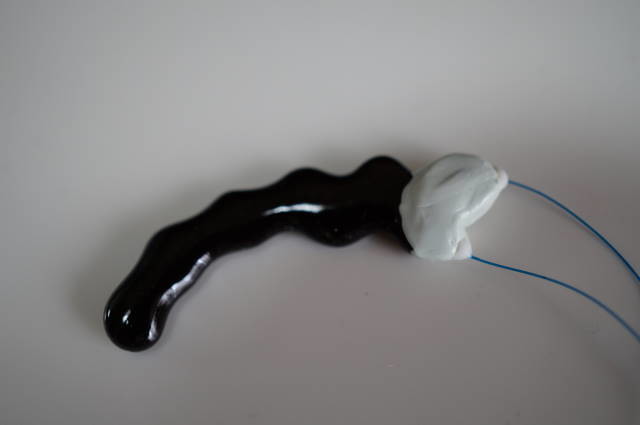
In an entry published in November 2020, Mr. Okada described a custom vibrating chip whose cable covering repeatedly peeled after repairs. The customer continued using it, the cable broke, and the chip reached the bladder. An initial hospital attempt failed, but an update reported later removal without further hospital treatment. Mr. Okada warned against using cables with exposed conductors.
(Source: ok-lab's diary, published November 2020)
https://ok-lab.hatenablog.com/entry/2020/11/14/131426
The manual offered several explanations for stuck chip problems
In an entry published in July 2021, Mr. Okada's manual listed drying, sticky semen, bladder entry, rotation, and overlapping chips as explanations. It distinguished thread breakage from cases where an attached thread could not free the chip. For hospital treatment, the manual pointed toward facilities with urology and emergency services.
(Source: ok-lab's diary, published July 2021)
https://ok-lab.hatenablog.com/entry/2021/07/24/125923
If you see blood in your urine, even a small amount or for the first time, do not wait and see. See a urologist right away. If you suddenly cannot urinate, or the device cannot be removed, do not try to fix it yourself. Go to a medical facility, including emergency care, immediately.
How stuck chip problems changed over time
| Published | What the diary said then |
|---|---|
| Jan 2018 | Epoxy resin (a bonding material) replaced silicone after thread detachments. |
| Feb 2018 | Coatings became thicker after reports of resin peeling from linked chips. |
| Apr 2019 | A broken-thread incident prompted a replacement with backup threading. |
| Mar 2021 | Mr. Okada rejected the freely stretching steel-ring design because it pinched tissue. |
| Jun 2021 | A proposed loop connection raised rotation concerns if one end broke. |
| Jan 2023 | A screw attachment reportedly jammed despite a 0 mm connection distance. |
| Mar 2024 | Experimental elastomer (soft, bendable material) chips became hard to remove when dry, Mr. Okada reported. |
| Jun 2025 | A cracked auxiliary screw remained inside after the main chip came out. |
| Apr 2026 | A retrieval-tool prototype remained unfinished while a customer planned medical consultation. |
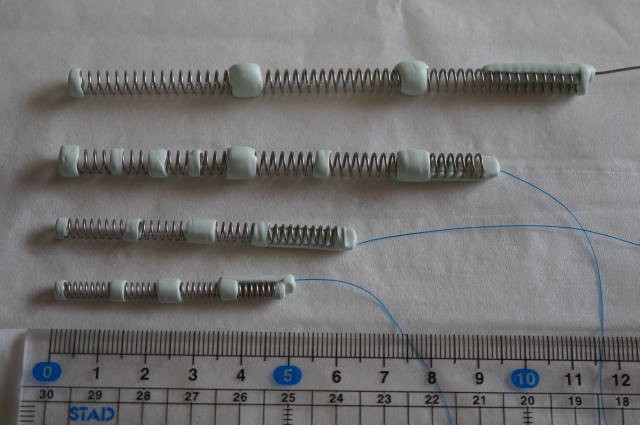
OK Prostate Chip products related to stuck chip problems
The current list includes products from an accident report and stoppers the diary proposed as safeguards.
Products that appear in these entries
| Product (official name) | Price incl. tax | Relation to this topic |
|---|---|---|
| Short twisted ceramic chip (OKプロステートチップ 陶器素材ショートタイプ ツイスト) | ¥4,400 (about $28 at ¥156 = $1, rate as of 2026-09-04) | In May 2020, this chip with an auxiliary screw could not initially be removed. |
| Screw-shaped auxiliary chip option (スクリュー型補助チップ追加オプション) | ¥3,300 (about $21 at ¥156 = $1, rate as of 2026-09-04) | In May 2020, this attachment accompanied the stuck short twisted ceramic chip. |
(Source: ok-lab's diary, published May 2020)
https://ok-lab.hatenablog.com/entry/2020/05/02/131505
Products the diary mentioned as alternatives
| Product (official name) | Price incl. tax | Relation to this topic |
|---|---|---|
| Thread-retaining external stopper (OKプロステートチップ用糸飲み込み防止ストッパーチップ) | ¥550 (about $4 at ¥156 = $1, rate as of 2026-09-04) | In March 2019, staff proposed this stopper to prevent another loss of accessible thread. |
| Three-hole external stopper (三穴方式オプションチップ(亀頭外側ストッパーチップ)) | ¥1,100 (about $7 at ¥156 = $1, rate as of 2026-09-04) | In March 2019, staff also proposed this external stopper to keep the thread outside. |
| Three-hole sphincter stopper (三穴方式オプションチップ(括約筋ストッパーチップ)) | ¥1,650 (about $11 at ¥156 = $1, rate as of 2026-09-04) | In March 2019, staff suggested this internal stopper to address bladder entry itself. |
(Source: ok-lab's diary, published March 2019)
https://ok-lab.hatenablog.com/entry/2019/03/23/173222
The historical builds include the 41 mm custom chip, curved ceramic chip (sea slug version 4), and repaired vibrating chip. The hollow, stretching-ring, elastomer, and retrieval-tool designs were experimental. No matching product can be confirmed on the current list.
Common worries about stuck chip problems
The reader questions cover threadless use, bleeding, and what happened when a chip remained inside.
"Can a threadless long chip get stuck?"
In an entry published in February 2018, a customer asked about using a long chip without its retrieval thread. Mr. Okada declined to recommend this because release might not occur when wanted. The customer's short chip subsequently became stuck, then came out the following morning; this was not a reported long-chip trial. Mr. Okada discouraged threadless use.
(Source: ok-lab's diary, published February 2018)
https://ok-lab.hatenablog.com/entry/20180214/1518601774
"Could ejaculation explain my stuck chip and bleeding?"
In an entry published in October 2021, a curved ceramic chip user asked about repeated bleeding during removal after ejaculation. This was the sea slug version 4; staff referred to the additional retrieval-thread option. Mr. Okada's answer addressed the two-direction thread arrangement and removal timing; he suspected that semen becoming sticky could increase resistance. The diary does not record whether the customer's bleeding stopped.
(Source: ok-lab's diary, published October 2021)
https://ok-lab.hatenablog.com/entry/2021/10/23/125707
"Could a new tool recover my stuck chip?"
In an entry published in April 2026, a customer reported that a blue resin chip remained inside after approximately 1 week. This followed the broken-thread report published in March 2026; Mr. Okada suspected that the chip was held between sphincters. The customer described pain and asked whether a newly developed tool could help.
Mr. Okada explained that the existing tool lacked the required retrieval function and proposed a separate prototype. A follow-up published in April 2026 identified the customer as living outside Japan and planning a urology visit in Japan. The material does not record whether the chip was eventually removed.
(Source: ok-lab's diary, published March 2026)
https://ok-lab.hatenablog.com/entry/2026/03/28/122908
(Source: ok-lab's diary, published April 2026)
https://ok-lab.hatenablog.com/entry/2026/04/04/122916
(Source: ok-lab's diary, published April 2026)
https://ok-lab.hatenablog.com/entry/2026/04/18/122906
Buying from outside Japan

OK Lab ships internationally to countries covered by Japan Post's EMS courier service. Overseas orders are paid in advance by PayPal. Each order carries a ¥400 (about $3 at ¥156 = $1, rate as of 2026-09-04) handling fee, and EMS shipping is charged on top. These terms come from OK Lab's official sales-terms page (written here as plain text, not a link: ok-lab.net/docs/law), checked on September 7, 2026; confirm them on the official store before you order, because they can change.
Summary of this article
| What you wanted to know | The answer |
|---|---|
| In short | A device that cannot be removed needs immediate medical care. |
| About this product | A urethral device made by a small Japanese company, priced in JPY. |
| Key terms | Threads connect to chips; external and internal stoppers have different purposes. |
| What happens | Reports include detached threads, tangled parts, rotation, and difficult hospital removal. |
| The maker's answer | Designs and safeguards changed, while serious incidents continued. |
| Changes over time | Attachment changes and rejected prototypes did not end the reports. |
| Related products | Current prices identify listed products; they do not confirm old custom specifications. |
| Common worries | Threadless use drew warnings; the 2026 removal outcome remains unrecorded. |
| Buying outside Japan | Advance PayPal payment, a ¥400 (about $3 at ¥156 = $1, rate as of 2026-09-04) handling fee, and additional EMS shipping apply. |
Source: ok-lab's diary (Okada Comfortable Life Laboratory). The original entries are in Japanese; quotations on this page are translated. Photos and videos are on the original entries.
This article is a summary of the maker's development diary. The product is not a medical device and no result is guaranteed. If anything feels wrong or worries you, see a doctor. Prices, specifications and cautions change, so confirm the latest information on the official blog and the official site. Questions about ordering and shipping go to the seller.