![How are prostate chips connected? | The joint depends on the design [OK Prostate Chip]](/img/a/T0229/eyecatch.svg)
This page is based on entries from "ok-lab's diary" (https://ok-lab.hatenablog.com/), the Japanese development diary written by Mr. Okada, founder of OK Lab, a small company in Japan (Okada Comfortable Life Laboratory). Only entries about connecting chips together are summarized here, in order of publication. Past prices and sizes are as written at the time. Current prices come from the official product list (retrieved September 4, 2026). Quotations are translated from Japanese.
Note: This page is a personal reading log by someone with no connection to the maker or the seller. It reflects the source entries as of their publication dates and makes no guarantee of accuracy or safety. The product is not a medical device; talk to a doctor about any health decision. Check the official site for current information. This page contains advertising.
In short
- Chip connections changed as the maker encountered broken wire, peeling rubber, and difficult removal.
- Mr. Okada proposed different joints for different designs, sometimes refusing combinations he could not assess.
- Related parts appear on the current list, but historical custom connection prices do not establish today's availability.
If you see blood in your urine, even a small amount or for the first time, do not wait and see. See a urologist right away.
If you suddenly cannot urinate, or the device cannot be removed, do not try to fix it yourself. Go to a medical facility, including emergency care, immediately.
About this product
The OK Prostate Chip is a small device that is placed in the urethra (the urine passage) so that it acts on the prostate; the maker sells it in several shapes, sizes and materials.
It is made and sold by OK Lab (Okada Comfortable Life Laboratory), a small company in Japan, through its own online store, and prices are in Japanese yen (JPY). The maker's development diary, "ok-lab's diary", is written in Japanese. This page is an English summary of it, and every quotation is translated. OK Lab ships internationally, so readers outside Japan can order (see "Buying from outside Japan" below). Product names on this page are plain-English descriptions. The official Japanese product name is shown once in the product table so you can find the same item in the store.
Before you read: key terms
| Term | Plain-English meaning |
|---|---|
| Cross joint | An interlocking connection allowing chips to bend vertically and horizontally. |
| Metal fatigue | Damage from repeated bending; the maker used this term to explain wire failure. |
| Screw support chip | A screw-shaped secondary part connected behind a main chip to help support its position. |
| Tube spring connection | Tubing surrounding connecting thread, intended to help a bent joint return toward its original shape. |
| Nitinol | The shape-memory wire used in later connections to provide flexible support. |
| Epoxy resin | A hard covering material used around some wire connections. |
What happens: connecting prostate chips
The OK Prostate Chip is a small device placed in the urethra to act on the prostate. Connecting chips means joining a main chip to another chip or a support part within the same assembly. The diary describes thread, cable, wire, and rubber-covered joints between those pieces. Mr. Okada changed these connections to address bending, overlapping, breakage, and how firmly the separate parts remained linked inside the urethra.
Cross joints became the standard for connected resin chips
In September 2018, Mr. Okada introduced a cross joint (an interlocking connection allowing vertical and horizontal bending). He described the previous tip-to-tip arrangement as somewhat unstable.
The change covered ordinary resin pairs and screw-shaped resin pairs. Mr. Okada made this joint standard for connected resin models and invited interested customers to consider it.
(Source: ok-lab's diary, published September 2018)
https://ok-lab.hatenablog.com/entry/20180908/1536384939
Short steel chip connections failed after about three weeks
In October 2019, Mr. Okada reported that a thick stainless steel connection broke after about 3 weeks of testing. The joining span was extremely short.
He blamed metal fatigue (damage from repeated bending) concentrated at the same point and abandoned that design. Nylon survived his pulling test, but he still chose 2 strands as a precaution. Mr. Okada planned further thread testing before offering a replacement.
(Source: ok-lab's diary, published October 2019)
https://ok-lab.hatenablog.com/entry/2019/10/12/125944
Thicker wire made chip connections too stiff for extended wear
In January 2021, Mr. Okada compared wire thicknesses for angled connections. He said 0.7mm wire resisted bending too strongly for extended wear.
The entry's amended price section lists ¥1,000 (about $6 at ¥156 = $1, rate as of 2026-09-04) per span, regardless of length, plus ¥1,000 (about $6 at ¥156 = $1, rate as of 2026-09-04) per connected chip, excluding tax. Long-term durability was unknown at publication. For that connection, Mr. Okada preferred 0.5mm wire.
(Source: ok-lab's diary, published January 2021)
https://ok-lab.hatenablog.com/entry/2021/01/23/130107
Wire chip connections took longer to remove in one comparison
In March 2021, Mr. Okada reported that removing his 3-chip assembly took 20 minutes. Its connection combined 0.5mm wire and nylon beneath rubber covering.
He reported no bleeding afterward. His separate 4-chip cable-and-nylon assembly took 1 minute to remove. He acknowledged other construction differences, so this was not an isolated comparison of connector materials. Mr. Okada asked for more time to investigate.
(Source: ok-lab's diary, published March 2021)
https://ok-lab.hatenablog.com/entry/2021/03/20/130148
A rubber chip connection lost elasticity after seven reported uses
In June 2022, a customer requested repair of an angled assembly (Umiushi version 5) whose rubber connection had lost elasticity. They recalled only 7 uses and suspected a lifespan below 2 years, even without use.
The maker replied that repair required almost as much work as rebuilding. The customer proposed another connector, but Mr. Okada thought it would weaken the intended spring action. He cautioned against expecting durability beyond about 2 years.
(Source: ok-lab's diary, published June 2022)
https://ok-lab.hatenablog.com/entry/2022/06/18/123201
Integrated screw connections were tied to an attached stopper
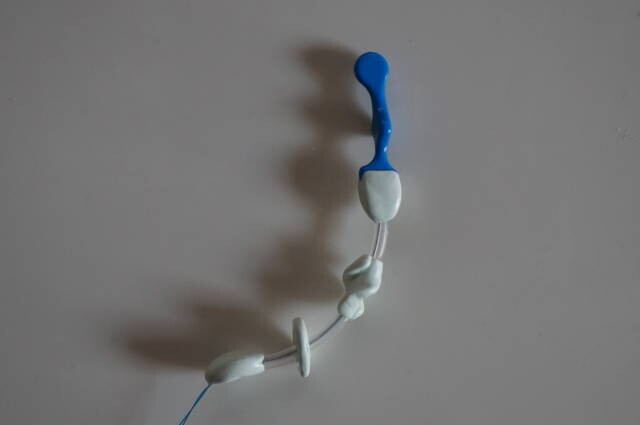
In October 2025, Mr. Okada described joining a main chip and screw support around concealed nitinol (shape-memory wire). The specified gap was 3–6mm.
The attached stopper cost ¥2,000 (about $13 at ¥156 = $1, rate as of 2026-09-04) excluding tax; joining the body and screw carried no additional charge in that arrangement. The screw had to be blue resin or stainless steel. Mr. Okada declined body-and-screw joining without the attached stopper.
(Source: ok-lab's diary, published October 2025)
https://ok-lab.hatenablog.com/entry/2025/10/11/123003
New ceramic chip connections used thinner joints with flexible wire
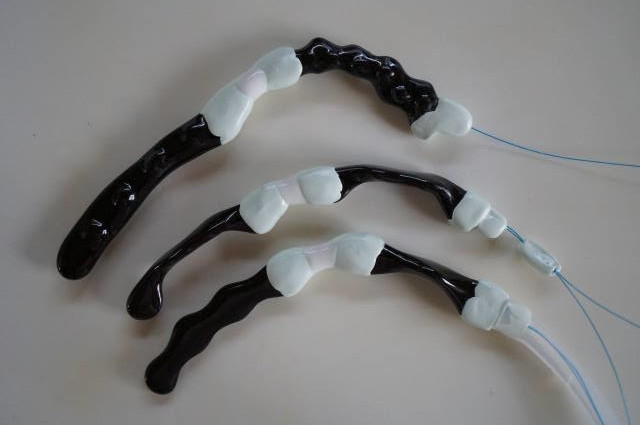
In January 2026, Mr. Okada described a revised angled ceramic pair (Umiushi version 5) using bonded nitinol instead of cable. He reported thinner connections and easier bending even at 90 degrees.
Published additions to the two chips' prices were ¥4,000 (about $26 at ¥156 = $1, rate as of 2026-09-04) with reinforcement or ¥3,000 (about $19 at ¥156 = $1, rate as of 2026-09-04) without it, excluding tax. These were custom construction charges. Mr. Okada made reinforcement the standard specification.
(Source: ok-lab's diary, published January 2026)
https://ok-lab.hatenablog.com/entry/2026/01/31/122917
The maker's answer to connecting prostate chips
The maker's proposed measures depended on the connection's shape, material, and reported failure.
Dedicated support parts were preferred for angled chip connections
In January 2021, a customer asked whether different ceramic chips could form angled pairs. Mr. Okada accepted arbitrary combinations, while describing manufacturing difficulties.
He considered the dedicated second chip's attachment arrangement stronger than the alternative construction discussed. His preferred second part was that dedicated component or a screw support chip (a screw-shaped secondary part supporting the main chip's position).
(Source: ok-lab's diary, published January 2021)
https://ok-lab.hatenablog.com/entry/2021/01/09/130022
Pain prompted a warning about thicker wire chip connections
In February 2021, a customer asked about 0.6mm wire. Mr. Okada lacked that thickness and tested 0.7mm instead.
He reported prostate pain after about 4 hours, despite initially finding the connection comfortable. For strength concerns, he pointed to an additional nylon connection. Based on his experience, he suggested avoiding 0.5mm or thicker wire for all-day wear.
(Source: ok-lab's diary, published February 2021)
https://ok-lab.hatenablog.com/entry/2021/02/06/125245
Rubber covering addressed overlapping risks in thin chip connections
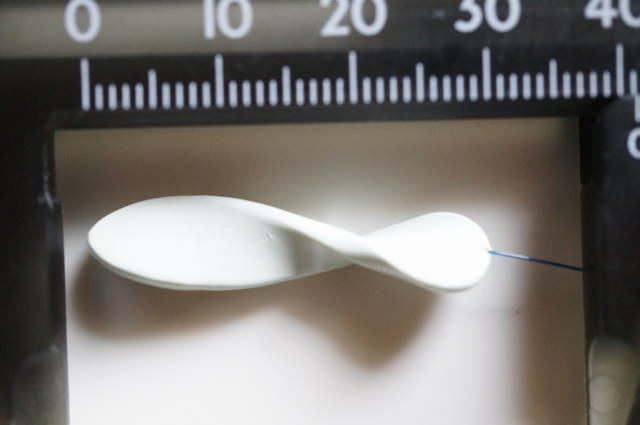
In May 2021, a customer requested a short ceramic twist chip connected to a thin custom second chip. They wanted thread alone across a gap of about 5mm.
The diary does not record how the finished combination felt in use. Mr. Okada requested rubber covering because he thought the thin chips could fold over each other inside the urethra.
(Source: ok-lab's diary, published May 2021)
https://ok-lab.hatenablog.com/entry/2021/05/15/130037
Tube spring connections were limited to a tested gap range
In August 2022, Mr. Okada tested a tube spring connection (tubing around thread intended to restore the joint's shape). It used 2mm tubing, with no additional charge.
He acknowledged that forced bending could still fold the chips together. The option was offered on request during testing. Mr. Okada limited the tested range to 2mm–6mm gaps.
(Source: ok-lab's diary, published August 2022)
https://ok-lab.hatenablog.com/entry/2022/08/27/123001
Cracked rubber chip connections prompted repair offers and shallower angles
In October 2022, a customer asked whether a cracked rubber connection remained usable. Staff described cracking as a warning of product deterioration and increased future breakage risk.
They offered repair with a shallower connection angle. The diary does not record this customer's result after repair. Mr. Okada said continued failures would prompt straighter designs, with unsuitable shapes potentially refused.
(Source: ok-lab's diary, published October 2022)
https://ok-lab.hatenablog.com/entry/2022/10/29/122854
Shape-memory chip connections came with a resin damage warning
In April 2024, Mr. Okada outlined shape-memory connections between a main chip and a support chip. Planned prices, excluding tax, were ¥3,000 (about $19 at ¥156 = $1, rate as of 2026-09-04) for the connection and ¥1,000 (about $6 at ¥156 = $1, rate as of 2026-09-04) for a tube cover.
A screw support was ¥3,000 (about $19 at ¥156 = $1, rate as of 2026-09-04), and a mesh stopper was ¥2,000 (about $13 at ¥156 = $1, rate as of 2026-09-04). The connection had an epoxy resin covering (a hard outer covering around the attachment). Mr. Okada advised stopping use if that outer resin broke.
(Source: ok-lab's diary, published April 2024)
https://ok-lab.hatenablog.com/entry/2024/04/13/123053
If you see blood in your urine, even a small amount or for the first time, do not wait and see. See a urologist right away.
If you suddenly cannot urinate, or the device cannot be removed, do not try to fix it yourself. Go to a medical facility, including emergency care, immediately.
How connecting prostate chips changed over time
| Published | What the diary said then |
|---|---|
| May 2019 | Two parallel wires needed about 10mm; one wire could bend across roughly 3mm. |
| Sep 2019 | Ceramic trials began with stainless steel connections confined to the gaps between chips. |
| Oct 2019 | Doubled 0.55mm wire produced a stiff, angle-adjustable prototype. |
| Jan 2020 | Nylon accompanied cable connections as an intended backup against cable damage. |
| Jul 2022 | Connecting ceramics cost ¥1,000 (about $6 at ¥156 = $1, rate as of 2026-09-04) extra; rubber joining cost ¥1,000, (about $6 at ¥156 = $1, rate as of 2026-09-04) both excluding tax. |
| Jul 2025 | Mr. Okada reported direct blue-chip thread connections with concealed thread ends. |
| Sep 2025 | Insufficient nitinol testing led to cable-and-nylon connections for a demanding ceramic custom build. |
| Jan 2026 | A four-joint ceramic prototype used paired 0.2mm wires; joining added ¥6,000, (about $38 at ¥156 = $1, rate as of 2026-09-04) excluding tax. |
The diary does not say what the current state is.
OK Prostate Chip products related to connecting prostate chips
The current list includes related ceramic and support parts; their listed prices do not include the historical custom builds.
Products that appear in these entries
| Product (official name) | Price incl. tax | Relation to this topic |
|---|---|---|
| Short ceramic twist chip (OKプロステートチップ 陶器素材ショートタイプ ツイスト) | ¥4,400 (about $28 at ¥156 = $1, rate as of 2026-09-04) | In May 2021, this was the first chip in a requested thread-only pair that prompted a rubber-covering recommendation. |
The short ceramic twist chip is listed in the company's own online store.
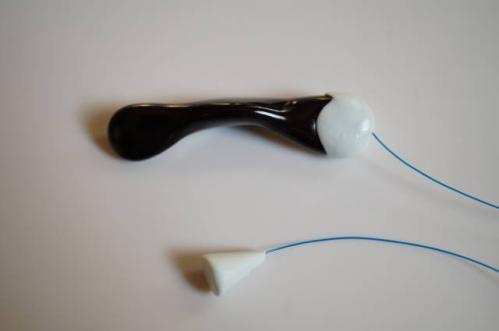
(Source: ok-lab's diary, published May 2021)
https://ok-lab.hatenablog.com/entry/2021/05/15/130037
Products the diary mentioned as alternatives
| Product (official name) | Price incl. tax | Relation to this topic |
|---|---|---|
| Screw support chip option (スクリュー型補助チップ追加オプション) | ¥3,300 (about $21 at ¥156 = $1, rate as of 2026-09-04) | In January 2021, Mr. Okada preferred this support part or the dedicated second chip over arbitrary angled pairings. |
The screw support chip option is listed in the company's own online store.
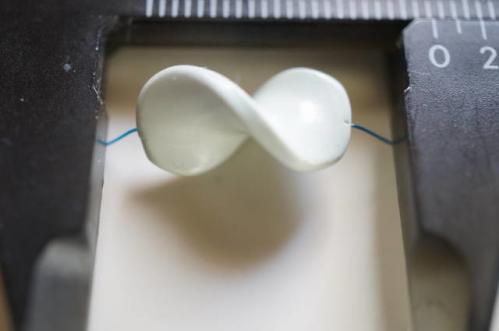
(Source: ok-lab's diary, published January 2021)
https://ok-lab.hatenablog.com/entry/2021/01/09/130022
The diary also describes custom angled assemblies, wire connections, integrated stopper combinations, and four-joint prototypes. No matching product can be confirmed on the current list.
In January 2026, the diary recalled discontinuing older thread-linked glass pairs because their threads tangled. A separate January 2026 reply called older nylon-core angled rubber joints effectively discontinued, although plain rubber covering remained possible.
(Source: ok-lab's diary, published January 2026)
https://ok-lab.hatenablog.com/entry/2026/01/10/122922
(Source: ok-lab's diary, published January 2026)
https://ok-lab.hatenablog.com/entry/2026/01/24/122909
Common worries about connecting prostate chips
Customer questions show that compatibility, replacement, and easier handling required separate answers.
"Can existing chips be connected into a longer chain?"
In April 2018, a customer wanted unused chips converted into a 6-chip chain. Mr. Okada explained that their mostly rounded tips made thread connections impossible or very difficult.
He also said a chain that long fell outside the company's product scope, leaving him unable to assess its usability. Mr. Okada therefore declined the work, including as a custom order.
(Source: ok-lab's diary, published April 2018)
https://ok-lab.hatenablog.com/entry/20180414/1523697398
"Can a failed rubber chip connection be replaced with steel?"
In January 2021, a customer reported near-total peeling between rubber and a screw support on a custom ceramic assembly (Umiushi version 2). This followed a free remake.
They asked whether steel could replace the joint, suggesting cable with rubber covering if steel was unsuitable. The supplied paragraph records the request but no maker reply or completed replacement.
(Source: ok-lab's diary, published January 2021)
https://ok-lab.hatenablog.com/entry/2021/01/30/122153
"Can screw chips have cable connections with a wider gap?"
In April 2022, a customer requested differently sized screw chips with a 30mm cable connection. Mr. Okada accepted the request, and the customer paid an additional ¥1,100 (about $7 at ¥156 = $1, rate as of 2026-09-04) for the connection work.
The diary does not record how the finished pair felt in use. Mr. Okada specified nylon alongside the cable, rather than a cable-only connection.
(Source: ok-lab's diary, published April 2022)
https://ok-lab.hatenablog.com/entry/2022/04/30/123451
"Do tube-covered screw connections make a chain easier to insert?"
In March 2024, a customer considering metal screw chips asked whether tube-covered connections would make a chain easier to insert. Mr. Okada said covering the thread was possible but could not promise easier insertion.
He thought tubing might cushion closely spaced chips. For easier handling, Mr. Okada favored one longer screw over several short connected screws.
(Source: ok-lab's diary, published March 2024)
https://ok-lab.hatenablog.com/entry/2024/03/02/123027
Buying from outside Japan
OK Lab ships internationally to countries covered by Japan Post's EMS courier service. Overseas orders are paid in advance by PayPal. Each order carries a ¥400 (about $3 at ¥156 = $1, rate as of 2026-09-04) handling fee, and EMS shipping is charged on top. These terms come from OK Lab's official sales-terms page (written here as plain text, not a link: ok-lab.net/docs/law), checked on September 7, 2026; confirm them on the official store before you order, because they can change.
Summary of this article
| What you wanted to know | The answer |
|---|---|
| What is the short answer? | Connections depend on chip shape, material, and the proposed assembly. |
| What is the product? | A urethral device made by OK Lab in Japan. |
| What do the connection terms mean? | They distinguish interlocking joints, thread, cable, wire, and spring-like tubing. |
| What happened in the diary? | Reports included broken wire, difficult removal, and deteriorated rubber. |
| What did the maker propose? | Different support parts, coverings, wire specifications, and repair designs. |
| What changed over time? | Later experiments added concealed thread connections and flexible wire joints. |
| What currently listed products relate? | The ceramic twist chip and screw support option have direct connections to these discussions. |
| Can any chips simply be joined? | Some requests were accepted; others were declined or remained unanswered. |
| How does overseas buying work? | Advance PayPal payment, a handling fee, and additional EMS shipping. |
Source: ok-lab's diary (Okada Comfortable Life Laboratory). The original entries are in Japanese; quotations on this page are translated. Photos and videos are on the original entries.
This article is a summary of the maker's development diary. The product is not a medical device and no result is guaranteed. If anything feels wrong or worries you, see a doctor. Prices, specifications and cautions change, so confirm the latest information on the official blog and the official site. Questions about ordering and shipping go to the seller.