![Can fishing line replace chip thread? | The maker favored surgical thread [OK Prostate Chip]](/img/a/T0208/eyecatch.svg)
This page is based on entries from "ok-lab's diary" (https://ok-lab.hatenablog.com/), the Japanese development diary written by Mr. Okada, founder of OK Lab, a small company in Japan (Okada Comfortable Life Laboratory). Only the entries about "fishing line instead of chip thread" are summarized here, in order of publication. Past prices and sizes are as written at the time. Current prices come from the official product list (retrieved September 4, 2026). Quotations are translated from Japanese.
Note: This page is a personal reading log by someone with no connection to the maker or the seller. It reflects the source entries as of their publication dates and makes no guarantee of accuracy or safety. The product is not a medical device; talk to a doctor about any health decision. Check the official site for current information. This page contains advertising.
In short
- Fishing line performed differently across the maker's tests; sewing thread also had durability limits.
- Mr. Okada favored surgical thread for comfort and warned against using a chip without its retrieval thread.
- The current list prices the glass semi-long chip at ¥4,400 (about $28 at ¥156 = $1, rate as of 2026-09-04) including tax.
About this product

The OK Prostate Chip is a small device that is placed in the urethra (the urine passage) so that it acts on the prostate; the maker sells it in several shapes, sizes and materials. It is made and sold by OK Lab (Okada Comfortable Life Laboratory), a small company in Japan, through its own online store, and prices are in Japanese yen (JPY).
The maker's development diary, "ok-lab's diary", is written in Japanese. This page is an English summary of it, and every quotation is translated. OK Lab ships internationally, so readers outside Japan can order (see "Buying from outside Japan" below).
Product names on this page are plain-English descriptions. The official Japanese product name is shown once in the product table so you can find the same item in the store.
Before you read: key terms
| Term | Plain-English meaning |
|---|---|
| Retrieval thread | Thread attached to the chip; Mr. Okada describes it as a backup for retrieving the device. |
| Nylon surgical thread | Nylon thread used to bind tissue in surgery; the maker selected it for chip connections. |
| Polyester thread | Machine-sewing thread tested as a possible chip-thread substitute; the maker reported breakage under strong tension. |
| Regilon sewing thread | A machine-sewing thread made from 100% nylon; proposed for the October 2017 trial arrangement. |
| Resin | Material used for chip bodies and for attachments between glass and thread. |
| Loop attachment | A thread-connection design intended to prevent complete separation from the chip. |
| Metal fatigue | Failure associated with repeated bending stress; Mr. Okada blamed it for the failed wire connector. |
| Urethral sound | A rodlike instrument for exploring or widening a passage; these entries discuss versions for the urethra. |
| Blue safety connector | An attachment component used for factory thread fitting to a sound; the diary does not explain its construction. |
What happens: fishing line instead of chip thread
The OK Prostate Chip is a small device placed in the urethra, with thread connecting it to other parts. Mr. Okada describes its retrieval thread (thread attached for recovery) as a backup. Proposed substitutes include fishing line and sewing thread, replacing nylon surgical thread (thread used to bind tissue in surgery). The diary also discusses thread extensions for a urethral sound (a rodlike instrument for exploring or widening a passage).
Sewing thread lowered the trial price without a long-term durability guarantee

In an entry published in October 2017, Mr. Okada proposed a ¥1,000 (about $6 at ¥156 = $1, rate as of 2026-09-04) excluding tax trial product. It used Regilon sewing thread (100% nylon machine-sewing thread) and omitted the separate factory embedding process. Parts-only buyers were also to receive soft sewing thread at no extra charge.
Mr. Okada considered the resin durable, but could not guarantee the thread's durability. Knots were another reason he would not guarantee long-term use, and these were proposed prices ahead of the planned launch. His advice was that the low-cost trial product was not intended for continued use.
(Source: ok-lab's diary, published October 2017)
https://ok-lab.hatenablog.com/entry/20171020/1508465071
A customer's fishing line proposal left actual chip use unreported
In an entry published in May 2018, a contributor with adhesive expertise sent Mr. Okada a fishing-line attachment proposal for trial chips. They questioned whether surgical thread had been selected for its bond with the resin (the material joining thread and glass). The contribution covered a glass trial chip and, in a follow-up, a resin trial chip.
The contributor reported ordinary nylon fishing line, but supplied no account of how the altered chips felt during use. Mr. Okada welcomed the proposal and said it had prompted further tests aimed at improving adhesion to glass. He continued to caution that the resin-separation problem remained unresolved.
(Source: ok-lab's diary, published May 2018)
https://ok-lab.hatenablog.com/entry/20180524/1527153380
Wire failure led Mr. Okada toward surgical thread connections
In an entry published in October 2019, Mr. Okada abandoned a stainless-steel connection after failure during about 3 weeks of testing. He blamed metal fatigue (failure associated with repeated bending stress), concentrated in the short connecting section. A fishing-line version then survived his prolonged pulling test, and he selected 2 strands as a precaution.
A later comparison of surface feel favored surgical thread over fishing line, according to his report. He still needed to determine how many surgical threads would provide suitable strength and how to produce the connection. His preferred development direction was a connection using several surgical threads, subject to further testing.
(Source: ok-lab's diary, published October 2019)
https://ok-lab.hatenablog.com/entry/2019/10/12/125944
A homemade chip used fishing line without establishing its durability
In May 2022's entry, a customer described making a titanium chip after thread on a purchased chip deteriorated. They chose nylon fishing line because, in their account, surgical thread was not readily available to ordinary buyers. They treated thread deterioration as something their homemade design would also face.
The customer reported a strongly positive experience with the homemade chip, but did not isolate the fishing line's contribution. The diary does not record separate testing of the replacement thread's long-term durability. Mr. Okada praised the craftsmanship, but gave no separate recommendation about the fishing line.
(Source: ok-lab's diary, published May 2022)
https://ok-lab.hatenablog.com/entry/2022/05/07/123013
The maker's answer to fishing line instead of chip thread
Mr. Okada treated material choice, attachment failure, and sound extensions as different problems.
Retrieval thread carried a separate factory charge for each part
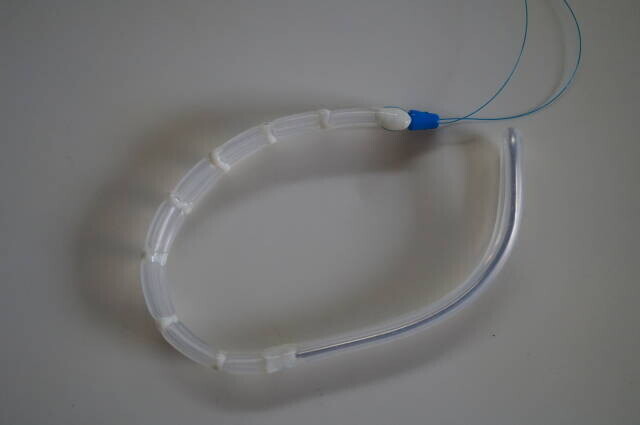
In an entry published in October 2017, Mr. Okada separated the cost of parts from the cost of embedding nylon surgical thread. That service cost ¥1,000 (about $6 at ¥156 = $1, rate as of 2026-09-04) excluding tax for 1 part, including the surgical thread itself. Purchasers arranging their own thread connection did not have to pay the embedding charge.
These were proposed launch terms; the diary said final prices would appear in the company's own online store. He put products intended for continued use in a ¥2,000 (about $13 at ¥156 = $1, rate as of 2026-09-04)–¥5,000 (about $32 at ¥156 = $1, rate as of 2026-09-04) price range. His advice was to choose from that group for continued use.
(Source: ok-lab's diary, published October 2017)
https://ok-lab.hatenablog.com/entry/20171020/1508465071
Retrieval thread gained loop attachments before resin separation was resolved
In an entry published in May 2018, Mr. Okada announced a loop attachment (a connection intended to prevent complete thread separation). He said shipments would use the new arrangement from May 24, 2018, with revised packaging distinguishing it from the earlier design. He believed complete thread detachment had been resolved, but said resin separation was still unresolved.
Requests to convert older connections were being accepted, with possible delays. For affected shipments from May 10 to May 23, 2018, he offered refunds, citing limited capacity for free thread replacement. His advice was to allow further time for the remaining adhesion tests.
(Source: ok-lab's diary, published May 2018)
https://ok-lab.hatenablog.com/entry/20180524/1527153380
Fishing line was accepted for sound extensions with separate fitting charges
In June 2023's entry, Mr. Okada accepted cord or fishing line for extending a sound that was too short. He limited the combined rigid and flexible sections to 22cm, explaining why an extension might be needed. Factory thread fitting with a blue safety connector (an attachment component) cost ¥2,000 (about $13 at ¥156 = $1, rate as of 2026-09-04) excluding tax.
A simple tied attachment was offered free, for customers accepting its less tidy appearance. The diary does not say what the current state is. His permission for fishing line in this entry concerned extending a sound.
(Source: ok-lab's diary, published June 2023)
https://ok-lab.hatenablog.com/entry/2023/06/03/121955
How fishing line instead of chip thread changed over time
| Published | What the diary said then |
|---|---|
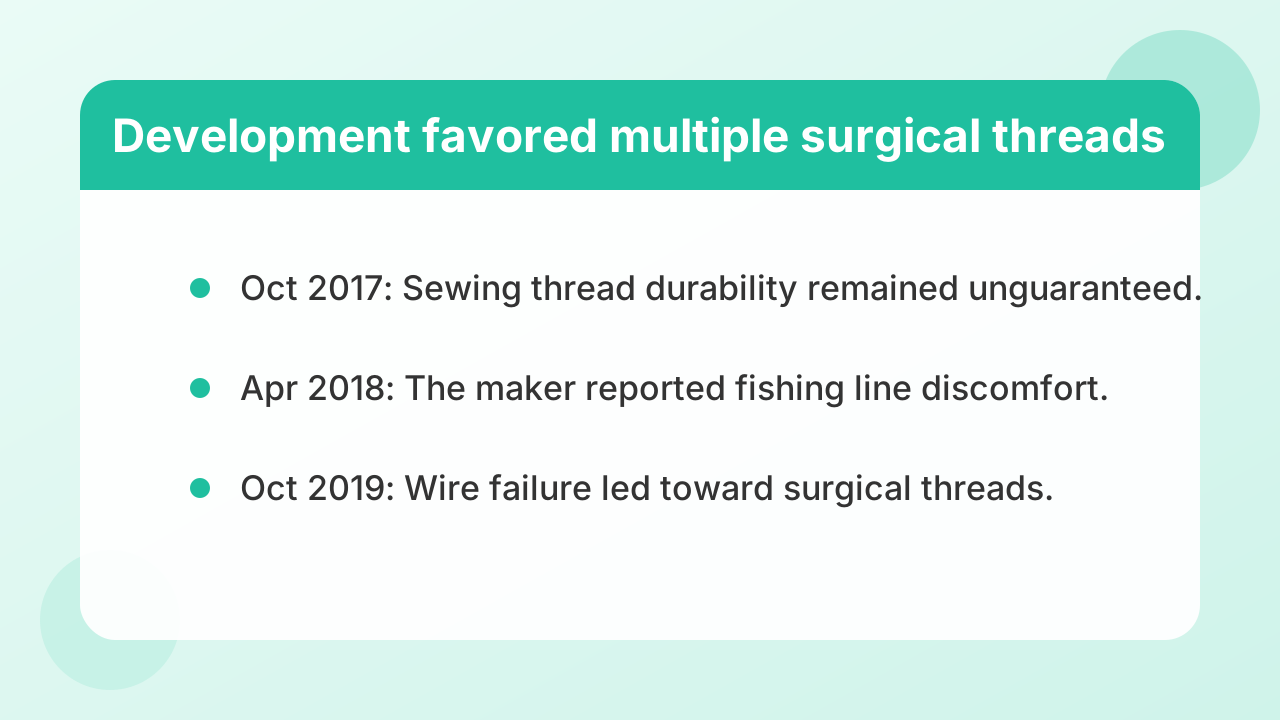
| Oct 2017 | Trial pricing used sewing thread; durability remained unguaranteed. |
| Apr 2018 | The maker reported discomfort with fishing line and breakage with polyester sewing thread. |
| May 2018 | Loop attachment began; resin separation remained unresolved. |
| Dec 2018 | He considered fishing line potentially acceptable, while explicitly saying it was untested. |
| Oct 2019 | A failed wire connection led development toward multiple surgical threads. |
| May 2022 | A customer reported fishing line in a homemade titanium chip after earlier thread deterioration. |
| Jun 2023 | Sound thread fitting: ¥2,000 (about $13 at ¥156 = $1, rate as of 2026-09-04) excluding tax with a connector; simple tying was free. |
OK Prostate Chip products related to fishing line instead of chip thread
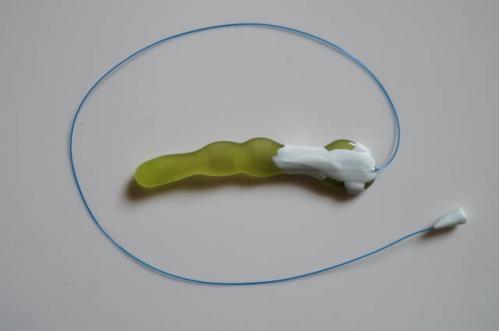
The current list includes the glass semi-long model involved in the May 2018 attachment complaint.
Products that appear in these entries
| Product (official name) | Price incl. tax | Relation to this topic |
|---|---|---|
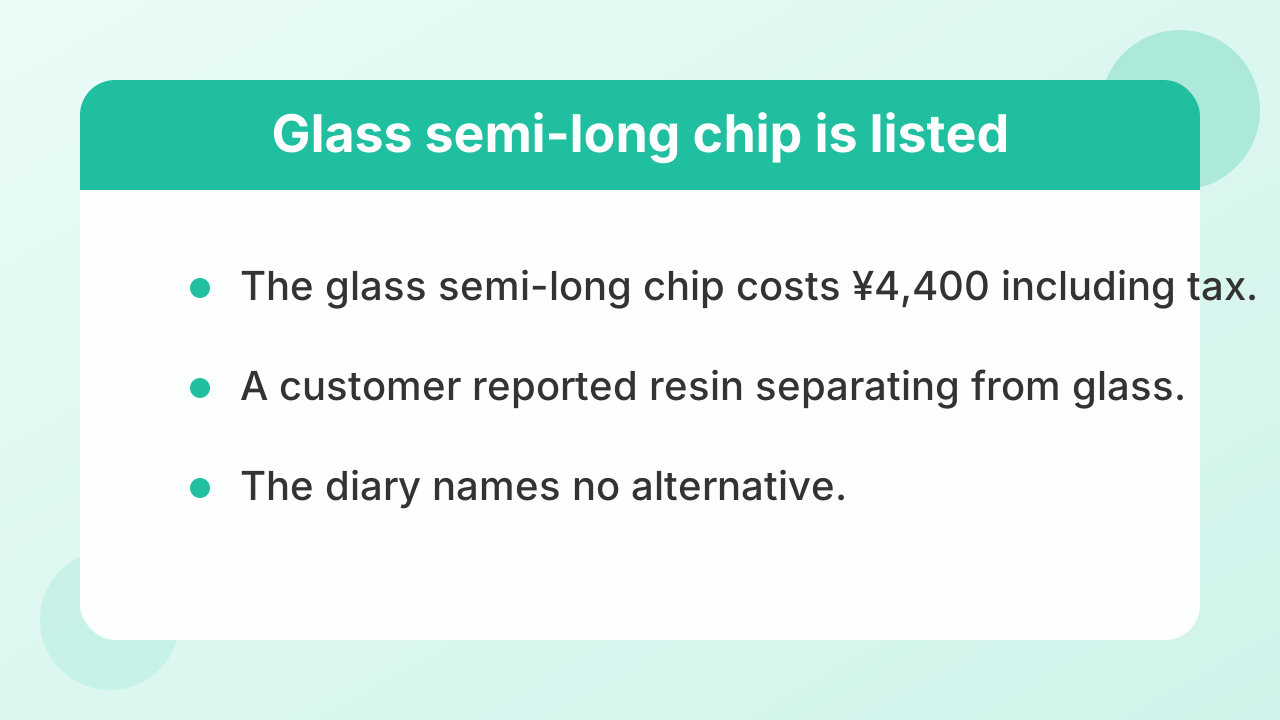
| Glass semi-long chip (OKプロステートチップ ガラス素材セミロングタイプ) | ¥4,400 (about $28 at ¥156 = $1, rate as of 2026-09-04) | In May 2018, a customer reported resin separating from the glass near this model's thread attachment. |
The glass semi-long chip is listed in OK Lab's own online store.
(Source: ok-lab's diary, published May 2018)
https://ok-lab.hatenablog.com/entry/20180524/1527153380
Products the diary mentioned as alternatives
The diary names no alternative.
October 2017's proposed parts arrangement, April 2018's custom trial size, and June 2023's sound configuration:
No matching product can be confirmed on the current list.
Common worries about fishing line instead of chip thread
The reader questions concerned missing threads, loosening attachments, and whether nylon fishing line was an acceptable substitute.
"Can a chip work without its retrieval thread?"
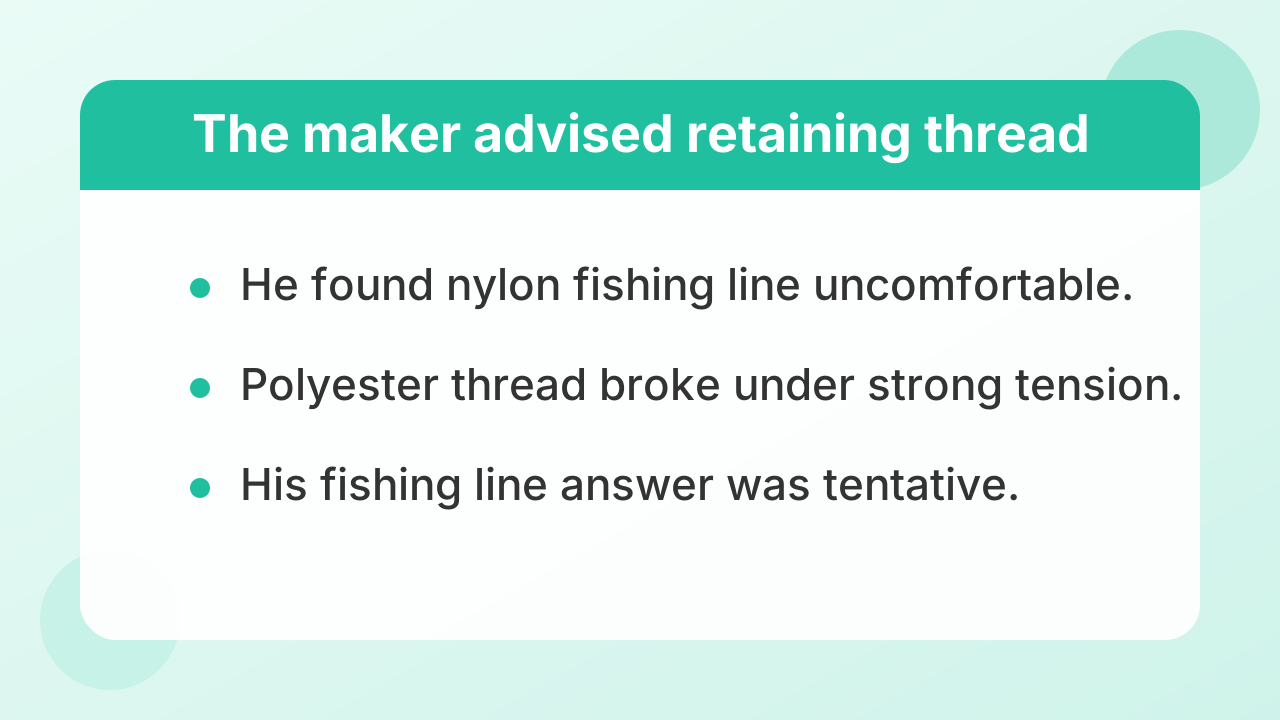
In an entry published in April 2018, a customer requested a custom trial chip after blaming nylon thread for urethral injuries. Mr. Okada accepted custom orders but described the retrieval thread as a lifeline, discouraging use of the chip alone. He found nylon fishing line uncomfortable; polyester thread (thread for machine sewing) felt comfortable but broke under strong tension.
He also warned that force on thread in a dry urethra could cause injury. The customer planned to try polyester thread, but the diary does not record how that felt in use. Mr. Okada again advised retaining the thread because the requested chip was larger.
(Source: ok-lab's diary, published April 2018)
https://ok-lab.hatenablog.com/entry/20180414/1523697398
"Is loose resin around the retrieval thread a problem?"
In an entry published in May 2018, a customer asked whether a glass semi-long chip remained usable after its attachment resin loosened. Movement near the retrieval thread had made the customer worry that the thread could detach.
Mr. Okada acknowledged similar reports, and the diary does not record whether this customer received a refund. His answer was a return for a refund, with any future purchase deferred until he offered a product without that concern.
(Source: ok-lab's diary, published May 2018)
https://ok-lab.hatenablog.com/entry/20180524/1527153380
"Is nylon fishing line equivalent to surgical thread?"
In an entry published in December 2018, a customer considering a trial chip asked about fishing line and whether the glass could separate. Mr. Okada considered fishing line and surgical thread alike in the limited sense that both were nylon. He said he selected thread used to bind tissue because he considered it gentlest on the urethral lining.
He also reported glass detachment complaints and a change to a thread-secured glass design, which he believed would prevent separation. The diary does not record whether this customer's proposed fishing-line arrangement was tried. His answer on fishing line was tentative: he said he had not tested it and thought it would probably be acceptable.
(Source: ok-lab's diary, published December 2018)
https://ok-lab.hatenablog.com/entry/20181222/1545459719
Buying from outside Japan

OK Lab ships internationally to countries covered by Japan Post's EMS courier service. Overseas orders are paid in advance by PayPal. Each order carries a ¥400 (about $3 at ¥156 = $1, rate as of 2026-09-04) handling fee, and EMS shipping is charged on top. These terms come from OK Lab's official sales-terms page (written here as plain text, not a link: ok-lab.net/docs/law), checked on September 7, 2026; confirm them on the official store before you order, because they can change.
Summary of this article
| What you wanted to know | The answer |
|---|---|
| What is the short answer? | Mr. Okada favored surgical thread; his fishing-line replies depended on the application. |
| What is the OK Prostate Chip? | A small urethral device made and sold by OK Lab in Japan. |
| What do thread and sound mean here? | Retrieval thread is a recovery backup; a sound is a separate rodlike instrument. |
| What did the examples show? | Price, breakage, surface feel, and attachment failure drove different material choices. |
| What measures did Mr. Okada describe? | Factory thread fitting, loop attachments, and extensions for sounds. |
| What changed over time? | The entries run from October 2017 trial pricing to June 2023 sound-extension options. |
| Which current product appears here? | The glass semi-long chip costs ¥4,400 (about $28 at ¥156 = $1, rate as of 2026-09-04) including tax on the current product list. |
| What did customers ask? | They asked about threadless use, loose attachment resin, and fishing line as a substitute. |
| How do overseas orders work? | Advance PayPal payment, a ¥400 (about $3 at ¥156 = $1, rate as of 2026-09-04) handling fee, and separate EMS shipping charges. |
Source: ok-lab's diary (Okada Comfortable Life Laboratory). The original entries are in Japanese; quotations on this page are translated. Photos and videos are on the original entries.
This article is a summary of the maker's development diary. The product is not a medical device and no result is guaranteed. If anything feels wrong or worries you, see a doctor. Prices, specifications and cautions change, so confirm the latest information on the official blog and the official site. Questions about ordering and shipping go to the seller.