![Is the chip cord too stiff? | Softer links helped movement, but wires still broke [OK Prostate Chip]](/img/a/T0227/eyecatch.svg)
This page is based on entries from "ok-lab's diary" (https://ok-lab.hatenablog.com/), the Japanese development diary written by Mr. Okada, founder of OK Lab, a small company in Japan (Okada Comfortable Life Laboratory). Only the entries about "wire core cords and cords with the core removed" are summarized here, in order of publication. Past prices and sizes are as written at the time. Current prices come from the official product list (retrieved September 4, 2026). Quotations are translated from Japanese.
Note: This page is a personal reading log by someone with no connection to the maker or the seller. It reflects the source entries as of their publication dates and makes no guarantee of accuracy or safety. The product is not a medical device; talk to a doctor about any health decision. Check the official site for current information. This page contains advertising.
In short
Wire reinforcement held curves, but some connections were too stiff, and later reports described broken wires.
Mr. Okada developed softer links for movement and later treated wire replacement as part of the design.
The current list includes the ring chip and screw-shaped support from an April 2021 connection inquiry.
About this product
The OK Prostate Chip is a small device that is placed in the urethra (the urine passage) so that it acts on the prostate; the maker sells it in several shapes, sizes and materials. It is made and sold by OK Lab (Okada Comfortable Life Laboratory), a small company in Japan, through its own online store, and prices are in Japanese yen (JPY). The maker's development diary, "ok-lab's diary", is written in Japanese. This page is an English summary of it, and every quotation is translated. OK Lab ships internationally, so readers outside Japan can order (see "Buying from outside Japan" below). Product names on this page are plain-English descriptions. The official Japanese product name is shown once in the product table so you can find the same item in the store.
Before you read: key terms
| Term | Plain-English meaning |
|---|---|
| Wire core cord | A cable sleeve containing metal wire, used between chips to help a connection hold its curve. |
| Soft chip cord | A sleeve without the metal core, used where a chip connection needs more flexibility. |
| Nylon thread | Reinforcing thread included in soft connections to help maintain their strength. |
| Electrode | The diary does not explain this. |
| Rubber coating | The outer covering Mr. Okada required around these connections. |
| Parallel cable | Two joined electrical leads; the later experiments added wire or a wire-containing tube alongside them. |
What happens: chip cord stiffness
The OK Prostate Chip is a small urethral device that the maker intends to press on the prostate. A wire core cord (a cable sleeve containing metal wire) joins chips and helps connections hold their shape. A soft chip cord (a sleeve without that metal core) provides a more flexible connection between chips. These links sit between chips inside the urethra, including longer assemblies reaching the moving part of the penis.
A wire core cord held its curve, with limits on coating durability
In an entry published in March 2021, a customer's request for stronger connections led Mr. Okada to a new construction. Its cord contained 0.5mm stainless wire in place of 24 copper strands, and he reported that it held a bend. He ruled out using the copper-free cord as an electrode (a term the diary does not explain).
Connection prices matched the earlier cord or wire versions, but rubber coating (an outer covering) was mandatory. Dedicated coating cost ¥500 (about $3 at ¥156 = $1, rate as of 2026-09-04) excluding tax per section, described as half the earlier bent connection's ¥1,000 (about $6 at ¥156 = $1, rate as of 2026-09-04) charge. Mr. Okada warned that reversing the original curve could strain the rubber and reduce durability.
(Source: ok-lab's diary, published March 2021)
https://ok-lab.hatenablog.com/entry/2021/03/27/130138
A soft chip cord addressed movement that displaced longer assemblies
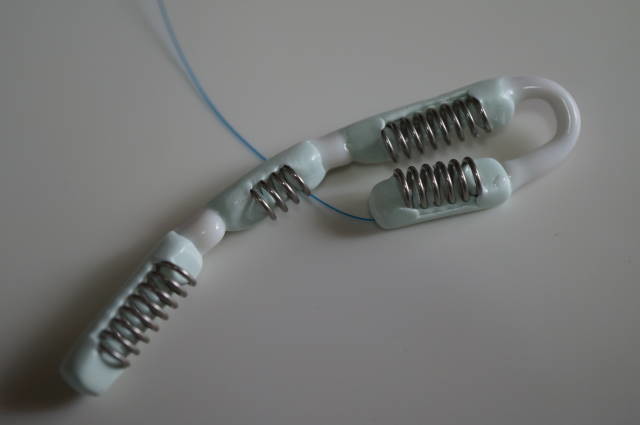
In an entry published in April 2021, Mr. Okada reported that the wire connection was too stiff in a longer assembly. Movement of the penis shifted its fourth chip, which also disturbed the chips nearer the prostate. He changed the affected connection to a cord without its metal core.
He reported that the softer connection could bend while maintaining the intended distance between chips. His initial account distinguished the pictured new assembly, which he had not tested internally, from an earlier assembly he had altered and tested. Mr. Okada favored the softer connection specifically for longer assemblies reaching the moving part of the penis.
(Source: ok-lab's diary, published April 2021)
https://ok-lab.hatenablog.com/entry/2021/04/03/130518
A soft chip cord also connected ceramic tips to screw supports
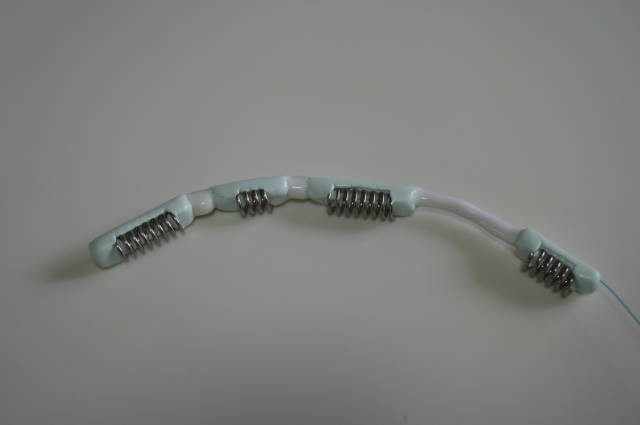
In an entry published in April 2021, Mr. Okada said his linked steel ring assembly felt too intense after about 3 days. He therefore tested a ceramic tip connected to screw-shaped supports through softer links. He described this trial as milder, while testing was still underway.
The ceramic connection incorporated nylon thread (reinforcing thread) inside the cord, with resin covering the attachment. Published spacing choices were 3mm–30mm, and prices apart from the leading chip matched the steel ring arrangement. Mr. Okada offered a choice of ceramic tip and number of screw-shaped supports for this construction.
(Source: ok-lab's diary, published April 2021)
https://ok-lab.hatenablog.com/entry/2021/04/10/125809
Wire breakage prompted a replacement with paired chip cords
In an entry published in June 2021, a customer who kept a device in place for 24 hours reported a broken wire. The customer ordered a replacement assembly with a different arrangement of connections. Mr. Okada showed paired cord sleeves, containing nylon thread in one and wire in the other.
The requested sections measured 2cm and 5cm, alongside 7.1mm steel ring chips. The diary does not record how the replacement performed for that customer. Mr. Okada cautioned that wire products had limits to their durability.
(Source: ok-lab's diary, published June 2021)
https://ok-lab.hatenablog.com/entry/2021/06/05/125933
Thicker wire-supported cable answered demand for the discontinued support
In an entry published in June 2023, a customer asked whether a previously comfortable 4-wire support cable could be made again. Mr. Okada cited the old design's strength problem and built a different support using thicker wire. About 5mm immediately behind the vibrating chip remained soft, followed by approximately 8cm supported by 1.2mm stainless wire.
Published additions, excluding tax, were ¥2,000 (about $13 at ¥156 = $1, rate as of 2026-09-04) for 6cm, ¥2,500 (about $16 at ¥156 = $1, rate as of 2026-09-04) for 8cm, and ¥3,000 (about $19 at ¥156 = $1, rate as of 2026-09-04) for 10cm. The diary describes the build but does not record the customer's experience with it. Mr. Okada warned that damage to the softer cable could separate it from the wire, whose ends he had rounded.
(Source: ok-lab's diary, published June 2023)
https://ok-lab.hatenablog.com/entry/2023/06/10/123053
The maker's answer to chip cord stiffness
Mr. Okada separated flexibility, shape retention, and breakage into different design problems.
A soft chip cord had strict limits on connection length
In an entry published in April 2021, Mr. Okada said the softer option could not accommodate sections 3cm or longer. He required reinforcing nylon thread and rubber coating for this construction. Its price was the same as the wire core version at that time.
He reported that shorter assemblies ending before the moving penile section worked for him with wire cores alone. He also said the overall length needed to reach that section varied between individuals. Mr. Okada asked custom-order customers to specify which connection sections required the softer construction.
(Source: ok-lab's diary, published April 2021)
https://ok-lab.hatenablog.com/entry/2021/04/03/130518
A wire-supported cable remained experimental while its materials were compared
In an entry published in March 2022, Mr. Okada described about 0.4mm wire alongside a parallel cable (two joined electrical leads). He reported easier bending and better shape retention than the stiffer custom cable he compared it with. His assessment of comfort came from his own testing.
In a later entry published in March 2022, he rejected nylon-coated wire because he felt the coating undermined the wire's useful behavior. He had not settled on the wire material or thickness. Mr. Okada emphasized that these choices still needed careful consideration.
(Source: ok-lab's diary, published March 2022)
https://ok-lab.hatenablog.com/entry/2022/03/12/122940
(Source: ok-lab's diary, published March 2022)
https://ok-lab.hatenablog.com/entry/2022/03/19/123203
Replaceable wire-supported cables followed reports of breakage in earlier designs
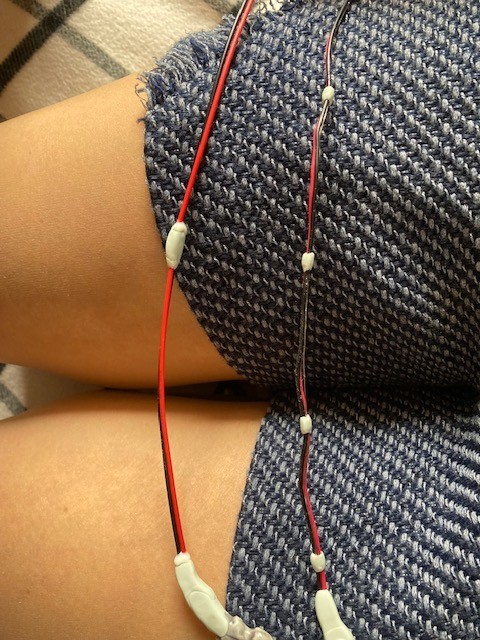
In an entry published in January 2023, Mr. Okada said the old 4-wire and 6-wire cables and earlier wire-in-tube support had been discontinued. Customers had reported breaks or signs that wires might break. He changed the design premise: wire had to be treated as a part that would eventually fail.
Direct wire attachments to chips or cables were abandoned; the new tube-based designs assigned wire replacement to the purchaser. He said the single-wire version could bend sharply, but repeated extreme bending would inevitably break it. Mr. Okada warned that more severe bending meant replacement would be needed sooner.
(Source: ok-lab's diary, published January 2023)
https://ok-lab.hatenablog.com/entry/2023/01/07/123115
How chip cord stiffness changed over time
| Published | What the diary said then |
|---|---|
| Mar 2021 | Metal reinforcement held curves, but reversing the coated bend could reduce durability. |
| Apr 2021 | Softer connections addressed movement in longer assemblies. |
| Apr 2021 | Softer connections were extended to ceramic tips with screw-shaped supports. |
| Jun 2021 | A broken wire prompted a replacement build and a durability warning. |
| Mar 2022 | Nylon-coated wire was rejected while material testing continued. |
| Jan 2023 | Earlier designs were discontinued; the new approach anticipated replaceable wires. |
| Jun 2023 | A thicker supported section combined stiffness with a soft connection behind the chip. |
| Jul 2023 | A further custom design used a replaceable wire, with proposed component prices. |
The diary does not say what the current state is.
OK Prostate Chip products related to chip cord stiffness
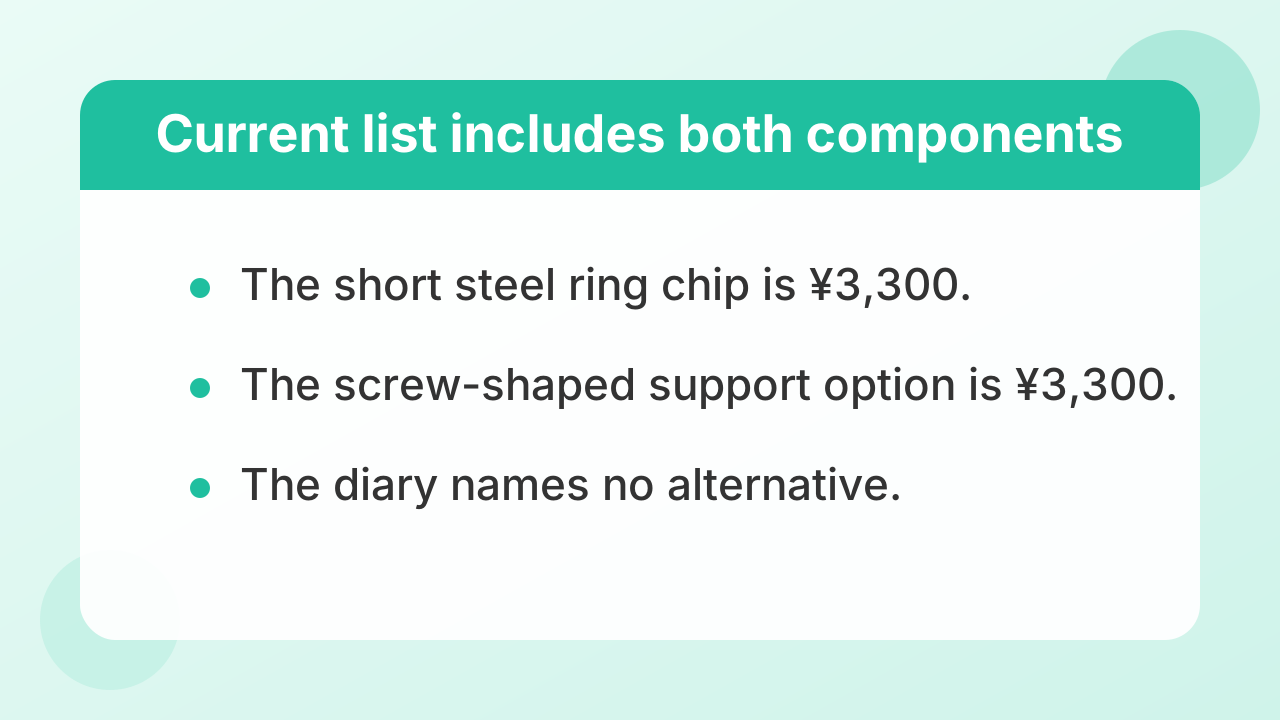
The current list includes the short steel ring chip and screw-shaped support discussed in an April 2021 connection inquiry.
Products that appear in these entries
| Product (official name) | Price incl. tax | Relation to this topic |
|---|---|---|
| Short stainless steel ring chip (OKプロステートチップ ステンレスリング ショートタイプ) | ¥3,300 (about $21 at ¥156 = $1, rate as of 2026-09-04) | In April 2021, a customer asked about adding stainless wire between this chip and a screw-shaped support. |
| Screw-shaped support option (スクリュー型補助チップ追加オプション) | ¥3,300 (about $21 at ¥156 = $1, rate as of 2026-09-04) | In the same April 2021 inquiry, this support was the other component requiring a separately charged wire attachment. |
The short stainless steel ring chip is listed in OK Lab's own online store.
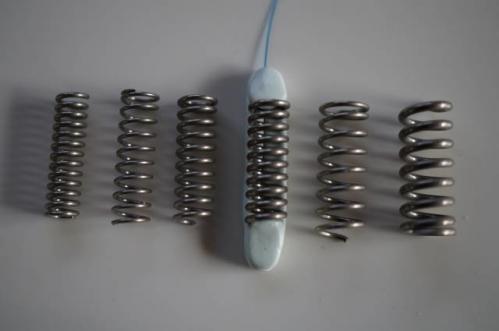
The screw-shaped support option is listed in OK Lab's own online store.
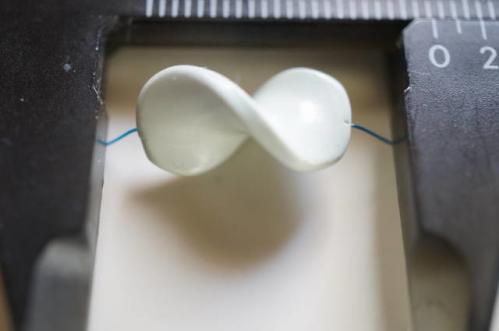
(Source: ok-lab's diary, published April 2021)
https://ok-lab.hatenablog.com/entry/2021/04/10/125809
Products the diary mentioned as alternatives
The diary names no alternative.
Custom linked assemblies and later cable designs: No matching product can be confirmed on the current list.
Common worries about chip cord stiffness
The reader inquiries concerned added reinforcement, fixed curves, and whether earlier custom cables could still be made.
"Can a chip connection include stainless wire and nylon thread?"
In an entry published in April 2021, a customer wanted both materials between a short steel ring chip and a screw-shaped support. The requested gap was 3cm, within an assembly specified as 14cm long. Mr. Okada explained that both components needed separately charged stainless attachments.
The diary does not record whether this order was completed. Mr. Okada's quoted condition was ¥1,100 (about $7 at ¥156 = $1, rate as of 2026-09-04) per chip requiring a stainless attachment.
(Source: ok-lab's diary, published April 2021)
https://ok-lab.hatenablog.com/entry/2021/04/10/125809
"Would a fixed curve solve chip cord stiffness?"
In an entry published in May 2021, a customer wanted a curved steel ring assembly that would neither stretch nor bend. The request followed the customer's preference for a curved ceramic model. Mr. Okada said resin could fix the connections into a curve.
The diary does not record a completed rigid version or its performance. Mr. Okada instead favored a wire core cord because it combined some flexibility with the ability to hold a chosen angle.
(Source: ok-lab's diary, published May 2021)
https://ok-lab.hatenablog.com/entry/2021/05/01/130245
"Could the earlier wire-supported cable still be custom-made?"
In an entry published in July 2023, a customer asked whether an earlier tube-supported cable could still be made in a longer configuration. Staff provisionally accepted, with pricing after production, but Mr. Okada changed the construction without first obtaining the customer's approval. He built it around a replaceable 0.7mm wire; the diary does not record the customer's response or experience.
Proposed prices, excluding tax, were ¥1,000 (about $6 at ¥156 = $1, rate as of 2026-09-04) for the base cord and ¥1,000 (about $6 at ¥156 = $1, rate as of 2026-09-04) for the base tube. The wire, up to 30cm, was another ¥1,000 (about $6 at ¥156 = $1, rate as of 2026-09-04). Mr. Okada favored easier replacement because he expected the earlier wire design to break again.
(Source: ok-lab's diary, published July 2023)
https://ok-lab.hatenablog.com/entry/2023/07/01/123130
Buying from outside Japan
OK Lab ships internationally to countries covered by Japan Post's EMS courier service. Overseas orders are paid in advance by PayPal. Each order carries a ¥400 (about $3 at ¥156 = $1, rate as of 2026-09-04) handling fee, and EMS shipping is charged on top. These terms come from OK Lab's official sales-terms page (written here as plain text, not a link: ok-lab.net/docs/law), checked on September 7, 2026; confirm them on the official store before you order, because they can change.
Summary of this article
| What you wanted to know | The answer |
|---|---|
| What is the short answer? | Softer connections addressed movement; wire breakage remained a separate concern. |
| What is the product? | A urethral device made by OK Lab in Japan, sold in Japanese yen. |
| What do the terms mean? | Wire cores hold curves; core-free sleeves allow softer connections between chips. |
| What happened in the cases? | Longer assemblies exposed stiffness problems, and later customers reported broken wires. |
| What did the maker change? | He developed flexible sections, tested reinforcement materials, and planned for wire replacement. |
| How did the designs develop? | The entries trace changing connections and cables from March 2021 through July 2023. |
| Which current products relate? | The listed ring chip and screw support appeared in a dated connection inquiry. |
| What did customers ask? | They asked about combined reinforcement, fixed curves, and renewed custom production. |
| How do overseas orders work? | Advance PayPal payment, a handling fee, and EMS shipping apply under the stated terms. |
Source: ok-lab's diary (Okada Comfortable Life Laboratory). The original entries are in Japanese; quotations on this page are translated. Photos and videos are on the original entries.
This article is a summary of the maker's development diary. The product is not a medical device and no result is guaranteed. If anything feels wrong or worries you, see a doctor. Prices, specifications and cautions change, so confirm the latest information on the official blog and the official site. Questions about ordering and shipping go to the seller.