![How thick and long is the retrieval thread? | Sizes changed by design [OK Prostate Chip]](/img/a/T0206/eyecatch.svg)
This page is based on entries from "ok-lab's diary" (https://ok-lab.hatenablog.com/), the Japanese development diary written by Mr. Okada, founder of OK Lab, a small company in Japan (Okada Comfortable Life Laboratory). Only the entries about "nylon thread thickness and length" are summarized here, in order of publication. Past prices and sizes are as written at the time. Current prices come from the official product list (retrieved September 4, 2026). Quotations are translated from Japanese.
Note: This page is a personal reading log by someone with no connection to the maker or the seller. It reflects the source entries as of their publication dates and makes no guarantee of accuracy or safety. The product is not a medical device; talk to a doctor about any health decision. Check the official site for current information. This page contains advertising.
In short
Nylon thread thickness and available lengths changed across the diary's designs.
Mr. Okada proposed extra strands and silicone covers to address strength and comfort concerns.
The current list includes loop-ended nylon thread and three-hole and six-hole stopper parts.
If you see blood in your urine, even a small amount or for the first time, do not wait and see. See a urologist right away.
If you suddenly cannot urinate, or the device cannot be removed, do not try to fix it yourself. Go to a medical facility, including emergency care, immediately.
About this product
The OK Prostate Chip is a small device that is placed in the urethra (the urine passage) so that it acts on the prostate; the maker sells it in several shapes, sizes and materials. It is made and sold by OK Lab (Okada Comfortable Life Laboratory), a small company in Japan, through its own online store, and prices are in Japanese yen (JPY).
The maker's development diary, "ok-lab's diary", is written in Japanese. This page is an English summary of it, and every quotation is translated. OK Lab ships internationally, so readers outside Japan can order (see "Buying from outside Japan" below).
Product names on this page are plain-English descriptions. The official Japanese product name is shown once in the product table so you can find the same item in the store.
Before you read: key terms
| Term | Plain-English meaning |
|---|---|
| Urethra | The urine passage; the device and part of its connecting thread occupy this passage. |
| Nylon suture | Medical stitching thread, used here to connect chip components and provide a retrieval connection. |
| Class 3 | A category Mr. Okada used to describe the suture's medical-device classification. The diary does not explain this. |
| Suture size codes | Labels such as 2-0 and 3-0, used to distinguish thread sizes in the maker's comparison. |
| Safety chip | An end piece intended to support retrieval; a later blue version also gathered multiple strands together. |
| Sphincter stopper | A small chip with what Mr. Okada describes as a barrier-like effect, intended to limit movement. |
| Silicone cover | A flexible tube around nylon thread, intended by the maker to protect it and change contact with tissue. |
| Double-tube tail | One tube enclosed within another, developed to increase the tail's rigidity while enclosing nylon strands. |
What happens: nylon thread thickness and length
The OK Prostate Chip is a small device placed in the urethra (the urine passage) to act on the prostate. The nylon suture (medical stitching thread) links the main chip with other parts, including a safety chip (an end piece intended to aid retrieval). In the October 2017 description, one continuous thread connected the pieces, with part of that thread lying inside the urine passage.
Nylon thread length initially involved planned spacing choices between components
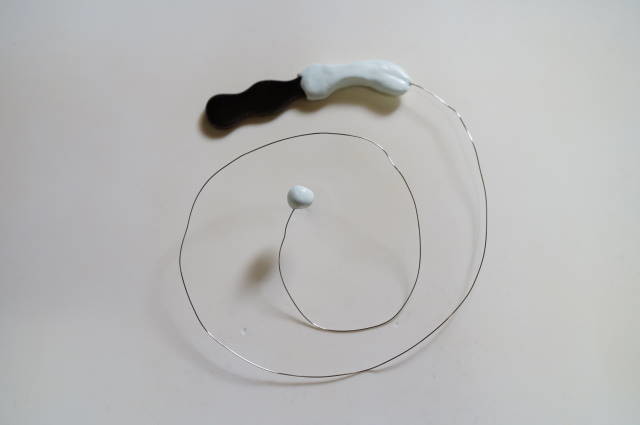
An entry published in October 2017 described nylon approximately 0.2 mm thick. Mr. Okada planned spacing choices in 1 cm steps between the main chip, an extra chip, and the safety end piece.
He explained that individual anatomy and changes during erection affected the spacing. A later October 2017 entry stated a maximum thread length of 40 cm, attributed to the medical suture being used. Mr. Okada advised customers to choose lengths with those individual differences in mind.
(Source: ok-lab's diary, published October 2017)
https://ok-lab.hatenablog.com/entry/20171009/1507521149
(Source: ok-lab's diary, published October 2017)
https://ok-lab.hatenablog.com/entry/20171023/1508726569
Nylon thread thickness settled on 3-0 after the largest sample irritated
An entry published in April 2019 explained the original comparison of 2-0, 3-0, 4-0, and 5-0 (suture size codes). Mr. Okada reported that none broke during his forceful hand-pulling checks.
He found the largest, 2-0, slightly irritating against sensitive lining and selected 3-0, the next-largest tested size. Mr. Okada cautioned that sharp edges could still damage the nylon, so careful handling remained necessary.
(Source: ok-lab's diary, published April 2019)
https://ok-lab.hatenablog.com/entry/2019/04/27/153239
Nylon thread thickness measured about 0.25 mm in the later comparison
An entry published in September 2019 described the nylon then in use as approximately 0.25 mm in diameter. The holes in three-hole and six-hole chips measured approximately 0.3 mm, leaving clearance for that nylon. The stainless-steel wire being tested measured 0.29 mm, making its fit much tighter. Mr. Okada cautioned that beginners might find stainless steel more stimulating or uncomfortable.
(Source: ok-lab's diary, published September 2019)
https://ok-lab.hatenablog.com/entry/2019/09/14/143710
Nylon thread length gained a separate extension with loops at both ends
An entry published in January 2021 introduced a loop-ended extension for a chip system whose thread already ended in a loop. Its specification was 20 cm of nylon thread, with a loop approximately 2 cm in diameter at each end. The published price was ¥500 (about $3 at ¥156 = $1, rate as of 2026-09-04) excluding tax.
Mr. Okada also planned a 30 cm thread version. The entry does not confirm that the longer version went on sale. He presented the extension as an option for customers uneasy about the short system's arrangement during an initial familiarization period.
(Source: ok-lab's diary, published January 2021)
https://ok-lab.hatenablog.com/entry/2021/01/16/124800
Covered nylon thread length was priced by separate prototype sections
An entry published in September 2022 described a silicone cover (a flexible tube surrounding the nylon) divided into sections. The first prototype had three 10 cm sections, giving the stated 30 cm length. Its nylon ran continuously through the sections, while the surrounding tubes were separate.
The published price was ¥1,000 (about $6 at ¥156 = $1, rate as of 2026-09-04) per section, or ¥3,000 (about $19 at ¥156 = $1, rate as of 2026-09-04) for that prototype, excluding tax. Mr. Okada set a maximum of four sections, explaining that longer assemblies became harder to make. He limited replacement service to matching specifications on products originally purchased with covered thread.
(Source: ok-lab's diary, published September 2022)
https://ok-lab.hatenablog.com/entry/2022/09/24/122837
A loop-shaped covered nylon thread had separate length limits and charges
The second prototype in an entry published in September 2022 incorporated a loop into the covered-thread assembly. Mr. Okada described that arrangement for a length behind the chip of 10 cm to 20 cm.
Its loop-part assembly charge was ¥1,000 (about $6 at ¥156 = $1, rate as of 2026-09-04) excluding tax, with a stated total of ¥4,000 (about $26 at ¥156 = $1, rate as of 2026-09-04) excluding tax. Mr. Okada specified two internal nylon strands for ceramic versions too, prioritizing strength because he expected the covering to conceal any difference in feel.
(Source: ok-lab's diary, published September 2022)
https://ok-lab.hatenablog.com/entry/2022/09/24/122837
The maker's answer to nylon thread thickness and length
Mr. Okada's proposals combined extra strands, protective tubing, and limits on which products could receive those changes.
Paired nylon thread avoided increasing the thickness of individual strands
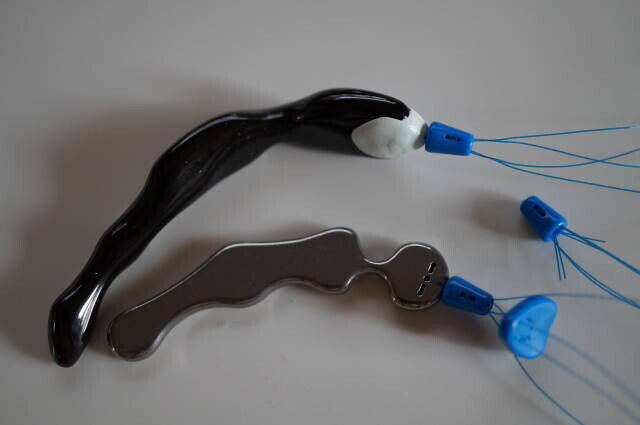
An entry published in April 2019 proposed two strands as Mr. Okada's preferred response to possible thread damage. He reported no extra thread sensation in his initial test, although the sphincter stopper (a barrier-like chip) felt different. The embedding charge stayed the same for one or two strands.
The two-strand arrangement did not include the usual safety chip because, he explained, the strands could stretch or shrink differently. Six-hole parts cost ¥500 (about $3 at ¥156 = $1, rate as of 2026-09-04) more than three-hole parts, excluding tax. Mr. Okada recommended a separately sold six-hole safety chip for the paired threads.
(Source: ok-lab's diary, published April 2019)
https://ok-lab.hatenablog.com/entry/2019/04/27/153239
A silicone cover addressed nylon thread deterioration from prolonged water exposure
In an entry published in September 2022, Mr. Okada identified gradual water-related breakdown as a weakness of nylon. He estimated that chip thread might last several years, or possibly less than one year if continuously submerged. Those were his estimates; the entry gives no completed lifespan test.
The proposed tube had an outside diameter of 1 mm and an inside diameter of 0.5 mm, enclosing two 0.25 mm nylon strands. He expected the cover to keep water away from the nylon and improve durability. He said existing ordinary-thread chips were not eligible for conversion to this construction.
(Source: ok-lab's diary, published September 2022)
https://ok-lab.hatenablog.com/entry/2022/09/24/122837
Covered nylon thread was proposed for gentler contact with sensitive tissue
In an entry published in September 2022, Mr. Okada also discussed discomfort from exposed nylon. He warned that forceful pulling on a stuck chip could make the thread dig into tissue and cause bleeding. His comparison of covered and uncovered thread involved contact with his tongue.
He reported gentler contact, but noted that silicone could collect dust and create more friction against the urethral lining. Mr. Okada promoted the covered thread on the basis of those personal observations.
(Source: ok-lab's diary, published September 2022)
https://ok-lab.hatenablog.com/entry/2022/09/24/122837
Four-strand nylon thread brought extra charges and strict replacement limits
In an entry published in May 2023, Mr. Okada linked heavier chips with greater load on their threads. He proposed four strands connected to the chip and gathered immediately behind it by a blue safety chip. He hoped extra strands would strengthen the connection without the change in sensation he associated with thicker nylon.
The quoted total was ¥2,500 (about $16 at ¥156 = $1, rate as of 2026-09-04) excluding tax: ¥1,500 (about $10 at ¥156 = $1, rate as of 2026-09-04) for the mandatory blue safety chip and ¥1,000 (about $6 at ¥156 = $1, rate as of 2026-09-04) for additional-thread work. Products originally sold with one or two strands could not become four-strand products through the thread-replacement service. Mr. Okada restricted four-strand replacement service to products originally purchased in that form.
(Source: ok-lab's diary, published May 2023)
https://ok-lab.hatenablog.com/entry/2023/05/13/123004
If you see blood in your urine, even a small amount or for the first time, do not wait and see. See a urologist right away.
If you suddenly cannot urinate, or the device cannot be removed, do not try to fix it yourself. Go to a medical facility, including emergency care, immediately.
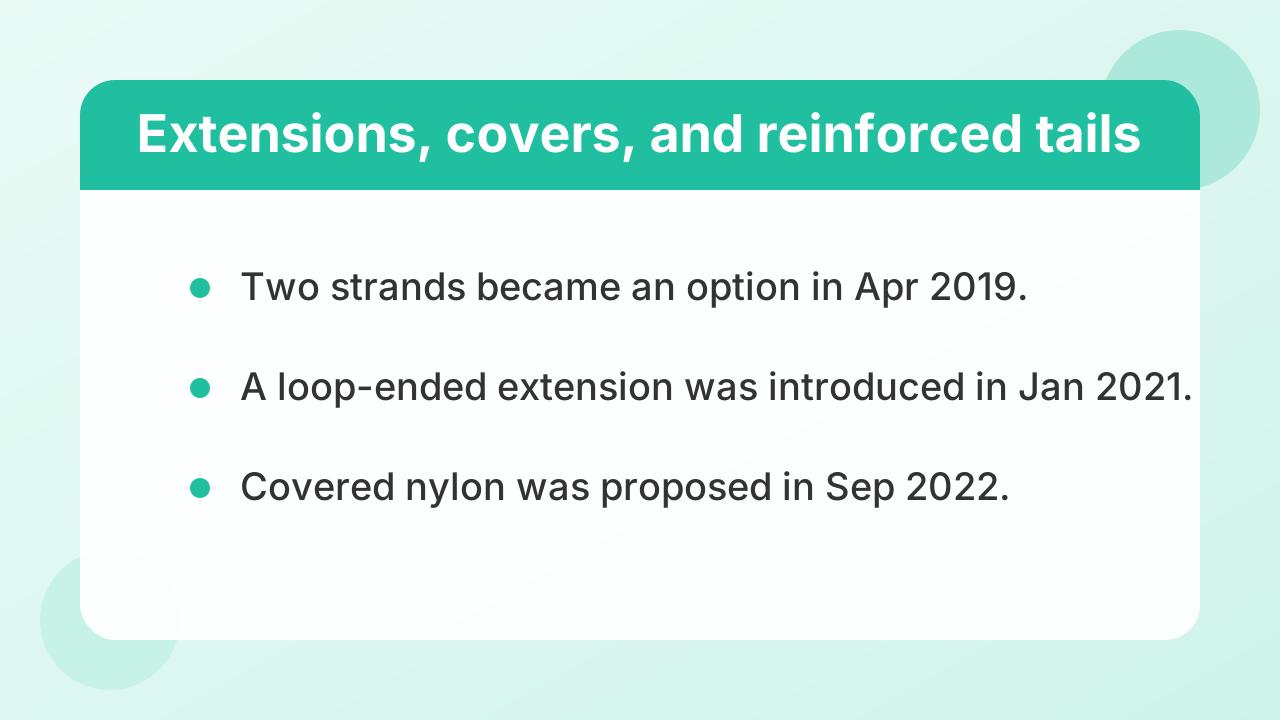
How nylon thread thickness and length changed over time
| Published | What the diary said then |
|---|---|
| Oct 2017 | Separate spacing choices were planned for the linked components. |
| Oct 2017 | The available medical suture imposed a maximum length. |
| Feb 2019 | Heat-related shrinkage prompted advice about ordering slightly longer thread. |
| Apr 2019 | Two strands became an option, with separate six-hole safety parts. |
| Sep 2019 | The stainless-wire trial was limited to ceramic chips and a single strand. |
| Jan 2021 | A loop-ended extension was introduced; a longer version was planned. |
| Sep 2022 | Covered nylon was proposed as a regular product, following sectioned prototypes. |
| May 2023 | Four-strand compatibility excluded sphincter stoppers and other auxiliary chips. |
| Jun 2024 | A double-tube tail addressed a customer's request for greater rigidity. |
OK Prostate Chip products related to nylon thread thickness and length
The current list includes an extension thread and stopper parts connected with these historical designs.
Products that appear in these entries
| Product (official name) | Price incl. tax | Relation to this topic |
|---|---|---|
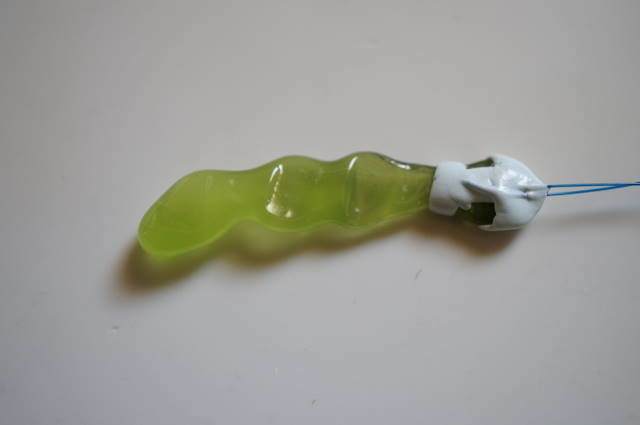
| Loop-ended nylon extension (両端ループナイロン糸) | ¥550 (about $4 at ¥156 = $1, rate as of 2026-09-04) | The January 2021 entry introduced this accessory to extend thread ending in a loop. |
| Six-hole sphincter stopper (六穴方式オプションチップ(括約筋ストッパーチップ)) | ¥2,200 (about $14 at ¥156 = $1, rate as of 2026-09-04) | The April 2019 two-strand discussion priced this part at ¥2,000 (about $13 at ¥156 = $1, rate as of 2026-09-04) excluding tax. |
| Six-hole external stopper (六穴方式オプションチップ(亀頭外側ストッパーチップ)) | ¥1,650 (about $11 at ¥156 = $1, rate as of 2026-09-04) | The April 2019 two-strand discussion priced this part at ¥1,500 (about $10 at ¥156 = $1, rate as of 2026-09-04) excluding tax. |
The loop-ended nylon extension is listed in OK Lab's own online store.
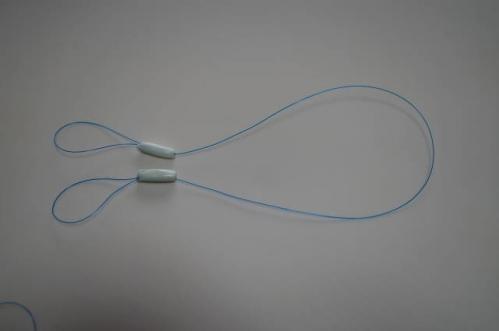
(Source: ok-lab's diary, published January 2021)
https://ok-lab.hatenablog.com/entry/2021/01/16/124800
(Source: ok-lab's diary, published April 2019)
https://ok-lab.hatenablog.com/entry/2019/04/27/153239
Products the diary mentioned as alternatives
| Product (official name) | Price incl. tax | Relation to this topic |
|---|---|---|
| Three-hole sphincter stopper (三穴方式オプションチップ(括約筋ストッパーチップ)) | ¥1,650 (about $11 at ¥156 = $1, rate as of 2026-09-04) | In April 2019, Mr. Okada allowed this alternative to the six-hole stopper when only one strand carried it. |
| Six-hole safety chip (六穴方式オプションチップ(セーフティチップ)) | ¥1,100 (about $7 at ¥156 = $1, rate as of 2026-09-04) | In April 2019, Mr. Okada proposed this separately sold replacement for the omitted safety piece at ¥1,000 (about $6 at ¥156 = $1, rate as of 2026-09-04) excluding tax. |
The six-hole safety chip is listed in OK Lab's own online store.
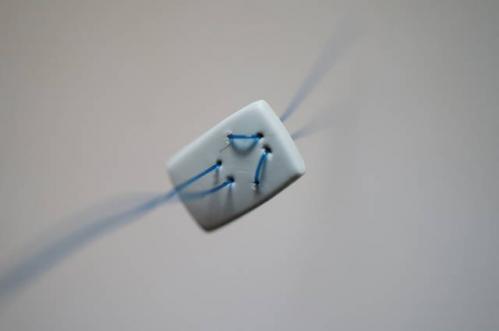
(Source: ok-lab's diary, published April 2019)
https://ok-lab.hatenablog.com/entry/2019/04/27/153239
Silicone-covered prototypes, stainless-wire test builds, four-strand custom builds, and the custom double-tube tail:
No matching product can be confirmed on the current list.
Common worries about nylon thread thickness and length
The reader exchanges concern material choices, heat-related shrinkage, and a tail's rigidity.
"Could the chip use medical materials beyond nylon thread?"
An entry published in October 2018 recalled a customer's request for a stainless-steel chip. The customer had argued that medical nylon was the only material in the existing product whose safety could be assured. Mr. Okada wrote that steel manufacture had not yet been achieved at that point.
He described the suture itself as Class 3 (a medical-device category). That classification statement concerned the thread; the entry does not establish approval of the complete chip. The diary does not record whether that customer's requested steel product was supplied.
(Source: ok-lab's diary, published October 2018)
https://ok-lab.hatenablog.com/entry/20181027/1540618195
"Can hot water change nylon thread length?"
An entry published in February 2019 discussed a customer's report of shrinkage associated with hot water. Mr. Okada accepted that shrinkage might occur, although he had not noticed a marked change during his routine heating experience. He recalled an earlier high-pressure heating episode that shortened thread by 15%, with visible thickening.
The diary does not record the customer's later experience with a revised length. Mr. Okada suggested ordering slightly longer thread if shrinkage was a concern.
(Source: ok-lab's diary, published February 2019)
https://ok-lab.hatenablog.com/entry/2019/02/09/152257
"Does thicker tubing around nylon thread provide a firmer tail?"
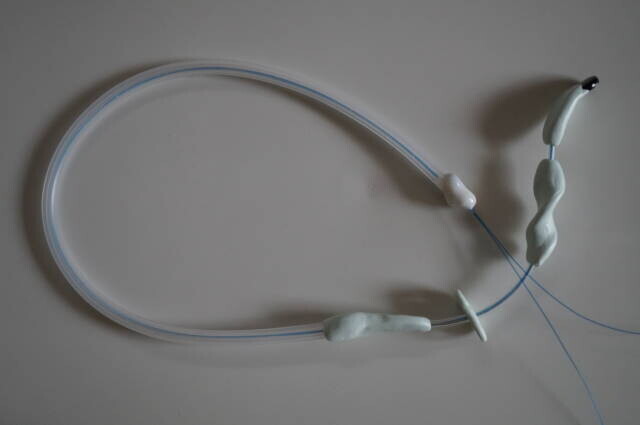
In an entry published in June 2024, a customer asked whether the wire-framed chip's tail could provide push-in support. Staff said the standard 2.5 mm tail lacked the requested rigidity; the customer then asked about a cable-like option. Mr. Okada considered an electrical cable unsuitable for this non-electrical device and developed a double-tube tail (one tube enclosed within another).
He reported improved rigidity from the prototype, containing two 0.24 mm nylon strands; the customer's later experience is unrecorded. The quoted surcharge was ¥3,000 (about $19 at ¥156 = $1, rate as of 2026-09-04) for up to 15 cm, or ¥4,500 (about $29 at ¥156 = $1, rate as of 2026-09-04) for up to 25 cm, excluding tax. Mr. Okada cautioned that the firmer tail still might not enable placement in a relatively dry urine passage.
(Source: ok-lab's diary, published June 2024)
https://ok-lab.hatenablog.com/entry/2024/06/01/123036
Buying from outside Japan
OK Lab ships internationally to countries covered by Japan Post's EMS courier service. Overseas orders are paid in advance by PayPal. Each order carries a ¥400 (about $3 at ¥156 = $1, rate as of 2026-09-04) handling fee, and EMS shipping is charged on top. These terms come from OK Lab's official sales-terms page (written here as plain text, not a link: ok-lab.net/docs/law), checked on September 7, 2026; confirm them on the official store before you order, because they can change.
Summary of this article
| What you wanted to know | The answer |
|---|---|
| The short answer | Thread thickness, strand count, and available lengths varied between designs. |
| What the product is | A Japanese device placed in the urine passage to act on the prostate. |
| What the terms mean | Nylon connects components; stoppers and covers serve separate purposes. |
| Which dimensions were described | Thread diameters, adjustable gaps, extensions, and covered prototypes. |
| What the maker proposed | Extra strands and tubing, subject to construction and replacement restrictions. |
| What changed over time | Later designs added extensions, covers, and reinforced tails. |
| What is listed today | Related extensions and stoppers, priced in Japanese yen. |
| What readers raised | Material safety, heat-related shrinkage, and tail rigidity. |
| How overseas buying works | Advance PayPal payment, a ¥400 (about $3 at ¥156 = $1, rate as of 2026-09-04) handling fee, and additional EMS shipping charges. |
Source: ok-lab's diary (Okada Comfortable Life Laboratory). The original entries are in Japanese; quotations on this page are translated. Photos and videos are on the original entries.
This article is a summary of the maker's development diary. The product is not a medical device and no result is guaranteed. If anything feels wrong or worries you, see a doctor. Prices, specifications and cautions change, so confirm the latest information on the official blog and the official site. Questions about ordering and shipping go to the seller.