![Why Does My Chip Cable Keep Breaking? | Reinforcement Has Limits [OK Prostate Chip]](/img/a/T0219/eyecatch.svg)
This page is based on entries from "ok-lab's diary" (https://ok-lab.hatenablog.com/), the Japanese development diary written by Mr. Okada, founder of OK Lab, a small company in Japan (Okada Comfortable Life Laboratory). Only the entries about "wire coatings and preventing broken connections" are summarized here, in order of publication. Past prices and sizes are as written at the time. Current prices come from the official product list (retrieved September 4, 2026). Quotations are translated from Japanese.
Note: This page is a personal reading log by someone with no connection to the maker or the seller. It reflects the source entries as of their publication dates and makes no guarantee of accuracy or safety. The product is not a medical device; talk to a doctor about any health decision. Check the official site for current information. This page contains advertising.
In short
- Broken connections, loose coverings, and failed inner wires all appear in the diary.
- Mr. Okada describes stronger joints, revised cables, and protective tubing as his responses.
- A related vibrating model remains listed; later custom coating options lack confirmed current matches.
If you see blood in your urine, even a small amount or for the first time, do not wait and see. See a urologist right away. If you suddenly cannot urinate, or the device cannot be removed, do not try to fix it yourself. Go to a medical facility, including emergency care, immediately.
About this product
The OK Prostate Chip is a small device that is placed in the urethra (the urine passage) so that it acts on the prostate; the maker sells it in several shapes, sizes and materials. It is made and sold by OK Lab (Okada Comfortable Life Laboratory), a small company in Japan, through its own online store, and prices are in Japanese yen (JPY). The maker's development diary, "ok-lab's diary", is written in Japanese. This page is an English summary of it, and every quotation is translated. OK Lab ships internationally, so readers outside Japan can order (see "Buying from outside Japan" below). Product names on this page are plain-English descriptions. The official Japanese product name is shown once in the product table so you can find the same item in the store.
Before you read: key terms
| Term | Plain-English meaning |
|---|---|
| Urethra | The urine passage; it carries urine and is where the chip sits. |
| Controller | An external power unit used to operate a vibrating chip. |
| Resin | Material that hardens around parts, used to secure and cover connections. |
| Silicone | A flexible material used for wire coverings and protective tubes. |
| Epoxy | A resin used to secure connections and provide electrical insulation. |
| Metal fatigue | Weakening from repeated bending; the diary uses this term to explain broken wires. |
| Solder joint | A metal bond used to connect electrical wires and parts. |
| Parallel cable | Paired wires running side by side, used to carry electrical current. |
| Nylon-reinforced cable | Fine electrical wires twisted with nylon thread, which provides strength against pulling. |
| AWG32 | A label for the fine wires carrying current. The diary does not explain this. |
| USB | A connector used to join the chip cable to a controller. |
What happens: chip cable problems
The OK Prostate Chip is a small device placed in the urethra (urine passage) to act on the prostate. Its vibrating versions have cables connecting an internal motor to an external controller (the unit supplying and controlling power). These wires run from the chip through the urethra, with coverings around wires and connections. The diary discusses resin (material that hardens around connections), silicone (a flexible covering material), and protective tubes.
Early cable breakage tests exposed weak connections at the motor
In an entry published in December 2018, Mr. Okada described destructive tests on about 100 small vibrators covering 3 types. Every failure occurred where a wire joined the motor.
He said resin should secure both the metal connection and its vinyl covering to improve strength. He also described metal fatigue (weakening from repeated bending) as a separate cause of broken wires. Mr. Okada recommended flexible silicone around connections so they could bend smoothly, reducing fatigue in his view.
(Source: ok-lab's diary, published December 2018)
https://ok-lab.hatenablog.com/entry/20181229/1546064791

Resin could not fix loose connections already present inside supplied motors
In an entry published in January 2019, Mr. Okada reported motor wires that detached with a light touch. His tests had produced about 2 contact faults.
He explained that epoxy (resin used to secure and insulate connections) could not correct an electrical connection that was unreliable beforehand. Mr. Okada advised treating vibrating parts as consumables, with periodic replacement costing ¥3,000 (about $19 at ¥156 = $1, rate as of 2026-09-04) as published that month.
(Source: ok-lab's diary, published January 2019)
https://ok-lab.hatenablog.com/entry/20190105/1546673405
A working controller light did not rule out loose connections
In an entry published in March 2019, a customer reported working controller lights but no motor vibration. Mr. Okada initially suspected the motor; the customer later reported that touching the controller's cable connection restarted it.
The entry records a repair and says early controller boxes had insufficient internal resin reinforcement. Recent shipments had changed to more substantial resin fixing inside the box. Mr. Okada had asked the customer to return the controller if the fault recurred, rather than expect further hardening to resolve it.
(Source: ok-lab's diary, published March 2019)
https://ok-lab.hatenablog.com/entry/2019/03/02/151104
Broken controller wires stopped vibration after just 1 or 2 uses
In an entry published in August 2019, a customer reported that a vibrating chip stopped after 1 or 2 uses. The customer reported restored operation after repairing a solder joint (a metal bond connecting electrical parts) inside the controller.
Mr. Okada apologized for the faulty connection and said he needed to improve his soldering. He offered free repair for failures occurring after so little use.
(Source: ok-lab's diary, published August 2019)
https://ok-lab.hatenablog.com/entry/2019/08/17/132641
Mr. Okada suspected fine motor wires after repeated cable breakage
In an entry published in February 2020, a customer reported another partial break near a repaired chip's base. The customer wanted an additional non-powered cable and asked about repairing the fault personally. Mr. Okada rejected the proposed placement but offered another arrangement with both cables carrying power; the customer accepted, and he made it.
He suspected the fine motor wires more than the parallel cable (paired electrical wires running side by side). Mr. Okada described personal repair as difficult because disturbing the protective resin could further damage those delicate wires.
(Source: ok-lab's diary, published February 2020)
https://ok-lab.hatenablog.com/entry/2020/02/08/151653
Nylon reinforcement could hold a chip cable together after electrical failure
In an entry published in August 2023, Mr. Okada described nylon-reinforced cable (fine electrical wires twisted with nylon thread). Its outside diameter was about 1 mm, and the fine electrical wires were labeled AWG32; the diary does not explain that designation.
He said broken internal wires would not necessarily sever the whole cable because the nylon retained its strength. He also acknowledged that long-duration results were unavailable and electrical failure might occur sooner than with the earlier parallel cable. Mr. Okada made order acceptance conditional on further testing.
(Source: ok-lab's diary, published August 2023)
https://ok-lab.hatenablog.com/entry/2023/08/19/123214
The maker's answer to chip cable problems
Mr. Okada's measures addressed connections, wire construction, and coverings, with different limits for each.
Separate wire reinforcement added production time before chips could be assembled
In an entry published in January 2019, Mr. Okada acknowledged that adapting the small motors for this application was his responsibility. He changed production so the vibrating part received resin reinforcement and demanding tests before being embedded in a chip.
Strengthening and drying the separate part added several days, delaying the planned provisional release. Mr. Okada told buyers that the revised process required about 2 weeks after ordering.
(Source: ok-lab's diary, published January 2019)
https://ok-lab.hatenablog.com/entry/20190112/1547275441
Thicker silicone wiring replaced six-strand cable after repeated bending failures
In an entry published in March 2019, Mr. Okada reported breakage during repeated-bending tests of the existing cable. Each vinyl-covered wire had an outside diameter of 1 mm and 6 internal strands.
The replacement used silicone-covered wire with an outside diameter of 1.2 mm and 24 strands. Mr. Okada offered the revised wiring as a response to those failures, believing it would improve strength.
(Source: ok-lab's diary, published March 2019)
https://ok-lab.hatenablog.com/entry/2019/03/23/173222
Exposed wires prompted a change in how cable coverings were secured
In an entry published in April 2020, a customer reported exposed copper where a ceramic chip met its cable after about 5 uses. The customer asked whether continued use was dangerous. Mr. Okada said the wire itself could remain attached while its covering slipped away.
He announced that future shipments would have the covering bonded against movement. The diary does not record whether this customer's repair was completed. Mr. Okada considered continued use in that condition undesirable and offered reinforcement for affected products.
(Source: ok-lab's diary, published April 2020)
https://ok-lab.hatenablog.com/entry/2020/04/11/151453
A larger protective tube changed the maker's approach to cable coating
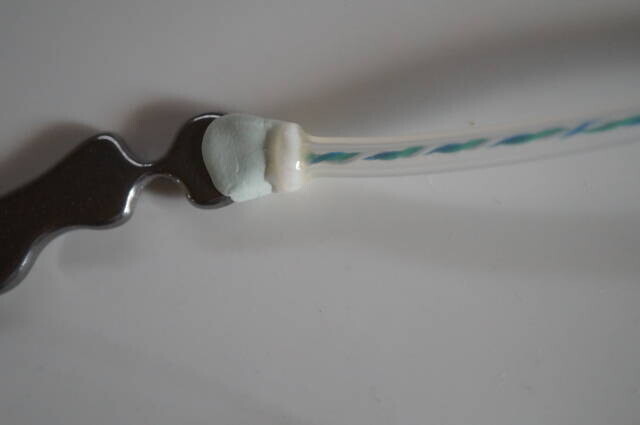
In an entry published in October 2023, a customer requested a protective tube around a nylon-reinforced electrical cable. Staff initially declined because the existing tube was too narrow and they lacked a way to hold the assembly securely. Mr. Okada reconsidered and tried tubing with about 2 mm inner and 4 mm outer diameters.
He reported gentler bending and considered breakage near the fine-wire connections almost eliminated. The entry records his prototype assessment, without long-term results. He offered this construction for an extra ¥2,000 (about $13 at ¥156 = $1, rate as of 2026-09-04) excluding tax, with work taking about 5 days.
(Source: ok-lab's diary, published October 2023)
https://ok-lab.hatenablog.com/entry/2023/10/07/123003
If you see blood in your urine, even a small amount or for the first time, do not wait and see. See a urologist right away. If you suddenly cannot urinate, or the device cannot be removed, do not try to fix it yourself. Go to a medical facility, including emergency care, immediately.
How chip cable problems changed over time
| Published | What the diary said then |
|---|---|
| Dec 2018 | The third design moved the cable-to-cable connection inside the chip. |
| Mar 2019 | Moving the cable joint made the motor section more than 1 mm thinner. |
| May 2019 | Controller replacement cost ¥2,160 (about $14 at ¥156 = $1, rate as of 2026-09-04); a basic battery-box replacement cost ¥1,080 (about $7 at ¥156 = $1, rate as of 2026-09-04). |
| Feb 2020 | Mr. Okada reported no detached joints in pulling tests of a new 10 mm motor. |
| Jun 2022 | Metal-based connections reduced bulk; earlier overlapping cable joints added about 2 mm. |
| Jun 2022 | Production changed to allow resin hardening between stages after repeated motor-wire failures. |
| Aug 2023 | Standard nylon-reinforced electrical cable equipment added ¥4,000 (about $26 at ¥156 = $1, rate as of 2026-09-04) excluding tax to the chip price. |
| Sep 2024 | Cable overlap: maximum 20 cm; length to USB (controller connector): 35 cm. |
| Oct 2024 | A cable was nicked during adjustment; Mr. Okada reported a rubber repair. |
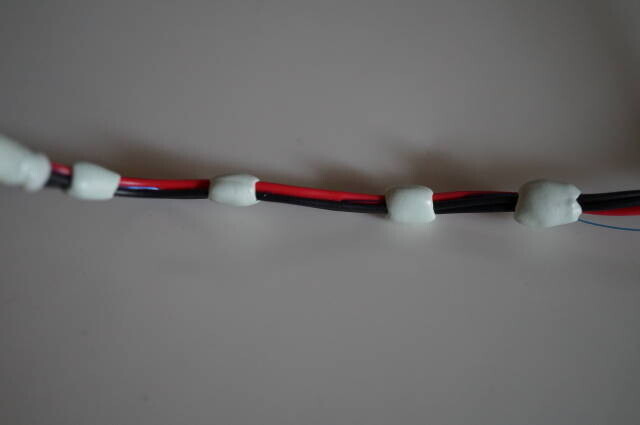
| Jul 2025 | Plug compatibility required a sealed transition from the tube to red-and-black parallel cable. |
OK Prostate Chip products related to chip cable problems
The current list includes the glass vibrating model involved in the thinner-wire repair request.
Products that appear in these entries
| Product (official name) | Price incl. tax | Relation to this topic |
|---|---|---|
| Medium-length glass vibrating chip (OKプロステート核振チップ ガラス素材セミロングタイプ) | ¥6,600 (about $42 at ¥156 = $1, rate as of 2026-09-04) | August 2019: a customer reported motor stoppage and requested thinner wiring on this model. |
The medium-length glass vibrating chip is sold through the company's own online store.
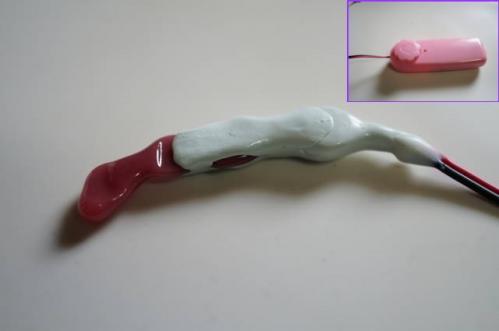
(Source: ok-lab's diary, published August 2019)
https://ok-lab.hatenablog.com/entry/2019/08/24/125858
Products the diary mentioned as alternatives
The diary names no alternative.
Earlier prototypes and custom cable assemblies:
No matching product can be confirmed on the current list.
Four-wire support was no longer offered, according to the entry published in June 2022.
(Source: ok-lab's diary, published June 2022)
https://ok-lab.hatenablog.com/entry/2022/06/11/123420
Common worries about chip cable problems
The diary's replies depend on the fault's location, the requested change, and the existing construction.
"How much did chip cable repairs cost?"
In an entry published in May 2019, a customer asked about repairing a fault near the motor. Mr. Okada offered free repair for an initial defect within the resin-covered section.
For an identified cable fault, reconnection and a resin cover cost ¥1,080 (about $7 at ¥156 = $1, rate as of 2026-09-04) at that time. A fault within 3 cm of the chip required motor-and-cable replacement at ¥3,240 (about $21 at ¥156 = $1, rate as of 2026-09-04). The diary does not record which repair this customer ultimately received. Mr. Okada asked where the fault was located before determining the applicable repair.
(Source: ok-lab's diary, published May 2019)
https://ok-lab.hatenablog.com/entry/2019/05/18/150144
"Can thinner chip wires be fitted without replacing the motor?"
In an entry published in August 2019, a customer requested 0.4 mm wires after a medium-length glass vibrating chip stopped working. The customer suspected motor failure following 6V operation. Mr. Okada acknowledged that failure was possible despite his own tests.
He explained that the existing epoxy-fixed connections could be damaged during a wiring change. The diary does not record whether the requested replacement was completed. Mr. Okada advised that thinner wiring would likely require motor replacement, and cautioned that 6V was outside rated operation.
(Source: ok-lab's diary, published August 2019)
https://ok-lab.hatenablog.com/entry/2019/08/24/125858
"Can cable coating address painful rubbing from existing wiring?"
In an entry published in November 2024, a customer asked about coating parallel wires after reporting severe pain from rubbing. Mr. Okada warned that a complicated assembly with several motors would increase the cost.
The diary does not record whether coating was supplied or whether the discomfort changed. Mr. Okada proposed rubber coating for short sections, or tubing with sealed ends for longer sections.
(Source: ok-lab's diary, published November 2024)
https://ok-lab.hatenablog.com/entry/2024/11/02/122858
Buying from outside Japan
OK Lab ships internationally to countries covered by Japan Post's EMS courier service. Overseas orders are paid in advance by PayPal. Each order carries a ¥400 (about $3 at ¥156 = $1, rate as of 2026-09-04) handling fee, and EMS shipping is charged on top. These terms come from OK Lab's official sales-terms page (written here as plain text, not a link: ok-lab.net/docs/law), checked on September 7, 2026; confirm them on the official store before you order, because they can change.
Summary of this article
| What you wanted to know | The answer |
|---|---|
| In short: what can fail? | The connection, internal wire, or outer covering. |
| About this product: what is it? | A urethral device made by OK Lab in Japan. |
| Key terms: what does reinforcement mean? | Materials supporting wires or their connections. |
| What happens: does stopped vibration identify the fault? | No; the diary records faults at both motor and controller connections. |
| The maker's answer: what changed? | Separate reinforcement, revised wire, bonded coverings, and protective tubes. |
| Changes over time: was there one permanent solution? | The entries describe successive revisions through July 2025. |
| Related products: what is listed now? | The medium-length glass vibrating chip is ¥6,600 (about $42 at ¥156 = $1, rate as of 2026-09-04) including tax. |
| Common worries: are repairs interchangeable? | Historical replies varied by fault location and construction. |
| Buying abroad: what are the stated terms? | Advance PayPal payment, a ¥400 (about $3 at ¥156 = $1, rate as of 2026-09-04) handling fee, and additional EMS shipping. |
Source: ok-lab's diary (Okada Comfortable Life Laboratory). The original entries are in Japanese; quotations on this page are translated. Photos and videos are on the original entries.
This article is a summary of the maker's development diary. The product is not a medical device and no result is guaranteed. If anything feels wrong or worries you, see a doctor. Prices, specifications and cautions change, so confirm the latest information on the official blog and the official site. Questions about ordering and shipping go to the seller.