![Why did 4-wire and 6-wire cables disappear? | Pain and durability problems led to withdrawals [OK Prostate Chip]](/img/a/T0218/eyecatch.svg)
This page is based on entries from "ok-lab's diary" (https://ok-lab.hatenablog.com/), the Japanese development diary written by Mr. Okada, founder of OK Lab, a small company in Japan (Okada Comfortable Life Laboratory). Only the entries about "4-wire and 6-wire cables and abandoned cable designs" are summarized here, in order of publication. Past prices and sizes are as written at the time. Current prices come from the official product list (retrieved September 4, 2026). Quotations are translated from Japanese.
Note: This page is a personal reading log by someone with no connection to the maker or the seller. It reflects the source entries as of their publication dates and makes no guarantee of accuracy or safety. The product is not a medical device; talk to a doctor about any health decision. Check the official site for current information. This page contains advertising.
In short
- The original 4-wire and 6-wire support cables drew reports of pain, exposed wires and breakage concerns.
- Mr. Okada changed the coverings and wire arrangement, then withdrew designs with durability problems.
- No matching product can be confirmed on the current list.
About this product

The OK Prostate Chip is a small device that is placed in the urethra (the urine passage) so that it acts on the prostate; the maker sells it in several shapes, sizes and materials. It is made and sold by OK Lab (Okada Comfortable Life Laboratory), a small company in Japan, through its own online store, and prices are in Japanese yen (JPY). The maker's development diary, "ok-lab's diary", is written in Japanese. This page is an English summary of it, and every quotation is translated. OK Lab ships internationally, so readers outside Japan can order (see "Buying from outside Japan" below). Product names on this page are plain-English descriptions. The official Japanese product name is shown once in the product table so you can find the same item in the store.
Before you read: key terms
| Term | Plain-English meaning |
|---|---|
| Parallel cable | Two electrical lines running together, used for electrical connections and as the base of these support cables. |
| 4-wire support | Parallel cable paired with supporting wires, intended to help maintain the chip's position. |
| 6-wire support | An arrangement with additional cables covering the supporting wires, intended to limit exposure and unwanted bending. |
| Super 6-wire | A version with thicker covering cables, intended to soften abrupt bends. |
| Floating wire | Wire with room to move inside a tube, intended to allow more flexible bending. |
| Wire-in-tube support | A support called a male pessary in the diary, intended to hold a chip's position. |
| Electrical circuit | A connected electrical path used to supply and control motors. |
| Electrode | An electrically connected chip component used to deliver electrical stimulation. |
What happens: 4-wire and 6-wire cable problems
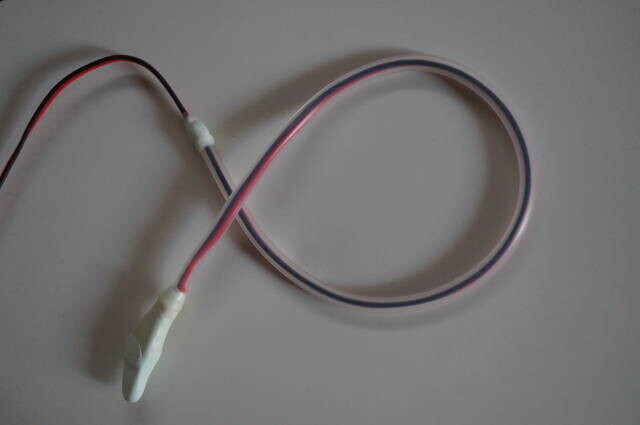
The OK Prostate Chip is a small device placed in the urethra to act on the prostate. The 4-wire cable combined a parallel cable (two electrical lines running together) with supporting wires to help hold the chip's position. Part of this cable occupied the urethra, while an external section could retain a bend. The later 6-wire design added covering cables over the supports.
Paired 4-wire supports held their shape in the maker's early tests
In an entry published in March 2022, Mr. Okada described 0.3 mm wires paired along the grooves of a parallel cable. His earlier arrangement with a single supporting wire had felt poorly balanced.
He reported that the paired arrangement resisted bending in confined space but retained bends made outside it. During his test involving a downward support garment, he reported that the chip stayed in place during urination.
(Source: ok-lab's diary, published March 2022)
https://ok-lab.hatenablog.com/entry/2022/03/26/123336
4-wire cables displaced a planned stopper before any formal launch
In an entry published in April 2022, Mr. Okada abandoned plans to release the U-turn stopper, a proposed retaining part. He considered the 4-wire support cable more effective.
However, 4-wire work remained experimental, and he planned no formal sale for a while. He invited inquiries for prototype work, subject to available time, while development continued cautiously.
(Source: ok-lab's diary, published April 2022)
https://ok-lab.hatenablog.com/entry/2022/04/02/123050
A concentrated 4-wire cable bend explained pain in Mr. Okada's account
In an entry published in May 2022, a customer reported that the 4-wire support felt painful. Mr. Okada attributed pain in his own tests to the cable bending sharply at one location when the urethra shortened.
He proposed a cable-shape change intended to spread that bend, but the diary does not record whether it helped this customer. He did not establish the cause of this customer's pain.
(Source: ok-lab's diary, published May 2022)
https://ok-lab.hatenablog.com/entry/2022/05/28/123218
6-wire cables replaced ordinary 4-wire after reports of pain
In an entry published in June 2022, Mr. Okada discontinued ordinary 4-wire sales following a pain report. He also dropped the Super 4-wire name and offered the renamed 6-wire at the former 4-wire price.
He still allowed exceptional 4-wire requests, while warning that repeated extreme bending would eventually break the wires. The June 2022 cable prices below excluded tax; he asked customers to consider the newly introduced Super 6-wire before renewing requests.
| Cable length | 6-wire, excluding tax | Super 6-wire, excluding tax |
|---|---|---|
| Up to 5 cm | ¥1,000 (about $6 at ¥156 = $1, rate as of 2026-09-04) | ¥1,500 (about $10 at ¥156 = $1, rate as of 2026-09-04) |
| Up to 10 cm | ¥2,000 (about $13 at ¥156 = $1, rate as of 2026-09-04) | ¥3,000 (about $19 at ¥156 = $1, rate as of 2026-09-04) |
| Up to 15 cm | ¥3,000 (about $19 at ¥156 = $1, rate as of 2026-09-04) | ¥4,500 (about $29 at ¥156 = $1, rate as of 2026-09-04) |
| Up to 20 cm | ¥4,000 (about $26 at ¥156 = $1, rate as of 2026-09-04) | ¥6,000 (about $38 at ¥156 = $1, rate as of 2026-09-04) |
| Up to 25 cm | ¥5,000 (about $32 at ¥156 = $1, rate as of 2026-09-04) | ¥7,500 (about $48 at ¥156 = $1, rate as of 2026-09-04) |
| Up to 30 cm | ¥7,000 (about $45 at ¥156 = $1, rate as of 2026-09-04) | ¥10,000 (about $64 at ¥156 = $1, rate as of 2026-09-04) |
(Source: ok-lab's diary, published June 2022)
https://ok-lab.hatenablog.com/entry/2022/06/11/123420
Floating 4-wire cables introduced freer bending at a higher price
In an entry published in October 2022, Mr. Okada introduced floating wire (wire able to move within a surrounding tube). This 4-wire design allowed diagonal and spiral bends that earlier support cables handled poorly.
Prices excluding tax were ¥6,000 (about $38 at ¥156 = $1, rate as of 2026-09-04) up to 10 cm, then ¥500 (about $3 at ¥156 = $1, rate as of 2026-09-04) per additional 1 cm; the published 20 cm price was ¥11,000 (about $70 at ¥156 = $1, rate as of 2026-09-04). Mr. Okada said protection against exposed wire was improved, but advised anyone still concerned against buying it.
(Source: ok-lab's diary, published October 2022)
https://ok-lab.hatenablog.com/entry/2022/10/15/123011
Breakage reports ended 6-wire sales and changed the next design
In an entry published in January 2023, Mr. Okada confirmed that 6-wire and wire-in-tube supports had been withdrawn. He cited reports of breakage or apparent impending breakage.
The next floating 3-wire design separated the replaceable supporting wire from the permanently connected product. Its tube measured 2 mm outside and 1 mm inside, alongside the parallel cable; Mr. Okada warned that repeated extreme bending would still break wire.
(Source: ok-lab's diary, published January 2023)
https://ok-lab.hatenablog.com/entry/2023/01/07/123115
Floating 3-wire pricing depended on separately priced cable and tube components
In an entry published in July 2023, a customer asked whether a floating 3-wire cable could still be made. Staff offered pricing after manufacture, and Mr. Okada built a revised version intended to make wire replacement easier.
Proposed prices excluding tax were ¥1,000 (about $6 at ¥156 = $1, rate as of 2026-09-04) each for the base cable and base tube, plus ¥500 (about $3 at ¥156 = $1, rate as of 2026-09-04) per 1.5 cm connection section. A 0.7 mm wire up to 30 cm was priced at ¥1,000 (about $6 at ¥156 = $1, rate as of 2026-09-04), excluding tax. The diary does not record how this revised custom build felt to the customer.
(Source: ok-lab's diary, published July 2023)
https://ok-lab.hatenablog.com/entry/2023/07/01/123130
A later 4-wire electrode label described paired electrical cables
In an entry published in August 2024, Mr. Okada described a stainless-steel electrode (an electrically connected component for stimulation) prototype. Its 4-wire description referred to two parallel cables bundled with nylon thread.
Its bundled section extended 20 cm behind the second chip. Mr. Okada also offered a version without that bundled section, reducing the associated work and charge.
(Source: ok-lab's diary, published August 2024)
https://ok-lab.hatenablog.com/entry/2024/08/03/122758
The maker's answer to 4-wire and 6-wire cable problems
Mr. Okada tried thicker coverings, revised wire support and simpler cable construction, while acknowledging continuing limitations.
Super 6-wire felt gentler to Mr. Okada, with a size tradeoff
In an entry published in June 2022, Mr. Okada compared the cables during manufacture and personal testing. Standard 6-wire had not felt dramatically better than 4-wire to him.
He thought Super 6-wire's thicker covering reduced abrupt wire bends, but customer evaluations were still awaited. Mr. Okada favored Super 6-wire if the approximately 1 mm wider covering side was acceptable.
(Source: ok-lab's diary, published June 2022)
https://ok-lab.hatenablog.com/entry/2022/06/18/123201
A damaged 4-wire cable prompted replacement terms and corrected advice
In an entry published in July 2022, a customer reported pain and exposed wire, stopped use, and asked about Super 6-wire replacement. Mr. Okada replied that extreme use could cause this after one use; neither 4-wire nor 6-wire cables themselves were repairable. He offered cable replacement, but a vibrating model also required a new motor; only the chip could be reused.
The confirmed July 2022 follow-up said shortening could not address damage beside the chip, correcting Mr. Okada's earlier assumption. The diary does not record whether replacement was completed. Mr. Okada acknowledged his misunderstanding; his revised explanation emphasized support for the 2 wires alongside the cable, rather than straightening them.
(Source: ok-lab's diary, published July 2022)
https://ok-lab.hatenablog.com/entry/2022/07/09/123142
(Source: ok-lab's diary, published July 2022)
https://ok-lab.hatenablog.com/entry/2022/07/16/123031
Silicone-covered 2-wire cables brought simpler construction and a separate surcharge
In an entry published in October 2023, Mr. Okada introduced a silicone-covered 2-wire cable following the earlier withdrawals. Its prototype used a short resin vibrating chip, with parallel cable enclosed in a tube 4 mm across. The additional charge was ¥2,000 (about $13 at ¥156 = $1, rate as of 2026-09-04) excluding tax, above the existing chip's price.
The covered section could reach 25 cm, with total cable length limited to 40 cm. The default was 25 cm covered plus 15 cm ordinary cable, and shorter versions cost the same. Mr. Okada cautioned that silicone could stick against the urethral lining when moisture was insufficient.
(Source: ok-lab's diary, published October 2023)
https://ok-lab.hatenablog.com/entry/2023/10/14/122718
How 4-wire and 6-wire cables changed over time
| Published | What the diary said then |
|---|---|
| Apr 2022 | Titanium wire was rejected after comparison tests; stainless steel was chosen. |
| May 2022 | A painful bend prompted a proposed cable-shape change. |
| Jun 2022 | Ordinary 4-wire sales ended; 6-wire and Super 6-wire pricing appeared. |
| Jul 2022 | Changed cable insulation threatened continued manufacture after existing stock ran out. |
| Oct 2022 | Floating 4-wire introduced multidirectional bending with wire housed in tubes. |
| Jan 2023 | Breakage reports prompted a design based on replaceable supporting wire. |
| Jul 2023 | Revised floating 3-wire construction received proposed component prices. |
| Aug 2023 | Super 6-wire's withdrawal prevented the requested independent motor configuration. |
| Oct 2023 | A silicone-covered parallel cable introduced a simpler construction. |
| Aug 2024 | A later electrode prototype used 4-wire to describe bundled electrical cables. |
OK Prostate Chip products related to 4-wire and 6-wire cable problems
The current list includes the support garment used in early testing.
Products that appear in these entries
| Product (official name) | Price incl. tax | Relation to this topic |
|---|---|---|
| Downward support garment (ペニストッキング2017) | ¥3,850 (about $25 at ¥156 = $1, rate as of 2026-09-04) | In March 2022, Mr. Okada tested this garment alongside a 4-wire-supported chip during urination. |
The downward support garment is listed in OK Lab's own online store.
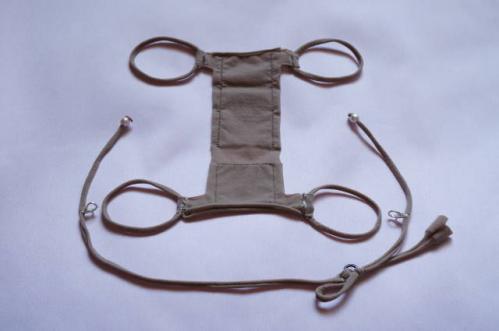
(Source: ok-lab's diary, published March 2022)
https://ok-lab.hatenablog.com/entry/2022/03/26/123336
Products the diary mentioned as alternatives
The diary names no alternative.
The floating-wire cables, silicone-covered cable and later bundled-cable electrode were historical builds. No matching product can be confirmed on the current list.
Common worries about 4-wire and 6-wire cables
Customers asked about customization, prolonged comfort and motor control.
"Could larger 4-wire cable bumps have wider gaps?"
In an entry published in May 2022, a customer requested more pronounced resin bumps on a 4-wire cable. Staff said the gaps could not grow beyond about 5 mm without compromising strength. The standard pattern was 4 mm of resin and 5 mm of gap, a 9 mm cycle.
The customer clarified that greater thickness mattered, then requested bumps 10 mm long, 7 mm wide and 3 mm thick. Mr. Okada presented the resulting build but gave no customer comfort follow-up. He advised that these shapes required individual quotations because resin volume and manufacturing difficulty varied.
(Source: ok-lab's diary, published May 2022)
https://ok-lab.hatenablog.com/entry/2022/05/14/123043
"Could 6-wire cables stay comfortable for several days?"
In an entry published in August 2022, a customer compared Super 6-wire with a wire-in-tube support, called a male pessary. They wanted stability over several days but worried about stiffness and discomfort.
Mr. Okada reported discomfort after about half a day during his own downward-position tests, requiring renewed positioning. He considered the wire-in-tube design more flexible but raised concerns about prolonged silicone contact; the customer's eventual choice is not recorded. Mr. Okada judged continuous 6-wire use impractical in that situation.
(Source: ok-lab's diary, published August 2022)
https://ok-lab.hatenablog.com/entry/2022/08/20/122920
"Could 2-wire cables still power several motors?"
In an entry published in December 2022, a customer asked about several motor positions after 6-wire manufacture stopped. Mr. Okada said ordinary 2-wire cable could power multiple motors together.
It provided one electrical circuit (a connected power and control path), so separate controllers could not run those motors independently. Floating 4-wire construction required preplanned sections and much more assembly work; the diary does not record whether this customer's order was completed.
(Source: ok-lab's diary, published December 2022)
https://ok-lab.hatenablog.com/entry/2022/12/24/122944
"Why did Super 6-wire independent motor control disappear?"
In an entry published in August 2023, a customer requested the earlier 3-motor build with separately controlled groups. Staff declined because Super 6-wire had been discontinued over durability problems.
Mr. Okada then proposed separate vibrating units with thinner, nylon-thread-reinforced cables as an alternative arrangement. His proposal combined a 2-motor unit and a 1-motor unit with separate controls, but the diary records no completed order or test result.
(Source: ok-lab's diary, published August 2023)
https://ok-lab.hatenablog.com/entry/2023/08/19/123214
Buying from outside Japan

OK Lab ships internationally to countries covered by Japan Post's EMS courier service. Overseas orders are paid in advance by PayPal. Each order carries a ¥400 (about $3 at ¥156 = $1, rate as of 2026-09-04) handling fee, and EMS shipping is charged on top. These terms come from OK Lab's official sales-terms page (written here as plain text, not a link: ok-lab.net/docs/law), checked on September 7, 2026; confirm them on the official store before you order, because they can change.
Summary of this article
| What you wanted to know | The answer |
|---|---|
| What is the short answer? | Pain and durability concerns led to changes and withdrawals. |
| What is the product? | A small urethral device made by OK Lab in Japan. |
| What do the cable terms mean? | They describe different combinations of electrical lines, supporting wires and tubes. |
| What happened to these designs? | Early stability claims were followed by discomfort reports, redesigns and discontinued sales. |
| What did the maker change? | Coverings, wire support, replacement arrangements and cable construction. |
| How did development progress? | The entries trace original supports, floating-wire designs and later cable arrangements. |
| What current item appears here? | The downward support garment is listed at ¥3,850 (about $25 at ¥156 = $1, rate as of 2026-09-04) including tax. |
| What did customers ask? | About larger bumps, prolonged comfort and separate motor control. |
| How does overseas buying work? | Advance PayPal payment, EMS shipping and a ¥400 (about $3 at ¥156 = $1, rate as of 2026-09-04) handling fee. |
Source: ok-lab's diary (Okada Comfortable Life Laboratory). The original entries are in Japanese; quotations on this page are translated. Photos and videos are on the original entries.
This article is a summary of the maker's development diary. The product is not a medical device and no result is guaranteed. If anything feels wrong or worries you, see a doctor. Prices, specifications and cautions change, so confirm the latest information on the official blog and the official site. Questions about ordering and shipping go to the seller.