![Which chip connection should I choose? | Nylon bends more; wire needs care [OK Prostate Chip]](/img/a/T0222/eyecatch.svg)
This page is based on entries from "ok-lab's diary" (https://ok-lab.hatenablog.com/), the Japanese development diary written by Mr. Okada, founder of OK Lab, a small company in Japan (Okada Comfortable Life Laboratory). Only the entries about silicone-covered nylon and wire connections are summarized here, in order of publication. Past prices and sizes are as written at the time. Current prices come from the official product list (retrieved September 4, 2026). Quotations are translated from Japanese.
Note: This page is a personal reading log by someone with no connection to the maker or the seller. It reflects the source entries as of their publication dates and makes no guarantee of accuracy or safety. The product is not a medical device; talk to a doctor about any health decision. Check the official site for current information. This page contains advertising.
In short
- Silicone-covered nylon cord bends readily, while the maker warns that the wire-core version can break under force.
- Mr. Okada limits some connections by spacing, chip weight, and whether parts were fitted before delivery.
- Later entries introduce different cores and stopper arrangements, but matching current listings for these custom connections cannot be confirmed.
If you see blood in your urine, even a small amount or for the first time, do not wait and see. See a urologist right away.
If you suddenly cannot urinate, or the device cannot be removed, do not try to fix it yourself. Go to a medical facility, including emergency care, immediately.
About this product
The OK Prostate Chip is a small device that is placed in the urethra (the urine passage) so that it acts on the prostate; the maker sells it in several shapes, sizes and materials. It is made and sold by OK Lab (Okada Comfortable Life Laboratory), a small company in Japan, through its own online store, and prices are in Japanese yen (JPY).
The maker's development diary, "ok-lab's diary", is written in Japanese. This page is an English summary of it, and every quotation is translated. OK Lab ships internationally, so readers outside Japan can order (see "Buying from outside Japan" below). Product names on this page are plain-English descriptions. The official Japanese product name is shown once in the product table so you can find the same item in the store.
Before you read: key terms
| Term | Plain-English meaning |
|---|---|
| Silicone-covered nylon cord | Nylon thread enclosed in silicone tubing, used to connect a chip to other parts or an external attachment. |
| Wire-core cord | Silicone tubing containing nylon-coated wire, intended to provide more support than thread alone. |
| Stranded wire | Several fine wires twisted together, forming the metal cord's bendable core. |
| Screw-shaped auxiliary chip | An additional twisted piece beside the main chip, intended to engage the muscle around the urethra. |
| External loop | A loop in the connection outside the body, intended for attachment around the head of the penis. |
| Nitinol | A nickel-titanium alloy used as shape-memory wire: a flexible core designed to recover its shape. |
| Antenna extension | A thin connection containing nylon and shape-memory wire, intended to combine pulling strength with support. |
| Stopper | A part intended to limit a chip's movement; its attachment depends on the connection design. |
What happens: silicone-covered chip connections
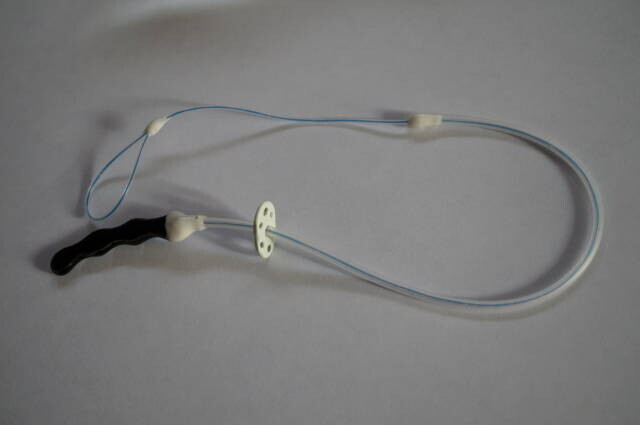
The OK Prostate Chip is a small device placed in the urethra, the urine passage, to act on the prostate. These silicone tubes contain nylon thread or wire and attach behind the chip, extending along the urethra. They connect the main chip to additional parts or an external loop intended for the head of the penis. Mr. Okada developed them partly to address folding connections and discomfort linked to exposed thread.
Silicone-covered chip connections began with a spring intended to resist folding
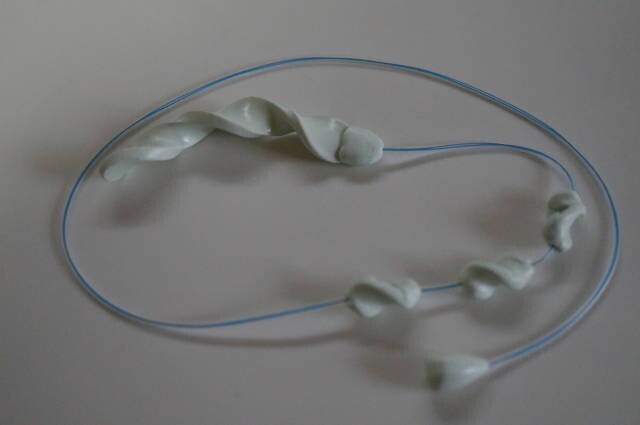
In an entry published in August 2022, Mr. Okada described a spring connector made from tubing covering the thread between chips. It joined a screw-shaped auxiliary chip (an extra twisted piece) to the main chip.
He reported a gentler feeling during roughly three days of personal testing, while acknowledging that longer testing remained unfinished. The spring treatment carried no additional charge because he considered it a safety measure, and he planned to make it standard later. Mr. Okada limited it to 2mm–6mm gaps; requests up to 10mm were possible without testing or a guarantee.
(Source: ok-lab's diary, published August 2022)
https://ok-lab.hatenablog.com/entry/2022/08/27/123001
Silicone-covered nylon cord combined a soft cover with replacement restrictions
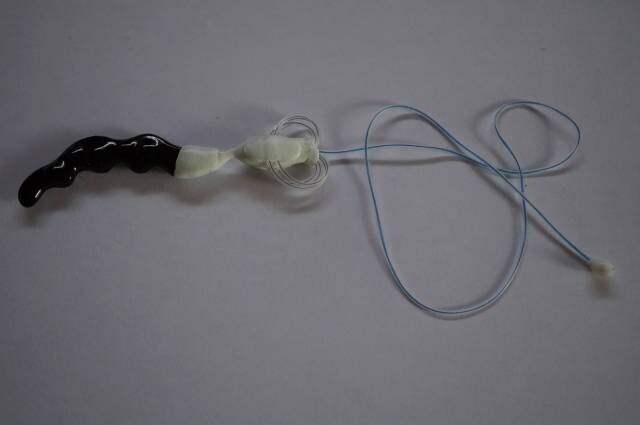
In an entry published in September 2022, Mr. Okada introduced silicone-covered nylon cord (nylon thread enclosed in flexible tubing). The tube measured 1mm outside and 0.5mm inside, enclosing two 0.25mm nylon threads. He described nylon stretching about 5%, compared with about 500% for the tubing.
The design divided the tubing into 10cm sections to contain that difference, while the nylon remained continuous. He also identified drawbacks: dust stuck to the surface, and friction against the urethral lining was somewhat greater than with nylon alone. Mr. Okada declined conversions of existing chips, offering replacement only for products originally purchased with this cord specification.
(Source: ok-lab's diary, published September 2022)
https://ok-lab.hatenablog.com/entry/2022/09/24/122837
A reported wire break changed one silicone-covered chip connection order
In an entry published in October 2022, Mr. Okada revisited a custom order described the previous week. He had informed the customer about a reported wire break.
The customer accepted a change, although the diary does not record how the revised connection felt in use. Mr. Okada's proposed replacement was silicone-covered nylon cord instead of the planned wire connection.
(Source: ok-lab's diary, published October 2022)
https://ok-lab.hatenablog.com/entry/2022/10/01/122944
A custom wire-core cord needed wider gaps and a rounded tip
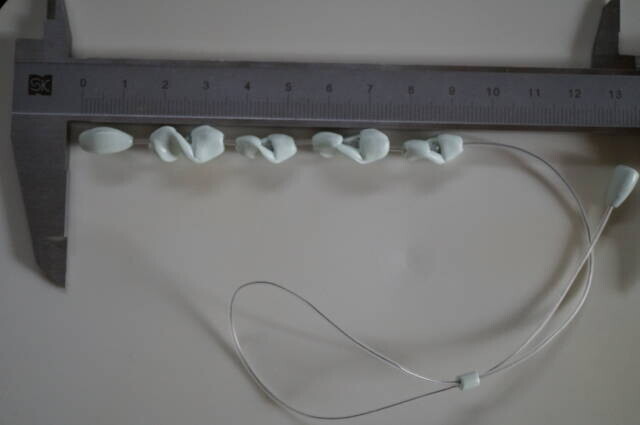
In entries published in June 2023, a customer requested five small screw-shaped pieces on a wire-core cord, with 3mm gaps. Mr. Okada initially doubted the build, then offered at least 5mm gaps and a sealed, rounded tip about 5–6mm across.
The customer rejected his separate linked-resin proposal over tangling concerns, describing bleeding with metal beads bought elsewhere. The completed build had a rounded tip and four miniature screw-shaped pieces; the diary does not record its performance in use. Mr. Okada nevertheless favored the separate linked-resin design, while allowing that the wire-core cord might provide better support.
(Source: ok-lab's diary, published June 2023)
https://ok-lab.hatenablog.com/entry/2023/06/03/121955
(Source: ok-lab's diary, published June 2023)
https://ok-lab.hatenablog.com/entry/2023/06/10/123053
A different wire core entered silicone-covered chip connection testing
In an entry published in October 2024, Mr. Okada described a prototype using nitinol (a nickel-titanium shape-memory alloy). Its silicone tube measured 1mm outside and 0.5mm inside, containing two 0.3mm wires.
He hoped this core would address the eventual breakage he associated with the older nylon-coated wire. Mr. Okada presented further development and cautious testing as his next steps.
(Source: ok-lab's diary, published October 2024)
https://ok-lab.hatenablog.com/entry/2024/10/12/122911
The maker's answer to silicone-covered chip connections
Mr. Okada's answers depend on the core material, the attached chip, and the requested arrangement.
Mr. Okada favored wire-core cord but warned about stiff loops
In an entry published in February 2023, a customer comparing connections asked about reported hospital cases. Mr. Okada thought the wire-core cord least likely to lead to a hospital visit; this was his judgment. He also considered it slightly easier to advance, while acknowledging that individual discomfort could occur.
For conventional screw-shaped auxiliary chips, he described 4–6mm spacing as common. He cautioned that the external loop (the attachment around the head of the penis) could be too stiff for some people.
(Source: ok-lab's diary, published February 2023)
https://ok-lab.hatenablog.com/entry/2023/02/18/122910
Heavier chips prompted a warning against the wire-core cord
In an entry published in May 2024, a new customer outside Japan requested a wire connection for a custom ceramic assembly. Staff advised against the heavier two-piece ceramic version, explaining that its mass could shorten the wire's life. The correspondence remained unresolved in that entry.
Mr. Okada warned that force against a chip held by friction could bend the thin wire; continued force could break it. He considered the lighter ceramic version (sea-slug version 4) a possible match. He advised against the heavier assembly (sea-slug version 5) for this customer, particularly given their lack of experience.
(Source: ok-lab's diary, published May 2024)
https://ok-lab.hatenablog.com/entry/2024/05/04/122911
The antenna extension became Mr. Okada's preference for supported connections
In an entry published in July 2025, a customer outside Japan sought more support after difficulty at a bend with a short resin chip. Mr. Okada identified the older wire-core cord as the established option capable of transmitting pushing force. His newer preference was the antenna extension (a fine connection containing nylon and shape-memory wire).
That design enclosed nylon thread and 0.2mm wire inside 1mm silicone tubing. The diary does not record whether the customer purchased the suggested configuration. Mr. Okada recommended the antenna extension for the combination of pulling strength and flexible support he attributed to it.
(Source: ok-lab's diary, published July 2025)
https://ok-lab.hatenablog.com/entry/2025/07/26/122909
A stopper request led to a thicker silicone-covered nylon cord prototype
In an entry published in February 2026, a customer asked about adding a stopper (a part intended to limit movement). Staff replied that the original silicone-covered nylon cord was too thin for direct stopper attachment. They initially offered to investigate a thicker outer cover instead.
Mr. Okada then produced a prototype with another tube surrounding the 1mm cord. He thought this arrangement had slightly more stiffness than the thicker extension alone.
(Source: ok-lab's diary, published February 2026)
https://ok-lab.hatenablog.com/entry/2026/02/07/122919
If you see blood in your urine, even a small amount or for the first time, do not wait and see. See a urologist right away.
If you suddenly cannot urinate, or the device cannot be removed, do not try to fix it yourself. Go to a medical facility, including emergency care, immediately.
How silicone-covered chip connections changed over time
| Published | What the diary said then |
|---|---|
| Sep 2022 | Each 10cm nylon-cord section cost ¥1,000, (about $6 at ¥156 = $1, rate as of 2026-09-04) tax excluded; maximum four sections. |
| Oct 2022 | A prototype's 2mm gap stretched to about 10mm, then returned. |
| Dec 2022 | A customer reported improved comfort with a 35cm wire-core connection after discomfort with thread. |
| Sep 2023 | A resin chip's cord attachment sat behind its body to avoid excess thickness. |
| Apr 2025 | Adding nylon inside a loop-based device's tubing cost an additional ¥1,100 (about $7 at ¥156 = $1, rate as of 2026-09-04) per tube. |
OK Prostate Chip products related to silicone-covered chip connections
The current list confirms these base chips, but does not confirm the historical custom connection packages.
Products that appear in these entries
| Product (official name) | Price incl. tax | Relation to this topic |
|---|---|---|
| Curved flat-face medium-length resin chip (OKプロステートチップ フラット面カーブ型 セミロングタイプ(生体適合樹脂)) | ¥6,050 (about $39 at ¥156 = $1, rate as of 2026-09-04) | In December 2022, a customer reported improved comfort with this chip fitted to a custom wire-core connection. |
| Short resin chip (OKプロステートチップ ショートタイプ(生体適合樹脂)) | ¥4,400 (about $28 at ¥156 = $1, rate as of 2026-09-04) | In July 2025, a customer outside Japan described difficulty at a bend with this chip before asking about supported connections. |
(Source: ok-lab's diary, published December 2022)
https://ok-lab.hatenablog.com/entry/2022/12/24/122944
(Source: ok-lab's diary, published July 2025)
https://ok-lab.hatenablog.com/entry/2025/07/26/122909
Products the diary mentioned as alternatives
The diary names no alternative.
Custom items discussed here include covered cords, the antenna extension, linked-chip assemblies, replacement cable designs, and stopper prototypes. No matching product can be confirmed on the current list.
The earlier four-line and six-line cable designs were discontinued after reported problems, according to the entry published in January 2023.
(Source: ok-lab's diary, published January 2023)
https://ok-lab.hatenablog.com/entry/2023/01/07/123115
Common worries about silicone-covered chip connections
"Can an existing silicone-covered nylon cord receive extra parts?"
In an entry published in November 2022, a customer liked a firm covered connection but wanted an additional miniature screw-shaped piece. Mr. Okada declined work on the delivered product, explaining that bonding additional parts to used tubing would be difficult.
He said the restriction on additional work after delivery applied across the company's products. His offered route was replacement of the tubing itself, during which extra parts could be included.
(Source: ok-lab's diary, published November 2022)
https://ok-lab.hatenablog.com/entry/2022/11/26/122622
"Can wire-core cord tolerate a very sharp bend?"
In an entry published in January 2023, a customer wanted a connection compatible with a garment holding the penis downward. Mr. Okada explained that the metal core was nylon-coated stranded wire (several fine wires twisted together).
He said it could bend, but was unsuitable for the extreme 180-degree fold involved in that request. He instead proposed a separate three-line cable assembly; the diary does not record whether the customer bought it.
(Source: ok-lab's diary, published January 2023)
https://ok-lab.hatenablog.com/entry/2023/01/07/123115
"Will wire-core cord stay inside as my body changes?"
In an entry published in December 2023, Mr. Okada contrasted nylon-core and wire-core connections using the same 1mm tubing. He described the nylon version as flexible enough to bend and slacken much like ordinary thread.
He thought the wire version would protrude as the penis became less erect because its core resisted folding. That entry also explored thicker tube-covered extensions, but Mr. Okada advised considering simple arrangements before his experimental multi-screw designs.
(Source: ok-lab's diary, published December 2023)
https://ok-lab.hatenablog.com/entry/2023/12/09/123055
"Does silicone-covered nylon cord prevent heat damage?"
In an entry published in February 2026, a customer wanted covered cord because ordinary thread had shrunk after contact with a hot pan. The request combined a custom ceramic chip, a separate apple-shaped stopper, and a covered connection.
Staff quoted ¥2,200 (about $14 at ¥156 = $1, rate as of 2026-09-04) for the 30cm nylon-cord portion, and Mr. Okada recorded making the combination. The diary does not record the customer's experience afterward. Mr. Okada thought the cover might withstand brief pan contact, but warned that internal nylon could still shrink if the pan boiled dry.
(Source: ok-lab's diary, published February 2026)
https://ok-lab.hatenablog.com/entry/2026/02/21/122935
Buying from outside Japan
OK Lab ships internationally to countries covered by Japan Post's EMS courier service. Overseas orders are paid in advance by PayPal. Each order carries a ¥400 (about $3 at ¥156 = $1, rate as of 2026-09-04) handling fee, and EMS shipping is charged on top. These terms come from OK Lab's official sales-terms page (written here as plain text, not a link: ok-lab.net/docs/law), checked on September 7, 2026; confirm them on the official store before you order, because they can change.
Summary of this article
| What you wanted to know | The answer |
|---|---|
| The short answer | Nylon-core and wire-core connections behave differently; the maker describes limits for both. |
| What the product is | A urethral device made by OK Lab in Japan. |
| What the connection terms mean | The names distinguish cores, covering tubes, loops, and additional parts. |
| What happened during development | Covered connections progressed from spring prototypes to cords and different wire cores. |
| What the maker suggested | His advice varied with chip weight, loop stiffness, and the intended arrangement. |
| What changed over time | Prices, attachments, customer feedback, and reinforcement options changed across dated entries. |
| What is listed today | Related base chips appear in the current list; custom connection packages lack confirmed matches. |
| What limits remain | Retrofitting, sharp bends, protrusion, and heat damage all received qualified answers. |
| How overseas buying works | Advance PayPal payment, a handling fee, and separate EMS shipping charges apply. |
| What this article establishes | It records the maker's dated explanations and customer reports, including their unresolved outcomes. |
Source: ok-lab's diary (Okada Comfortable Life Laboratory). The original entries are in Japanese; quotations on this page are translated. Photos and videos are on the original entries.
This article is a summary of the maker's development diary. The product is not a medical device and no result is guaranteed. If anything feels wrong or worries you, see a doctor. Prices, specifications and cautions change, so confirm the latest information on the official blog and the official site. Questions about ordering and shipping go to the seller.