![Which vibrating chip cable and color should I choose? | Construction and color serve different purposes [OK Prostate Chip]](/img/a/T0221/eyecatch.svg)
This page is based on entries from "ok-lab's diary" (https://ok-lab.hatenablog.com/), the Japanese development diary written by Mr. Okada, founder of OK Lab, a small company in Japan (Okada Comfortable Life Laboratory). Only entries about vibrating chip cables and colors are summarized here, in order of publication. Past prices and sizes are as written at the time. Current prices come from the official product list (retrieved September 4, 2026). Quotations are translated from Japanese.
Note: This page is a personal reading log by someone with no connection to the maker or the seller. It reflects the source entries as of their publication dates and makes no guarantee of accuracy or safety. The product is not a medical device; talk to a doctor about any health decision. Check the official site for current information. This page contains advertising.
In short
The diary describes differences in cable comfort, durability and how easily colors can be distinguished.
Mr. Okada proposed reinforced wiring and protective covers, with compatibility limits and possible electrical failures.
Current chip listings do not confirm every historical custom cable assembly described below.
If you see blood in your urine, even a small amount or for the first time, do not wait and see. See a urologist right away. If you suddenly cannot urinate, or the device cannot be removed, do not try to fix it yourself. Go to a medical facility, including emergency care, immediately.
About this product
The OK Prostate Chip is a small device that is placed in the urethra (the urine passage) so that it acts on the prostate; the maker sells it in several shapes, sizes and materials. It is made and sold by OK Lab (Okada Comfortable Life Laboratory), a small company in Japan, through its own online store, and prices are in Japanese yen (JPY).
The maker's development diary, "ok-lab's diary", is written in Japanese. This page is an English summary of it, and every quotation is translated. OK Lab ships internationally, so readers outside Japan can order (see "Buying from outside Japan" below).
Product names on this page are plain-English descriptions. The official Japanese product name is shown once in the product table so you can find the same item in the store.
Before you read: key terms
| Term | Plain-English meaning |
|---|---|
| Urethra | The urine passage; the chip and part of its cable occupy this passage. |
| Parallel cable | Electrical wires running side by side, carrying power to a motor or electrode. |
| Nylon-reinforced cable | Fine electrical wires combined with nylon thread, intended to carry power while providing pulling strength. |
| Silicone cover | Tubing around a cable, proposed to protect its wiring. |
| Electrode | A conductive chip used for electrical stimulation. |
| Controller | A unit that controls the motors' vibration. |
| AWG32 | The fine wire's size label. The diary does not explain this. |
| USB connector | An electrical plug used to connect the cable to external equipment. |
| Snap-button connector | A press-stud electrical terminal used as an outside connection. |
| Jointed two-wire cable | A jointed structure based on parallel cable, developed to aid placement. |
| Pessary-style design | An older design offered to aid placement. The diary does not explain this. |
| End safety piece | An end component in the proposed assembly. The diary does not explain this. |
What happens: vibrating chip cables
The OK Prostate Chip is a small device placed in the urethra, near the prostate. Vibrating versions contain motors, with a cable running from the chip toward a connector outside the body. The diary describes parallel cable (wires running side by side), nylon-reinforced cable (fine wires combined with nylon thread), and silicone-covered versions. Customers and Mr. Okada discuss differences in cable thickness, stiffness, comfort, durability and color identification.
An ultra-thin vibrating chip cable improved one customer's comfort but complicated color identification
In an entry published in August 2020, a customer reported that an ultra-thin cable felt unobtrusive compared with thicker cords. They described frequent bleeding with thick cords and said that concern had disappeared with the thinner cable. However, the black wire was difficult to distinguish from the blue nylon thread.
The customer thought white and yellow wires might have provided clearer contrast. The diary does not record a test of those suggested colors. Mr. Okada welcomed the report and said the apparent durability reassured him.
(Source: ok-lab's diary, published August 2020)
https://ok-lab.hatenablog.com/entry/2020/08/08/130037
Nylon-reinforced cable introduced thinner wiring with an acknowledged risk of electrical failure
In an entry published in August 2023, Mr. Okada introduced nylon-reinforced cable, about 1mm across, for vibrating chips and electrodes (electrical stimulation chips). He warned that its AWG32 wires (an unexplained wire-size label) could break and stop conducting sooner than ordinary parallel cable.
The proposed assembly had 30cm of cable, a waterproof USB connector (an electrical plug), then 5cm of nylon thread and an end safety piece. The powered assembly added ¥4,000 (about $26 at ¥156 = $1, rate as of 2026-09-04) excluding tax to the existing chip price, as published that August. For ordinary chips, the non-powered reinforced thread option added ¥3,000 (about $19 at ¥156 = $1, rate as of 2026-09-04) excluding tax to the existing nylon-thread version. Mr. Okada made the planned opening of orders conditional on further testing.
(Source: ok-lab's diary, published August 2023)
https://ok-lab.hatenablog.com/entry/2023/08/19/123214
Silicone-covered cables arrived with length limits and concerns about sticking
An entry published in October 2023 introduced silicone-covered parallel cable, using tubing with a 4mm outside diameter. Mr. Okada said 4-wire, 6-wire and pessary-style designs had been discontinued over durability problems; only the jointed 2-wire design remained. The diary does not explain the pessary-style design.
He reported sticking against dry urethral tissue, but easier movement when both the tube and tissue were moist. The covering added ¥2,000 (about $13 at ¥156 = $1, rate as of 2026-09-04) excluding tax to the existing product price. The silicone section could measure up to 25cm, with the overall cable limited to 40cm.
(Source: ok-lab's diary, published October 2023)
https://ok-lab.hatenablog.com/entry/2023/10/14/122718
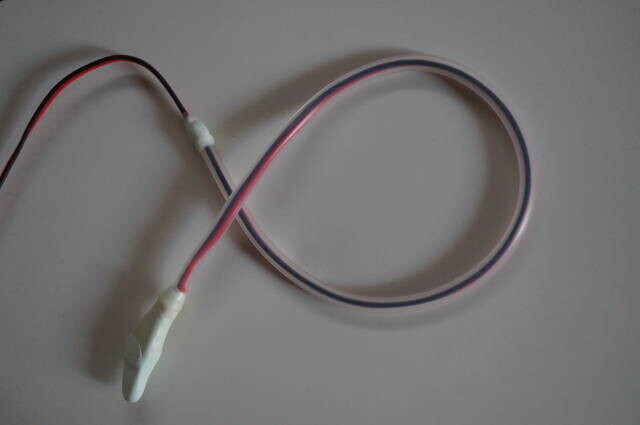
Vibrating chip cable stiffness affected movement sensations in one customer's account
In an entry published in March 2025, a returning customer compared a glass vibrating chip with a stainless-steel electrode. They felt the glass model's stiff parallel cable carried some vibration away from the chip. They also felt the steel model's silicone-covered reinforced cable restricted movement and weakened sensations associated with that movement.
The customer attributed this partly to the steel chip's weight and the covered cable. They said the cover had been suggested when they originally wanted bare reinforced cable. Mr. Okada thanked them for the electrode proposal; the exchange records no resulting cable change.
(Source: ok-lab's diary, published March 2025)
https://ok-lab.hatenablog.com/entry/2025/03/22/122906
Red-and-black vibrating chip cable connection work carried a separate charge
In an entry published in October 2025, a quotation paired an extended second-generation resin chip with red-and-black cable connection work. The chip was quoted at ¥9,900 (about $63 at ¥156 = $1, rate as of 2026-09-04), with 25cm of cable connection work separately priced at ¥2,200 (about $14 at ¥156 = $1, rate as of 2026-09-04). The diary does not record whether that particular order was completed.
(Source: ok-lab's diary, published October 2025)
https://ok-lab.hatenablog.com/entry/2025/10/18/122911
The maker's answer to vibrating chip cables
Mr. Okada's proposals addressed separate concerns: motor control, compatible connections and protection for fine wiring.
Ordinary two-wire cables supported multiple motors with only one controller
In an entry published in December 2022, a customer asked about a custom vibrating chip with motors at multiple locations. The older 6-wire design, developed for 2 or 3 motor locations, had been discontinued. Mr. Okada offered ordinary 2-wire parallel cable, allowing multiple motors to run together from 1 controller (the unit controlling vibration).
This arrangement could not provide the separate control previously possible with 2 controllers. The diary does not record whether the proposed order was completed. Mr. Okada said additional USB connections offered little benefit when only one controller could be used.
(Source: ok-lab's diary, published December 2022)
https://ok-lab.hatenablog.com/entry/2022/12/24/122944
Nylon-reinforced cable was the only supported stainless-steel electrode connection
In an entry published in September 2023, a customer asked about several connection options for a stainless-steel electrode. Mr. Okada rejected the jointed 2-wire option (a jointed assembly based on parallel cable) for that electrical connection. Only nylon-reinforced cable could connect electrically to the stainless-steel electrode at that time.
He thought reinforced cable alongside the jointed structure might be possible, although he considered the arrangement awkward. The diary does not record a completed build using that proposal.
(Source: ok-lab's diary, published September 2023)
https://ok-lab.hatenablog.com/entry/2023/09/09/122848
Silicone-covered cable protected fine wiring in the maker's prototype assessment
In an entry published in October 2023, a customer requested reinforced cable inside the tubing used for a nylon-thread assembly. Staff initially declined because the cable would not fit and they lacked a stable construction method. Mr. Okada subsequently reported a prototype using larger tubing with a 4mm outside diameter.
Manufacture took about 5 days. He believed the cover greatly reduced the risk of wire breakage near connections, and proposed it as protection for the fine cable. The coating added ¥2,000 (about $13 at ¥156 = $1, rate as of 2026-09-04) excluding tax to the existing reinforced-cable stainless-steel electrode price.
(Source: ok-lab's diary, published October 2023)
https://ok-lab.hatenablog.com/entry/2023/10/07/123003
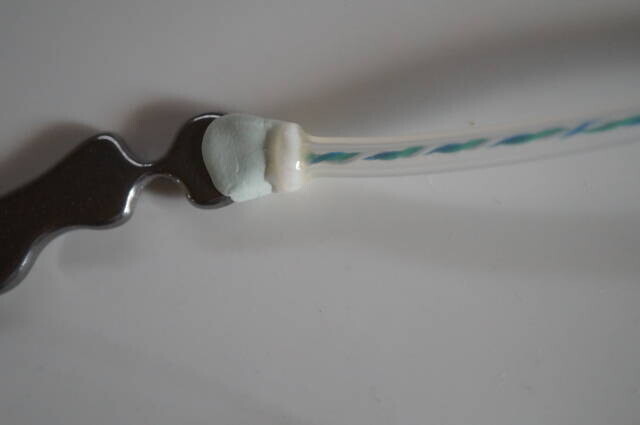
Silicone-covered cables for paired stainless-steel electrodes required more costly work
In an entry published in October 2023, Mr. Okada reported fitting both reinforced electrode cables inside 4mm tubing. He considered the result sturdier, but said manufacture was substantially harder than covering two separate electrodes. The tube processing added ¥4,000 (about $26 at ¥156 = $1, rate as of 2026-09-04) excluding tax to the existing reinforced-cable paired stainless-steel electrode price.
(Source: ok-lab's diary, published October 2023)
https://ok-lab.hatenablog.com/entry/2023/10/14/122718
If you see blood in your urine, even a small amount or for the first time, do not wait and see. See a urologist right away. If you suddenly cannot urinate, or the device cannot be removed, do not try to fix it yourself. Go to a medical facility, including emergency care, immediately.
How vibrating chip cables changed over time
| Published | What the diary said then |
|---|---|
| Aug 2020 | Customer praised thin cable comfort but found blue thread and black wire difficult to distinguish. |
| Dec 2022 | Discontinued six-wire designs could be replaced by two-wire arrangements sharing one controller. |
| Aug 2023 | Nylon reinforcement enabled finer wiring; earlier electrical failure remained a concern. |
| Aug 2023 | Snap connectors replaced the proposed USB layout, whose sale remained undecided. |
| Sep 2023 | Stainless-steel electrode connections supported reinforced cable, excluding the requested jointed two-wire option. |
| Oct 2023 | White, green and mixed-color reinforced cables were offered for single stainless-steel electrodes. |
| Oct 2023 | Silicone covering expanded to parallel cables and paired stainless-steel electrode cables. |
| Jun 2024 | Mr. Okada reported his first reinforced-cable USB connection for paired stainless-steel electrodes. |
| Mar 2025 | Customer described different vibration and movement sensations with parallel and silicone-covered cables. |
| Oct 2025 | Red-and-black cable connection work was quoted separately at ¥2,200 (about $14 at ¥156 = $1, rate as of 2026-09-04) for 25cm. |
OK Prostate Chip products related to vibrating chip cables
Current listings identify the base chips used in these quotations; the historical custom cable assemblies remain unconfirmed.
Products that appear in these entries
| Product (official name) | Price incl. tax | Relation to this topic |
|---|---|---|
| Short resin vibrating chip (OKプロステート核振チップ 樹脂素材ショートタイプ) | ¥4,400 (about $28 at ¥156 = $1, rate as of 2026-09-04) | An October 2023 quotation paired this chip with silicone-covered two-wire cable processing. |
| Extended second-generation resin chip (OKプロステートチップ 覚醒タイプ(第二世代生体適合樹脂)) | ¥9,900 (about $63 at ¥156 = $1, rate as of 2026-09-04) | An October 2025 quotation listed this chip with separately charged red-and-black cable connection work. |
The short resin vibrating chip is listed in the company's own online store.
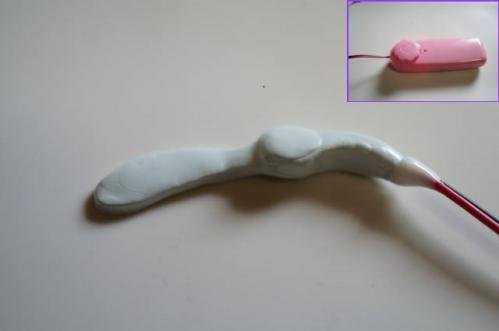
The awakening-type second-generation resin chip appears in a custom-order quotation in the diary.

(Source: ok-lab's diary, published October 2023)
https://ok-lab.hatenablog.com/entry/2023/10/21/123054
(Source: ok-lab's diary, published October 2025)
https://ok-lab.hatenablog.com/entry/2025/10/18/122911
Products the diary mentioned as alternatives
The diary names no alternative.
Historical custom cable assemblies: No matching product can be confirmed on the current list.
Common worries about vibrating chip cables
"Can nylon-reinforced cable come without an electrical connector?"
In an entry published in August 2023, a customer requested a stainless-steel electrode with cable ends left without a connector. Staff initially declined because of connection difficulties and a stock delay; Mr. Okada later reported a workable reinforced-cable connection. His trial product used a snap-button connector (a press-stud electrical terminal), replacing the USB connector he found bulky.
Its specification was 25cm of cable, a snap connection, then 10cm of doubled thread, adding ¥4,000 (about $26 at ¥156 = $1, rate as of 2026-09-04) excluding tax to the stainless-steel chip price. The diary does not record whether this customer's order was completed. Mr. Okada allowed unfinished ends, but said the attached nylon thread was necessary for his cable-strength assurance.
(Source: ok-lab's diary, published August 2023)
https://ok-lab.hatenablog.com/entry/2023/08/26/122534
"Which cable colors distinguish the paired stainless-steel electrode leads?"
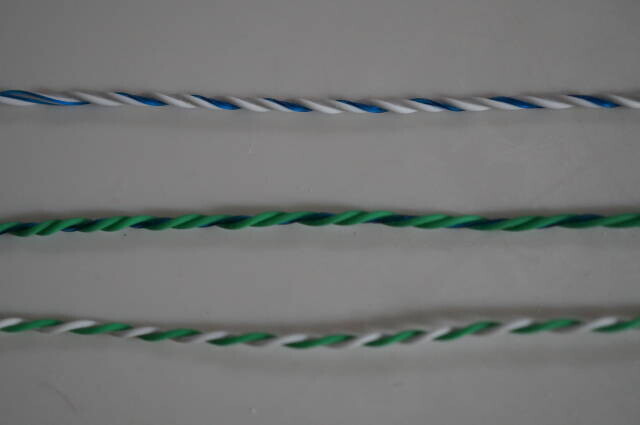
In an entry published in October 2023, a customer wanted the two electrode cables to be easier to distinguish. Mr. Okada first considered colored connector markings, then proposed changing the wire colors. He explained that vibrating motors needed positive and negative wires, while each stainless-steel electrode formed a single electrical pole.
For single electrodes, he offered white with white, green with green, or white with green; the mixed pair remained the default. For paired electrodes, his plan assigned white wires to one cable and green wires to the other. Mr. Okada invited single-electrode customers to specify their preferred combination.
(Source: ok-lab's diary, published October 2023)
https://ok-lab.hatenablog.com/entry/2023/10/07/123003
"Could electrode cables use USB instead of snap connectors?"
In an entry published in June 2024, a customer requested paired stainless-steel electrodes with a waterproof USB connection instead of snap buttons. Mr. Okada reported connecting the reinforced cable ends to USB for the first time. The diary does not record a later durability report for that custom connection.
(Source: ok-lab's diary, published June 2024)
https://ok-lab.hatenablog.com/entry/2024/06/29/123044
Buying from outside Japan
OK Lab ships internationally to countries covered by Japan Post's EMS courier service. Overseas orders are paid in advance by PayPal.
Each order carries a ¥400 (about $3 at ¥156 = $1, rate as of 2026-09-04) handling fee, and EMS shipping is charged on top. These terms come from OK Lab's official sales-terms page (written here as plain text, not a link: ok-lab.net/docs/law), checked on September 7, 2026; confirm them on the official store before you order, because they can change.
Summary of this article
| What you wanted to know | The answer |
|---|---|
| What distinguishes the cables? | Construction affects the reported feel; colors help distinguish wires or electrode leads. |
| What is the underlying product? | A urethral device made by OK Lab in Japan. |
| What do the cable names mean? | Parallel describes wire arrangement; reinforced describes added nylon; covered describes outer tubing. |
| What problems appeared? | Reports included bleeding, poor color contrast, electrical failure concerns and restricted movement. |
| What did the maker propose? | Compatible wiring, shared motor control and protective cable covers. |
| What changed over time? | Older designs ended; reinforced, covered and differently connected assemblies followed. |
| What prices are current? | The listed short resin vibrating chip is ¥4,400 (about $28 at ¥156 = $1, rate as of 2026-09-04); the extended resin chip is ¥9,900 (about $63 at ¥156 = $1, rate as of 2026-09-04). |
| Could colors and connectors be specified? | Dated entries describe electrode color choices, unfinished ends and custom USB connections. |
| How do overseas orders work? | Advance PayPal payment, EMS shipping and the stated handling fee. |
Source: ok-lab's diary (Okada Comfortable Life Laboratory). The original entries are in Japanese; quotations on this page are translated. Photos and videos are on the original entries.
This article is a summary of the maker's development diary. The product is not a medical device and no result is guaranteed. If anything feels wrong or worries you, see a doctor. Prices, specifications and cautions change, so confirm the latest information on the official blog and the official site. Questions about ordering and shipping go to the seller.