![Will a thinner cable break? | Cable thickness alone does not settle strength [OK Prostate Chip]](/img/a/T0217/eyecatch.svg)
This page is based on entries from "ok-lab's diary" (https://ok-lab.hatenablog.com/), the Japanese development diary written by Mr. Okada, founder of OK Lab, a small company in Japan (Okada Comfortable Life Laboratory). Only the entries about "cable thickness and strength" are summarized here, in order of publication. Past prices and sizes are as written at the time. Current prices come from the official product list (retrieved September 4, 2026). Quotations are translated from Japanese.
Note: This page is a personal reading log by someone with no connection to the maker or the seller. It reflects the source entries as of their publication dates and makes no guarantee of accuracy or safety. The product is not a medical device; talk to a doctor about any health decision. Check the official site for current information. This page contains advertising.
In short
- Thinner cables felt gentler in one report, but other entries describe broken connections, bending failures, and weak electrical performance.
- Mr. Okada reinforced connections and tested different cables, while acknowledging tradeoffs between softness and strength.
- The current list includes nylon-thread additions; historical custom cable specifications remain unconfirmed.
If you see blood in your urine, even a small amount or for the first time, do not wait and see. See a urologist right away. If you suddenly cannot urinate, or the device cannot be removed, do not try to fix it yourself. Go to a medical facility, including emergency care, immediately.
About this product

The OK Prostate Chip is a small device that is placed in the urethra (the urine passage) so that it acts on the prostate; the maker sells it in several shapes, sizes and materials. It is made and sold by OK Lab (Okada Comfortable Life Laboratory), a small company in Japan, through its own online store, and prices are in Japanese yen (JPY). The maker's development diary, "ok-lab's diary", is written in Japanese. This page is an English summary of it, and every quotation is translated. OK Lab ships internationally, so readers outside Japan can order (see "Buying from outside Japan" below). Product names on this page are plain-English descriptions. The official Japanese product name is shown once in the product table so you can find the same item in the store.
Before you read: key terms
| Term | Plain-English meaning |
|---|---|
| Parallel cable | Insulated wires joined side by side, used for electrical connections and, in some designs, physical support. |
| Conductor | The metal wire inside a cable that carries electrical current. |
| Sheath | A cable's outer covering; Mr. Okada describes it as contributing to pulling strength. |
| Silicone | Flexible material covering wires; Mr. Okada selected it to reduce strain from bending. |
| Stopper | An attachment intended to limit unwanted chip movement; some versions fit parallel cables. |
| Resin | Material used around components to hold connections together. |
| Nylon thread | A separate thread used for retrieval support or reinforcement, depending on the design. |
| Controller | The external unit supplying power to a vibrating chip. |
| Electrode | An electrical contact on a chip, used to carry current. |
| AWG32 | A specification identifying the fine electrical wire discussed in August 2023. The diary does not explain this. |
What happens: cable breakage
The OK Prostate Chip is a small urethral device designed to act on the prostate. In vibrating versions, a cable connects the chip's motor to an external controller (the unit supplying power). Electrodes (electrical contacts) carry current, while some cable designs also provide physical support. The diary discusses the cable inside the urethra, its connection to the chip, and the portion extending outside the body.
Early cable strength tests exposed failures at the motor connection
In an entry published in December 2018, Mr. Okada described destructive tests on about 100 small vibrators of three types. Every failure occurred at the motor connection. Some separated under 2–300 grams of pulling force; even stronger examples separated at about 1kg.
He attributed this weakness to thin wires held only by solder. His proposed answer was reinforcement around the connection, rather than reliance on the metal joint alone.
(Source: ok-lab's diary, published December 2018)
https://ok-lab.hatenablog.com/entry/20181229/1546064791
Repeated bending prompted a thicker cable with more internal strands
In an entry published in March 2019, Mr. Okada reported cable breakage during repeated bending tests. The old vinyl-covered cable measured 1mm across each wire and contained 6 internal strands. Its replacement had silicone (a flexible covering), measured 1.2mm, and contained 24 strands.
The diary does not record the replacement cable's service life. Mr. Okada favored the new covering and additional strands for their expected durability.
(Source: ok-lab's diary, published March 2019)
https://ok-lab.hatenablog.com/entry/2019/03/23/173222
Thin cable strength limited how closely two electrodes could sit
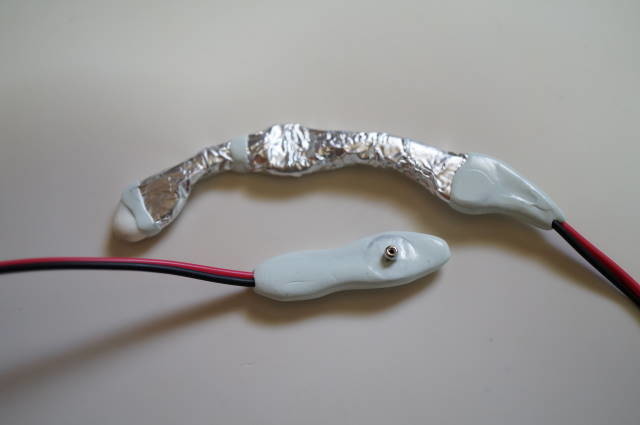
An entry published in May 2019 described a request for closely spaced electrodes on connected resin chips (resin holds components together). Mr. Okada's prototype needed 10mm or more of 1.2mm parallel cable (wires joined side by side) to follow the urethral curve. Otherwise, he reported strain on the urethra.
Allowing about 5mm of resin cover at each connection meant roughly 15mm between electrodes; thinner cable was one possibility below 10mm. The customer accepted a compromise, and the completed build achieved 10mm or less, although Mr. Okada remained concerned about durability. He asked the customer to weigh spacing against strength, warning that tested 0.6mm wire might be too weak between chips.
(Source: ok-lab's diary, published May 2019)
https://ok-lab.hatenablog.com/entry/2019/05/11/152432
A thick cable met one customer's request for firmer support
In an entry published in October 2019, a customer requested a firmer cable. Mr. Okada completed a build with 1.6mm cable for the first 20cm, followed by standard cable. Future connection work would cost ¥1,000 (about $6 at ¥156 = $1, rate as of 2026-09-04) excluding tax, as published in October 2019.
The same customer's follow-up, published in November 2019, described 1.6mm as their personal minimum and suggested a 25cm section. They reported that standard cable folded too readily, while the thicker version provided the support they wanted. Mr. Okada's original reply favored limiting the stiff section because it was awkward outside the urethra.
(Source: ok-lab's diary, published October 2019)
https://ok-lab.hatenablog.com/entry/2019/10/12/125944
(Source: ok-lab's diary, published November 2019)
https://ok-lab.hatenablog.com/entry/2019/11/02/132358
An ultrathin cable weakened one motor's output during testing
In an entry published in July 2020, Mr. Okada measured a customer's supplied cable at about 0.4mm. He cautioned that compression during measurement might mean it was actually 0.5mm. The comparison nylon thread (a separate retrieval support) measured 0.24mm.
With about 200cm of cable, the newer 10mm motor ran weakly, while the older 10mm motor worked normally. A set of 3 connected 8mm motors also vibrated normally; he suspected the thin, long cable restricted power reaching the motor. Despite its softness, Mr. Okada expressed no confidence in its strength and considered a two-cable arrangement necessary.
(Source: ok-lab's diary, published July 2020)
https://ok-lab.hatenablog.com/entry/2020/07/04/130440
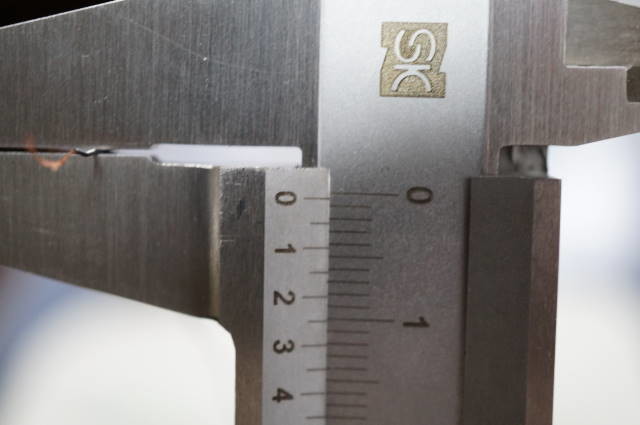
One customer reported less discomfort with an ultrathin cable
In an entry published in August 2020, a customer reported that thicker cords had often accompanied urethral bleeding. With the ultrathin cable, they no longer noticed the cord and said that concern had disappeared.
They also reported difficulty distinguishing the dark cable from the blue nylon thread. Mr. Okada welcomed the feedback and thought it suggested durability as well as softness.
(Source: ok-lab's diary, published August 2020)
https://ok-lab.hatenablog.com/entry/2020/08/08/130037
A supplier change made the parallel cable thicker and less flexible
In an entry published in August 2022, Mr. Okada reproduced a supplier's explanation of a manufacturing change. Deliveries from April 2022 had switched from China-made to Malaysia-made parallel cable. The supplier acknowledged reduced flexibility and approximately 0.1mm greater thickness, explaining that the change maintained its selling price.
Mr. Okada expected difficulty obtaining material for the existing six-wire support design. He asked that future requests mainly concern vibrating chips or electrodes, which needed electrical connections, while allowing exceptions.
(Source: ok-lab's diary, published August 2022)
https://ok-lab.hatenablog.com/entry/2022/08/06/123150
Cable breakage appeared after three months in one jointed build
In an entry published in April 2023, a customer reported a broken parallel cable after 3 months of daily use. The break was about 5cm from the end, at a section bent through 90 degrees. Mr. Okada had previously expected roughly 6 months of durability.
He attributed additional pulling strain to the customer's unusually thick jointed section, which resisted bending. The customer requested another build, but the diary does not record whether that replacement lasted longer.
(Source: ok-lab's diary, published April 2023)
https://ok-lab.hatenablog.com/entry/2023/04/29/123107
The maker's answer to cable breakage
Mr. Okada addressed weak joints, pulling loads, and repeated bending through different forms of reinforcement.
Reinforced coverings were central to Mr. Okada's cable strength approach
In the December 2018 entry, Mr. Okada explained why the conductor (the metal wire carrying current) was only part of the connection. He also relied on the sheath (the outer covering) for pulling strength.
His proposed design enclosed both in resin (material holding the components together). He said this could make the connection as strong as the cable itself.
(Source: ok-lab's diary, published December 2018)
https://ok-lab.hatenablog.com/entry/20181229/1546064791
Ultrafine cable strength depended on separate support in a custom request
In an entry published in June 2020, a customer supplied unusually fine cable for custom vibrating chips. Mr. Okada initially reserved acceptance until he could inspect the material and assess its connection.
After inspection, he considered the cable almost unable to withstand pulling. He made acceptance conditional on nylon thread taking 100% of the retrieval load, without strong pulling or repeated sharp cable bends.
(Source: ok-lab's diary, published June 2020)
https://ok-lab.hatenablog.com/entry/2020/06/27/120614
Pain reports changed cable thickness options by ending regular four-wire sales
In an entry published in June 2022, Mr. Okada discontinued the simple four-wire support cable following reports of pain. Special requests remained possible, but he warned that repeated extreme bending would cause breakage.
The new upgraded six-wire design used 1mm silicone-covered auxiliary wires, with that side about 5mm wide. For electrical connections through the auxiliary wires, he favored the upgraded version because he anticipated internal breaks in the ordinary six-wire design.
(Source: ok-lab's diary, published June 2022)
https://ok-lab.hatenablog.com/entry/2022/06/11/123420
Nylon-reinforced thin cable retained pulling strength in the maker's assessment
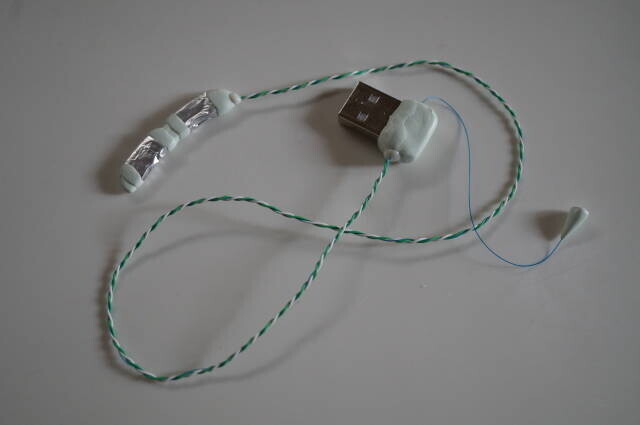
In an entry published in August 2023, Mr. Okada introduced fine wires twisted together with nylon thread, forming a cable about 1mm across. He believed the thread improved pulling strength beyond that of the existing parallel cable.
However, the AWG32 wire (a specification the diary does not explain) might lose electrical function sooner than parallel cable. He said the nylon would retain its strength even if the internal wire broke. Long-term failure rates were unknown because extended testing had not been completed.
(Source: ok-lab's diary, published August 2023)
https://ok-lab.hatenablog.com/entry/2023/08/19/123214
If you see blood in your urine, even a small amount or for the first time, do not wait and see. See a urologist right away. If you suddenly cannot urinate, or the device cannot be removed, do not try to fix it yourself. Go to a medical facility, including emergency care, immediately.
How cable breakage changed over time
| Published | What the diary said then |
|---|---|
| Dec 2018 | The third design moved cable joins inside the chip to reduce possible damage. |
| Apr 2019 | Parallel wires were selected for an electrode chip because their flexibility suited it. |
| Dec 2021 | Successful thick-cable builds enabled stoppers (attachments limiting movement) for two parallel cables. |
| May 2022 | A single-wire electrode arrangement was rejected because of strength concerns. |
| Jun 2022 | Mr. Okada credited thicker auxiliary coverings with resisting abrupt wire bends. |
| Aug 2022 | A repair using an additional electrical path preserved the cable's original length. |
| Aug 2024 | A new linked electrode build combined parallel cable, nylon reinforcement, and resin covering. |
| Oct 2024 | Separate wire branches raised strength concerns during a custom connector discussion. |
The diary does not say what the current state is.
OK Prostate Chip products related to cable breakage
The current list confirms these items, without confirming the historical custom cable configurations.
Products that appear in these entries
| Product (official name) | Price incl. tax | Relation to this topic |
|---|---|---|
| Semi-long glass vibrating chip (OKプロステート核振チップ ガラス素材セミロングタイプ) | ¥6,600 (about $42 at ¥156 = $1, rate as of 2026-09-04) | In August 2019, an owner requested repair and thinner wiring after this model stopped working. |
| Additional nylon thread (ナイロン糸追加(オプション)) | ¥1,100 (about $7 at ¥156 = $1, rate as of 2026-09-04) | In June 2020, additional thread accompanied custom fine-cable requests that Mr. Okada made conditional on separate pulling support. |
(Source: ok-lab's diary, published August 2019)
https://ok-lab.hatenablog.com/entry/2019/08/24/125858
(Source: ok-lab's diary, published June 2020)
https://ok-lab.hatenablog.com/entry/2020/06/27/120614
Products the diary mentioned as alternatives
The diary names no alternative.
The historical cable assemblies described above include custom builds, jointed supports, and reinforced options. No matching product can be confirmed on the current list.
Common worries about cable breakage
The diary distinguishes cable strength from joint strength and electrical reliability.
"Is cable strength greater than nylon thread's?"
In an entry published in February 2019, a customer asked whether extra nylon thread was necessary. Mr. Okada thought cable about 1mm across, even on one side, resisted pulling better than roughly 0.2mm nylon thread.
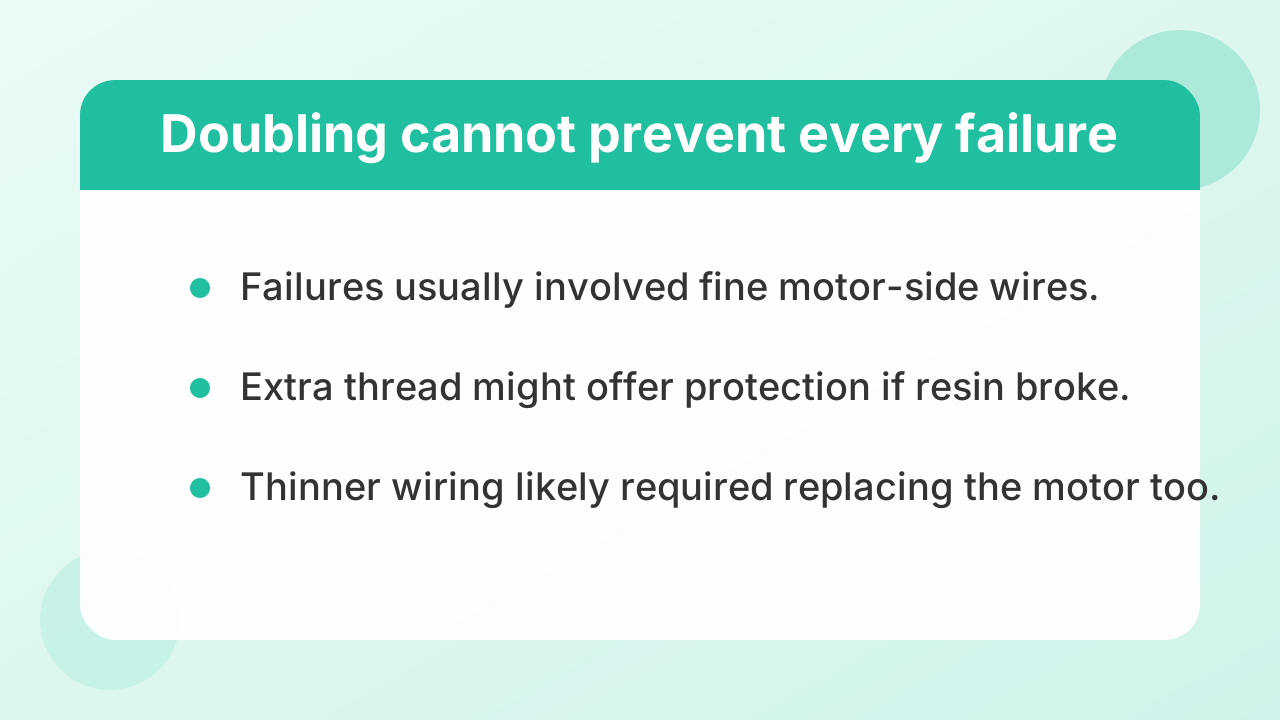
The diary does not record whether this customer ordered the addition. The cable extended only about 15mm into the chip, while the thread was attached to the glass tip. Mr. Okada suggested that extra thread might offer protection if the resin broke.
(Source: ok-lab's diary, published February 2019)
https://ok-lab.hatenablog.com/entry/2019/02/23/142754
"Do two parallel cables prevent cable breakage?"
In an entry published in February 2020, a customer asked whether doubling the cable reduced failures and what it cost. Mr. Okada replied that failures usually involved fine motor-side wires, so doubling the external cable would not solve that problem.
He said another cable could still carry current if a parallel cable failed. The extra charge was ¥1,500 (about $10 at ¥156 = $1, rate as of 2026-09-04) excluding tax, as published in February 2020. He wanted longer testing before confidently recommending the doubled arrangement, since his favorable assessment covered only a few days.
(Source: ok-lab's diary, published February 2020)
https://ok-lab.hatenablog.com/entry/2020/02/15/144151
"Can a thinner cable be fitted during repair?"
In an entry published in August 2019, the owner of a semi-long glass vibrating chip reported that it had stopped working. They requested repair and replacement wiring measuring 0.4mm.
Mr. Okada said thinner wiring was possible, but likely required replacing the motor too. The diary does not record whether the repair was completed. He cautioned that disturbing the fixed connection could damage the motor's delicate terminals.
(Source: ok-lab's diary, published August 2019)
https://ok-lab.hatenablog.com/entry/2019/08/24/125858
Buying from outside Japan

OK Lab ships internationally to countries covered by Japan Post's EMS courier service. Overseas orders are paid in advance by PayPal. Each order carries a ¥400 (about $3 at ¥156 = $1, rate as of 2026-09-04) handling fee, and EMS shipping is charged on top. These terms come from OK Lab's official sales-terms page (written here as plain text, not a link: ok-lab.net/docs/law), checked on September 7, 2026; confirm them on the official store before you order, because they can change.
Summary of this article
| What you wanted to know | The answer |
|---|---|
| The short answer | Softness, pulling strength, and electrical reliability varied between designs. |
| What the product is | A urethral device made by OK Lab in Japan. |
| What the terms mean | Cable coverings, internal wires, and nylon thread play different roles. |
| What happened | The diary records weak joints, bending failures, and differing customer experiences. |
| The maker's response | Reinforced joints, separate thread support, and revised cable designs addressed different weaknesses. |
| What changed over time | Construction, materials, repair approaches, and connector designs changed across the entries. |
| Which current products appear | The list includes a semi-long glass vibrating chip and additional nylon thread. |
| Common worries | Extra thickness or another cable did not resolve every potential failure. |
| Buying internationally | PayPal payment, a ¥400 (about $3 at ¥156 = $1, rate as of 2026-09-04) handling fee, and EMS shipping charges apply. |
Source: ok-lab's diary (Okada Comfortable Life Laboratory). The original entries are in Japanese; quotations on this page are translated. Photos and videos are on the original entries.
This article is a summary of the maker's development diary. The product is not a medical device and no result is guaranteed. If anything feels wrong or worries you, see a doctor. Prices, specifications and cautions change, so confirm the latest information on the official blog and the official site. Questions about ordering and shipping go to the seller.