![Why does the retrieval thread feel sharp or pull unevenly? | The exit position matters [OK Prostate Chip]](/img/a/T0214/eyecatch.svg)
This page is based on entries from "ok-lab's diary" (https://ok-lab.hatenablog.com/), the Japanese development diary written by Mr. Okada, founder of OK Lab, a small company in Japan (Okada Comfortable Life Laboratory). Only the entries about thread-hole position and thread exits are summarized here, in order of publication. Past prices and sizes are as written at the time. Current prices come from the official product list (retrieved September 4, 2026). Quotations are translated from Japanese.
Note: This page is a personal reading log by someone with no connection to the maker or the seller. It reflects the source entries as of their publication dates and makes no guarantee of accuracy or safety. The product is not a medical device; talk to a doctor about any health decision. Check the official site for current information. This page contains advertising.
In short
- Thread exits can feel sharp, and Mr. Okada links off-center connections with difficult retrieval.
- The maker tried rubber covers, independent extra threads, and different attachment points.
- Current listings include thread accessories; the latest back-to-back arrangement remains a diary prototype.
If you see blood in your urine, even a small amount or for the first time, do not wait and see. See a urologist right away. If you suddenly cannot urinate, or the device cannot be removed, do not try to fix it yourself. Go to a medical facility, including emergency care, immediately.
About this product

The OK Prostate Chip is a small device that is placed in the urethra (the urine passage) so that it acts on the prostate; the maker sells it in several shapes, sizes and materials. It is made and sold by OK Lab (Okada Comfortable Life Laboratory), a small company in Japan, through its own online store, and prices are in Japanese yen (JPY). The maker's development diary, "ok-lab's diary", is written in Japanese. This page is an English summary of it, and every quotation is translated. OK Lab ships internationally, so readers outside Japan can order (see "Buying from outside Japan" below). Product names on this page are plain-English descriptions. The official Japanese product name is shown once in the product table so you can find the same item in the store.
Before you read: key terms
| Term | Plain-English meaning |
|---|---|
| Retrieval thread | A line attached to the device for taking it out. |
| Thread hole | An opening that anchors or guides a thread. |
| Thread exit | The point where a thread emerges, affecting the direction of force in the maker's explanations. |
| Resin | Material used for chip bodies and hardened coverings around thread attachments. |
| Nylon | The thread material used for retrieval and accessory connections. |
| Sphincter stopper | A part intended to limit the chip's movement toward the bladder. |
| External safety piece | A fitting outside the body; different sizes distinguished independent threads in one design. |
| Nitinol thread | Fine shape-memory metal wire tested as an alternative or backup to nylon. |
What happens: prostate chip thread problems
The OK Prostate Chip is a small device placed in the urethra (the urine passage) to act on the prostate. The retrieval thread (a line attached for taking the chip out) connects the device to a point outside the body. A thread hole anchors or guides that line, while the thread exit is where it emerges. Mr. Okada links different exit positions and finishes with sharpness and retrieval difficulties.
A centered rear thread exit allowed linked chips without gaps
In an entry published in November 2019, Mr. Okada described a revised rear thread exit. Ceramic, glass, and resin (chip and coating material) versions now had the exit near the rear center.
The older surface connection on glass had sometimes peeled away when closely connected chips bent against each other. He said the revised design allowed 0mm spacing between linked chips, replacing the previous 2mm minimum. Mr. Okada favored the shorter option after his own tests.
(Source: ok-lab's diary, published November 2019)
https://ok-lab.hatenablog.com/entry/2019/11/23/162919
Sharp thread exits prompted standard rubber covers in August 2020
In an entry published in August 2020, a customer found a sharp resin spot on the sea-slug-shaped ceramic chip (Ver.4). The spot hurt the customer's finger; they feared severe pain or bleeding during removal. They reported no bleeding in their actual use.
Mr. Okada acknowledged difficulty finishing its thin rear end. He adopted rubber covers at the thread junction for Ver.4 and 2-thread chips as the general specification. Mr. Okada proposed the cover to soften the sharp-feeling connection.
(Source: ok-lab's diary, published August 2020)
https://ok-lab.hatenablog.com/entry/2020/08/08/130037
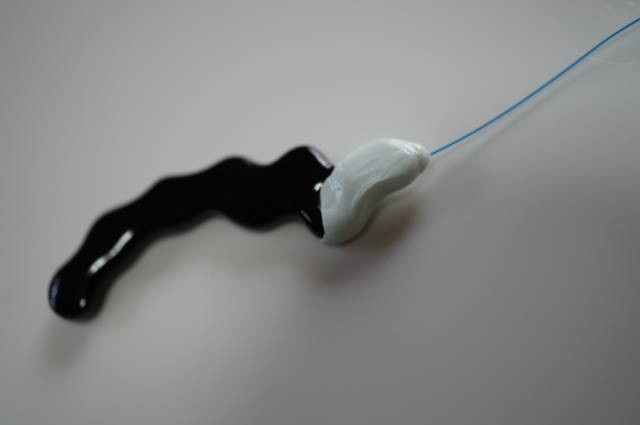
An off-center retrieval thread was linked to difficult removal
In an entry published in September 2020, a Ver.4 customer requested help because the chip remained stuck into the following day. They also reported some bleeding when tension was applied to the thread.
Mr. Okada attributed part of the difficulty to the attachment being offset from the chip's center of gravity. The customer subsequently reported successful removal, but the diary does not establish the exact cause of the obstruction. Mr. Okada advised consulting a urologist if removal remained impossible.
(Source: ok-lab's diary, published September 2020)
https://ok-lab.hatenablog.com/entry/2020/09/05/095734
Internal thread holes housed the attachment without an exposed glued joint
In an entry published in June 2021, Mr. Okada described a titanium prototype with an internal thread attachment requiring no adhesive. The hole structure occupied a rear section about 3mm thick and 6mm wide, enclosing the secured portion of the thread.
In another passage that month, he described an exit slightly wider than the thread, allowing it to move freely. Mr. Okada presented this connection as a gentler option because he felt it lacked the sharpness of a rigidly coated junction.
(Source: ok-lab's diary, published June 2021)
https://ok-lab.hatenablog.com/entry/2021/06/12/125849
A loop-tip retrieval thread became backup against complete bladder entry
In an entry published in August 2024, a customer considering a locking-loop assembly asked whether its loop would prevent bladder entry. Staff said the shape offered resistance but could not guarantee protection for someone whose devices tended to move inward.
The request prompted a slightly larger loop and a change placing the nylon thread at the loop's tip. Mr. Okada said pending orders received this change too. He retained the thread as a backup for the possibility of the whole assembly entering the bladder.
(Source: ok-lab's diary, published August 2024)
https://ok-lab.hatenablog.com/entry/2024/08/31/122909
Moving thread exits to the central connection introduced another retrieval concern
In an entry published in August 2026, a customer's request for opposing thread directions prompted a back-to-back prototype. Mr. Okada first found the proposed arrangement awkward, then developed a version with 4 threads emerging together from the joining section.
This left the assembly's outer ends without projecting threads, which he thought might reduce lining injuries. The diary does not record a customer's experience with the resulting prototype. Mr. Okada cautioned that complete bladder entry could leave the chips overlapping during attempted retrieval.
(Source: ok-lab's diary, published August 2026)
https://ok-lab.hatenablog.com/entry/2026/08/29/122931
The maker's answer to prostate chip thread problems
The maker's responses addressed connection bulk, sharpness, and force direction as separate problems.
Smaller thread connections involved a tradeoff between bulk and strength
In an entry published in May 2020, a customer asked whether ceramic rear ends could be smaller after trouble with three chips. The medium-length ceramic cobra-twist chip had been painful to remove.
Mr. Okada offered thread replacement at ¥1,100 (about $7 at ¥156 = $1, rate as of 2026-09-04) per chip, expecting about 0.5mm less thickness and 0.5mm less width without reinforcement wire. The customer deferred the work, planning to consult again if needed. Mr. Okada cautioned that the thinner attachment could be somewhat weaker.
(Source: ok-lab's diary, published May 2020)
https://ok-lab.hatenablog.com/entry/2020/05/02/131505
Secure thread holes did not eliminate possible damage to nylon
In an entry published in August 2020, a customer worried that the ceramic thread connection relied only on glue. Mr. Okada explained that its hole held a tied thread beneath resin.
He distinguished a secure attachment from nylon (the thread material) that could still break after damage. Mr. Okada suggested two threads as an option for that concern.
(Source: ok-lab's diary, published August 2020)
https://ok-lab.hatenablog.com/entry/2020/08/01/124144
Independent retrieval threads helped in Mr. Okada's prototype tests
In an entry published in September 2020, Mr. Okada described his own Ver.4 prototype with an additional, independently attached thread on the opposite side. He reported easier retrieval in his test with the lower connection. The two lines remained fully independent.
A later entry published in September 2020 priced separate attachment points at ¥1,000 (about $6 at ¥156 = $1, rate as of 2026-09-04) tax excluded. Different-sized external safety pieces (thread fittings outside the body) distinguished the lines. Mr. Okada proposed the extra line specifically for difficult retrieval.
(Source: ok-lab's diary, published September 2020)
https://ok-lab.hatenablog.com/entry/2020/09/05/095734
(Source: ok-lab's diary, published September 2020)
https://ok-lab.hatenablog.com/entry/2020/09/19/123115
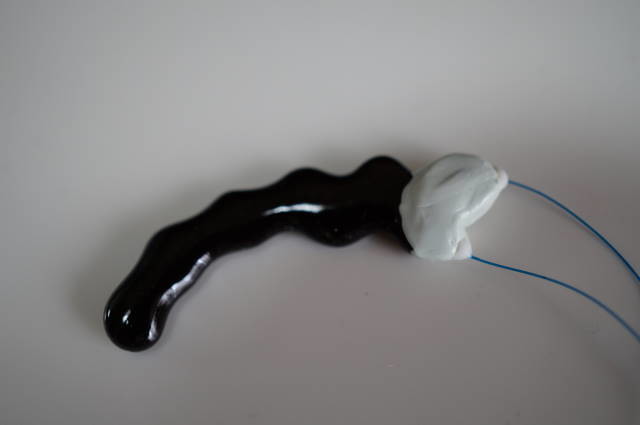
Separate thread exits lost their purpose with a shared internal stopper
In an entry published in September 2020, a customer requested separate threads together with a six-hole sphincter stopper (a part limiting inward movement). Mr. Okada said a shared stopper would largely cancel the intended difference between their force directions.
His proposed alternative was a 3-hole stopper associated with the main thread alone. The customer changed the order accordingly. Mr. Okada favored this arrangement to preserve the extra thread's independent role.
(Source: ok-lab's diary, published September 2020)
https://ok-lab.hatenablog.com/entry/2020/09/26/124400
Mixed retrieval threads brought different materials and separate custom charges
In an entry published in August 2025, Mr. Okada tested nylon alongside a 0.1mm nitinol thread (fine shape-memory metal wire). He also tried separate attachment positions on a standard medium-length ceramic chip.
He quoted ¥1,000 (about $6 at ¥156 = $1, rate as of 2026-09-04) tax excluded for connecting nitinol to ceramic, plus ¥500 (about $3 at ¥156 = $1, rate as of 2026-09-04) tax excluded per thread up to 35cm. The separate-position option carried an additional ¥1,500 (about $10 at ¥156 = $1, rate as of 2026-09-04) tax excluded, as published in August 2025. Mr. Okada proposed mixed materials because he believed they would resist different causes of breakage.
(Source: ok-lab's diary, published August 2025)
https://ok-lab.hatenablog.com/entry/2025/08/30/122943
If you see blood in your urine, even a small amount or for the first time, do not wait and see. See a urologist right away. If you suddenly cannot urinate, or the device cannot be removed, do not try to fix it yourself. Go to a medical facility, including emergency care, immediately.
How prostate chip thread problems changed over time
| Published | What the diary said then |
|---|---|
| Jul 2019 | Ceramic holes enclosed knots; the visible thread was planned to exit at the rear. |
| Nov 2019 | Thin ceramic ends needed holes farther inward to preserve strength. |
| May 2020 | Drying resin could let stiff nylon drift away from a precisely centered exit. |
| Nov 2020 | A linked prototype separated lower connections from upper exits at nearly 90 degrees. |
| Jan 2021 | Front and rear holes separated the second chip's joining line from its retrieval thread. |
| May 2021 | Mr. Okada thought side holes might ease retrieval but could tilt the stopper. |
| Jun 2021 | The designer opposed a reversible loop arrangement because thread breakage could complicate retrieval. |
| Nov 2024 | Mr. Okada warned that a 1mm hole entrance might irritate the lining. |
| Mar 2025 | A three-thread build kept an independent retrieval line alongside two accessory threads. |
| Oct 2025 | Integrated stopper wings concealed the thread connection and provided a new central exit. |
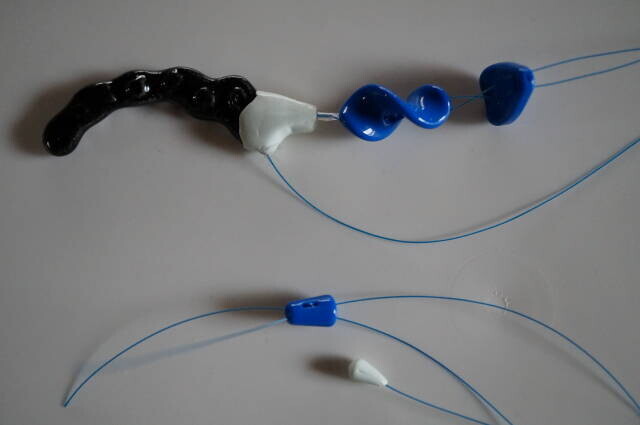
OK Prostate Chip products related to prostate chip thread problems
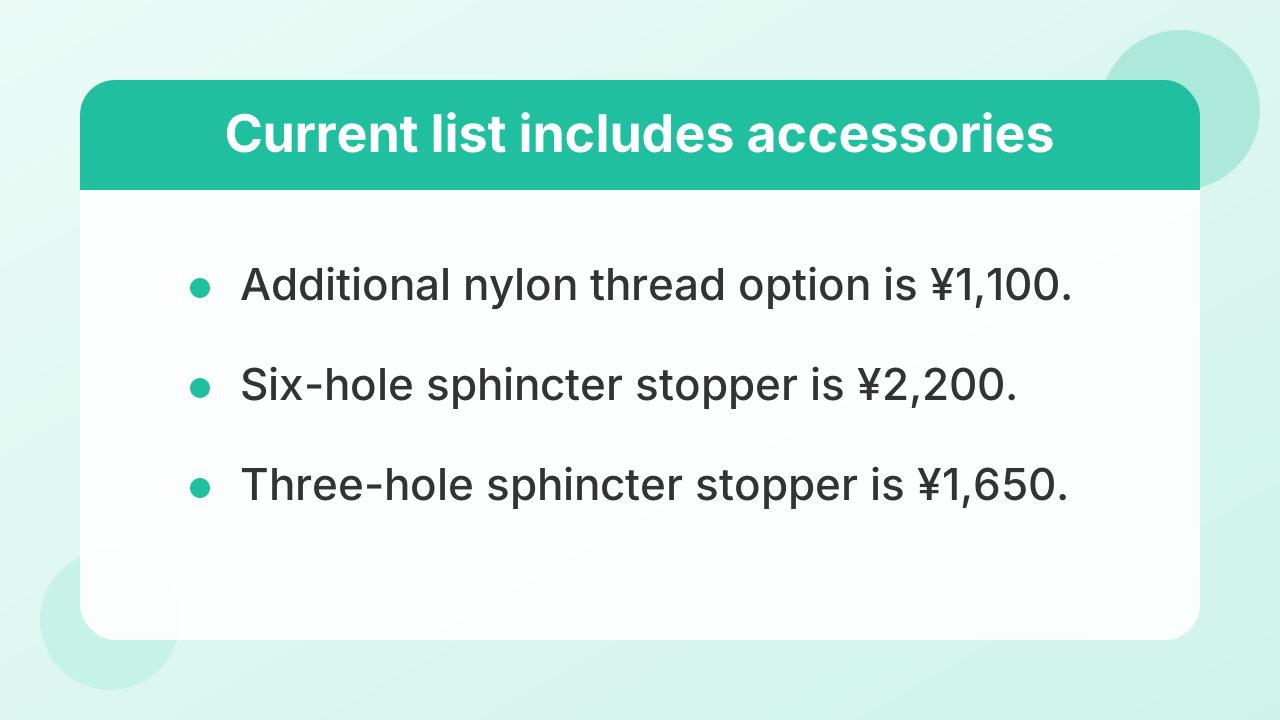
The current list includes accessories and ceramic models discussed in these cases.
Products that appear in these entries
| Product (official name) | Price incl. tax | Relation to this topic |
|---|---|---|
| Medium-length ceramic cobra-twist chip (OKプロステートチップ 陶器素材セミロングタイプ コブラツイスト) | ¥5,500 (about $35 at ¥156 = $1, rate as of 2026-09-04) | In May 2020, this chip appeared in the customer's report about rear-end bulk and painful removal. |
| Additional nylon thread option (ナイロン糸追加(オプション)) | ¥1,100 (about $7 at ¥156 = $1, rate as of 2026-09-04) | In September 2020, Mr. Okada named this option when explaining the separate-thread custom order. |
| Six-hole sphincter stopper (六穴方式オプションチップ(括約筋ストッパーチップ)) | ¥2,200 (about $14 at ¥156 = $1, rate as of 2026-09-04) | In September 2020, a customer changed from this stopper after the warning about joining independent threads. |
| Screw-shaped auxiliary chip option (スクリュー型補助チップ追加オプション) | ¥3,300 (about $21 at ¥156 = $1, rate as of 2026-09-04) | In November 2019, its required central thread exit prevented the requested three-hole arrangement. |
| Resin screw-shaped auxiliary option (スクリュー型補助チップ追加オプション(生体適合樹脂)) | ¥3,300 (about $21 at ¥156 = $1, rate as of 2026-09-04) | In March 2025, staff accepted this material for the customer's requested ceramic-chip repair arrangement. |
(Source: ok-lab's diary, published May 2020)
https://ok-lab.hatenablog.com/entry/2020/05/02/131505
(Source: ok-lab's diary, published September 2020)
https://ok-lab.hatenablog.com/entry/2020/09/19/123115
(Source: ok-lab's diary, published September 2020)
https://ok-lab.hatenablog.com/entry/2020/09/26/124400
(Source: ok-lab's diary, published November 2019)
https://ok-lab.hatenablog.com/entry/2019/11/23/162919
(Source: ok-lab's diary, published March 2025)
https://ok-lab.hatenablog.com/entry/2025/03/22/122906
Products the diary mentioned as alternatives
| Product (official name) | Price incl. tax | Relation to this topic |
|---|---|---|
| Three-hole sphincter stopper (三穴方式オプションチップ(括約筋ストッパーチップ)) | ¥1,650 (about $11 at ¥156 = $1, rate as of 2026-09-04) | In September 2020, Mr. Okada proposed this instead of a shared six-hole stopper for separately attached threads. |
(Source: ok-lab's diary, published September 2020)
https://ok-lab.hatenablog.com/entry/2020/09/26/124400
The entries also discuss the Ver.4 custom shape, titanium prototype, locking-loop assembly, mixed-thread builds, and back-to-back prototype. No matching product can be confirmed on the current list.
Common worries about prostate chip thread problems
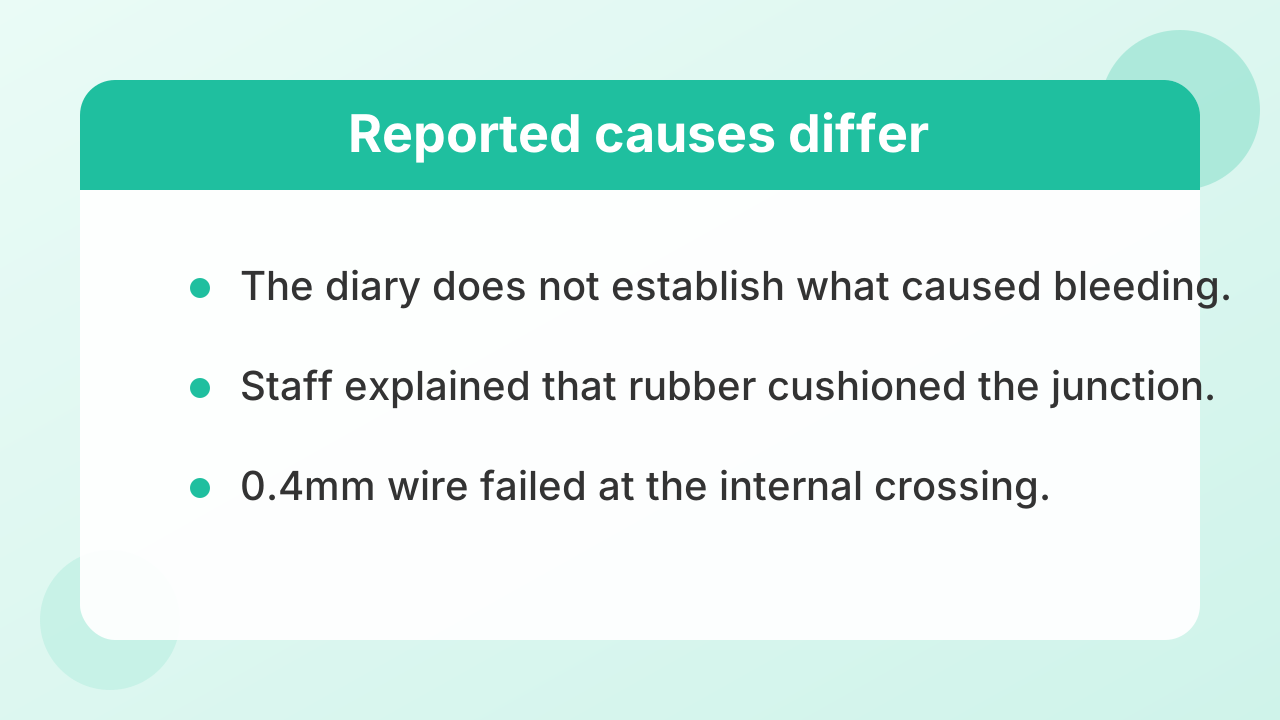
The diary distinguishes sharpness, difficult retrieval, and incompatible thread holes; their reported causes differ.
"Can screw thread holes support three-hole adjustment?"
In an entry published in November 2019, a customer requested adjustable 3-hole machining on a screw-shaped auxiliary chip. Mr. Okada said his process could not combine that machining with the twist. He also said the thread needed to emerge along the shaft's center.
He offered an unfixed version, warning its gap might shift from 2mm to 5mm. The diary does not record whether the customer accepted it. Mr. Okada offered that alternative only with the sliding risk understood.
(Source: ok-lab's diary, published November 2019)
https://ok-lab.hatenablog.com/entry/2019/11/23/162919
"Why does my retrieval thread hurt during removal?"
In an entry published in October 2021, a Ver.4 customer reported bleeding every time the chip came out. The customer asked whether ejaculation was drawing it deeper toward the bladder. Staff said difficult retrieval was a recurring complaint with this shape.
Mr. Okada discussed possible movement, but the diary does not establish what caused this customer's bleeding. The diary does not record whether the problem resolved. Staff pointed to the independent extra-thread option.
(Source: ok-lab's diary, published October 2021)
https://ok-lab.hatenablog.com/entry/2021/10/23/125707
"Can one thread exit solve sharpness from separate connections?"
In an entry published in March 2025, a Ver.4 customer linked repeated bleeding to sharp-feeling, separate thread exits. They requested two threads from one location and a resin screw-shaped auxiliary. Staff accepted the material combination, pending inspection and a final quote.
Staff explained that rubber cushioned the junction; the customer put a decision about removing that protection on hold. The diary does not record the repaired chip's performance. Mr. Okada favored retaining the cover and avoiding separate exits where the urethra was narrow.
(Source: ok-lab's diary, published March 2025)
https://ok-lab.hatenablog.com/entry/2025/03/22/122906
"Can screw thread holes accept thicker shape-memory wire?"
In an entry published in March 2026, a customer requested a blue screw assembly incorporating 0.4mm wire. Mr. Okada explained that the holes were designed for 0.24mm nylon. His test accommodated 0.3mm wire, while 0.4mm wire failed at the internal crossing.
He also feared the thicker wire's spring force could damage the resin. The diary does not record a completed assembly. Mr. Okada declined the thicker specification and suggested 0.3mm as a possible alternative.
(Source: ok-lab's diary, published March 2026)
https://ok-lab.hatenablog.com/entry/2026/03/14/122910
Buying from outside Japan

OK Lab ships internationally to countries covered by Japan Post's EMS courier service. Overseas orders are paid in advance by PayPal. Each order carries a ¥400 (about $3 at ¥156 = $1, rate as of 2026-09-04) handling fee, and EMS shipping is charged on top. These terms come from OK Lab's official sales-terms page (written here as plain text, not a link: ok-lab.net/docs/law), checked on September 7, 2026; confirm them on the official store before you order, because they can change.
Summary of this article
| What you wanted to know | The answer |
|---|---|
| What is the short answer? | The maker links both thread position and connection finish to reported problems. |
| What is this product? | A urethral device made by OK Lab in Japan, priced in Japanese yen. |
| What do the terms mean? | Thread holes secure or guide the line; exits determine where it emerges. |
| What happened in the cases? | Reports included sharp junctions, difficult retrieval, and later changes to thread locations. |
| What did the maker propose? | Covers, smaller attachments, independent threads, and mixed materials, with different limitations. |
| How did designs change? | The diary moved from rear attachment details toward separate connections and integrated exits. |
| Which current products relate? | The tables identify listed accessories and a ceramic model involved in the reported problems. |
| What remains uncertain? | Several cases lack follow-up; prototype results do not establish outcomes for other customers. |
| How can overseas readers buy? | The stated terms specify advance PayPal payment, EMS shipping, and a handling fee. |
Source: ok-lab's diary (Okada Comfortable Life Laboratory). The original entries are in Japanese; quotations on this page are translated. Photos and videos are on the original entries.
This article is a summary of the maker's development diary. The product is not a medical device and no result is guaranteed. If anything feels wrong or worries you, see a doctor. Prices, specifications and cautions change, so confirm the latest information on the official blog and the official site. Questions about ordering and shipping go to the seller.