![Does the prostate chip thread hurt? | Rubber protection has limits [OK Prostate Chip]](/img/a/T0213/eyecatch.svg)
This page is based on entries from "ok-lab's diary" (https://ok-lab.hatenablog.com/), the Japanese development diary written by Mr. Okada, founder of OK Lab, a small company in Japan (Okada Comfortable Life Laboratory). Only the entries about rubber coating and protection at thread ends are summarized here, in order of publication. Past prices and sizes are as written at the time. Current prices come from the official product list (retrieved September 4, 2026). Quotations are translated from Japanese.
Note: This page is a personal reading log by someone with no connection to the maker or the seller. It reflects the source entries as of their publication dates and makes no guarantee of accuracy or safety. The product is not a medical device; talk to a doctor about any health decision. Check the official site for current information. This page contains advertising.
In short
Customers reported pain at sharp thread junctions, including some fitted with rubber protection.
Mr. Okada introduced soft covers, longer coatings, and enclosed cords, with limits depending on construction.
Relevant ceramic and resin models remain on the supplied current product list.
If you see blood in your urine, even a small amount or for the first time, do not wait and see. See a urologist right away.
If you suddenly cannot urinate, or the device cannot be removed, do not try to fix it yourself. Go to a medical facility, including emergency care, immediately.
About this product

The OK Prostate Chip is a small device that is placed in the urethra (the urine passage) so that it acts on the prostate; the maker sells it in several shapes, sizes and materials. It is made and sold by OK Lab (Okada Comfortable Life Laboratory), a small company in Japan, through its own online store, and prices are in Japanese yen (JPY). The maker's development diary, "ok-lab's diary", is written in Japanese. This page is an English summary of it, and every quotation is translated. OK Lab ships internationally, so readers outside Japan can order (see "Buying from outside Japan" below). Product names on this page are plain-English descriptions. The official Japanese product name is shown once in the product table so you can find the same item in the store.
Before you read: key terms
| Term | Plain-English meaning |
|---|---|
| Urethra | The urine passage, where the maker's device is placed. |
| Nylon thread | A line attached to a chip for retrieval or connection to other components. |
| Epoxy | A resin that hardens around some thread attachments to secure them. |
| Silicone rubber | A soft material used to cover junctions or sections of thread. |
| Silicone-and-nylon cord | Nylon enclosed in soft tubing, intended to protect the thread while retaining its strength. |
| Double-tube tail | Nested tubing around thread, developed to make the tail firmer. |
| Nitinol | A nickel-and-titanium alloy used here as wire in place of nylon thread. |
| Positioning tool | A separate tool intended to help position a chip. |
| Stopper | A component intended to help keep a chip in position. |
What happens: prostate chip thread pain
The OK Prostate Chip is a small device placed in the urethra, the urine passage, to act on the prostate. Its nylon thread (a line attached for retrieval) can meet hardened resin at the chip's back, where customers have reported sharp points. Rubber coating covers that junction or a longer section of thread. Mr. Okada describes these coverings as ways to cushion contact, while some later designs also use them to stiffen connections between parts.
Sharp thread connections hurt on two ceramic models in June 2019
In an entry published in June 2019, a customer reported painful burrs on 2 products: the ceramic awakening model and short curved ceramic chip. The customer had stopped using both.
Mr. Okada explained that epoxy (a hard-setting resin) could taper into a point around the emerging thread. He received the returned chips and proposed silicone rubber (a flexible covering) at their junctions. The diary does not record how the repaired chips felt. At that time, Mr. Okada advised concerned customers to request rubber treatment when ordering.
(Source: ok-lab's diary, published June 2019)
https://ok-lab.hatenablog.com/entry/2019/06/29/143536
Rubber coating relieved one customer's prickling, while rounded ends addressed shape
In entries published in July 2019, a customer sought rubber treatment for prickling from a medium-length curved ceramic chip. Mr. Okada offered free treatment for unused chips or those used only once.
The customer later reported that prickling had stopped, although the pointed shape still felt uncomfortable. Mr. Okada accepted the criticism and changed newly made curved chips to rounded ends. His accompanying advice opposed knife work near the junction, favoring gentler treatment because a blade could damage the thread.
(Source: ok-lab's diary, published July 2019)
https://ok-lab.hatenablog.com/entry/2019/07/06/152113
(Source: ok-lab's diary, published July 2019)
https://ok-lab.hatenablog.com/entry/2019/07/27/130537
Repeated thread pain reports brought standard covers for selected designs
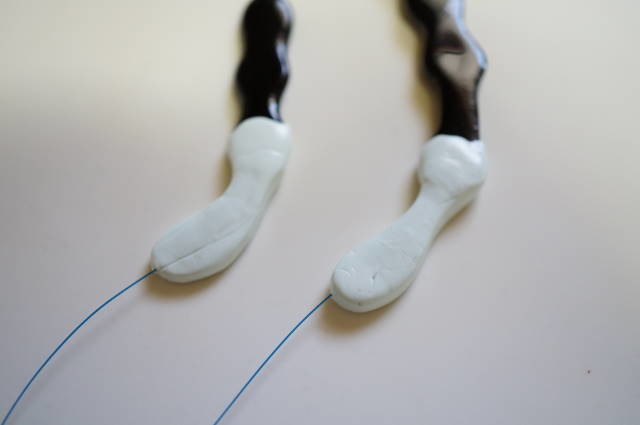
In an entry published in August 2020, a customer reported a thorn-like resin deposit around the thread of a sea-slug-shaped chip, Ver.4. Mr. Okada acknowledged difficulty finishing its narrow end.
The diary does not record this customer's experience with a coated replacement. Following repeated complaints, Mr. Okada's stated response was standard rubber junction covers for Ver.4 and two-thread chips.
(Source: ok-lab's diary, published August 2020)
https://ok-lab.hatenablog.com/entry/2020/08/08/130037
Rubber end protection addressed pain from an epoxy-stiffened thread
In an entry published in February 2025, Mr. Okada traced pain in his hybrid wire-and-cable prototype to epoxy-stiffened nylon. The thread stood up like a horn at the device's end. He reported that rubber covering at the junction removed that source of pain. For the hybrid design overall, Mr. Okada recommended a shorter length of 4cm to 5cm.
(Source: ok-lab's diary, published February 2025)
https://ok-lab.hatenablog.com/entry/2025/02/08/122932
Rubber end protection became a contact point for another tool
In an entry published in March 2026, Mr. Okada described a looped positioning tool (a separate device for positioning chips), called Apple bougie Ver.2. Its compatibility depended on a rubber or tube section on the chip. The published charge for a suitably sized end cover was ¥500 (about $3 at ¥156 = $1, rate as of 2026-09-04) excluding tax. Mr. Okada specified a flexible contact section because hard ceramic or resin surfaces did not provide the required grip.
(Source: ok-lab's diary, published March 2026)
https://ok-lab.hatenablog.com/entry/2026/03/14/122910
The maker's answer to prostate chip thread pain
The maker's measures changed with the connection material, coating length, and intended purpose.
Rubber coating charges depended on the length of covered nylon
In an entry published in October 2020, Mr. Okada introduced a nylon-coating service nicknamed horn coating. Examples covered about 10mm behind a chip or the connection to a screw-shaped supporting chip.
The published schedule made coating through 2mm free and listed 2mm–10mm at ¥500 (about $3 at ¥156 = $1, rate as of 2026-09-04) excluding tax. Longer coating added ¥500 (about $3 at ¥156 = $1, rate as of 2026-09-04) excluding tax for each further 10mm. Mr. Okada's terms warned that peeling rubber would not receive repairs under this service.
(Source: ok-lab's diary, published October 2020)
https://ok-lab.hatenablog.com/entry/2020/10/31/121353
Rubber coating extended to wire, but durability remained uncertain
In an entry published in February 2021, Mr. Okada described coating a 0.5mm wire to approximately 2mm overall diameter. He reported comfortable use during his own day-long test.
Published coating prices were ¥500 (about $3 at ¥156 = $1, rate as of 2026-09-04) excluding tax through 10cm, and ¥1,000 (about $6 at ¥156 = $1, rate as of 2026-09-04) excluding tax for 11–20cm. Mr. Okada cautioned that durability remained unknown and extreme bending might damage the covering.
(Source: ok-lab's diary, published February 2021)
https://ok-lab.hatenablog.com/entry/2021/02/13/121440
Thread protection expanded into tubing with nylon enclosed inside
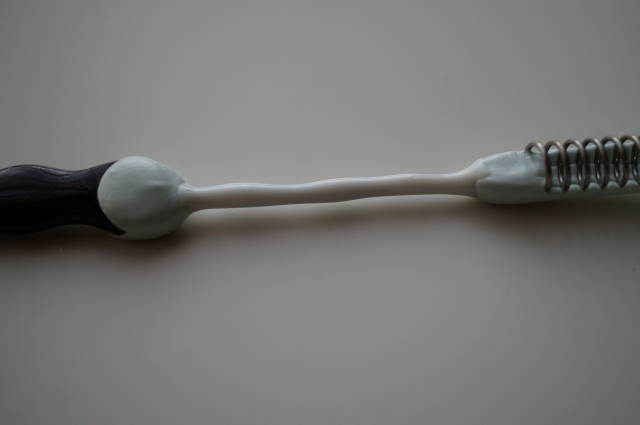
In an entry published in September 2022, Mr. Okada introduced silicone-and-nylon cord (nylon enclosed in soft silicone tubing). The tube had 1mm outer and 0.5mm inner diameters, enclosing two 0.25mm nylon strands. He described the enclosure as protection from water exposure while retaining nylon's pulling strength.
Each 10cm section cost ¥1,000 (about $6 at ¥156 = $1, rate as of 2026-09-04) excluding tax, with a maximum of 4 sections. Incorporating a loop cost another ¥1,000 (about $6 at ¥156 = $1, rate as of 2026-09-04) excluding tax. Mr. Okada declined conversions of existing chips, offering replacement only with the same cord specification already purchased.
(Source: ok-lab's diary, published September 2022)
https://ok-lab.hatenablog.com/entry/2022/09/24/122837
Thread protection gained stiffness through a double-tube tail design
An entry published in June 2024 records a customer's request for a firmer tail on the wire-form chip called the Alien. Staff first said the existing 2.5mm tube lacked sufficient stiffness. Mr. Okada developed a double-tube tail (one tube inside another), using 2mm tubing inside 4mm tubing.
He reported less folding in the prototype. Published prices were ¥3,000 (about $19 at ¥156 = $1, rate as of 2026-09-04) excluding tax through 15cm, or ¥4,500 (about $29 at ¥156 = $1, rate as of 2026-09-04) excluding tax through 25cm. Mr. Okada cautioned that the design could still be difficult to use in a dry urethra.
(Source: ok-lab's diary, published June 2024)
https://ok-lab.hatenablog.com/entry/2024/06/01/123036
Rubber coating on nitinol separated metal from direct body contact
In an entry published in September 2025, Mr. Okada adopted silicone-coated nitinol (a nickel-and-titanium alloy wire) to avoid direct metal contact. He presented this as a precaution concerning metal allergy.
Thin coating over the whole thread carried no extra charge. Thicker coating cost ¥500 (about $3 at ¥156 = $1, rate as of 2026-09-04) excluding tax per 5cm. Mr. Okada cautioned that thick sections would no longer fit through supporting chip holes.
(Source: ok-lab's diary, published September 2025)
https://ok-lab.hatenablog.com/entry/2025/09/06/122911
If you see blood in your urine, even a small amount or for the first time, do not wait and see. See a urologist right away.
If you suddenly cannot urinate, or the device cannot be removed, do not try to fix it yourself. Go to a medical facility, including emergency care, immediately.
How prostate chip thread pain changed over time

| Published | What the diary said then |
|---|---|
| Oct 2017 | An early glass prototype received silicone over exposed knots to reduce irritation. |
| Aug 2020 | Mr. Okada warned that residue on used chips could weaken the coating's bond. |
| Nov 2020 | Mr. Okada reported slower urination with a coated stopper (a positioning component). |
| Sep 2023 | Mr. Okada warned that concentrated force at knots could reduce coating durability. |
| Apr 2026 | Testing of a coated 0.1mm wire retrieval prototype stopped after slight bleeding. |
OK Prostate Chip products related to prostate chip thread pain

The current list includes ceramic and resin products involved in these complaints and compatibility questions.
Products that appear in these entries
| Product (official name) | Price incl. tax | Relation to this topic |
|---|---|---|
| Ceramic awakening model (OKプロステートチップ 陶器素材覚醒タイプ) | ¥5,500 (about $35 at ¥156 = $1, rate as of 2026-09-04) | In June 2019, a customer reported a painful burr at this model's thread junction. |
| Short curved ceramic chip (OKプロステートチップ 陶器素材ショート勾玉タイプ) | ¥4,400 (about $28 at ¥156 = $1, rate as of 2026-09-04) | In June 2019, this was the other ceramic model reported with a painful junction. |
| Medium-length curved ceramic chip (OKプロステートチップ 陶器素材セミロング勾玉タイプ) | ¥5,500 (about $35 at ¥156 = $1, rate as of 2026-09-04) | In July 2019, a customer requested rubber treatment after experiencing prickling. |
| Contoured resin chip (OKプロステートチップ 凶悪ゾロ(生体適合樹脂)) | ¥5,500 (about $35 at ¥156 = $1, rate as of 2026-09-04) | In September 2021, staff declined coating a connection between this chip and a supporting chip. |
| Long ceramic chip with four twists (OKプロステートチップ 陶器素材ロングタイプ 4点ツイスト) | ¥7,700 (about $49 at ¥156 = $1, rate as of 2026-09-04) | In September 2021, staff accepted coating on its side of a proposed mixed-material connection. |
| Resin screw-shaped supporting chip (スクリュー型補助チップ追加オプション(生体適合樹脂)) | ¥3,300 (about $21 at ¥156 = $1, rate as of 2026-09-04) | In September 2021, its tied attachment prevented approval of coating directly onto that end. |
(Source: ok-lab's diary, published June 2019)
https://ok-lab.hatenablog.com/entry/2019/06/29/143536
(Source: ok-lab's diary, published July 2019)
https://ok-lab.hatenablog.com/entry/2019/07/06/152113
(Source: ok-lab's diary, published September 2021)
https://ok-lab.hatenablog.com/entry/2021/09/04/125843
Products the diary mentioned as alternatives
The diary names no alternative.
The entries also discuss custom Ver.4 chips, coating services, enclosed cords, double-tube tails, hybrid assemblies, positioning tools, detachable stoppers, and prototypes. No matching product can be confirmed on the current list.
Common worries about prostate chip thread pain

The diary records limits involving repairs, material compatibility, protective covers, and peeling.
"Can a sharp thread connection be filed?"
In an entry published in April 2020, a customer reported bleeding with every use and asked about filing a sharp glued thread root. Mr. Okada discussed reducing the protrusion and offered a return for rubber repair if the problem persisted.
The diary does not record whether the chip was returned or repaired. Mr. Okada advised against filing because a file could catch and sever the thread.
(Source: ok-lab's diary, published April 2020)
https://ok-lab.hatenablog.com/entry/2020/04/25/133218
"Can resin chips have rubber coating between them?"
In an entry published in September 2021, a customer asked about coating the connection between a contoured resin chip and its supporting chip. Staff refused because the tied attachment could move enough to strain and peel the covering. The customer then asked about a ceramic main chip paired with a resin supporting chip.
Staff allowed coating from the ceramic side, stopping a few millimeters before the resin component. The diary does not record whether that proposed order was completed. Mr. Okada's final advice rejected an epoxy workaround because he doubted its adhesion to the resin chip.
(Source: ok-lab's diary, published September 2021)
https://ok-lab.hatenablog.com/entry/2021/09/04/125843
"Could rubber end protection be causing the pain?"
In an entry published in March 2025, a Ver.4 customer reported repeated bleeding and requested two threads emerging from the same place. After receiving the returned chip, staff addressed the customer's question about omitting its rubber protection.
Staff explained that the rubber was cushioning the transition from the pointed chip to its thread. The customer deferred the decision about that cover; the diary does not record the subsequent experience. Mr. Okada favored retaining rubber protection and advised against separate thread exits where the chip already fitted tightly.
(Source: ok-lab's diary, published March 2025)
https://ok-lab.hatenablog.com/entry/2025/03/22/122906
"Does peeling rubber coating mean the connection has failed?"
In an entry published in June 2026, a customer reported peeling at a detachable apple-shaped stopper's connection and asked whether use should stop. Staff said the nylon remained connected and regarded the rubber as cushioning, without a structural role.
Mr. Okada explained that thin covers could peel, while thicker covers would restrict movement. The diary does not record the customer's later experience. OK Lab warned against sharp tools near the nylon thread.
(Source: ok-lab's diary, published June 2026)
https://ok-lab.hatenablog.com/entry/2026/06/13/122909
Buying from outside Japan

OK Lab ships internationally to countries covered by Japan Post's EMS courier service. Overseas orders are paid in advance by PayPal. Each order carries a ¥400 (about $3 at ¥156 = $1, rate as of 2026-09-04) handling fee, and EMS shipping is charged on top. These terms come from OK Lab's official sales-terms page (written here as plain text, not a link: ok-lab.net/docs/law), checked on September 7, 2026; confirm them on the official store before you order, because they can change.
Summary of this article
| What you wanted to know | The answer |
|---|---|
| What is the immediate concern? | Customers reported painful thread junctions, sometimes with bleeding. |
| What is the product? | A urethral device made and sold by OK Lab in Japan. |
| What do the component terms mean? | Hard resin secures some attachments; soft coverings cushion or enclose their threads. |
| What happened in the cases? | Rubber helped some reported problems, while shape and connection design also mattered. |
| What did the maker change? | Junction covers expanded into longer coatings, enclosed cords, and covered wire. |
| What changed over time? | Later entries added concerns about adhesion, restricted movement, durability, and bleeding during prototype testing. |
| Which products have current prices? | The table identifies matching ceramic and resin products from the supplied list. |
| What questions remain? | Compatibility and peeling depend on construction; several cases lack later results. |
| How do overseas orders work? | Advance PayPal payment, a ¥400 (about $3 at ¥156 = $1, rate as of 2026-09-04) handling fee, and additional EMS shipping. |
| Does coating settle the worry? | The diary records improvements alongside limitations and later complaints. |
Source: ok-lab's diary (Okada Comfortable Life Laboratory). The original entries are in Japanese; quotations on this page are translated. Photos and videos are on the original entries.
This article is a summary of the maker's development diary. The product is not a medical device and no result is guaranteed. If anything feels wrong or worries you, see a doctor. Prices, specifications and cautions change, so confirm the latest information on the official blog and the official site. Questions about ordering and shipping go to the seller.