![Can the safety chip slip inside? | Extra thread was added in August 2026 [OK Prostate Chip]](/img/a/T0212/eyecatch.svg)
This page is based on entries from "ok-lab's diary" (https://ok-lab.hatenablog.com/), the Japanese development diary written by Mr. Okada, founder of OK Lab, a small company in Japan (Okada Comfortable Life Laboratory). Only the entries about "the safety chip at the thread end" are summarized here, in order of publication. Past prices and sizes are as written at the time. Current prices come from the official product list (retrieved September 4, 2026). Quotations are translated from Japanese.
Note: This page is a personal reading log by someone with no connection to the maker or the seller. It reflects the source entries as of their publication dates and makes no guarantee of accuracy or safety. The product is not a medical device; talk to a doctor about any health decision. Check the official site for current information. This page contains advertising.
In short
- The maker acknowledged that the safety chip itself could slip inside.
- He added extra thread behind the standard single-thread safety chip in August 2026.
- The current list includes separate safety chips and versions supplied with connection service.
If you see blood in your urine, even a small amount or for the first time, do not wait and see. See a urologist right away.
If you suddenly cannot urinate, or the device cannot be removed, do not try to fix it yourself. Go to a medical facility, including emergency care, immediately.
About this product

The OK Prostate Chip is a small device that is placed in the urethra (the urine passage) so that it acts on the prostate; the maker sells it in several shapes, sizes and materials. It is made and sold by OK Lab (Okada Comfortable Life Laboratory), a small company in Japan, through its own online store, and prices are in Japanese yen (JPY). The maker's development diary, "ok-lab's diary", is written in Japanese. This page is an English summary of it, and every quotation is translated. OK Lab ships internationally, so readers outside Japan can order (see "Buying from outside Japan" below). Product names on this page are plain-English descriptions. The official Japanese product name is shown once in the product table so you can find the same item in the store.
Before you read: key terms
| Term | Plain-English meaning |
|---|---|
| Urethra | The urine passage, where the maker intends the main chip to sit. |
| Retrieval thread | Nylon cord connecting the chip and its end piece, intended to maintain a retrieval connection. |
| Safety chip | A small thread attachment intended as a retrieval aid or position marker. |
| 3-hole safety chip | A thread-end piece with three through-holes, introduced to allow position adjustment. |
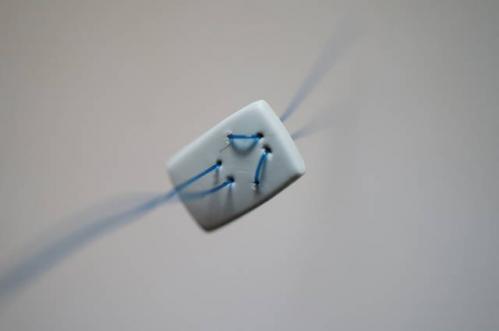
| 6-hole safety chip | A separate part with six holes, recommended for bringing two thread ends together. |
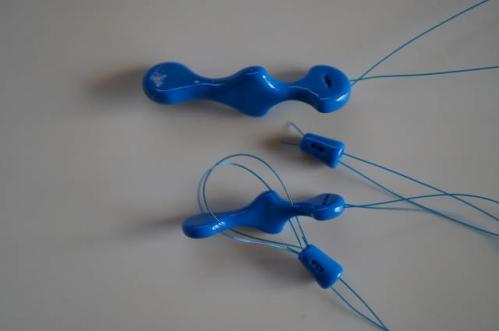
| Two-thread resin safety chip (Blue Safety) | The diary's resin part for organizing thread ends, forming loops, or making certain connections. |
| Gatekeeper | An external holder intended to limit chip movement; its locking arrangements changed over time. |
| Lock key | A small fastener used in the holder to secure a tube and its associated thread. |
| Silicone-and-metal urethral rod | A rod combining silicone and metal, developed for placement in the urethra. |
What happens: safety chip slipping inside
The OK Prostate Chip is a small device placed in the urethra (the urine passage) to act on the prostate. Its retrieval thread (a nylon cord connecting the parts) ends in a small piece the maker calls a safety chip. The diary describes that piece as an aid to retrieval, with later versions also holding thread ends together or forming loops.
A safety chip followed development problems involving hard-to-locate devices
In an entry published in January 2018, a first-time customer described severe pain and losing track of the chip's position. The customer wanted to know why progress stopped and where the chip had gone. Mr. Okada linked the commercial product's retrieval thread and safety chip to problems he had experienced during development.
He wrote that earlier test chips had become impossible to locate and sometimes would not come out. Those test chips eventually reappeared, but he could not confirm where they had been. Mr. Okada proposed estimating depth from thread movement, but the diary does not record whether this helped the customer.
(Source: ok-lab's diary, published January 2018)
https://ok-lab.hatenablog.com/entry/20180127/1517054930
The 3-hole safety chip allowed its position to change
In an entry published in June 2018, Mr. Okada announced a 3-hole safety chip (an adjustable thread-end piece). Earlier positions had been fixed, creating problems when the thread was too long or too short. For orders requiring adjustable positions, Mr. Okada recommended specifying the maximum thread length of 35cm.
(Source: ok-lab's diary, published June 2018)
https://ok-lab.hatenablog.com/entry/20180630/1530342059
A resin safety chip prototype supported both ends and loops
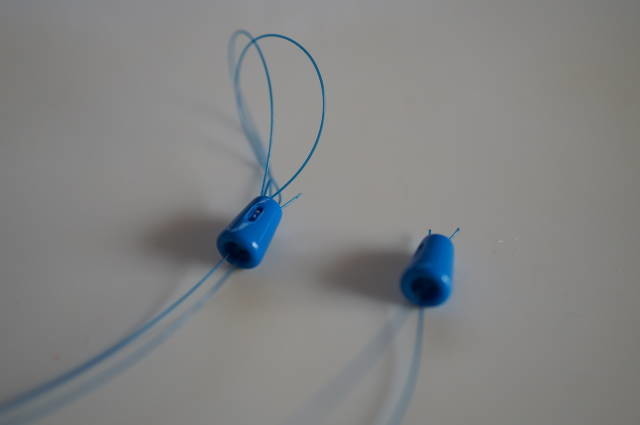
In an entry published in November 2021, Mr. Okada described a two-thread resin safety chip prototype (Blue Safety). It had four sets of holes and was intended for either ordinary thread ends or a loop. He attributed its holding action to friction between the threads. Mr. Okada cautioned that length adjustment depended on understanding the part's thread arrangement.
(Source: ok-lab's diary, published November 2021)
https://ok-lab.hatenablog.com/entry/2021/11/06/125812
The safety chip loop could shrink and resist reopening
In an entry published in March 2023, Mr. Okada identified a weakness in the resin safety chip's loop. Tension on the thread below could shrink it, and restoring the original size required rethreading. He subsequently used that tendency in a connection to a silicone-and-metal urethral rod (a rod intended for placement in the urine passage).
The special close connection cost ¥2,500 (about $16 at ¥156 = $1, rate as of 2026-09-04) excluding tax, because its hidden holes made assembly difficult. The entry contrasted its ¥1,000 (about $6 at ¥156 = $1, rate as of 2026-09-04) threading charge with the usual ¥500, (about $3 at ¥156 = $1, rate as of 2026-09-04) both excluding tax, alongside a ¥1,500 (about $10 at ¥156 = $1, rate as of 2026-09-04) excluding tax part. Mr. Okada favored this rod connector.
(Source: ok-lab's diary, published March 2023)
https://ok-lab.hatenablog.com/entry/2023/03/04/123042
A safety chip connection carried a separate July 2026 quote
In an entry published in July 2026, a customer requested a two-thread safety chip with connection service for a custom wire device. The quote listed the safety-chip connection at ¥2,300 (about $15 at ¥156 = $1, rate as of 2026-09-04). The diary does not record how this order felt in use.
(Source: ok-lab's diary, published July 2026)
https://ok-lab.hatenablog.com/entry/2026/07/11/122904
A linked-chip trial retained the maker's warning despite its safety chip
In an entry published in August 2026, a customer wanted 2 chips joined by a short nylon connection. Staff first warned that early versions were discontinued after chips overlapped and threads tangled inside the urethra, where they could not be untangled. The customer acknowledged the warning and asked again; staff then agreed to accept a custom request.
Mr. Okada produced a trial connection using the required resin safety chip, without confirming whether it met the customer's needs. He quoted an extra ¥1,000 (about $6 at ¥156 = $1, rate as of 2026-09-04) excluding tax beyond the usual price of the safety chip with thread attached. Mr. Okada still said this arrangement was unsuitable for the standard range.
(Source: ok-lab's diary, published August 2026)
https://ok-lab.hatenablog.com/entry/2026/08/22/122905
The maker's answer to safety chip slipping inside
The maker changed thread arrangements and attachment positions, while also recording limits and failed connections.
Two retrieval threads required a separate part for aligned ends
In an entry published in April 2019, Mr. Okada introduced products with 2 threads without a fixed safety chip. He said the threads could stretch differently, making a fixed shared end uneven. A separate 6-hole safety chip (a part for bringing two thread ends together) was offered at ¥1,000 (about $6 at ¥156 = $1, rate as of 2026-09-04) excluding tax.
Six-hole parts cost ¥500 (about $3 at ¥156 = $1, rate as of 2026-09-04) more than three-hole versions, excluding tax, according to that entry. He wrote that the product could function without this extra part. For customers wanting the two ends aligned, Mr. Okada recommended the 6-hole safety chip.
(Source: ok-lab's diary, published April 2019)
https://ok-lab.hatenablog.com/entry/2019/04/27/153239
A safety chip tube connection was proposed but later failed
In an entry published in July 2022, Mr. Okada proposed using the resin safety chip to eliminate gaps between a chip and silicone tube. He said gaps could pinch the urethral lining and cause sudden pain. A revised Gatekeeper (an external device holder) secured the tube and thread with a lock key (a small fastener), replacing the discontinued 6-hole Gatekeeper.
In a reply published in August 2022, staff reported that the earlier connection attempt had failed. A customer then suggested another design and an adhesive connection, but no successful result was reported. Staff favored a newly made direct connection on cost grounds and ruled out a service modifying customers' existing chips.
(Source: ok-lab's diary, published July 2022)
https://ok-lab.hatenablog.com/entry/2022/07/16/123031
(Source: ok-lab's diary, published August 2022)
https://ok-lab.hatenablog.com/entry/2022/08/20/122920
Four retrieval threads introduced another safety chip beside the device
In an entry published in May 2023, Mr. Okada introduced an arrangement with 4 threads in response to increasingly heavy chips. The design grouped the threads with a resin safety chip immediately behind the main device. Its processing price was ¥2,500 (about $16 at ¥156 = $1, rate as of 2026-09-04) excluding tax, including the required safety chip.
At that time, he said only this safety-chip design could accommodate four threads; the additional two were intended solely for retrieval backup. Other auxiliary chips did not yet support that arrangement. Mr. Okada ruled out upgrading previously sold single-thread or two-thread products during the thread-replacement service.
(Source: ok-lab's diary, published May 2023)
https://ok-lab.hatenablog.com/entry/2023/05/13/123004
Extra retrieval thread extended beyond the standard single-thread safety chip
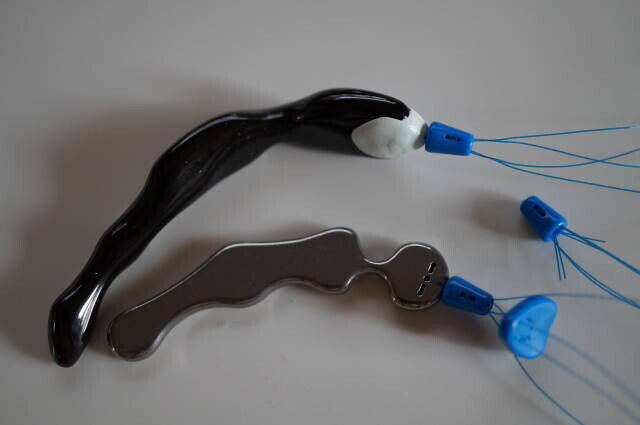
In an entry published in August 2026, Mr. Okada changed the standard single-thread safety chip's arrangement. For a 20cm specification, the piece remained at that position, with approximately 5-10cm of thread extending behind it. He said the purpose was to leave thread outside even if the safety chip slipped into the head of the penis.
The standard single-thread setup still included 1 free safety chip; additional pieces cost ¥500 (about $3 at ¥156 = $1, rate as of 2026-09-04) excluding tax each. The maximum thread length remained 35cm. Mr. Okada specified that orders at that maximum retained the previous end-stop arrangement.
(Source: ok-lab's diary, published August 2026)
https://ok-lab.hatenablog.com/entry/2026/08/15/122912
If you see blood in your urine, even a small amount or for the first time, do not wait and see. See a urologist right away.
If you suddenly cannot urinate, or the device cannot be removed, do not try to fix it yourself. Go to a medical facility, including emergency care, immediately.
How safety chip slipping inside changed over time
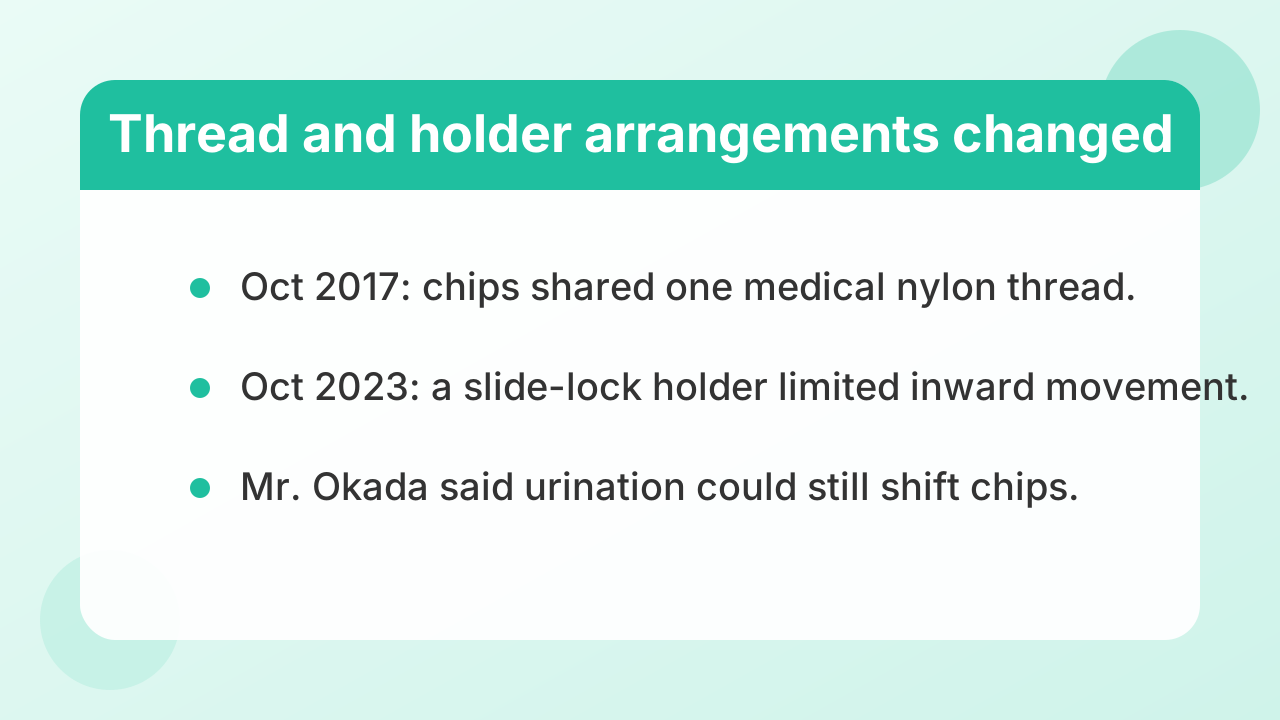
| Published | What the diary said then |
|---|---|
| Oct 2017 | All chips shared one medical nylon thread, approximately 0.2mm in diameter. |
| Mar 2018 | Resin and glass connector chips gained slim safety rods with approximately 1cm of exposed thread. |
| Apr 2019 | Mr. Okada chose 3-0 nylon thread after finding 2-0 irritating. |
| Dec 2020 | Mr. Okada reported that paired loop threads stayed taut in his test. |
| Nov 2021 | Two-thread resin safety chip launched: 7mm high; ¥1,500 (about $10 at ¥156 = $1, rate as of 2026-09-04) excluding tax; attachment ¥500 (about $3 at ¥156 = $1, rate as of 2026-09-04) excluding tax. |
| Oct 2023 | A slide-lock holder limited inward movement; Mr. Okada said urination could still shift chips. |
| Mar 2026 | A custom steel auxiliary chip accommodated all four nylon threads after factory processing. |
| Aug 2026 | Mr. Okada suggested an extra positional marker for differences between erection and shrinkage. |
OK Prostate Chip products related to safety chip slipping inside
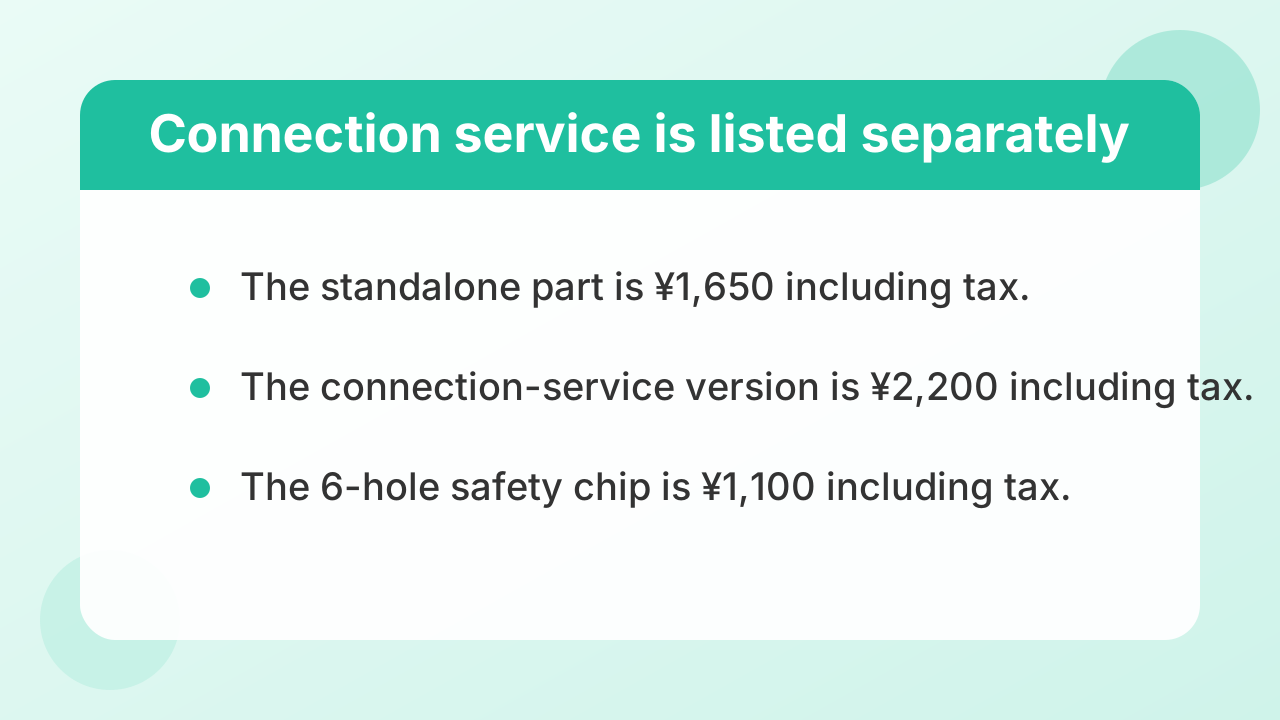
The current list separates the resin safety chip sold alone from the version with connection service.
Products that appear in these entries
| Product (official name) | Price incl. tax | Relation to this topic |
|---|---|---|
| Two-thread resin safety chip, part only (二本糸用セーフティチップ(生体適合樹脂)単体) | ¥1,650 (about $11 at ¥156 = $1, rate as of 2026-09-04) | An October 2022 customer received this standalone part after expecting a connected safety chip. |
| Two-thread resin safety chip with connection service (二本糸用セーフティチップ(生体適合樹脂)接続オプション込み) | ¥2,200 (about $14 at ¥156 = $1, rate as of 2026-09-04) | A January 2023 quote included this service for a ceramic chip and short steel-ring assembly with an end loop. |
| Additional nylon thread option (ナイロン糸追加(オプション)) | ¥1,100 (about $7 at ¥156 = $1, rate as of 2026-09-04) | Staff named this option in September 2020 when answering a customer's request for two threads. |
| Medium-length stainless-steel chip (OKプロステートチップ セミロングタイプ(サージカルステンレス)) | ¥9,900 (about $63 at ¥156 = $1, rate as of 2026-09-04) | An October 2022 customer ordered this chip with a standalone safety chip and reported completing the connection. |
The standalone two-thread resin safety chip is listed in OK Lab's own online store.

The two-thread resin safety chip with connection service has a separate store listing.
(Source: ok-lab's diary, published October 2022)
https://ok-lab.hatenablog.com/entry/2022/10/01/122944
(Source: ok-lab's diary, published January 2023)
https://ok-lab.hatenablog.com/entry/2023/01/14/122952
(Source: ok-lab's diary, published September 2020)
https://ok-lab.hatenablog.com/entry/2020/09/19/123115
Products the diary mentioned as alternatives
| Product (official name) | Price incl. tax | Relation to this topic |
|---|---|---|
| 6-hole safety chip (六穴方式オプションチップ(セーフティチップ)) | ¥1,100 (about $7 at ¥156 = $1, rate as of 2026-09-04) | In April 2019, Mr. Okada recommended this separate part for aligning two thread ends instead of a fixed shared end. |
The 6-hole safety chip is listed in OK Lab's own online store.
(Source: ok-lab's diary, published April 2019)
https://ok-lab.hatenablog.com/entry/2019/04/27/153239
Discontinued designs: the 6-hole Gatekeeper, reported in July 2022, and early short-thread two-chip connections, reported in August 2026.
For the spherical safety chip, early prototypes, custom wire assembly, and linked-chip trial: No matching product can be confirmed on the current list.
Common worries about safety chip slipping inside
Reader questions show that shape requests, two-thread options, and connection service were separate issues.
"Can I order a spherical safety chip?"
In an entry published in May 2018, a customer requested a spherical safety chip measuring 8.5mm. Mr. Okada explained that his equipment was intended for two-dimensional work, so the shape was outside normal production. He nevertheless made a trial piece; the diary does not record how it felt in use. Because it took considerable work, Mr. Okada said he was reluctant to accept further requests.
(Source: ok-lab's diary, published May 2018)
https://ok-lab.hatenablog.com/entry/20180513/1526181573
"Can a safety chip distinguish two retrieval threads?"
In an entry published in September 2020, a customer wanted two threads on a custom ceramic chip. The customer offered to accept one thread if two were unavailable. Staff confirmed that two threads were possible and quoted an additional ¥1,100 (about $7 at ¥156 = $1, rate as of 2026-09-04).
Mr. Okada described different-sized safety chips for distinguishing the threads, but no report of use followed in that case. For future orders, staff directed the customer to the separately listed additional-thread option.
(Source: ok-lab's diary, published September 2020)
https://ok-lab.hatenablog.com/entry/2020/09/19/123115
"Why did my safety chip arrive unattached?"
In an entry published in October 2022, a customer received a medium-length stainless-steel chip and an unattached safety chip. The customer had mistakenly ordered the standalone part, but completed the connection after about three hours. Staff repaired the broken video link the customer had reported.
Mr. Okada explained that standalone parts shipped partly threaded to check for blocked holes and provide a sample. He acknowledged that he lacked information about the internal structure and had worked out a threading pattern through trial. His response presented the sample as a guide while allowing that a better threading arrangement might exist.
(Source: ok-lab's diary, published October 2022)
https://ok-lab.hatenablog.com/entry/2022/10/01/122944
Buying from outside Japan

OK Lab ships internationally to countries covered by Japan Post's EMS courier service. Overseas orders are paid in advance by PayPal. Each order carries a ¥400 (about $3 at ¥156 = $1, rate as of 2026-09-04) handling fee, and EMS shipping is charged on top. These terms come from OK Lab's official sales-terms page (written here as plain text, not a link: ok-lab.net/docs/law), checked on September 7, 2026; confirm them on the official store before you order, because they can change.
Summary of this article
| What you wanted to know | The answer |
|---|---|
| What is the short answer? | Extra thread was added because the safety chip itself could slip inside. |
| What is the base product? | A urethral device made by OK Lab in Japan. |
| What do the terms mean? | The safety chip is an attachment on the device's retrieval thread. |
| What problems appeared? | Lost positions, shrinking loops, and tangled linked-chip arrangements. |
| What was the maker's answer? | Revised thread arrangements, separate end pieces, and extra thread behind the standard safety chip. |
| What changed over time? | Fixed positions gave way to adjustable pieces and loop designs. |
| Which related products are listed now? | Separate safety chips, a connection-service version, and an additional-thread option. |
| What did customers ask? | Whether shapes could be customized, two threads were possible, and connection was included. |
| How does overseas buying work? | Advance PayPal payment, a ¥400 (about $3 at ¥156 = $1, rate as of 2026-09-04) handling fee, and separate Japan Post EMS shipping. |
Source: ok-lab's diary (Okada Comfortable Life Laboratory). The original entries are in Japanese; quotations on this page are translated. Photos and videos are on the original entries.
This article is a summary of the maker's development diary. The product is not a medical device and no result is guaranteed. If anything feels wrong or worries you, see a doctor. Prices, specifications and cautions change, so confirm the latest information on the official blog and the official site. Questions about ordering and shipping go to the seller.