![Should I choose two or four threads, and what length? | Material and attachments matter [OK Prostate Chip]](/img/a/T0210/eyecatch.svg)
This page is based on entries from "ok-lab's diary" (https://ok-lab.hatenablog.com/), written by Mr. Okada, founder of OK Lab, a small company in Japan.
Its full name is Okada Comfortable Life Laboratory. Only entries about "two or four retrieval threads and custom lengths" are summarized here, in order of publication.
Past prices and sizes are as written at the time. Current prices come from the official product list (retrieved September 4, 2026).
Quotations are translated from Japanese.
Note: This page is a personal reading log by someone with no connection to the maker or the seller. It reflects the source entries as of their publication dates and makes no guarantee of accuracy or safety. The product is not a medical device; talk to a doctor about any health decision. Check the official site for current information. This page contains advertising.
In short
The diary records thread breakage and painful attachments during the development of extra-thread options.
Mr. Okada changed thread counts, connection covers, and compatible accessories in response.
The current product list includes chips and thread accessories, without specifying thread-length options.
If you see blood in your urine, even a small amount or for the first time, do not wait and see. See a urologist right away. If you suddenly cannot urinate, or the device cannot be removed, do not try to fix it yourself. Go to a medical facility, including emergency care, immediately.
About this product

The OK Prostate Chip is a small device that is placed in the urethra (the urine passage) so that it acts on the prostate; the maker sells it in several shapes, sizes and materials. It is made and sold by OK Lab (Okada Comfortable Life Laboratory), a small company in Japan, through its own online store, and prices are in Japanese yen (JPY). The maker's development diary, "ok-lab's diary", is written in Japanese. This page is an English summary of it, and every quotation is translated. OK Lab ships internationally, so readers outside Japan can order (see "Buying from outside Japan" below). Product names on this page are plain-English descriptions. The official Japanese product name is shown once in the product table so you can find the same item in the store.
Before you read: key terms
| Term | Plain-English meaning |
|---|---|
| Retrieval thread | A line attached to the chip for removal; some designs also connect accessories along it. |
| Urethra | The urine passage, where the chip and part of its thread are located. |
| Sphincter stopper | An accessory intended to limit the main chip’s movement toward the bladder. |
| Safety piece | A fitting on the thread; the entries discuss versions that keep multiple lines together. |
| Screw accessory | A separate screw-shaped part connected behind the main chip to assist its positioning. |
| Nitinol thread | Thin shape-memory metal used as a connection material and explored as an alternative to nylon. |
| Kgf | The force unit Mr. Okada used for breakage estimates. The diary does not explain this. |
What happens: two or four retrieval threads
The OK Prostate Chip is a small device placed in the urethra, the urine passage, to act on the prostate. A retrieval thread (a line attached for removal) extends from the chip toward the outside of the body. Some versions have two or four threads, and accessories may connect to those same lines. The diary discusses their number, attachment points, material, and requested length because these details changed across models and development stages.
Retrieval thread breakage prompted a separate two-thread replacement in April 2019
In an entry published in April 2019, a customer reported that a linked resin chip’s thread had broken, leaving its leading chip inside. The customer reported its removal after five and a half days and requested repair with two threads. Mr. Okada made a separate replacement, keeping the recovered chip intact as a record.
A follow-up published in May 2019 said the replacement had arrived and worked well for that customer. Mr. Okada favored duplicate threads over a stronger single line as his proposed safeguard.
(Source: ok-lab's diary, published April 2019)
https://ok-lab.hatenablog.com/entry/2019/04/27/153239
(Source: ok-lab's diary, published May 2019)
https://ok-lab.hatenablog.com/entry/2019/05/11/152432
Pain around two-thread attachments led to rubber covers in August 2020
An entry published in August 2020 described unbearable pain during position adjustment around a curved ceramic chip’s two-thread connection. The customer reported sharp, hardened resin near the thread exits and requested a single-thread repair, while allowing another two-thread version for testing.
Mr. Okada acknowledged recurring complaints about painful thread ends. He announced rubber covers at the connection, generally for two-thread chips and the curved ceramic version (Umiushi Ver.4). The diary does not record the result of this customer’s repair.
(Source: ok-lab's diary, published August 2020)
https://ok-lab.hatenablog.com/entry/2020/08/08/130037
Four-thread nylon designs initially required one specific bundling accessory in May 2023
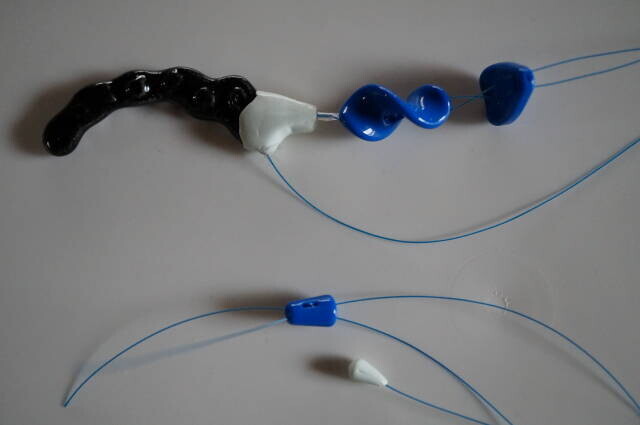
In an entry published in May 2023, Mr. Okada proposed extra nylon threads for increasingly heavy chips. His design had four threads attached to the main chip, gathered by a blue resin safety piece immediately behind it.
That required piece cost ¥1,500 (about $10 at ¥156 = $1, rate as of 2026-09-04) tax excluded; including additional threads and bundling, the quoted charge was ¥2,500 (about $16 at ¥156 = $1, rate as of 2026-09-04) tax excluded. At that time, only the blue safety piece supported the arrangement; sphincter stoppers and other auxiliary chips did not. Mr. Okada declined four-thread conversions during replacement service for products originally sold with one or two threads.
(Source: ok-lab's diary, published May 2023)
https://ok-lab.hatenablog.com/entry/2023/05/13/123004
Four threads fitted the stainless flat accessory by August 2023
In an entry published in August 2023, a customer requested a stainless steel chip with four threads and a stainless flat accessory. Mr. Okada replied that he had not tried that combination and would test it.
He subsequently reported that all four threads connected successfully through the accessory’s larger holes. The diary does not record how the finished arrangement felt in use.
(Source: ok-lab's diary, published August 2023)
https://ok-lab.hatenablog.com/entry/2023/08/19/123214
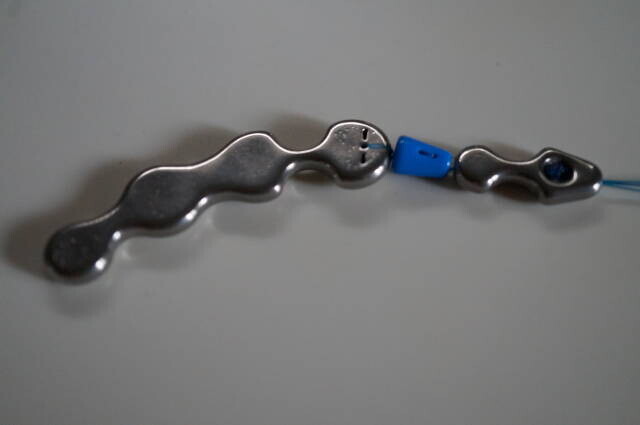
Four nitinol threads were proposed as standard in August 2025
In an entry published in August 2025, Mr. Okada proposed four 0.15mm nitinol threads (thin shape-memory metal lines) as a standard arrangement. He estimated their breaking force at 9Kgf (the diary’s force unit), comparable to his figure for 0.3mm wire.
This was his proposed specification and strength estimate. For the 0.15mm thread, Mr. Okada favored a finished end rather than an exposed cut end.
(Source: ok-lab's diary, published August 2025)
https://ok-lab.hatenablog.com/entry/2025/08/23/122935
Nitinol thread counts depended on silicone coating by September 2025
In an entry published in September 2025, Mr. Okada proposed combining nitinol with nylon in the same line. Silicone-coated 0.15mm nitinol was limited to two threads, because the coating increased its thickness.
Uncoated nitinol allowed four threads, with room for two per hole. Mr. Okada recommended nitinol for the internal section and nylon toward the outside, where he found nylon easier to accommodate.
(Source: ok-lab's diary, published September 2025)
https://ok-lab.hatenablog.com/entry/2025/09/13/122925
The maker's answer to two or four retrieval threads
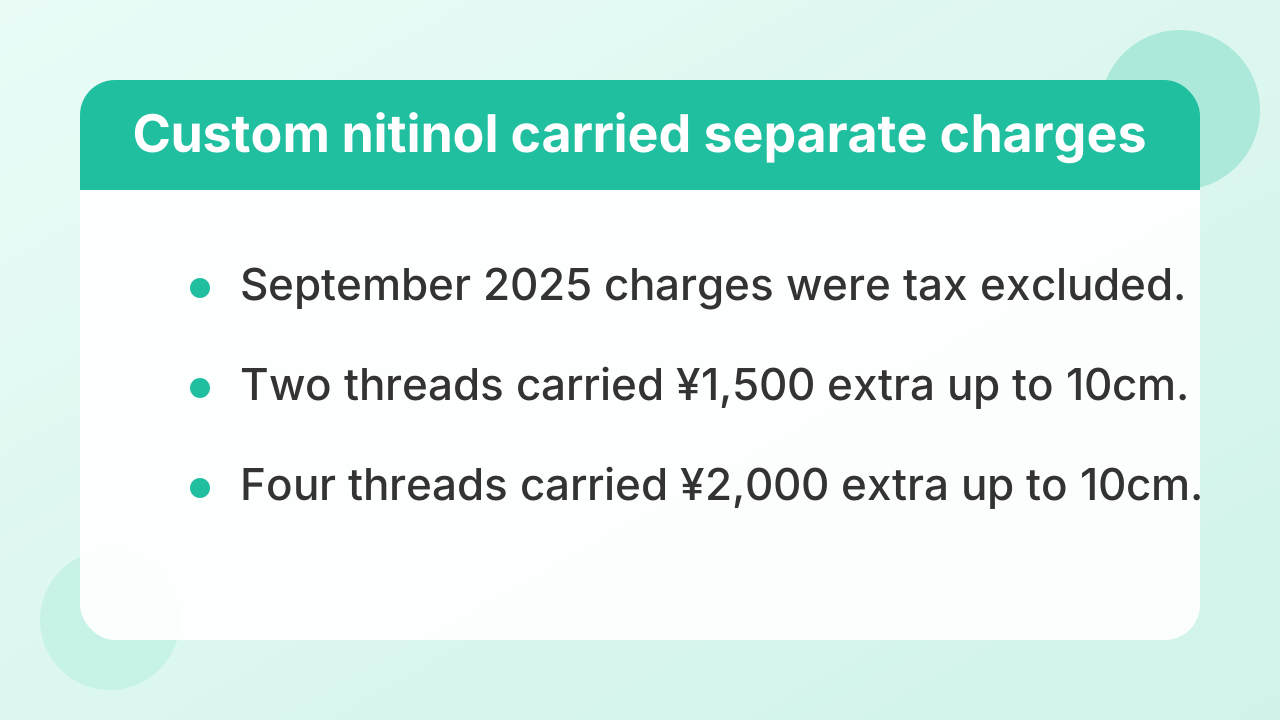
Mr. Okada’s answers depended on the connection design, accessory compatibility, and material being priced.
Two-thread nylon pricing initially excluded the safety piece in April 2019
In an entry published in April 2019, the embedding charge was the same for one or two threads. However, the two-thread version did not include a safety piece (the fitting used to gather the lines). Mr. Okada explained that fixing both lines together could leave them unequal as they stretched.
A three-hole stopper remained compatible with a single line within a two-thread arrangement. For the final fitting gathering both lines, he specified a six-hole safety piece. Mr. Okada advised purchasing that fitting separately; its published price was ¥1,000 (about $6 at ¥156 = $1, rate as of 2026-09-04) tax excluded.
(Source: ok-lab's diary, published April 2019)
https://ok-lab.hatenablog.com/entry/2019/04/27/153239
Two-thread ordering required an explicit request from April 2019
An entry published in April 2019 opened two-thread orders from that publication day, excluding motorized chips. Products already being made could not be changed; completed, unshipped products incurred the same charge as thread repair.
Existing products could also receive two threads through the repair service at the single-thread repair price. Mr. Okada asked customers to specify their two-thread request in the order’s notes field.
(Source: ok-lab's diary, published April 2019)
https://ok-lab.hatenablog.com/entry/2019/04/27/153239
Custom nitinol thread length carried separate charges by September 2025
An entry published in September 2025 priced the nitinol section separately from the normal nylon-thread chip. For two threads, extra charges were ¥1,500 (about $10 at ¥156 = $1, rate as of 2026-09-04) up to 10cm, ¥2,000 (about $13 at ¥156 = $1, rate as of 2026-09-04) up to 20cm, and ¥2,500 (about $16 at ¥156 = $1, rate as of 2026-09-04) up to 30cm. For four threads, they were ¥2,000 (about $13 at ¥156 = $1, rate as of 2026-09-04) up to 10cm, ¥2,500 (about $16 at ¥156 = $1, rate as of 2026-09-04) up to 20cm, and ¥3,000 (about $19 at ¥156 = $1, rate as of 2026-09-04) up to 30cm.
All these September 2025 charges were tax excluded. They covered the nitinol section between the chip and its nylon thread, not the complete device. Mr. Okada recommended retaining nylon for the part outside the body.
(Source: ok-lab's diary, published September 2025)
https://ok-lab.hatenablog.com/entry/2025/09/13/122925
If you see blood in your urine, even a small amount or for the first time, do not wait and see. See a urologist right away. If you suddenly cannot urinate, or the device cannot be removed, do not try to fix it yourself. Go to a medical facility, including emergency care, immediately.
How two or four retrieval threads changed over time
| Published | What the diary said then |
|---|---|
| May 2019 | A cable-plus-nylon connection required a gap about 2mm longer than the earlier prototype. |
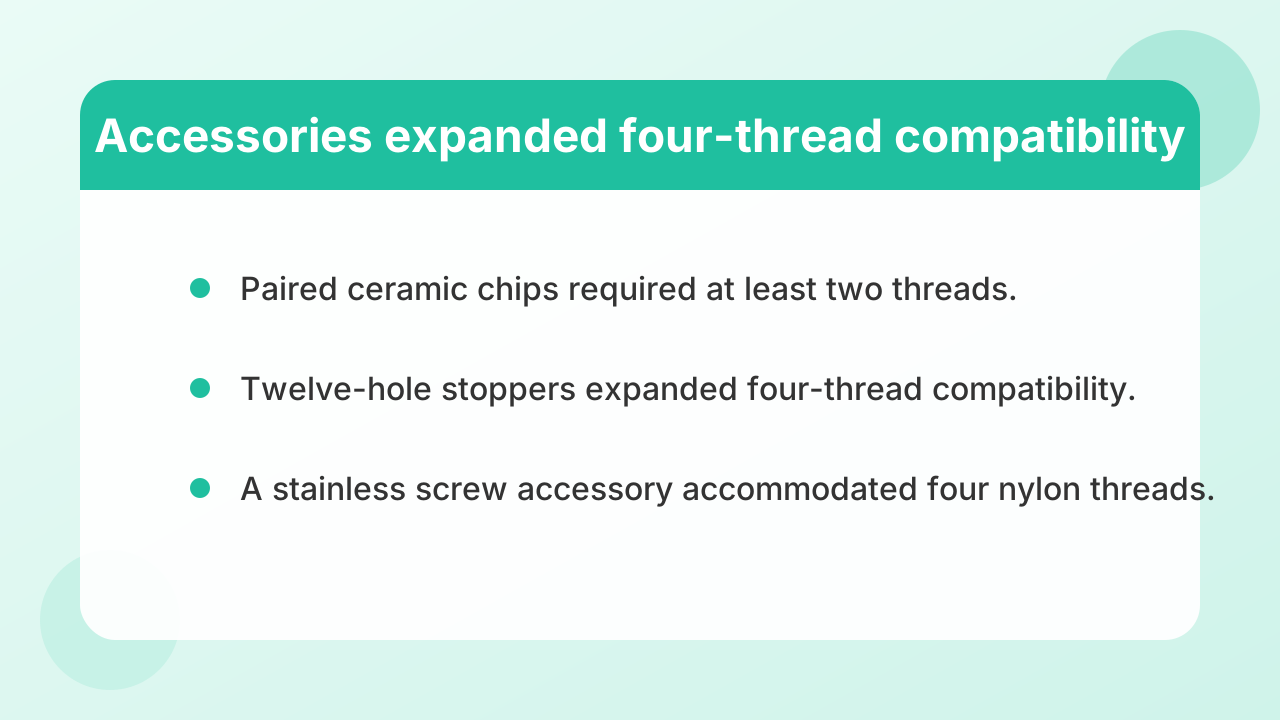
| Feb 2021 | Paired ceramic chips required at least two threads; doubling each chip’s attachment made four. |
| Aug 2021 | A cage-shaped nylon loop required two threads and cost ¥2,000 (about $13 at ¥156 = $1, rate as of 2026-09-04) tax excluded. |
| Sep 2022 | Silicone-covered nylon used 10cm sections, maximum four, priced at ¥1,000 (about $6 at ¥156 = $1, rate as of 2026-09-04) each tax excluded. |
| Jul 2023 | Stainless-chip reservations specified thread length; the four-thread option cost an extra ¥2,750 (about $18 at ¥156 = $1, rate as of 2026-09-04). |
| Jul 2023 | Twelve-hole stoppers expanded four-thread compatibility, with greater resistance during position adjustment. |
| Nov 2024 | Loop-connector tolerances: 20mm requests meant roughly 15–25mm; angles could vary about 10 degrees. |
| Apr 2025 | A 35cm, two-plus-one-thread custom build carried a ¥1,100 (about $7 at ¥156 = $1, rate as of 2026-09-04) extra charge. |
| Mar 2026 | A stainless screw accessory accommodated all four nylon threads in a completed custom build. |
OK Prostate Chip products related to two or four retrieval threads
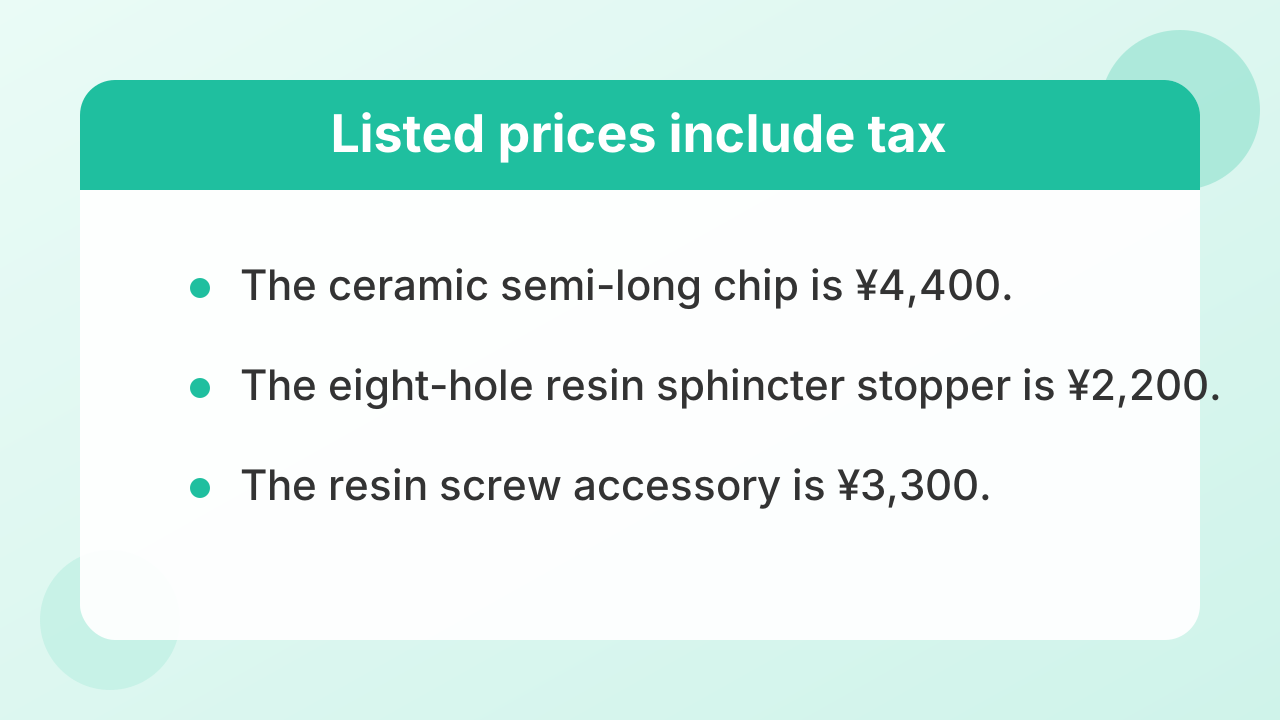
The current list includes the ceramic chip and resin accessories discussed in the maker’s replies.
Products that appear in these entries
| Product (official name) | Price incl. tax | Relation to this topic |
|---|---|---|
| Ceramic semi-long chip (OKプロステートチップ 陶器素材セミロングタイプ) | ¥4,400 (about $28 at ¥156 = $1, rate as of 2026-09-04) | In October 2024, a prospective buyer asked whether this ceramic model shared the stainless version’s two-thread default. |
| Eight-hole resin sphincter stopper (八穴方式括約筋ストッパーチップ(生体適合樹脂)) | ¥2,200 (about $14 at ¥156 = $1, rate as of 2026-09-04) | In August 2021, Mr. Okada announced that it would go on sale the following week at ¥2,000 (about $13 at ¥156 = $1, rate as of 2026-09-04) tax excluded and that the previous six-hole sphincter stopper would be discontinued. |
(Source: ok-lab's diary, published August 2021)
https://ok-lab.hatenablog.com/entry/2021/08/28/125823
(Source: ok-lab's diary, published October 2024)
https://ok-lab.hatenablog.com/entry/2024/10/26/122649
Products the diary mentioned as alternatives
| Product (official name) | Price incl. tax | Relation to this topic |
|---|---|---|
| Resin screw accessory (スクリュー型補助チップ追加オプション(生体適合樹脂)) | ¥3,300 (about $21 at ¥156 = $1, rate as of 2026-09-04) | In August 2021, Mr. Okada favored this two-thread accessory over epoxy because thread replacement did not require discarding the accessory. |
(Source: ok-lab's diary, published August 2021)
https://ok-lab.hatenablog.com/entry/2021/08/28/125823
Custom builds, ceramic twins, and stainless flat or screw accessories: No matching product can be confirmed on the current list.
Common worries about two or four retrieval threads
Readers asked about attachment security, standard thread counts, and whether separate lines would remain independent.
"Can a ceramic chip’s retrieval thread pull free?"
In an entry published in August 2020, a customer asked whether the ceramic chip’s thread attachment relied only on glue. Mr. Okada described a knot secured inside a hole left from firing, with resin enclosing it. He said this prevented the thread from pulling free or untying, while acknowledging that damaged nylon could still break.
The diary does not record a follow-up from this questioner. Mr. Okada suggested two threads for buyers concerned about breakage.
(Source: ok-lab's diary, published August 2020)
https://ok-lab.hatenablog.com/entry/2020/08/01/124144
"Does a ceramic chip also come with two threads?"
An entry published in October 2024 concerned a buyer who expected a ceramic semi-long chip to match their stainless model’s two-thread arrangement. Mr. Okada clarified that the blue resin and stainless steel ranges had two threads as standard. Ceramic and glass chips had one.
The diary does not record whether this buyer placed an order. Mr. Okada asked buyers wanting two threads on a ceramic chip to state that request in the order’s notes field.
(Source: ok-lab's diary, published October 2024)
https://ok-lab.hatenablog.com/entry/2024/10/26/122649
"Can three retrieval threads keep a separate backup line?"
In an entry published in March 2025, a customer requested independently attached threads and several accessories on a curved ceramic chip. OK Lab replied that the accessories would bring those lines together immediately, reducing the intended separation.
The customer then requested two threads for the accessories and one independent retrieval thread on the opposite side. Mr. Okada reported completing that arrangement, but the diary does not record how it performed for the buyer.
(Source: ok-lab's diary, published March 2025)
https://ok-lab.hatenablog.com/entry/2025/03/01/122825
Buying from outside Japan

OK Lab ships internationally to countries covered by Japan Post's EMS courier service. Overseas orders are paid in advance by PayPal. Each order carries a ¥400 (about $3 at ¥156 = $1, rate as of 2026-09-04) handling fee, and EMS shipping is charged on top. These terms come from OK Lab's official sales-terms page (written here as plain text, not a link: ok-lab.net/docs/law), checked on September 7, 2026; confirm them on the official store before you order, because they can change.
Summary of this article
| What you wanted to know | The answer |
|---|---|
| What is the main concern? | Extra threads were introduced following breakage reports, but attachment problems also occurred. |
| What is this product? | A small urethral device made and sold by OK Lab in Japan. |
| What do its thread fittings do? | Different fittings connect accessories, gather threads, or limit chip movement. |
| What happened during development? | Nylon and nitinol arrangements changed, including their covers and compatible accessories. |
| How were options requested and priced? | Requests used order notes; dated charges depended on the material and configuration. |
| What changed most recently? | In March 2026, a custom stainless screw assembly accommodated four nylon threads. |
| Which related products are listed now? | The ceramic semi-long chip, eight-hole resin stopper, and resin screw accessory appear above with current prices. |
| Does thread count settle every compatibility question? | The maker’s replies also considered attachment position, coating, and shared accessories. |
| How do overseas purchases work? | Advance PayPal payment, EMS shipping, and a ¥400 (about $3 at ¥156 = $1, rate as of 2026-09-04) handling fee apply under the stated terms. |
Source: ok-lab's diary (Okada Comfortable Life Laboratory). The original entries are in Japanese; quotations on this page are translated. Photos and videos are on the original entries.
This article is a summary of the maker's development diary. The product is not a medical device and no result is guaranteed. If anything feels wrong or worries you, see a doctor. Prices, specifications and cautions change, so confirm the latest information on the official blog and the official site. Questions about ordering and shipping go to the seller.