![Can the chip's thread be replaced? | The fee depends on the repair [OK Prostate Chip]](/img/a/T0207/eyecatch.svg)
This page is based on entries from "ok-lab's diary" (https://ok-lab.hatenablog.com/), the Japanese development diary written by Mr. Okada, founder of OK Lab, a small company in Japan (Okada Comfortable Life Laboratory). Only the entries about "thread attachment and replacement costs" are summarized here, in order of publication. Past prices and sizes are as written at the time. Current prices come from the official product list (retrieved September 4, 2026). Quotations are translated from Japanese.
Note: This page is a personal reading log by someone with no connection to the maker or the seller. It reflects the source entries as of their publication dates and makes no guarantee of accuracy or safety. The product is not a medical device; talk to a doctor about any health decision. Check the official site for current information. This page contains advertising.
In short
- Threads have broken, detached, or caused discomfort at the chip connection.
- Mr. Okada offered replacement or revised connections, with limits depending on the material and design.
- The September 2026 product list includes related parts, but no universal thread-replacement price.
If you see blood in your urine, even a small amount or for the first time, do not wait and see. See a urologist right away. If you suddenly cannot urinate, or the device cannot be removed, do not try to fix it yourself. Go to a medical facility, including emergency care, immediately.
About this product

The OK Prostate Chip is a small device that is placed in the urethra (the urine passage) so that it acts on the prostate; the maker sells it in several shapes, sizes and materials. It is made and sold by OK Lab (Okada Comfortable Life Laboratory), a small company in Japan, through its own online store, and prices are in Japanese yen (JPY). The maker's development diary, "ok-lab's diary", is written in Japanese. This page is an English summary of it, and every quotation is translated. OK Lab ships internationally, so readers outside Japan can order (see "Buying from outside Japan" below). Product names on this page are plain-English descriptions. The official Japanese product name is shown once in the product table so you can find the same item in the store.
Before you read: key terms
| Term | Plain-English meaning |
|---|---|
| Urethra | The urine passage; it carries urine and is where the chip is placed. |
| Nylon suture | Medical stitching thread, used here to connect the chip and other parts. |
| Epoxy | A resin coating used to hold thread against the chip. |
| Sterilization | A workshop treatment used on returned chips before repairs. The diary does not explain this. |
| Safety chip | A small part on the thread, intended to remain outside the body for retrieval. |
| Two-thread system | Two exposed thread lengths, intended to provide a backup if one side breaks. |
| Urethral sound | A rod used to explore or widen a passage; these entries discuss connecting one to a chip. |
What happens: chip thread repair
The OK Prostate Chip is a small device placed in the urethra to act on the prostate. Its retrieval thread connects the main body to other parts and provides a way to recover the device. An October 2017 entry describes nylon suture (medical stitching thread), about 0.2mm in diameter, joining all the chips. On glass chips, the thread was held in epoxy (a resin coating), rather than inside the glass itself.
(Source: ok-lab's diary, published October 2017)
https://ok-lab.hatenablog.com/entry/20171009/1507521149
Thread attachment had a separate per-part charge in October 2017
In an entry published in October 2017, Mr. Okada proposed separate charges for chip parts and the work connecting them. Thread embedding cost ¥1,000 (about $6 at ¥156 = $1, rate as of 2026-09-04) excluding tax per part, including the thread itself. Parts bought for customer-made thread connections did not carry that embedding fee. Mr. Okada advised confirming the planned prices through the company's own online store.
(Source: ok-lab's diary, published October 2017)
https://ok-lab.hatenablog.com/entry/20171020/1508465071
Even small chip thread repairs required complete replacement in April 2018
In an entry published in April 2018, Mr. Okada explained his policy for returned chips. He wrote that high-pressure steam sterilization (the workshop's treatment for returned chips) shrank their nylon thread. His policy therefore required complete thread replacement, even when the requested repair was small.
(Source: ok-lab's diary, published April 2018)
https://ok-lab.hatenablog.com/entry/20180421/1524299808
Loose thread reports prompted a limited attachment change in May 2018
An entry published in May 2018 described two reports of thread pulling out of linked two-chip devices. Both involved strong pulling intended to increase the gap between chips. Mr. Okada said he had added an anchoring feature to the embedded thread. He cautioned that this change covered only the main chip; thread could still pull free from other parts under strong tension.
(Source: ok-lab's diary, published May 2018)
https://ok-lab.hatenablog.com/entry/20180513/1526181573
Broken or detached thread qualified for replacement in January 2019
In an entry published in January 2019, Mr. Okada described a service for thread that had peeled away or broken. The charge was ¥1,000 (about $6 at ¥156 = $1, rate as of 2026-09-04) excluding tax, using the thread-embedding fee. His offered remedy was replacement with new thread.
(Source: ok-lab's diary, published January 2019)
https://ok-lab.hatenablog.com/entry/20190105/1546673405
Thread repair changed the gap on a withdrawn linked design
In an entry published in March 2019, a customer requested repair of an older linked two-chip device. Mr. Okada wrote that this design had already been withdrawn because of repeated problems. During repair, he changed its original zero gap to about 3mm. Mr. Okada favored a gap because he suspected the original spacing put extra strain on the connection.
(Source: ok-lab's diary, published March 2019)
https://ok-lab.hatenablog.com/entry/2019/03/23/173222
A sharp thread connection caused pain on ceramic chips
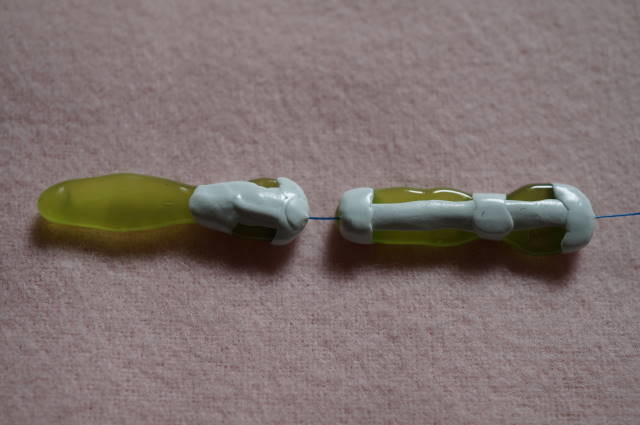
In an entry published in June 2019, a customer reported sharp thread junctions on ceramic awakening and short comma-shaped chips. The customer had experienced pain and stopped using them; Mr. Okada initially offered to round the connections. After receiving the returned chips, he proposed soft silicone rubber at the junction instead.
He wrote that extra rigid coating would not fully address the problem, although he had previously considered the sharpness acceptable. The diary does not record how the returned products felt afterward. Mr. Okada offered the rubber treatment on request, while noting added cleaning complexity and possible odor absorption.
(Source: ok-lab's diary, published June 2019)
https://ok-lab.hatenablog.com/entry/2019/06/29/143536
Exposed metal at the thread attachment led to a repair offer
In an entry published in August 2019, a customer questioned a small metal protrusion near a ceramic chip's thread attachment. The customer reported irritation during use. Mr. Okada acknowledged that exposed fixing metal was a manufacturing oversight and described aluminum added to resist thread peeling.
The diary does not record the repair's outcome. Mr. Okada asked for the product to be returned for repair.
(Source: ok-lab's diary, published August 2019)
https://ok-lab.hatenablog.com/entry/2019/08/31/131337
Custom thread repositioning carried a specific charge in August 2026
In an entry published in August 2026, a customer requested easier retrieval from a sea-slug-shaped ceramic chip, version 4. Mr. Okada identified ¥1,100 (about $7 at ¥156 = $1, rate as of 2026-09-04) as the price-adjustment charge for changing the positions of its two threads. The entry does not report whether this improved retrieval. His offered response was a custom change to the thread positions.
(Source: ok-lab's diary, published August 2026)
https://ok-lab.hatenablog.com/entry/2026/08/29/122931
The maker's answer to chip thread repair
The diary describes material-specific repairs, replacement services, and connection changes rather than one remedy for every chip.
Glass thread replacement was possible, but molded resin had limits
In an entry published in February 2019, a customer asked whether a custom resin chip with peeling thread could be repaired or remade. Mr. Okada replied that glass chips allowed complete replacement, while resin molded around thread generally did not. He first suggested customer repair, then reconsidered and developed a reinforced trial.
The trial combined different resins to address the peeling problem. The diary does not record its durability afterward. Mr. Okada asked for feedback before offering the reinforced treatment more widely.
(Source: ok-lab's diary, published February 2019)
https://ok-lab.hatenablog.com/entry/2019/02/02/153358
Two-thread replacement became an option after breakage reports in April 2019
An entry published in April 2019 announced a two-thread system (a connection with two exposed thread lengths) after two breakage reports. Mr. Okada offered it for new orders from that date, excluding motorized vibrating chips. Existing products could receive two-thread replacement for the same price as single-thread repair.
That replacement did not include a safety chip (a small thread-mounted part intended to stay outside the body). Mr. Okada asked customers to specify the two-thread option when ordering.
(Source: ok-lab's diary, published April 2019)
https://ok-lab.hatenablog.com/entry/2019/04/27/153239
Thread extension received separate prices for unused and used products
In an entry published in April 2020, Mr. Okada introduced an extension service after requests to change thread lengths. Once the original length was set, changing it could otherwise require replacement of both the thread and attached auxiliary parts. Extension cost ¥500 (about $3 at ¥156 = $1, rate as of 2026-09-04) excluding tax for unshipped or unused products, and ¥1,000 (about $6 at ¥156 = $1, rate as of 2026-09-04) excluding tax for used products.
He attributed the higher used-product charge to sterilization before workshop repairs. The service allowed up to 35cm of additional length per extension. Mr. Okada offered extension as his response to these length-change requests.
(Source: ok-lab's diary, published April 2020)
https://ok-lab.hatenablog.com/entry/2020/04/04/152310
A prototype safety connector introduced another thread attachment charge
In an entry published in November 2021, Mr. Okada described a blue resin safety-connector prototype supporting ordinary and loop connections. He said friction between threads gave the part a braking function. Its planned standalone price was ¥1,500 (about $10 at ¥156 = $1, rate as of 2026-09-04) excluding tax, with another ¥500 (about $3 at ¥156 = $1, rate as of 2026-09-04) for attachment. Mr. Okada offered the planned connection service alongside the part.
(Source: ok-lab's diary, published November 2021)
https://ok-lab.hatenablog.com/entry/2021/11/06/125812
A specialized thread connection cost more because assembly was difficult
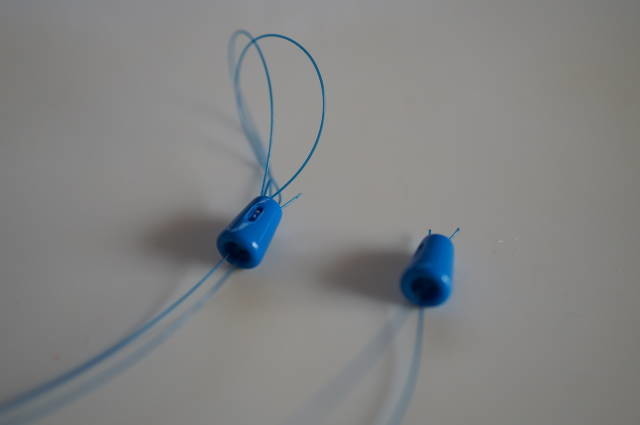
In an entry published in March 2023, Mr. Okada discussed connecting chips to silicone-and-metal urethral sounds (rods used to explore or widen a passage). He favored a blue resin safety connector over direct thread attachment. He described this particular assembly as difficult.
For that connection, the threading charge was ¥1,000 (about $6 at ¥156 = $1, rate as of 2026-09-04), and the stated total connection cost was ¥2,500 (about $16 at ¥156 = $1, rate as of 2026-09-04) excluding tax. Mr. Okada recommended the safety connector as the intermediary between the chip and sound.
(Source: ok-lab's diary, published March 2023)
https://ok-lab.hatenablog.com/entry/2023/03/04/123042
If you see blood in your urine, even a small amount or for the first time, do not wait and see. See a urologist right away. If you suddenly cannot urinate, or the device cannot be removed, do not try to fix it yourself. Go to a medical facility, including emergency care, immediately.
How chip thread repair changed over time

| Published | What the diary said then |
|---|---|
| Oct 2017 | Spacing between connected parts was planned in 1cm increments. |
| Feb 2019 | Reinforced coating would add about five days to production. |
| Apr 2019 | Already-made, unshipped products required a repair fee for conversion to two threads. |
| Aug 2019 | Aluminum-backed thread attachments were planned across products. |
| Jul 2021 | Planned short resin and titanium chip prices included separate ¥500 (about $3 at ¥156 = $1, rate as of 2026-09-04) thread attachment, excluding tax. |
| Oct 2021 | Blue resin chips receiving thread replacement would be returned without sterilization. |
| Jun 2023 | For sounds alone, connector attachment cost ¥2,000 (about $13 at ¥156 = $1, rate as of 2026-09-04) excluding tax; basic thread attachment was free. |
| Aug 2026 | Custom two-thread repositioning was quoted at ¥1,100 (about $7 at ¥156 = $1, rate as of 2026-09-04). |
OK Prostate Chip products related to chip thread repair

The current list includes products involved in these reports, but their listed prices do not establish a general repair tariff.
Products that appear in these entries
| Product (official name) | Price incl. tax | Relation to this topic |
|---|---|---|
| Ceramic awakening chip (OKプロステートチップ 陶器素材覚醒タイプ) | ¥5,500 (about $35 at ¥156 = $1, rate as of 2026-09-04) | In June 2019, this was one of the customer's ceramic chips with a painful thread junction. |
| Short comma-shaped ceramic chip (OKプロステートチップ 陶器素材ショート勾玉タイプ) | ¥4,400 (about $28 at ¥156 = $1, rate as of 2026-09-04) | In June 2019, the same customer reported a sharp thread junction on this model too. |
| Price adjustment (差額調整) | ¥1,100 (about $7 at ¥156 = $1, rate as of 2026-09-04) | In August 2026, this charge covered custom thread repositioning on the version 4 sea-slug-shaped ceramic chip. |
(Source: ok-lab's diary, published June 2019)
https://ok-lab.hatenablog.com/entry/2019/06/29/143536
(Source: ok-lab's diary, published August 2026)
https://ok-lab.hatenablog.com/entry/2026/08/29/122931
Products the diary mentioned as alternatives
| Product (official name) | Price incl. tax | Relation to this topic |
|---|---|---|
| Two-thread blue resin safety chip, supplied separately (二本糸用セーフティチップ(生体適合樹脂)単体) | ¥1,650 (about $11 at ¥156 = $1, rate as of 2026-09-04) | In March 2023, Mr. Okada favored this connector over direct tying for a sound connection, while describing assembly as difficult. |
(Source: ok-lab's diary, published March 2023)
https://ok-lab.hatenablog.com/entry/2023/03/04/123042
The historical linked two-chip design was reported withdrawn in March 2019. The entry attributed its withdrawal to repeated problems.
The reinforced resin trial, short titanium chip, and version 4 sea-slug-shaped ceramic build are historical or custom items. No matching product can be confirmed on the current list.
Common worries about chip thread repair

The reader questions concern attachment bulk, replacement feasibility, and irritation where the thread leaves the chip.
"Can thread replacement make the ceramic chip's rear smaller?"
In an entry published in May 2020, a customer reported insertion or retrieval difficulties with several ceramic chips and asked about smaller rear ends. Mr. Okada offered thread replacement for ¥1,100 (about $7 at ¥156 = $1, rate as of 2026-09-04) per chip, estimating reductions of about 0.5mm in rear thickness and width. He explained that the existing wire attachment needed a covering about 0.5mm thick on one side.
His proposed alternative omitted the wire. The customer deferred the paid repair and said they might consult him later. Mr. Okada cautioned that the revised connection could be weaker under rough handling.
(Source: ok-lab's diary, published May 2020)
https://ok-lab.hatenablog.com/entry/2020/05/02/131505
"Can a titanium chip's thread replacement be done by its owner?"
In an entry published in September 2021, a short titanium chip owner asked about the two-thread design and possible replacement after breakage. Mr. Okada explained that it used one continuous thread with a trapped middle knot, intended to prevent one broken side releasing the other. He said replacement with customer-sourced thread was possible, but a tool for gripping thread was necessary.
The entry records no completed replacement by this customer. Mr. Okada cautioned that fingers alone would not suffice for threading.
(Source: ok-lab's diary, published September 2021)
https://ok-lab.hatenablog.com/entry/2021/09/11/125735
"Would removing the rubber help a painful thread connection?"
In an entry published in March 2025, a version 4 sea-slug-shaped ceramic chip owner reported bleeding every time at the thread exits. The customer requested two threads emerging together and questioned the rubber covering. OK Lab's staff said the rubber was intended as cushioning and suspected the chip's rear shape contributed to the irritation.
After that explanation, the customer left the rubber decision on hold. The diary does not record whether the bleeding resolved. Mr. Okada favored retaining the rubber and advised against separate thread exits when the urethral fit was already tight.
(Source: ok-lab's diary, published March 2025)
https://ok-lab.hatenablog.com/entry/2025/03/22/122906
Buying from outside Japan

OK Lab ships internationally to countries covered by Japan Post's EMS courier service. Overseas orders are paid in advance by PayPal. Each order carries a ¥400 (about $3 at ¥156 = $1, rate as of 2026-09-04) handling fee, and EMS shipping is charged on top. These terms come from OK Lab's official sales-terms page (written here as plain text, not a link: ok-lab.net/docs/law), checked on September 7, 2026; confirm them on the official store before you order, because they can change.
Summary of this article
| What you wanted to know | The answer |
|---|---|
| In short: is thread repair possible? | The diary records repair services with material-specific limits. |
| About the product | A urethral device made and sold by OK Lab in Japan. |
| Key terms | The thread, coating, and safety connector serve different roles. |
| What happens at the connection? | Reports include detached thread, breakage, sharp junctions, and a custom repositioning charge. |
| What did the maker offer? | Replacement, extension, revised connections, and specialized attachment services. |
| What changed over time? | Attachment designs, workshop policies, and service prices changed. |
| Which current products relate? | The listed ceramic models, a safety connector, and a price-adjustment item. |
| What did customers ask? | Whether repairs could reduce bulk, permit replacement, or address irritation. |
| Buying outside Japan | Advance PayPal payment, a handling fee, and EMS shipping charges apply. |
Source: ok-lab's diary (Okada Comfortable Life Laboratory). The original entries are in Japanese; quotations on this page are translated. Photos and videos are on the original entries.
This article is a summary of the maker's development diary. The product is not a medical device and no result is guaranteed. If anything feels wrong or worries you, see a doctor. Prices, specifications and cautions change, so confirm the latest information on the official blog and the official site. Questions about ordering and shipping go to the seller.