![Which prostate chip material feels best? | Experiences vary with shape and fit [OK Prostate Chip]](/img/a/T0168/eyecatch.svg)
This page is based on entries from "ok-lab's diary" (https://ok-lab.hatenablog.com/), the Japanese development diary written by Mr. Okada, founder of OK Lab, a small company in Japan (Okada Comfortable Life Laboratory). Only the entries about "how different chip materials feel" are summarized here, in order of publication. Past prices and sizes are as written at the time. Current prices come from the official product list (retrieved September 4, 2026). Quotations are translated from Japanese.
Note: This page is a personal reading log by someone with no connection to the maker or the seller. It reflects the source entries as of their publication dates and makes no guarantee of accuracy or safety. The product is not a medical device; talk to a doctor about any health decision. Check the official site for current information. This page contains advertising.
In short
- Customers describe differences in smoothness, grip and weight, with preferences varying by person and chip shape.
- Mr. Okada considers construction as well as material when discussing discomfort.
- The current list includes resin (plastic) screw chips and several ceramic designs.
If you see blood in your urine, even a small amount or for the first time, do not wait and see. See a urologist right away.
If you suddenly cannot urinate, or the device cannot be removed, do not try to fix it yourself. Go to a medical facility, including emergency care, immediately.
About this product

The OK Prostate Chip is a small device that is placed in the urethra (the urine passage) so that it acts on the prostate; the maker sells it in several shapes, sizes and materials. It is made and sold by OK Lab (Okada Comfortable Life Laboratory), a small company in Japan, through its own online store, and prices are in Japanese yen (JPY).
The maker's development diary, "ok-lab's diary", is written in Japanese. This page is an English summary of it, and every quotation is translated. OK Lab ships internationally, so readers outside Japan can order (see "Buying from outside Japan" below).
Product names on this page are plain-English descriptions. The official Japanese product name is shown once in the product table so you can find the same item in the store.
Before you read: key terms
| Term | Plain-English meaning |
|---|---|
| Urethra | The passage carrying urine out of the body; the main chips discussed here sit inside it. |
| Resin | Plastic used to form chip bodies or cover parts of ceramic chips. |
| Epoxy adhesive | A bonding resin used in ceramic chip construction. |
| Biocompatible resin | The maker's label for resin intended for use inside the body, used to make chips. |
| Elastomer | A soft material that bends and yields under pressure, tested for flexible chips. |
| Glaze | The coating on ceramic chips that forms their exposed surface. |
What happens: how different chip materials feel
The OK Prostate Chip is a small device placed in the urethra to act on the prostate. The materials discussed here form the chip body, which touches the inside of that passage. The diary compares glass, ceramic, resin and metal, alongside softer prototypes, for smoothness, weight and sensation. Mr. Okada and customers describe both how those materials feel and whether different shapes stay in place.
Glass chip smoothness drove early development, but breakage remained possible
In an entry published in October 2017, Mr. Okada explained why he had selected glass after testing silicone and other resins. Silicone had suited short tests with lubricant, but he found repeated friction troublesome as moisture diminished. Other resins also felt comfortable initially, yet disappointed him during tests lasting days.
He said glass alone had moved satisfactorily with the small amount of moisture remaining after urination. At that time, he regarded glass as necessary for continuous, extended placement. Mr. Okada nevertheless warned that glass could break and that complete safety was impossible.
(Source: ok-lab's diary, published October 2017)
https://ok-lab.hatenablog.com/entry/20171005/1507210406
Ceramic chip smoothness did not prevent an impact fracture
In an entry published in October 2019, a customer compared a short ceramic chip with a resin screw chip. They found ceramic smoother, with less friction, while the screw's three-dimensional shape felt more noticeable. However, the ceramic chip shot out during urination, struck the toilet and broke in half.
Mr. Okada replied that the improved ceramic version introduced that week was considerably stronger. He also cautioned that resistance to impact depended on the point of contact, and his comparative testing was limited.
(Source: ok-lab's diary, published October 2019)
https://ok-lab.hatenablog.com/entry/2019/10/05/141806
A ceramic chip complaint involved raised adhesive, bleeding and breakage
A separate customer in the October 2019 entry requested a replacement long ceramic curved-tail chip without raised epoxy adhesive (a bonding resin). They blamed an exposed adhesive edge for catching and causing bleeding. The ceramic core later broke, revealing what they described as a sandy-looking fracture surface.
Mr. Okada questioned whether the raised adhesive explained the bleeding and said he would consult the ceramic maker about the fracture. He could not provide the requested replacement and offered a refund; the diary does not record whether that refund was completed.
(Source: ok-lab's diary, published October 2019)
https://ok-lab.hatenablog.com/entry/2019/10/05/141806
Ceramic anal chip weight impressed Mr. Okada during separate testing
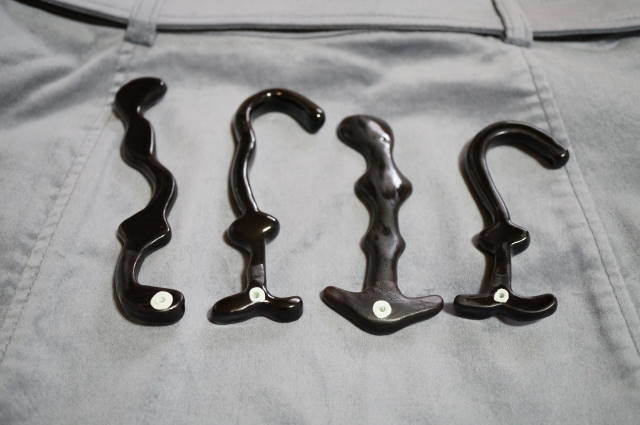
In an entry published in December 2019, Mr. Okada compared ceramic anal chips with earlier glass test pieces. These were devices for the anus, separate from the urethral chips discussed elsewhere here. He found ceramic lighter and more pleasant to handle.
Published prices, excluding tax, were ¥5,000 (about $32 at ¥156 = $1, rate as of 2026-09-04) for the single-bump U-turn, ¥6,000 (about $38 at ¥156 = $1, rate as of 2026-09-04) for the double-bump U-turn, and ¥5,000 (about $32 at ¥156 = $1, rate as of 2026-09-04) for free-design versions. Custom orders required at least ¥10,000 (about $64 at ¥156 = $1, rate as of 2026-09-04), excluding tax. Mr. Okada favored free-design Type 1 for staying in place and the double-bump version for shorter sessions.
(Source: ok-lab's diary, published December 2019)
https://ok-lab.hatenablog.com/entry/2019/12/07/162608
A white resin chip request led to another twist design
In an entry published in September 2023, a customer wanted a curved screw chip made from their preferred white resin. Mr. Okada initially accepted the request without promising that the combined shape could be made. He reported that the attempt succeeded, encouraging him to try an awakening-style twist.
That second design also succeeded, and he announced the white-resin five-point awakening twist. Its published price was ¥6,000 (about $38 at ¥156 = $1, rate as of 2026-09-04), excluding tax, with length and width approximately matching the ordinary awakening design.
(Source: ok-lab's diary, published September 2023)
https://ok-lab.hatenablog.com/entry/2023/09/16/122723
A soft elastomer chip produced more friction during prototype testing
In an entry published in March 2024, Mr. Okada tested elastomer (a soft, bendable material) proposed for customers wary of hard chips. He reported stronger irritation against the urethral lining and wondered whether the unfinished surface explained it. Although he expected extra grip, the prototype shifted outward during his second urination.
He ranked smoothness as glass, ceramic, then hard resin, with silicone and elastomer offering less glide. In his view, harder materials produced less urethral friction. Mr. Okada cautioned that elastomer might present similar difficulties for people who found silicone uncomfortable.
(Source: ok-lab's diary, published March 2024)
https://ok-lab.hatenablog.com/entry/2024/03/02/123027
Ceramic chip comfort did not resolve concerns about exposed connecting wire
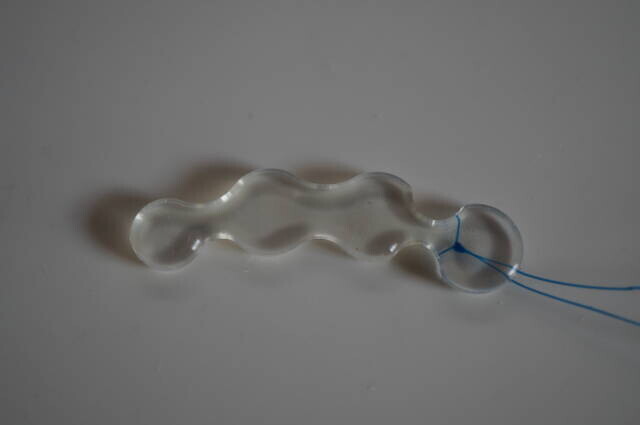
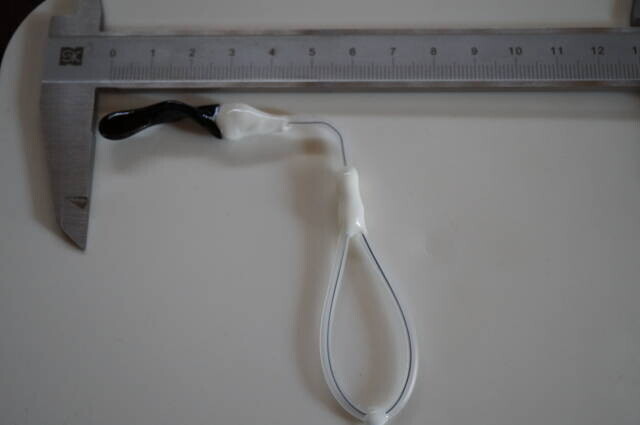
In an entry published in April 2024, Mr. Okada tested two ceramic twist chips joined at 90 degrees by wire. He described mild sensation and better staying power than a short, single ceramic chip. Their lack of movement later made him wonder whether the exposed wire was pressing into the urethral lining.
He reported no obvious problem afterward, but still believed the uncovered wire must exert pressure somewhere. Mr. Okada therefore decided against leaving chips joined by bare wire in place for days.
(Source: ok-lab's diary, published April 2024)
https://ok-lab.hatenablog.com/entry/2024/04/20/122856
The maker's answer to how different chip materials feel
Mr. Okada's replies connect material preferences with friction, manufacturing limits and the construction of the whole device.
Resin chip grip involved harder entry and somewhat better staying power
In an entry published in March 2020, a customer compared resin screws with glass and ceramic twists. They wanted to know which was less likely to come out during urination. Mr. Okada thought resin's poorer glide made entry harder but also made it somewhat less likely to come out.
The diary does not record a later result for this customer. He also said custom ceramic twists were generally unavailable because making their molds was difficult. Mr. Okada offered to consider a larger short ceramic twist.
(Source: ok-lab's diary, published March 2020)
https://ok-lab.hatenablog.com/entry/2020/03/07/152901
Glass chip manufacturing could not reproduce one customer's preferred resin curve
In an entry published in March 2021, a customer preferred a custom resin screw's feel and requested a glass screw. Their comparison favored its grip and angular shape over the fuller contours of ceramic. Mr. Okada said his glasswork could achieve sharp bends, but not the gradual curve needed for a screw.
The diary does not record a completed replacement. Mr. Okada pointed to future digital titanium design as a possible route, believing it could accommodate any requested shape.
(Source: ok-lab's diary, published March 2021)
https://ok-lab.hatenablog.com/entry/2021/03/27/130138
White resin chip preferences prompted discussion of grip and sticking
In an entry published in March 2022, a customer wanted another white-resin screw after comparing several materials. Ceramic felt too slippery to them, while blue resin felt too firmly held. White resin offered their preferred balance of movement and resistance.
Mr. Okada said he had generally discouraged entirely white-resin designs other than screws because he believed they could stick to the urethral lining. The diary does not record how the requested custom screw felt in use. He acknowledged that staying power might provide a reason to consider other choices.
(Source: ok-lab's diary, published March 2022)
https://ok-lab.hatenablog.com/entry/2022/03/05/123200
Resin chip discomfort could involve structure as well as material
In an entry published in August 2024, a customer compared a semi-long chip in biocompatible resin (resin labeled for internal use) with an epoxy-resin design. The latter design, nicknamed Alien, sometimes hurt during urination, whereas the semi-long chip had rarely caused that problem. The customer suspected poorer glide and proposed an all-biocompatible-resin configuration.
Mr. Okada replied that the devices differed substantially in structure, so material alone might not explain the discomfort. He thought the proposed arrangement could stay in place reasonably well and also mentioned a blue-resin locking prototype. He advised considering other customers' experiences because pain varied individually; no subsequent result is recorded for this customer.
(Source: ok-lab's diary, published August 2024)
https://ok-lab.hatenablog.com/entry/2024/08/31/122909
If you see blood in your urine, even a small amount or for the first time, do not wait and see. See a urologist right away.
If you suddenly cannot urinate, or the device cannot be removed, do not try to fix it yourself. Go to a medical facility, including emergency care, immediately.
How how different chip materials feel changed over time
| Published | What the diary said then |
|---|---|
| Oct 2017 | Mr. Okada selected glass for low-moisture movement, while acknowledging breakage risk. |
| Oct 2019 | Improved ceramic chips were described as stronger; impact comparisons remained limited. |
| Dec 2019 | Ceramic anal designs received initial prices, with custom work priced separately. |
| Mar 2020 | Ceramic twists were thicker for strength, with gentler bends than glass. |
| Oct 2021 | Mr. Okada's titanium semi-long prototype felt settled by day 3. |
| Nov 2021 | Mr. Okada requested production of a biocompatible-resin short twist. |
| Mar 2022 | A customer's preference prompted reconsideration of white resin's staying power. |
| Sep 2023 | A successful custom request led to a white-resin five-point twist offering. |
| Apr 2024 | Mr. Okada rejected days-long placement for ceramic pairs joined by uncovered wire. |
| Mar 2026 | A customer found the movable ceramic short chip milder, but easier to dislodge. |
OK Prostate Chip products related to how different chip materials feel
The current list identifies these products and prices, without confirming historical custom configurations or size options.
Products that appear in these entries
| Product (official name) | Price incl. tax | Relation to this topic |
|---|---|---|
| Resin screw chip (OKプロステートチップ 樹脂素材1チップタイプ スクリュー) | ¥4,400 (about $28 at ¥156 = $1, rate as of 2026-09-04) | An October 2019 customer compared its noticeable three-dimensional shape with a smoother short ceramic chip. |
| Short ceramic chip (OKプロステートチップ 陶器素材ショートタイプ) | ¥3,300 (about $21 at ¥156 = $1, rate as of 2026-09-04) | An October 2019 customer reported smoothness but also breakage after impact with a toilet. |
| Long ceramic curved-tail chip (OKプロステートチップ 陶器素材ロング勾玉タイプ) | ¥7,700 (about $49 at ¥156 = $1, rate as of 2026-09-04) | A separate October 2019 complaint concerned raised adhesive, bleeding and a broken ceramic core. |
| Single-bump ceramic anal U-turn chip (OKプロステートお尻チップ 陶器素材1コブUターン型) | ¥5,500 (about $35 at ¥156 = $1, rate as of 2026-09-04) | Mr. Okada included this design in his December 2019 ceramic anal-chip comparison. |
| Double-bump ceramic anal U-turn chip (OKプロステートお尻チップ 陶器素材2コブUターン型) | ¥6,600 (about $42 at ¥156 = $1, rate as of 2026-09-04) | Mr. Okada favored this design for shorter sessions in December 2019. |
| Short ceramic twist chip (OKプロステートチップ 陶器素材ショートタイプ ツイスト) | ¥4,400 (about $28 at ¥156 = $1, rate as of 2026-09-04) | A March 2020 customer asked how its grip compared with resin screws and glass twists. |
| Semi-long biocompatible-resin chip (OKプロステートチップ セミロングタイプ(生体適合樹脂)) | ¥5,500 (about $35 at ¥156 = $1, rate as of 2026-09-04) | An August 2024 customer reported little urinary discomfort with this model before describing pain with another design. |
The short ceramic chip is listed in OK Lab's own online store.
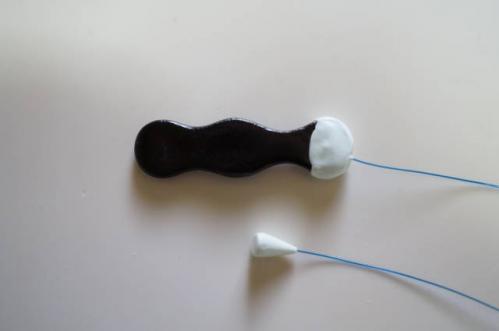
The resin screw chip is listed in the company's own online store.
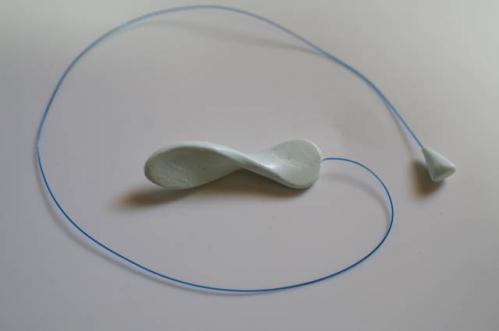
(Source: ok-lab's diary, published October 2019)
https://ok-lab.hatenablog.com/entry/2019/10/05/141806
(Source: ok-lab's diary, published December 2019)
https://ok-lab.hatenablog.com/entry/2019/12/07/162608
(Source: ok-lab's diary, published March 2020)
https://ok-lab.hatenablog.com/entry/2020/03/07/152901
(Source: ok-lab's diary, published August 2024)
https://ok-lab.hatenablog.com/entry/2024/08/31/122909
Products the diary mentioned as alternatives
The diary names no alternative.
Historical items discussed here include glass test pieces, free-design ceramic anal chips, the white-resin five-point twist, and titanium and elastomer prototypes. No matching product can be confirmed on the current list.
Other historical items include the resin short-twist prototype, custom resin screw, exposed-wire ceramic pair, Alien design, locking prototype and movable ceramic short chip.
Common worries about how different chip materials feel
The diary addresses questions about resin designs, noticeable weight and variations in ceramic glaze.
"Were more biocompatible-resin chip shapes planned for sale?"
In an entry published in November 2021, a customer asked whether short twists would become available in biocompatible resin. They also wanted an all-resin linked design after discomfort from a different resin component. Mr. Okada said a short-twist prototype had arrived, but he had not completed his own tests of how it stayed in place.
Making the requested linked design remained technically difficult. The diary does not record when commercial short-twist production began. Mr. Okada nevertheless asked the fabricator to start production using the fabricator's judgment.
(Source: ok-lab's diary, published November 2021)
https://ok-lab.hatenablog.com/entry/2021/11/06/125812
"Does greater chip weight mean stronger stimulation?"
In an entry published in April 2025, a prospective customer asked whether ceramic weighed more than biocompatible resin and whether weight increased stimulation. Mr. Okada considered weight and stimulation largely separate. He said ceramic was denser, but both materials were so light that the difference would be difficult to notice.
He suggested that their different glide might matter more in comparison. No subsequent purchase or experience is recorded in this exchange. Mr. Okada suggested stainless steel specifically for someone seeking a clearly noticeable sense of weight.
(Source: ok-lab's diary, published April 2025)
https://ok-lab.hatenablog.com/entry/2025/04/12/122910
"Does pale ceramic chip glaze mean a faulty surface?"
In an entry published in August 2025, a customer questioned a pale area on a custom short ceramic twist configuration. They reported a smooth surface and a distinctly slippery sensation compared with their favorite resin screw. Staff explained that glaze (the ceramic surface coating) could become thinner at projecting points, allowing the underlying color to show through.
Mr. Okada agreed that this color variation followed from the coating process. Staff's answer was that they did not consider the reported variation a problem for use.
(Source: ok-lab's diary, published August 2025)
https://ok-lab.hatenablog.com/entry/2025/08/23/122935
Buying from outside Japan

OK Lab ships internationally to countries covered by Japan Post's EMS courier service. Overseas orders are paid in advance by PayPal. Each order carries a ¥400 (about $3 at ¥156 = $1, rate as of 2026-09-04) handling fee, and EMS shipping is charged on top. These terms come from OK Lab's official sales-terms page (written here as plain text, not a link: ok-lab.net/docs/law), checked on September 7, 2026; confirm them on the official store before you order, because they can change.
Summary of this article
| What you wanted to know | The answer |
|---|---|
| What is the short answer? | Reported preferences depend on material, shape and the individual. |
| What is this product? | A small urethral device made by OK Lab in Japan. |
| What do the material terms mean? | They describe chip bodies, bonding materials and surface coatings. |
| What happened in the reported cases? | Smoothness and comfort appeared alongside breakage, bleeding and concerns about pressure. |
| What did Mr. Okada suggest? | He considered friction, construction and manufacturing limits when answering material questions. |
| What changed over time? | Ceramic improvements, resin designs and metal or flexible prototypes broadened the comparisons. |
| Which prices apply today? | The product table uses the September 2026 list, separately from historical prices. |
| What did customers ask? | They asked about new resin shapes, weight and ceramic surface variations. |
| How do overseas orders work? | Advance PayPal payment, a ¥400 (about $3 at ¥156 = $1, rate as of 2026-09-04) handling fee and additional EMS shipping charges. |
Source: ok-lab's diary (Okada Comfortable Life Laboratory). The original entries are in Japanese; quotations on this page are translated. Photos and videos are on the original entries.
This article is a summary of the maker's development diary. The product is not a medical device and no result is guaranteed. If anything feels wrong or worries you, see a doctor. Prices, specifications and cautions change, so confirm the latest information on the official blog and the official site. Questions about ordering and shipping go to the seller.