![How long does getting used to a prostate chip take? | Persistent pain needs attention [OK Prostate Chip]](/img/a/T0167/eyecatch.svg)
This page is based on entries from "ok-lab's diary" (https://ok-lab.hatenablog.com/), the Japanese development diary written by Mr. Okada, founder of OK Lab, a small company in Japan (Okada Comfortable Life Laboratory). Only the entries about "getting used to a prostate chip" are summarized here, in order of publication. Past prices and sizes are as written at the time. Current prices come from the official product list (retrieved September 4, 2026). Quotations are translated from Japanese.
Note: This page is a personal reading log by someone with no connection to the maker or the seller. It reflects the source entries as of their publication dates and makes no guarantee of accuracy or safety. The product is not a medical device; talk to a doctor about any health decision. Check the official site for current information. This page contains advertising.
In short
- The diary describes changing comfort, but gives no reliable deadline for getting used to a prostate chip.
- Mr. Okada advises against use during pain and recommends stopping when painful urination keeps returning.
- The current list includes the ceramic semi-long chip, but provides no size options.
If you see blood in your urine, even a small amount or for the first time, do not wait and see. See a urologist right away.
If you suddenly cannot urinate, or the device cannot be removed, do not try to fix it yourself. Go to a medical facility, including emergency care, immediately.
About this product
The OK Prostate Chip is a small device that is placed in the urethra (the urine passage) so that it acts on the prostate; the maker sells it in several shapes, sizes and materials. It is made and sold by OK Lab (Okada Comfortable Life Laboratory), a small company in Japan, through its own online store, and prices are in Japanese yen (JPY). The maker's development diary, "ok-lab's diary", is written in Japanese. This page is an English summary of it, and every quotation is translated. OK Lab ships internationally, so readers outside Japan can order (see "Buying from outside Japan" below). Product names on this page are plain-English descriptions. The official Japanese product name is shown once in the product table so you can find the same item in the store.
Before you read: key terms
| Term | Plain-English meaning |
|---|---|
| Urethra | The urine passage; it carries urine and is where the device is placed. |
| Lubricant | A slippery lotion or gel discussed as a way to reduce friction against the lining of the urine passage. |
| Sphincter stopper | An accessory associated with the muscle that grips the device; its purpose is to help maintain the chip's position. |
| Chipless loop | A wire-and-tube structure intended to act on the prostate without a solid chip in that position. |
| Retrieval thread | A thread attached to the device so it can be taken out. |
| Urologist | A doctor treating urinary problems; Mr. Okada mentions consultation when painful urination repeatedly follows use. |
What happens: getting used to a prostate chip
The OK Prostate Chip is a small device placed in the urethra (the urine passage) to act on the prostate. Getting used to it means changes in sensation and how the device settles inside that passage, as described by diary contributors. Their accounts cover chips, positioning accessories and wire-and-tube loops, all discussed in relation to comfort within the urine passage. They include increasing comfort, pain and problems with particular builds.
Early prostate chip discomfort stopped a beginner before much progress
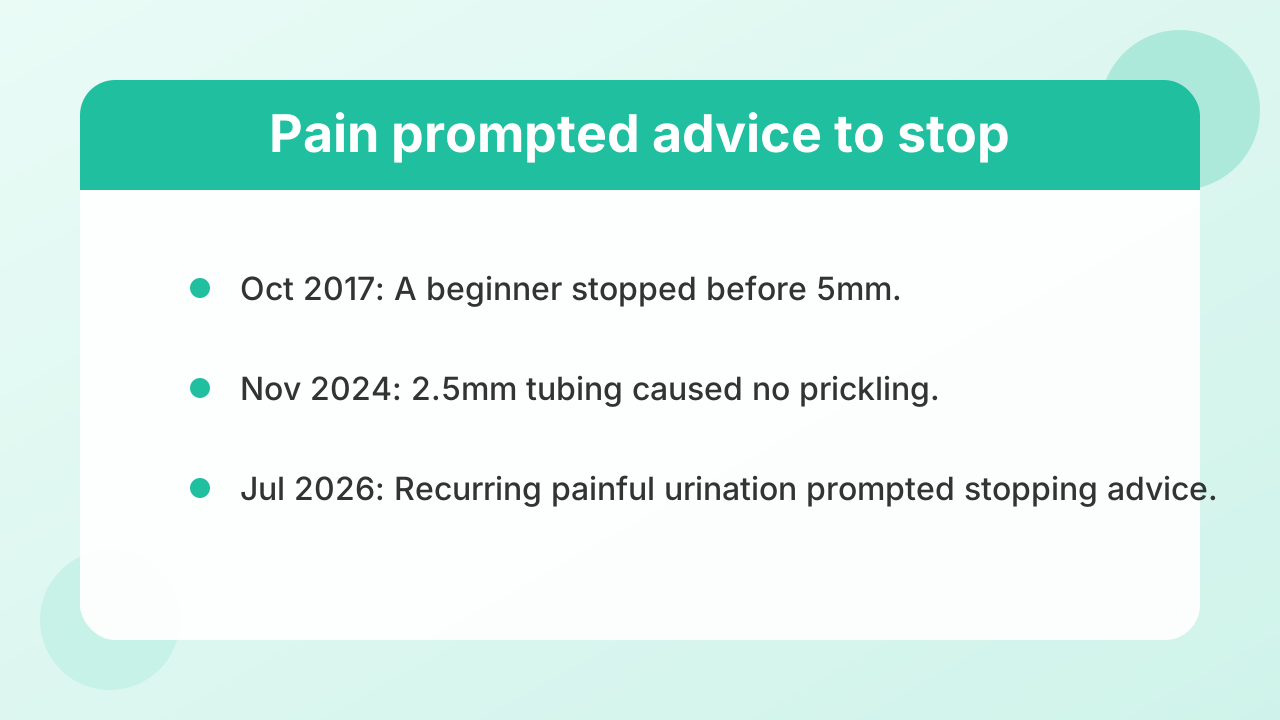
In an entry published in October 2017, a beginner's staff report described stopping before the chip had advanced 5mm. The beginner wanted to explore the device but initially found the sensation intolerable.
Later attempts became less unfamiliar, although the report still described pain and unexpected movement during urination. Mr. Okada acknowledged that he could not accurately remember his own earliest difficulties. His accompanying advice described lubricant (a slippery lotion) as safer for resin chips when the urethra was dry.
(Source: ok-lab's diary, published October 2017)
https://ok-lab.hatenablog.com/entry/20171019/1508375473
Prostate chip discomfort also came from a handmade stopper accessory
In an entry published in August 2018, a tester described difficulty adjusting to a sphincter stopper (an accessory intended to maintain the chip's position). The customer said adjustment took time, and differences between handmade pieces could leave an uncomfortable rolling sensation inside.
The same report praised a smaller, three-bump prototype supplied by Mr. Okada. In response, he announced a 50mm version with an S size option. His suggestion was that this smaller version might be less difficult for customers.
(Source: ok-lab's diary, published August 2018)
https://ok-lab.hatenablog.com/entry/20180811/1533969999
Reported improvement in prostate chip discomfort followed pain and inflammation
In an entry published in August 2020, a customer described initial pain and inflammation with a ceramic semi-long SS chip. The customer later reported becoming more accustomed to it, then finding its sensations insufficient for the experience they wanted.
The diary does not record whether the initial inflammation received medical assessment. Mr. Okada acknowledged the message but did not explain those symptoms in his reply. His product suggestion concerned a model with bumps after his return to work, rather than an assessment of the customer's earlier pain.
(Source: ok-lab's diary, published August 2020)
https://ok-lab.hatenablog.com/entry/2020/08/29/130333
Correct tubing changed the maker's account of prostate chip discomfort
An entry published in November 2024 corrected Mr. Okada's earlier account of a chipless loop (a wire-and-tube device without a solid prostate chip). He had mistakenly tested an older prototype with 2mm tubing while describing a model specified with 2.5mm tubing.
With the correct 2.5mm version, he reported no prickling and almost no discomfort from the beginning. He still described roughly half a day before it felt fully settled. The correction therefore ties the prickling report to the older prototype.
(Source: ok-lab's diary, published November 2024)
https://ok-lab.hatenablog.com/entry/2024/11/30/122919
Experience did not prevent prostate chip discomfort with stronger wire
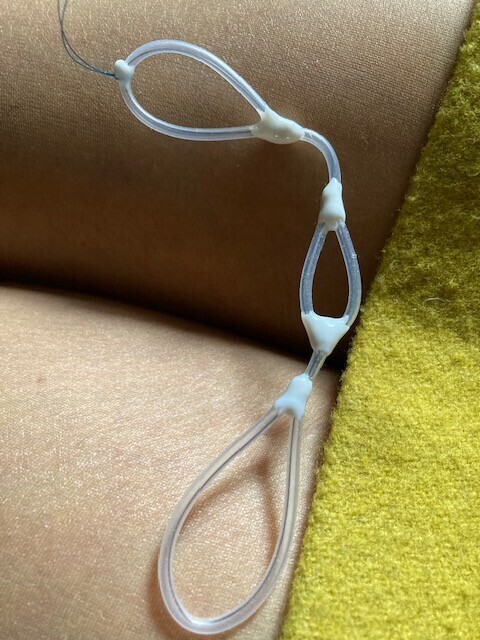
In an entry published in March 2025, Mr. Okada described testing a 0.4mm double-wire prototype. He reported excessive pressure and a pounding heart, ending that test after 2 hours. He then changed devices and still felt unwell, although he said this settled after about 1 hour.
His next ceramic-chip loop assembly initially moved 5mm-10mm, then felt steadier from around the second day. He attributed the lingering symptoms to the earlier double-wire test. The diary does not record a medical assessment confirming that explanation.
(Source: ok-lab's diary, published March 2025)
https://ok-lab.hatenablog.com/entry/2025/03/08/123016
The maker's answer to getting used to a prostate chip
Mr. Okada's responses considered time, lubrication, size and friction; later advice placed limits on continuing through pain.
Getting used to a prostate chip had no promised deadline
In an entry published in January 2018, Mr. Okada questioned expecting the intended position after only 2 or 3 attempts. He described learning as potentially lengthy, even mentioning a year, without establishing a normal adjustment period.
He also wrote that lubricant could be depleted along the passage before the tip reached a difficult curve. His proposed response was renewed lubrication, which he thought could make passage easier. He mentioned a linked two-chip design for people focused on reaching the prostate, while placing greater emphasis on allowing time. His broader advice was to avoid judging progress solely by the first few attempts.
(Source: ok-lab's diary, published January 2018)
https://ok-lab.hatenablog.com/entry/20180127/1517054930
Smaller sizes became part of the maker's answer to prostate chip discomfort
In an entry published in June 2019, Mr. Okada wrote that small ceramic chips could initially feel almost unstimulating, then become pleasurable. He also described larger chips settling into a position he found more comfortable. These experiences led him to favor the smallest chip that produced the sensations he wanted.
The ceramic range launched with 8 sizes, with short S and SS and semi-long SS planned about 2 weeks later. Those were launch plans; the current product list supplies no size options. At the time, he advised customers seeking those smaller versions to wait for their release.
(Source: ok-lab's diary, published June 2019)
https://ok-lab.hatenablog.com/entry/2019/06/08/144200
Prostate chip pain prompted the maker to question prolonged friction
In an entry published in February 2020, a customer reported lingering aching after repeated position adjustments with a four-point twist long chip. The customer also reported blood in semen on 2 occasions and asked whether the retrieval thread (attached for taking the device out) caused it.
Mr. Okada allowed that the thread might have been involved, but said most bleeding in his experience seemed related to friction. The diary does not record whether this customer's bleeding or pain resolved. His advice was to limit prolonged friction with larger chips.
(Source: ok-lab's diary, published February 2020)
https://ok-lab.hatenablog.com/entry/2020/02/22/145216
If you see blood in your urine, even a small amount or for the first time, do not wait and see. See a urologist right away.
If you suddenly cannot urinate, or the device cannot be removed, do not try to fix it yourself. Go to a medical facility, including emergency care, immediately.
How getting used to a prostate chip changed over time
| Published | What the diary said then |
|---|---|
| Oct 2017 | A beginner stopped before 5mm; Mr. Okada discussed dryness and lubricant. |
| Aug 2018 | Stopper discomfort accompanied a report that prompted a 50mm version. |
| Jun 2019 | Smaller ceramic sizes were planned after Mr. Okada reconsidered the value of larger chips. |
| Feb 2020 | A bleeding report prompted Mr. Okada's warning about prolonged friction. |
| Aug 2020 | A ceramic semi-long SS customer described adjustment following initial pain and inflammation. |
| Oct 2021 | Mr. Okada found the stainless-steel long M uncomfortable after about 48 hours. |
| Jun 2022 | Four-line support had ended; revised connections addressed excessive joint thickness. |
| Nov 2024 | Corrected report: 2.5mm tubing caused none of the prickling attributed to the 2mm prototype. |
| Mar 2025 | Mr. Okada ended a double-wire test after excessive pressure and a pounding heart. |
| Jul 2026 | Recurring painful urination prompted advice to stop use and consider medical assessment. |
OK Prostate Chip products related to getting used to a prostate chip
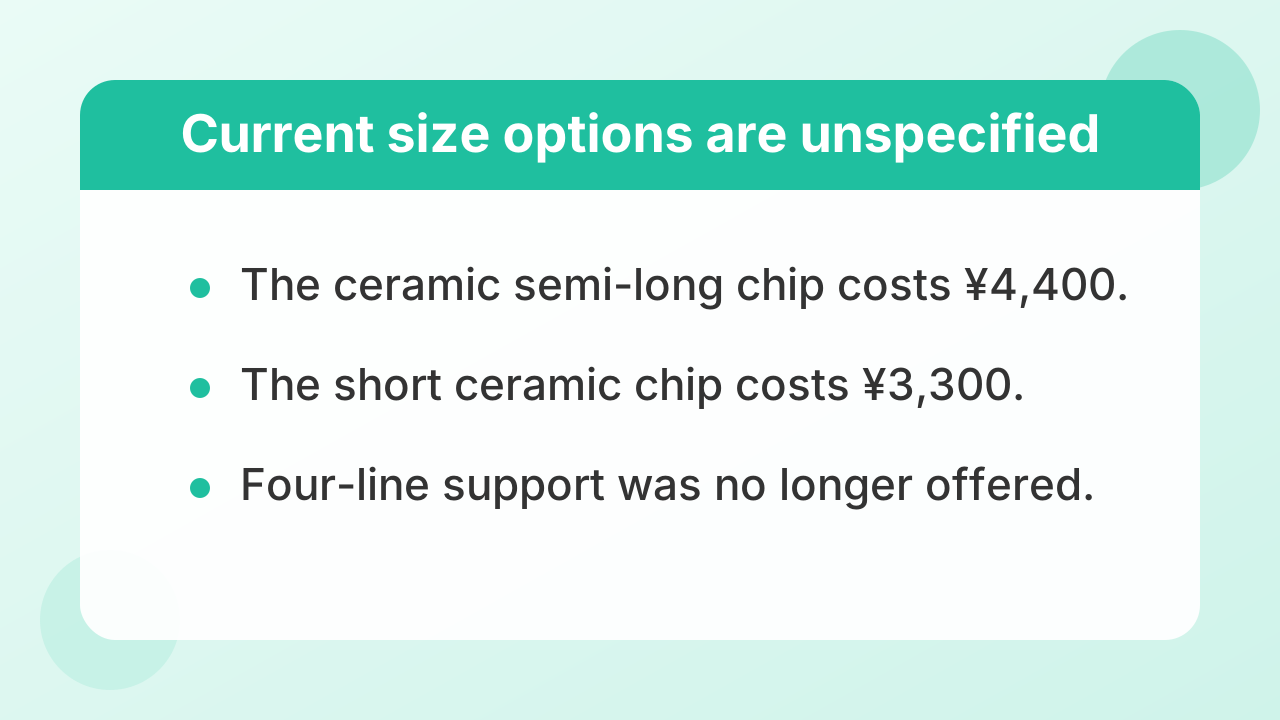
The current list includes ceramic models discussed in these entries, without confirming their historical size options.
Products that appear in these entries
| Product (official name) | Price incl. tax | Relation to this topic |
|---|---|---|
| Ceramic semi-long chip (OKプロステートチップ 陶器素材セミロングタイプ) | ¥4,400 (about $28 at ¥156 = $1, rate as of 2026-09-04) | An August 2020 customer reported initial pain and inflammation with an SS version; current size options are unspecified. |
The ceramic semi-long chip is listed in OK Lab's own online store.
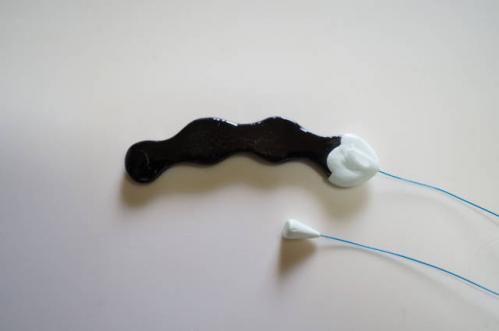
(Source: ok-lab's diary, published August 2020)
https://ok-lab.hatenablog.com/entry/2020/08/29/130333
Products the diary mentioned as alternatives
| Product (official name) | Price incl. tax | Relation to this topic |
|---|---|---|
| Short ceramic chip (OKプロステートチップ 陶器素材ショートタイプ) | ¥3,300 (about $21 at ¥156 = $1, rate as of 2026-09-04) | In June 2019, Mr. Okada proposed smaller short ceramic options after questioning the need for larger chips to obtain satisfying sensations. |
The short ceramic chip is listed in OK Lab's own online store.
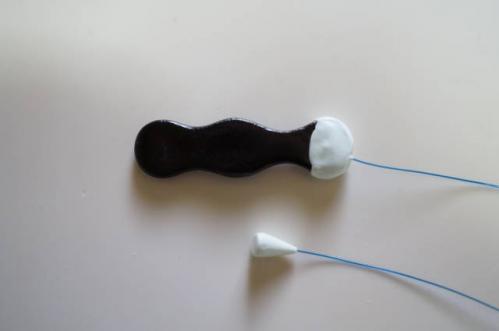
(Source: ok-lab's diary, published June 2019)
https://ok-lab.hatenablog.com/entry/2019/06/08/144200
Historical custom screws, stopper prototypes, metal test pieces and chipless wire assemblies: No matching product can be confirmed on the current list.
Four-line support was no longer offered by the June 2022 entry.
(Source: ok-lab's diary, published June 2022)
https://ok-lab.hatenablog.com/entry/2022/06/11/123420
Common worries about getting used to a prostate chip
Questions about fit and recurring pain received different answers in the diary.
"Can a shorter prostate chip reduce friction?"
In an entry published in April 2019, a customer considering a shorter custom screw described bleeding and urethral pain after increasing chip size. They reported becoming accustomed to larger chips after several days, and later said insertion had become possible with lubricant. Mr. Okada thought a shape without a narrowed middle could increase friction, while a shorter chip could reduce it.
The requested screw was 10mm wide and 10mm long; the finished prototype measured 10mm wide and about 18mm long. The diary does not record how that prototype felt in use. He offered to make the proposed designs, leaving size and shape choices to the customer.
(Source: ok-lab's diary, published April 2019)
https://ok-lab.hatenablog.com/entry/2019/04/13/150233

"Can prostate chip discomfort come from an oversized connection?"
In an entry published in June 2022, a customer reported that 3 cable-supported builds could not pass the urethral opening. The connecting filler was thicker than the chips, prompting a request for a slimmer joint. Mr. Okada explained that older connections added about 2mm compared with thread-connected chips.
He also confirmed that four-line support had already ended. The diary does not record whether a replacement solved this customer's difficulty. His reply offered a newer connection intended to produce a much thinner finished joint.
(Source: ok-lab's diary, published June 2022)
https://ok-lab.hatenablog.com/entry/2022/06/11/123420
"Will prostate chip pain disappear with more practice?"
In an entry published in July 2026, a customer asked whether practice would prevent painful urination lasting 2 or 3 days after first use. Mr. Okada considered pain lasting more than a day a possible sign of a problem. He suggested injury from forced insertion or inflammation that already existed among possible explanations.
He thought experience could reduce strain through smoother movement, but the diary does not establish what caused this customer's symptoms. The diary does not record a follow-up showing whether the pain resolved. He advised no use during pain, stopping if several days of pain recurred, and considering a urologist (a doctor treating urinary problems).
(Source: ok-lab's diary, published July 2026)
https://ok-lab.hatenablog.com/entry/2026/07/25/123012
Buying from outside Japan
OK Lab ships internationally to countries covered by Japan Post's EMS courier service. Overseas orders are paid in advance by PayPal. Each order carries a ¥400 (about $3 at ¥156 = $1, rate as of 2026-09-04) handling fee, and EMS shipping is charged on top. These terms come from OK Lab's official sales-terms page (written here as plain text, not a link: ok-lab.net/docs/law), checked on September 7, 2026; confirm them on the official store before you order, because they can change.
Summary of this article
| What you wanted to know | The answer |
|---|---|
| What is the short answer? | The diary gives no reliable adjustment deadline; Mr. Okada advises against continuing during pain. |
| What is this product? | A device made by OK Lab in Japan, placed in the urine passage to act on the prostate. |
| What do the key terms mean? | They distinguish the urine passage, positioning accessories, lubrication and the wire-and-tube alternative to a solid chip. |
| What happened in the reports? | Some contributors described increasing comfort; others reported inflammation, unsuitable dimensions or excessive pressure. |
| What did the maker suggest? | His replies discussed time, lubrication, smaller sizes and limiting prolonged friction. |
| What changed over time? | Smaller options and revised connections appeared, and a tubing correction changed one discomfort report. |
| Which related products are currently listed? | The ceramic semi-long chip costs ¥4,400 (about $28 at ¥156 = $1, rate as of 2026-09-04) and the short ceramic chip ¥3,300, (about $21 at ¥156 = $1, rate as of 2026-09-04) including tax. |
| Does repeated pain simply mean more practice is needed? | Mr. Okada's July 2026 reply treated persistent or recurring painful urination as a possible problem. |
| How do overseas orders work? | Advance PayPal payment, a ¥400 (about $3 at ¥156 = $1, rate as of 2026-09-04) handling fee and additional Japan Post EMS shipping charges apply. |
Source: ok-lab's diary (Okada Comfortable Life Laboratory). The original entries are in Japanese; quotations on this page are translated. Photos and videos are on the original entries.
This article is a summary of the maker's development diary. The product is not a medical device and no result is guaranteed. If anything feels wrong or worries you, see a doctor. Prices, specifications and cautions change, so confirm the latest information on the official blog and the official site. Questions about ordering and shipping go to the seller.