![Which prostate chip should beginners buy? | Start simply; fit is not guaranteed [OK Prostate Chip]](/img/a/T0153/eyecatch.svg)
This page is based on entries from "ok-lab's diary" (https://ok-lab.hatenablog.com/), the Japanese development diary written by Mr. Okada, founder of OK Lab, a small company in Japan (Okada Comfortable Life Laboratory). Only the entries about "buying your first prostate chip" are summarized here, in order of publication. Past prices and sizes are as written at the time. Current prices come from the official product list (retrieved September 4, 2026). Quotations are translated from Japanese.
Note: This page is a personal reading log by someone with no connection to the maker or the seller. It reflects the source entries as of their publication dates and makes no guarantee of accuracy or safety. The product is not a medical device; talk to a doctor about any health decision. Check the official site for current information. This page contains advertising.
In short
A first chip may fail to fit, cause discomfort, or provide no noticeable benefit.
The diary's practical starting point is one inexpensive, small chip without unnecessary extras.
Solid resin and ceramic products remain listed, with current prices shown separately from historical examples.
If you see blood in your urine, even a small amount or for the first time, do not wait and see. See a urologist right away.
If you suddenly cannot urinate, or the device cannot be removed, do not try to fix it yourself. Go to a medical facility, including emergency care, immediately.
About this product
The OK Prostate Chip is a small device that is placed in the urethra (the urine passage) so that it acts on the prostate; the maker sells it in several shapes, sizes and materials. It is made and sold by OK Lab (Okada Comfortable Life Laboratory), a small company in Japan, through its own online store, and prices are in Japanese yen (JPY).
The maker's development diary, "ok-lab's diary", is written in Japanese. This page is an English summary of it, and every quotation is translated. OK Lab ships internationally, so readers outside Japan can order (see "Buying from outside Japan" below).
Product names on this page are plain-English descriptions. The official Japanese product name is shown once in the product table so you can find the same item in the store.
Before you read: key terms
| Term | Plain-English meaning |
|---|---|
| Urethra | The urine passage; these devices occupy sections of it near the prostate. |
| Sphincter | The muscle gate discussed along the chip's route; stopper designs aim to limit movement past it. |
| Medium-length chip | The range called semilong in the diary, offered as an alternative to short chips. |
| Biocompatible resin | A named material used for chip bodies. The diary does not explain this. |
| Auxiliary chip | An extra component near the main chip, intended to assist positioning or stability. |
| Chipless device | Wire covered by silicone tubing, offered as a flexible alternative to solid chips. |
| Shape-memory wire | The flexible core of chipless devices, allowing their shape to change in narrow or curved sections. |
What happens: buying your first prostate chip
The OK Prostate Chip is a small device placed in the urethra (the urine passage) to act on the prostate. First-purchase choices include material, size, shape, and extra parts connected by thread. The main solid chip occupies the prostate area, while some supporting parts sit elsewhere inside the urethra. The diary's answers depend on the buyer's difficulty, and later entries introduce flexible designs alongside the original solid chips.
Early beginner chip prices separated brief trials from continued use
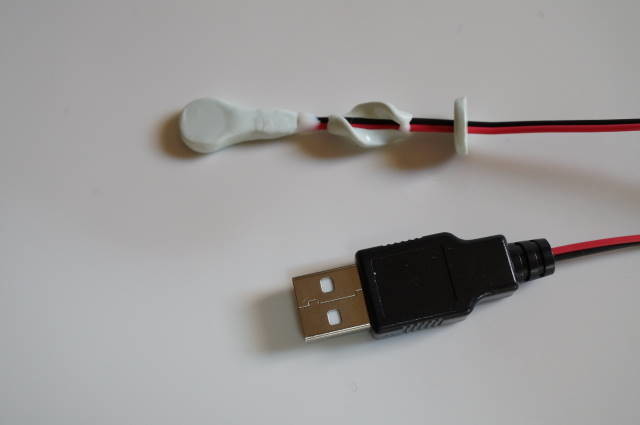
In October 2017, planned launch prices ranged from ¥1,000 (about $6 at ¥156 = $1, rate as of 2026-09-04) to ¥5,000 (about $32 at ¥156 = $1, rate as of 2026-09-04), excluding tax, depending on material and configuration. The ¥1,000 (about $6 at ¥156 = $1, rate as of 2026-09-04) option was intended for about 2 trials; the diary did not recommend it for continued use.
Its limitation concerned the thread's durability and knot, even though the resin itself was described as durable. Mr. Okada advised choosing products priced ¥2,000 (about $13 at ¥156 = $1, rate as of 2026-09-04) to ¥5,000 (about $32 at ¥156 = $1, rate as of 2026-09-04) for continued use.
(Source: ok-lab's diary, published October 2017)
https://ok-lab.hatenablog.com/entry/20171020/1508465071
First purchases favored one separate component over a complete pair
In March 2018, Mr. Okada advised first-time buyers considering the original single-chip design to choose its separate main component instead. It cost the same: resin was ¥2,000 (about $13 at ¥156 = $1, rate as of 2026-09-04) and glass ¥3,000 (about $19 at ¥156 = $1, rate as of 2026-09-04), excluding tax.
The resin helper cost ¥2,500 (about $16 at ¥156 = $1, rate as of 2026-09-04) and assisted passage past the sphincter (the muscle gate on the route). Mr. Okada advised buying that helper only if the main component alone could not pass.
(Source: ok-lab's diary, published March 2018)
https://ok-lab.hatenablog.com/entry/20180317/1521275320
First chip choices carry risks illustrated by one linked resin injury
In January 2020, a customer reported receiving a custom vibrating ceramic chip and wanting stronger stimulation. They described an earlier linked resin chip going farther inside than intended, alongside urethral injury and fever.
They found the ceramic model easier to place; the diary does not record medical follow-up on the earlier injury. Mr. Okada said he would accept such custom work, while warning of transport accidents and equipment failure.
(Source: ok-lab's diary, published January 2020)
https://ok-lab.hatenablog.com/entry/2020/01/04/155235
Mr. Okada considered one ceramic beginner chip a reasonable starting choice
In January 2020, a buyer without urethral-device experience chose an SS medium-length chip with a curved, comma-shaped extension. The order specified approximately 37+15 mm and ¥5,500 (about $35 at ¥156 = $1, rate as of 2026-09-04), and the customer asked about stability and discomfort.
Mr. Okada considered that configuration relatively stable and low in urethral burden. The buyer then reported paying, but the diary does not record how it felt in use. His buying advice was that this SS configuration was a reasonable first choice.
(Source: ok-lab's diary, published January 2020)
https://ok-lab.hatenablog.com/entry/2020/01/25/150127
No first chip could be promised to suit everyone
In September 2021, a prospective buyer asked whether a short glass chip was best for a first purchase. Mr. Okada said glass, ceramic, and biocompatible resin (a named chip material) differed in feel, but he could not identify a best material.
He added that urethral dimensions varied greatly and some buyers reported being unable to accommodate even the smallest chip. No subsequent purchase is recorded; his answer was that no single beginner recommendation suited everyone.
(Source: ok-lab's diary, published September 2021)
https://ok-lab.hatenablog.com/entry/2021/09/11/125735
Extra length was not endorsed as a beginner chip solution
In November 2022, a reader proposed a longer, slimmer chip after hearing from beginners who struggled to reach the intended position. Mr. Okada declined to endorse that approach, describing long, nearly straight chips as particularly dangerous in his experience.
He opposed beginner use at 40 mm or longer and said chips at that length required a curve. He remained willing to consider a prototype, but this material records no resulting test. His advice favored addressing difficulty with a short chip before considering extra length.
(Source: ok-lab's diary, published November 2022)
https://ok-lab.hatenablog.com/entry/2022/11/12/122932
The thinnest stainless ring still felt unsuitable as a beginner chip
In June 2025, a customer reported that even the thinnest stainless ring felt demanding despite being comparatively easy to place. They had hoped for 4–6 hours, but felt prostate fatigue after about 15 minutes and removed it after about 1 hour.
They regarded that thin ring as an advanced-user choice and preferred medium-length S for longer sessions. Mr. Okada's caution was that he, too, found the stainless ring demanding.
(Source: ok-lab's diary, published June 2025)
https://ok-lab.hatenablog.com/entry/2025/06/07/122954
The maker's answer to buying your first prostate chip
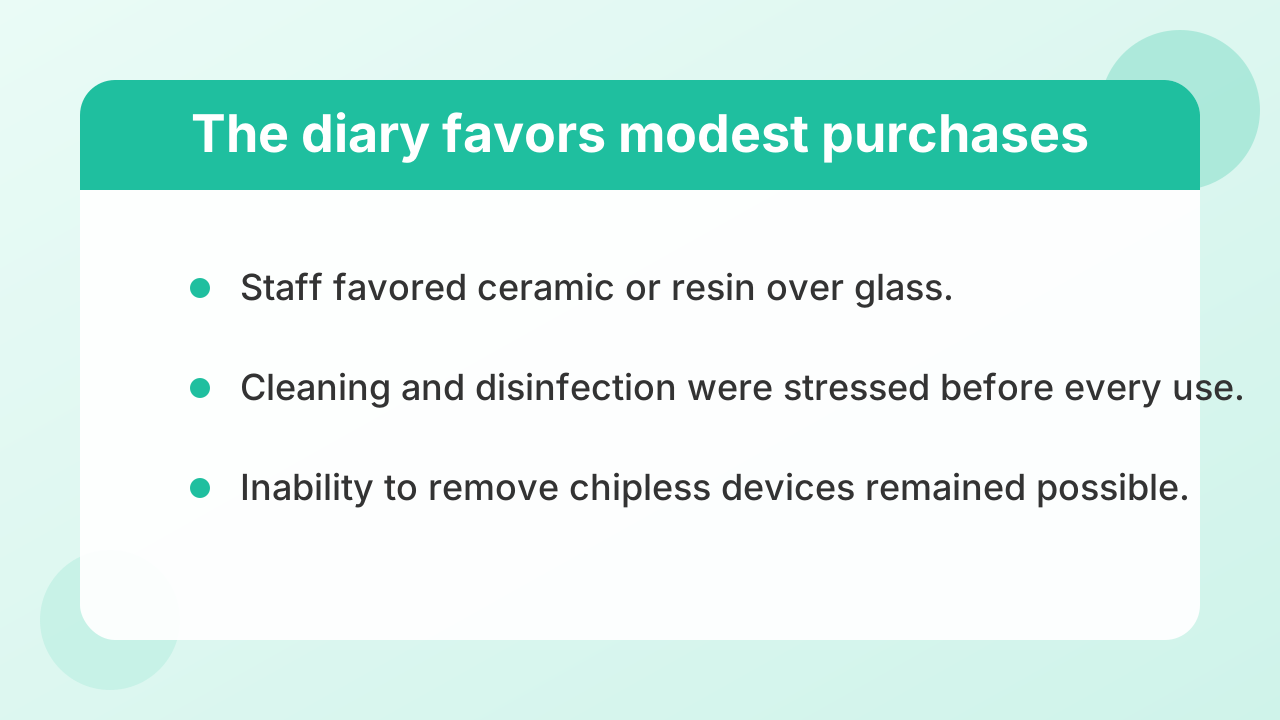
The diary favors a modest first purchase, distinguishes accessory roles, and later considers flexible devices for beginners.
A simple first purchase limited spending without removing material risks
In June 2020, a South Korean buyer asked about first purchases; no later buying or use outcome is recorded. OK Lab's staff replied that smaller chips entered more easily, while somewhat larger ones could be easier to move internally.
They said size had little bearing on slipping into the bladder, and acknowledged a few internal breakages without major injuries. They favored ceramic or resin over glass, saying broken pieces would not become sharp.
Because handmade production lacked factory-level precision and hygiene controls, they stressed cleaning and disinfection before every use, including the first. Their buying advice was 1 inexpensive, small chip, avoiding complex combinations that might prove unusable or ineffective.
(Source: ok-lab's diary, published June 2020)
https://ok-lab.hatenablog.com/entry/2020/06/27/120614
Beginner chip accessories were optional, with different purposes and limitations
In December 2024, a first-time buyer asked whether ordered chips needed extra parts and whether these would make placement harder. Staff declined to decide for them and offered to pause production while Mr. Okada explained the options.
He considered an internal sphincter stopper (a part intended to limit inward movement) difficult for beginners to judge. He treated a screw-shaped auxiliary chip (a twisted supporting component) as optional, with little protection against movement into the bladder.
The diary does not record whether the order changed. For beginners, he preferred an external stopper outside the penis tip, provided they already knew their urethral length accurately.
(Source: ok-lab's diary, published December 2024)
https://ok-lab.hatenablog.com/entry/2024/12/28/122907
Flexible designs expanded first chip choices without guaranteeing safe removal
In April 2025, staff requested fewer questions before answering a prospective buyer; the diary records no eventual purchase. They described ceramic and biocompatible resin through medium-length S as physically usable by roughly anyone, while acknowledging individual differences.
Above medium-length M, staff said some buyers would need urethral widening for a chip to fit. Mr. Okada instead discussed chipless devices, made from shape-memory wire (their flexible internal core) inside silicone tubing.
He believed these were substantially safer than solid chips, although inability to remove them remained possible. He now considered them an option for beginners because newly introduced placement tools could make them easier to position.
(Source: ok-lab's diary, published April 2025)
https://ok-lab.hatenablog.com/entry/2025/04/05/122932
If you see blood in your urine, even a small amount or for the first time, do not wait and see. See a urologist right away.
If you suddenly cannot urinate, or the device cannot be removed, do not try to fix it yourself. Go to a medical facility, including emergency care, immediately.
How buying your first prostate chip changed over time
| Published | What the diary said then |
|---|---|
| Oct 2017 | Finished assemblies were withheld; parts and thread-embedding work were sold separately. |
| Dec 2019 | Three ceramic twist versions appeared, each approximately 8 mm at its widest. |
| Jun 2020 | Staff acknowledged that some people felt nothing and sensation was not continuous. |
| Sep 2021 | Titanium was still pending; Mr. Okada suggested biocompatible resin meanwhile. |
| Nov 2022 | Short chips with comma-shaped extensions or flat assistance reached approximately 45 mm. |
| Feb 2025 | A shortened, bendable prototype measured about 60 mm overall. |
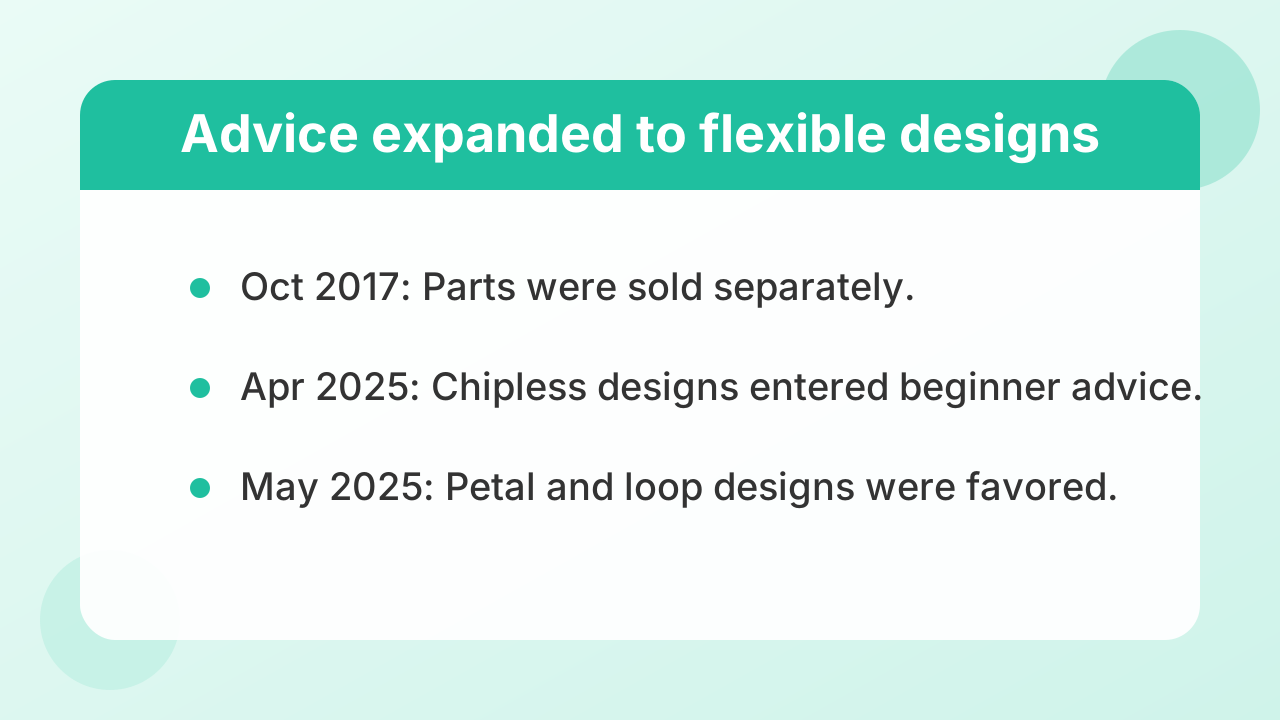
| Apr 2025 | Flexible chipless designs entered beginner advice after new placement tools appeared. |
| May 2025 | Mr. Okada favored petal and loop chipless designs as inexpensive beginner choices. |
OK Prostate Chip products related to buying your first prostate chip
The current list confirms these product names and prices, without confirming every historical size or custom configuration.
Products that appear in these entries
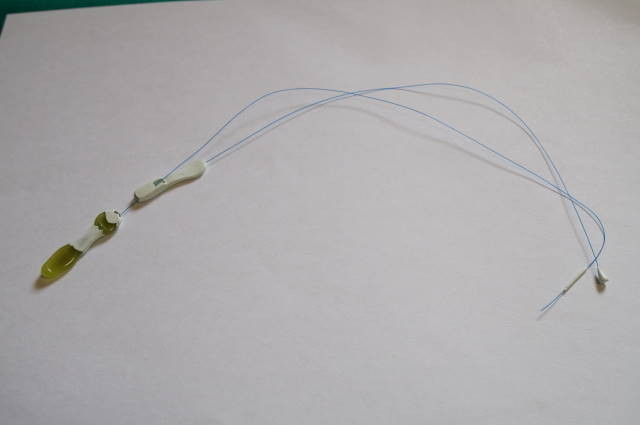
| Product (official name) | Price incl. tax | Relation to this topic |
|---|---|---|
| Linked resin chip (OKプロステートチップ 樹脂素材2連結タイプ) | ¥4,400 (about $28 at ¥156 = $1, rate as of 2026-09-04) | January 2020: a customer reported earlier inward movement, urethral injury, and fever with this design. |
| Medium-length ceramic chip with comma-shaped extension (OKプロステートチップ 陶器素材セミロング勾玉タイプ) | ¥5,500 (about $35 at ¥156 = $1, rate as of 2026-09-04) | January 2020: Mr. Okada considered a buyer's SS configuration a reasonable first choice. |
| Short ceramic twist (OKプロステートチップ 陶器素材ショートタイプ ツイスト) | ¥4,400 (about $28 at ¥156 = $1, rate as of 2026-09-04) | December 2020: a beginner reported repeated failure to position a 32 mm version. |
| Medium-length ceramic chip (OKプロステートチップ 陶器素材セミロングタイプ) | ¥4,400 (about $28 at ¥156 = $1, rate as of 2026-09-04) | April 2025: staff discussed sizes through S when answering a buyer's fit question. |
| Medium-length biocompatible resin chip (OKプロステートチップ セミロングタイプ(生体適合樹脂)) | ¥5,500 (about $35 at ¥156 = $1, rate as of 2026-09-04) | April 2025: staff included this material in their qualified assessment of smaller sizes. |
(Source: ok-lab's diary, published January 2020)
https://ok-lab.hatenablog.com/entry/2020/01/04/155235
(Source: ok-lab's diary, published January 2020)
https://ok-lab.hatenablog.com/entry/2020/01/25/150127
(Source: ok-lab's diary, published December 2020)
https://ok-lab.hatenablog.com/entry/2020/12/12/124126
(Source: ok-lab's diary, published April 2025)
https://ok-lab.hatenablog.com/entry/2025/04/05/122932
Products the diary mentioned as alternatives
| Product (official name) | Price incl. tax | Relation to this topic |
|---|---|---|
| Separate resin main chip (OKプロステートチップ 樹脂素材セパレートタイプ♂チップ) | ¥2,200 (about $14 at ¥156 = $1, rate as of 2026-09-04) | March 2018: Mr. Okada recommended it instead of the original single-chip design for first-time buyers. |
| Separate glass main chip (OKプロステートチップ ガラス素材セパレートタイプ♂チップ) | ¥3,300 (about $21 at ¥156 = $1, rate as of 2026-09-04) | March 2018: this was the glass option in the same first-purchase recommendation. |
| Separate resin helper (OKプロステートチップ 樹脂素材セパレートタイプ♀チップ) | ¥2,750 (about $18 at ¥156 = $1, rate as of 2026-09-04) | March 2018: Mr. Okada proposed adding it only if the separate main chip could not pass. |
| Screw-shaped auxiliary chip option (スクリュー型補助チップ追加オプション) | ¥3,300 (about $21 at ¥156 = $1, rate as of 2026-09-04) | December 2019: staff preferred it among alternatives for a beginner reporting expulsion during urination. |
(Source: ok-lab's diary, published March 2018)
https://ok-lab.hatenablog.com/entry/20180317/1521275320
(Source: ok-lab's diary, published December 2019)
https://ok-lab.hatenablog.com/entry/2019/12/28/131319
For the historical trial setup, custom ceramic build, thinnest ring specification, and discussed chipless designs: No matching product can be confirmed on the current list.
Common worries about buying your first prostate chip
Readers asked about unwanted movement, unsuccessful placement, and whether sex with a chip carried risks.
"Does a first chip need help staying put during urination?"
In December 2019, a beginner reported that their chip came out during urination and asked what to choose next. Staff discussed larger medium-length chips, comma-shaped designs, and screw-shaped assistance as alternatives.
Their reply distinguished a chip shifting within the urethra from one leaving the body. The diary does not record whether an alternative solved this customer's problem. The reply favored screw-shaped assistance for this particular concern.
(Source: ok-lab's diary, published December 2019)
https://ok-lab.hatenablog.com/entry/2019/12/28/131319
"Could buying a plain first chip avoid difficulty with twists?"
In December 2020, a beginner described four failed attempts with a 32 mm ceramic short twist and several add-ons. They asked whether a plain ceramic or glass single chip would be a better starting point.
Mr. Okada could not explain the reported prickling or determine placement from unused thread length. He thought the twisted main chip's greater bulk increased resistance. The diary does not record whether a replacement helped. He regarded a plain, untwisted chip as easier to accommodate than that twisted model.
(Source: ok-lab's diary, published December 2020)
https://ok-lab.hatenablog.com/entry/2020/12/12/124126
"Can beginners keep their first chip in during sex?"
In February 2023, a customer dissatisfied with a medium-length chip also asked about sex while the chip remained in place. Mr. Okada said he frequently received reports of bleeding during ejaculation with a chip in place.
The diary does not record an overall rate or this customer's later outcome. His reply left that decision to the customer, while explicitly raising the bleeding concern.
(Source: ok-lab's diary, published February 2023)
https://ok-lab.hatenablog.com/entry/2023/02/18/122910
Buying from outside Japan
OK Lab ships internationally to countries covered by Japan Post's EMS courier service. Overseas orders are paid in advance by PayPal. Each order carries a ¥400 (about $3 at ¥156 = $1, rate as of 2026-09-04) handling fee, and EMS shipping is charged on top. These terms come from OK Lab's official sales-terms page (written here as plain text, not a link: ok-lab.net/docs/law), checked on September 7, 2026; confirm them on the official store before you order, because they can change.
Summary of this article
| What you wanted to know | The answer |
|---|---|
| In short: what comes first? | A small, inexpensive purchase was the diary's basic starting point. |
| About this product: what is it? | A urethral device made by OK Lab in Japan, priced in JPY. |
| Key terms: what differs? | Main chips, supporting components, and flexible chipless devices serve different roles. |
| What happens for beginners? | Fit, comfort, and sensation vary; small size does not guarantee suitability. |
| The maker's answer: which approach? | Limit initial complexity and distinguish accessory functions; later advice includes flexible designs. |
| What changed over time? | Advice expanded from solid components to flexible designs and placement tools. |
| Related products: what costs apply? | The product tables show current tax-inclusive prices, separately from dated examples. |
| Common worries: what remains uncertain? | Successful placement, stable positioning, and freedom from injury are not guaranteed. |
| Buying abroad: how does payment work? | Advance PayPal payment, a ¥400 (about $3 at ¥156 = $1, rate as of 2026-09-04) handling fee, and additional EMS shipping. |
Source: ok-lab's diary (Okada Comfortable Life Laboratory). The original entries are in Japanese; quotations on this page are translated. Photos and videos are on the original entries.
This article is a summary of the maker's development diary. The product is not a medical device and no result is guaranteed. If anything feels wrong or worries you, see a doctor. Prices, specifications and cautions change, so confirm the latest information on the official blog and the official site. Questions about ordering and shipping go to the seller.