![Why is finding the right chip size so difficult? | Fit involves more than length [OK Prostate Chip]](/img/a/T0152/eyecatch.svg)
This page is based on entries from "ok-lab's diary" (https://ok-lab.hatenablog.com/), the Japanese development diary written by Mr. Okada, founder of OK Lab, a small company in Japan (Okada Comfortable Life Laboratory). Only the entries about finding the right size are summarized here, in order of publication. Past prices and sizes are as written at the time. Current prices come from the official product list (retrieved September 4, 2026). Quotations are translated from Japanese.
Note: This page is a personal reading log by someone with no connection to the maker or the seller. It reflects the source entries as of their publication dates and makes no guarantee of accuracy or safety. The product is not a medical device; talk to a doctor about any health decision. Check the official site for current information. This page contains advertising.
In short
A chip can feel too thin, slip out of position, or fit differently despite a familiar size label.
Mr. Okada says individual differences prevent a reliable size choice from labels or anatomy diagrams alone.
The current list includes several discussed products, but it does not confirm historical custom dimensions.
If you see blood in your urine, even a small amount or for the first time, do not wait and see. See a urologist right away.
If you suddenly cannot urinate, or the device cannot be removed, do not try to fix it yourself. Go to a medical facility, including emergency care, immediately.
About this product

The OK Prostate Chip is a small device that is placed in the urethra (the urine passage) so that it acts on the prostate; the maker sells it in several shapes, sizes and materials. It is made and sold by OK Lab (Okada Comfortable Life Laboratory), a small company in Japan, through its own online store, and prices are in Japanese yen (JPY). The maker's development diary, "ok-lab's diary", is written in Japanese. This page is an English summary of it, and every quotation is translated. OK Lab ships internationally, so readers outside Japan can order (see "Buying from outside Japan" below). Product names on this page are plain-English descriptions. The official Japanese product name is shown once in the product table so you can find the same item in the store.
Before you read: key terms
| Term | Plain-English meaning |
|---|---|
| Urethra | The urine passage; it is also where the device is placed. |
| Resin | A material used for chip bodies and coatings in these entries. |
| Sphincter | The muscle discussed as gripping a chip; the maker considers its thickness when designing the chip’s neck. |
| Bulbar urethra | A section of the urine passage where the diary describes chips slipping; it also accommodates certain supporting parts. |
| Chip neck | A narrow portion intended to sit where the sphincter grips the chip. |
| Stopper | An additional part intended to limit inward movement; the diary records limits to that function. |
What happens: choosing the right chip size
The OK Prostate Chip is a small device placed in the urethra to act on the prostate. Choosing its size involves the length, width and shape of the part intended to remain near the prostate. The entries also discuss narrower sections and supporting parts intended to help it stay in position. Customers describe problems with both entry and staying in place, while Mr. Okada reports different results with different materials and dimensions.
A custom chip size felt too thin despite earlier preferences
In an entry published in April 2018, a customer reported disappointment with a custom resin chip. Its 3 mm thickness felt insufficient, with less presence than previously used linked and long chips.
The customer expected to request another custom long design, but the diary does not record whether that order followed. Mr. Okada acknowledged the feedback; this passage contains no further sizing recommendation.
(Source: ok-lab's diary, published April 2018)
https://ok-lab.hatenablog.com/entry/20180414/1523697398
Semi-long chip sizing exposed problems with length and shifting position
In an entry published in April 2018, Mr. Okada reported that 45 mm was unsuitable in his semi-long tests. He considered 38 mm–42 mm more promising, while emphasizing that small length differences affected the experience.
He wrote that a longer chip could cause discomfort when its position changed. His response was further testing before sale, rather than presenting that range as a fit guarantee.
(Source: ok-lab's diary, published April 2018)
https://ok-lab.hatenablog.com/entry/20180421/1524299808
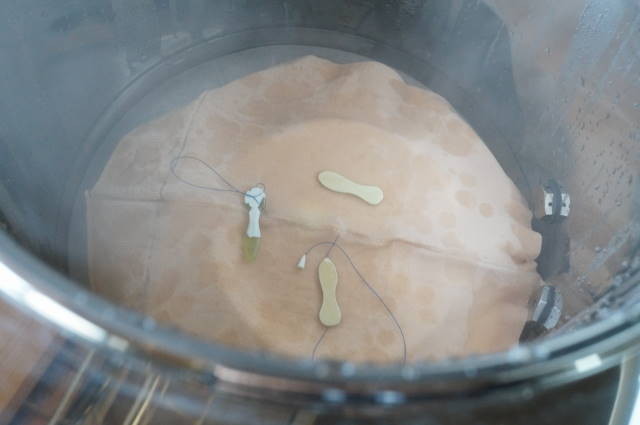
Glass chip fit involved slippage and limits on prolonged wear
In an entry published in May 2018, a customer liked the glass semi-long chip but struggled to keep it in position. Mr. Okada described glass as more slippery than resin and said about half the chip commonly slipped into the bulbar urethra.
His reply treated repeated position correction as typical use. He described a deeply narrowed version as staying put except during urination, but limited continuous wear to about half a day.
He attributed that limit to strain on the sphincter. He suggested a custom resin semi-long design as potentially less likely to slip; the diary does not record the customer’s subsequent experience.
(Source: ok-lab's diary, published May 2018)
https://ok-lab.hatenablog.com/entry/20180519/1526708081
Stopper chip sizing could not guarantee protection against inward movement
In an entry published in June 2018, Mr. Okada concluded that the stopper chip could not reliably prevent movement into the bladder. He reported that its size and distance from the main chip substantially changed how the combination felt.
Reports of the stopper passing the sphincter also made him consider changing its name. Because parts could tangle, he favored smaller stopper designs that he considered less troublesome in that situation.
(Source: ok-lab's diary, published June 2018)
https://ok-lab.hatenablog.com/entry/20180616/1529136608
Stopper chip fit raised durability concerns after repeated breakage reports
In an entry published in February 2019, a customer reported that a stopper had broken before use. Mr. Okada acknowledged previous breakage reports and said he had wanted to stop selling that design.
Staff had opposed withdrawal because of its low price and existing users, so sales had continued. He identified changing the resin as the only strengthening measure he could envisage, with no clear prospect of delivering it.
(Source: ok-lab's diary, published February 2019)
https://ok-lab.hatenablog.com/entry/2019/02/16/171153
Wire-connected chip fit brought comfort alongside concerns about breakage
In an entry published in May 2024, a customer reported finding a comfortable thin-wire connection after trying various combinations. The customer particularly valued reduced discomfort around the deeper bend in the urethra.
Mr. Okada agreed that the connection could offer support with little burden, but described it as delicate. He warned that resistance could make the wire buckle, with continued pressure potentially causing breakage. He sometimes advised against this connection for inexperienced customers requesting large chips.
(Source: ok-lab's diary, published May 2024)
https://ok-lab.hatenablog.com/entry/2024/05/04/122911
The maker's answer to choosing the right chip size
Mr. Okada’s responses considered individual fit, each accessory’s purpose, and the limits of a particular design.
Accessory choice depended on purpose as well as chip fit
In an entry published in January 2020, a customer asked whether a three-hole stopper or screw-shaped auxiliary chip would help. Mr. Okada declined a universal recommendation because inward movement varied between individuals.
He described the three-hole stopper as intended to prevent sphincter crossing, while the screw-shaped auxiliary chip held a position across that muscle. He expressly said the screw-shaped accessory did not prevent inward movement. After further discussion, the customer placed a custom order, although this excerpt does not identify its final configuration.
Mr. Okada advised choosing according to the intended purpose, because these accessories were not interchangeable.
(Source: ok-lab's diary, published January 2020)
https://ok-lab.hatenablog.com/entry/2020/01/18/132849
Neck dimensions made chip sizing more individual in the maker’s tests
In an entry published in May 2021, Mr. Okada described 33 test chips made to compare neck dimensions. The neck is the narrow portion intended to sit where the sphincter grips the chip.
The tested neck thicknesses were 2 mm, 2.75 mm and 3.5 mm. He believed thinner necks were easier to keep in position, but connected suitable neck length with individual sphincter thickness.
The entry announced his comparison tests without reporting a completed set of results. His sizing conclusion was that neck length would differ between people.
(Source: ok-lab's diary, published May 2021)
https://ok-lab.hatenablog.com/entry/2021/05/08/125938
Custom chip sizing costs differed for the gourd-shaped urethral device
In an entry published in November 2023, Mr. Okada established standard sizes for a gourd-shaped device intended to remain in the urethra. Standard SS, S, M and L versions were ¥8,000 (about $51 at ¥156 = $1, rate as of 2026-09-04) excluding tax, as published that month.
Custom pricing was ¥500 (about $3 at ¥156 = $1, rate as of 2026-09-04) excluding tax per cm of total length, with a ¥8,000 (about $51 at ¥156 = $1, rate as of 2026-09-04) minimum excluding tax. The stated custom range was approximately 12–25 cm.
He based the size labels on his own preferred fit, between S and M, and acknowledged having no other objective basis. For sizing, he said the design’s broad end was intended to stop before the sphincter.
(Source: ok-lab's diary, published November 2023)
https://ok-lab.hatenablog.com/entry/2023/11/04/122744
Modular chip sizing separated the costs of changing individual parts
In an entry published in December 2025, Mr. Okada proposed separate chip, shaft and heart-shaped stopper units to accommodate different dimensions. The four-layer stopper cost ¥3,000 (about $19 at ¥156 = $1, rate as of 2026-09-04); the two-layer version cost ¥2,500 (about $16 at ¥156 = $1, rate as of 2026-09-04), both excluding tax.
Shafts up to 100 mm, 150 mm and 200 mm cost ¥2,000, (about $13 at ¥156 = $1, rate as of 2026-09-04) ¥3,000 (about $19 at ¥156 = $1, rate as of 2026-09-04) and ¥4,000 (about $26 at ¥156 = $1, rate as of 2026-09-04) excluding tax, respectively. Jointed connections added a ¥2,000 (about $13 at ¥156 = $1, rate as of 2026-09-04) base charge plus ¥500 (about $3 at ¥156 = $1, rate as of 2026-09-04) per joint, excluding tax, to the chip price.
Following staff concerns about disconnected parts, he added retaining tubes, bringing the specified total to 4 without changing those prices. He preferred the four-layer stopper, offering the softer two-layer alternative for people who could not accommodate it.
(Source: ok-lab's diary, published December 2025)
https://ok-lab.hatenablog.com/entry/2025/12/13/122917
If you see blood in your urine, even a small amount or for the first time, do not wait and see. See a urologist right away.
If you suddenly cannot urinate, or the device cannot be removed, do not try to fix it yourself. Go to a medical facility, including emergency care, immediately.
How choosing the right chip size changed over time
| Published | What the diary said then |
|---|---|
| Apr 2018 | Semi-long development involved about 30 prototypes, with about 10 tested in use. |
| May 2021 | Neck-length testing used 11 patterns spaced 0.5 mm apart. |
| Sep 2023 | Custom rear width increased from 12 mm to 15 mm; thickness stayed unchanged. |
| Oct 2023 | A stainless twin measured 9.6 mm thick, yet exceeded 10 mm in width. |
| Nov 2023 | Mr. Okada attributed a custom chip’s stability partly to width and less-slippery white resin. |
| Dec 2025 | Mr. Okada found a connection without joints too uncomfortable for prolonged use. |
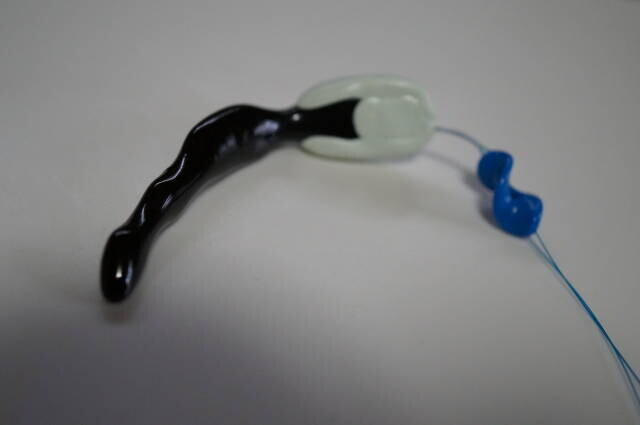
OK Prostate Chip products related to choosing the right chip size
The current list includes products discussed here, but their historical cases do not establish a suitable size for another buyer.
Products that appear in these entries
| Product (official name) | Price incl. tax | Relation to this topic |
|---|---|---|
| Glass semi-long chip (OKプロステートチップ ガラス素材セミロングタイプ) | ¥4,400 (about $28 at ¥156 = $1, rate as of 2026-09-04) | In May 2018, a customer asked why this chip would not stay in position. |
| Trial-sale vibrating chip (OKプロステート核振チップ(仮販売)) | ¥6,600 (about $42 at ¥156 = $1, rate as of 2026-09-04) | In February 2019, a customer asked how to choose between its M and L labels. |
| Curved chip (OKプロステート覚醒チップ) | ¥5,500 (about $35 at ¥156 = $1, rate as of 2026-09-04) | In May 2019, a customer asked whether changing curvature would address slipping out of position. |
(Source: ok-lab's diary, published May 2018)
https://ok-lab.hatenablog.com/entry/20180519/1526708081
(Source: ok-lab's diary, published February 2019)
https://ok-lab.hatenablog.com/entry/2019/02/16/171153
(Source: ok-lab's diary, published May 2019)
https://ok-lab.hatenablog.com/entry/2019/05/25/144939
Products the diary mentioned as alternatives
| Product (official name) | Price incl. tax | Relation to this topic |
|---|---|---|
| Three-hole sphincter stopper (三穴方式オプションチップ(括約筋ストッパーチップ)) | ¥1,650 (about $11 at ¥156 = $1, rate as of 2026-09-04) | In January 2020, Mr. Okada discussed it for preventing sphincter crossing, while declining a universal recommendation. |
| Screw-shaped auxiliary chip option (スクリュー型補助チップ追加オプション) | ¥3,300 (about $21 at ¥156 = $1, rate as of 2026-09-04) | In January 2020, he discussed this holding accessory but said it did not prevent inward movement. |
(Source: ok-lab's diary, published January 2020)
https://ok-lab.hatenablog.com/entry/2020/01/18/132849
The entries also describe custom resin builds, semi-long and anchor prototypes, early stoppers, neck test chips, and a widened custom model. No matching product can be confirmed on the current list.
Other descriptions include a custom stainless twin, gourd-shaped device, custom white-resin chip, thin-wire connection, and modular assembly. No matching product can be confirmed on the current list.
Common worries about choosing the right chip size
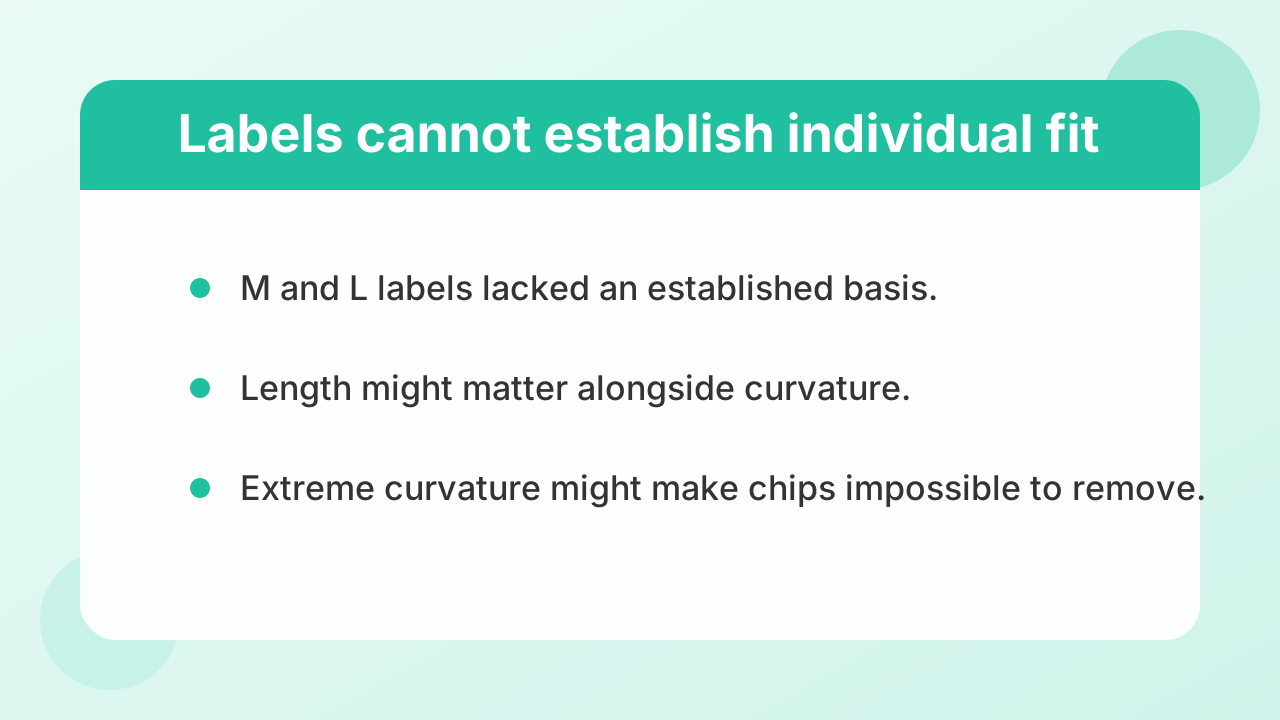
The diary’s questions show why a diagram, size label or stronger curve could leave the fit question unresolved.
"Can an anatomy diagram identify the right chip size?"
In an entry published in May 2018, a customer wanted anatomical measurements before specifying a custom chip. Mr. Okada said he had no suitable diagram and doubted that one could settle the dimensions.
He pointed to individual differences, including prostate enlargement. The diary does not record whether a custom order followed. His answer emphasized individual fit rather than treating a general diagram as a personal sizing guide.
(Source: ok-lab's diary, published May 2018)
https://ok-lab.hatenablog.com/entry/20180519/1526708081
"Do M and L labels predict chip fit?"
In an entry published in February 2019, a customer asked how to determine which vibrating-chip size would fit. Mr. Okada acknowledged that his M and L labels lacked an established basis.
He described M as 55 mm and L as 60 mm, relating length to the urethral portion within the prostate, not penis length. The diary does not record the customer’s eventual choice. Mr. Okada said the labels alone could not establish whether the device would fit in practice.
(Source: ok-lab's diary, published February 2019)
https://ok-lab.hatenablog.com/entry/2019/02/16/171153
"Would a stronger curve improve chip fit?"
In an entry published in May 2019, a customer wanted to compare more-curved and less-curved long designs because the existing chip slipped out. Mr. Okada could not identify the cause, but suggested length might matter alongside curvature.
He reported that his S-sized curved chip seemed too short to accommodate his prostate between its ends. No result from the customer’s proposed comparison is recorded. Mr. Okada cautioned that extreme curvature might make a chip impossible to remove.
(Source: ok-lab's diary, published May 2019)
https://ok-lab.hatenablog.com/entry/2019/05/25/144939
"Could an anchor solve unstable chip fit?"
In an entry published in May 2019, a customer asked to test the anchor prototype shown previously. Mr. Okada declined because he was not satisfied with its ability to stay in position under different conditions.
He wrote that thick, slippery secretions made its friction-based holding method fail completely. Development had therefore been suspended. His response withheld customer testing rather than offering the prototype as a dependable solution.
(Source: ok-lab's diary, published May 2019)
https://ok-lab.hatenablog.com/entry/2019/05/25/144939
Buying from outside Japan

OK Lab ships internationally to countries covered by Japan Post's EMS courier service. Overseas orders are paid in advance by PayPal. Each order carries a ¥400 (about $3 at ¥156 = $1, rate as of 2026-09-04) handling fee, and EMS shipping is charged on top. These terms come from OK Lab's official sales-terms page (written here as plain text, not a link: ok-lab.net/docs/law), checked on September 7, 2026; confirm them on the official store before you order, because they can change.
Summary of this article
| What you wanted to know | The answer |
|---|---|
| What is the short answer? | The diary describes fit as individual and dependent on more than length. |
| What is this product? | A urethral device made and sold by a small Japanese company. |
| Which terms matter? | Neck dimensions, sphincter contact and stopper purpose recur in the sizing discussions. |
| What can go wrong with fit? | Customers reported insufficient presence, slipping and difficulty finding suitable dimensions. |
| What did the maker propose? | Different dimensions, purpose-specific accessories and separately replaceable components. |
| What changed over time? | The entries record prototype comparisons, custom dimensions and later modular designs. |
| Which products are listed today? | The product tables identify current matches and tax-inclusive JPY prices. |
| Can labels or diagrams settle the choice? | Mr. Okada said neither established an individual fit. |
| How do overseas purchases work? | Advance PayPal payment, a handling fee and additional EMS shipping charges apply. |
Source: ok-lab's diary (Okada Comfortable Life Laboratory). The original entries are in Japanese; quotations on this page are translated. Photos and videos are on the original entries.
This article is a summary of the maker's development diary. The product is not a medical device and no result is guaranteed. If anything feels wrong or worries you, see a doctor. Prices, specifications and cautions change, so confirm the latest information on the official blog and the official site. Questions about ordering and shipping go to the seller.