![Which prostate chip suits all-day wear? | The maker favors less pressure and flexible connections [OK Prostate Chip]](/img/a/T0164/eyecatch.svg)
This page is based on entries from "ok-lab's diary" (https://ok-lab.hatenablog.com/), the Japanese development diary written by Mr. Okada, founder of OK Lab, a small company in Japan (Okada Comfortable Life Laboratory). Only the entries about "configurations for long-term wear" are summarized here, in order of publication. Past prices and sizes are as written at the time. Current prices come from the official product list (retrieved September 4, 2026). Quotations are translated from Japanese.
Note: This page is a personal reading log by someone with no connection to the maker or the seller. It reflects the source entries as of their publication dates and makes no guarantee of accuracy or safety. The product is not a medical device; talk to a doctor about any health decision. Check the official site for current information. This page contains advertising.
In short
- Pressure, rigid connections, and strong stimulation limited long-term wear in the maker's tests.
- Mr. Okada favored less sphincter pressure and more flexible connections, with recommendations varying by design.
- Current listings include ceramic chips and auxiliary supports; they do not confirm the historical custom assemblies.
If you see blood in your urine, even a small amount or for the first time, do not wait and see. See a urologist right away. If you suddenly cannot urinate, or the device cannot be removed, do not try to fix it yourself. Go to a medical facility, including emergency care, immediately.
About this product
The OK Prostate Chip is a small device that is placed in the urethra (the urine passage) so that it acts on the prostate; the maker sells it in several shapes, sizes and materials. It is made and sold by OK Lab (Okada Comfortable Life Laboratory), a small company in Japan, through its own online store, and prices are in Japanese yen (JPY). The maker's development diary, "ok-lab's diary", is written in Japanese. This page is an English summary of it, and every quotation is translated. OK Lab ships internationally, so readers outside Japan can order (see "Buying from outside Japan" below). Product names on this page are plain-English descriptions. The official Japanese product name is shown once in the product table so you can find the same item in the store.
Before you read: key terms
| Term | Plain-English meaning |
|---|---|
| Urethra | The urine passage; the chip occupies it to act on the prostate. |
| Sphincter | A muscle around the passage; the diary describes it gripping narrower parts to help retain the chip. |
| Bulbar urethra | The section outside the sphincter in these examples; it accommodates a second chip or support. |
| Seminal vesicles | Paired structures behind the bladder, discussed as stimulation targets; the diary does not explain their biological function. |
| Auxiliary screw chip | An extra screw-shaped chip used as a support near the main chip. |
| Shape-memory wire | A spring-like connecting wire used to link parts and resist displacement. |
| Shape-memory holder | A support described as securing the device against movement in either direction. |
| Chipless | A wire-loop design without a solid chip, developed as another form of retained stimulation. |
What happens: long-term wear
The OK Prostate Chip is a small device placed in the urethra to act on the prostate. Long-term wear means keeping it in place for hours or days, as described in these entries. The configurations discussed here change the chip's shape, connections between parts, or supports along the urine passage. Mr. Okada's comparisons concern pressure at the sphincter (a muscle that can grip the device) and flexibility along the urine passage.
All-day wear exceeded the maker's recommendation for his twin-motor resin chip
In an entry published in February 2019, Mr. Okada reported discomfort after about half a day with resin chips without vibration. He attributed this to drying and said long resin types were not being sold because he considered them problematic.
The twin-motor resin design posed another limitation: he found its vibration too intense for continuous use. He restricted that design to short sessions and favored an ordinary vibrating chip with 1 motor for longer wear.
(Source: ok-lab's diary, published February 2019)
https://ok-lab.hatenablog.com/entry/2019/02/09/152257
Wider spacing made long-term wear easier in the maker's coated twin assembly
In an entry published in October 2019, Mr. Okada said unbending stainless-steel and nylon connections gradually burdened the sphincter. The revised twin assembly therefore had a resin-covered connection. Its structure used two 0.45mm wires, with a separate nylon connection.
Both chip sections were 10mm shorter than standard, and the terminal chip was omitted. Close, medium, and wider spacing were planned options; Mr. Okada favored wider spacing for extended wear.
(Source: ok-lab's diary, published October 2019)
https://ok-lab.hatenablog.com/entry/2019/10/26/145539
Bleeding ended the maker's curved-chip test, raising concerns about long-term wear
In an entry published in November 2019, Mr. Okada reported bleeding during a strongly curved twin-chip test. The tested arrangement extended into the prostate and bladder. He stopped after blood appeared at the urethral opening.
He suspected pressure-related injury, but the diary does not record medical confirmation of that explanation. Mr. Okada cautioned that this twin-chip design appeared to impose strain during extended wear.
(Source: ok-lab's diary, published November 2019)
https://ok-lab.hatenablog.com/entry/2019/11/16/154802
A longer tip limited all-day wear despite strong retention
In an entry published in November 2020, Mr. Okada tested a glass chip joined to a screw-shaped support through a rubber-coated connection. He described excellent retention, but approximately 10-15mm of the tip extended into the bladder.
He ended the test after about 3 hours because the stimulation was too strong. Mr. Okada favored a shorter front chip for extended wear.
(Source: ok-lab's diary, published November 2020)
https://ok-lab.hatenablog.com/entry/2020/11/21/130647
A flexible cable addressed another obstacle to long-term wear
In an entry published in March 2022, Mr. Okada described a cable reinforced with approximately 0.4mm wire. He reported that it bent easily while retaining its shape, unlike the stiffer cable previously considered.
After about 5 days, he described the new cable as more comfortable in his own tests. Mr. Okada judged hard, unbending components unsuitable for prolonged placement along the penile part of the urethra.
(Source: ok-lab's diary, published March 2022)
https://ok-lab.hatenablog.com/entry/2022/03/12/122940
Stimulation sites changed the maker's experience of long-term wear with paired motors
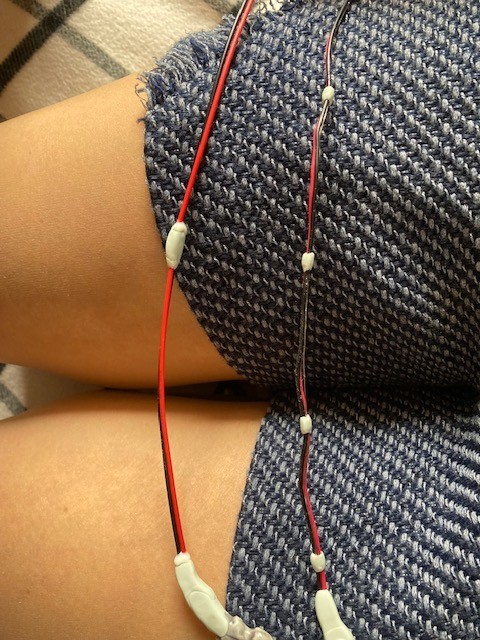
In an entry published in June 2024, Mr. Okada described paired motors connecting a short ceramic chip with a short resin chip. Its published total was ¥14,000 (about $90 at ¥156 = $1, rate as of 2026-09-04) excluding tax. He reported no worsening of his health during extended vibration at the prostate and bulbar urethra (the section outside the sphincter).
With a different, bladder-stimulating design, he described sensations of impending heart failure after about 5 minutes. The diary does not record medical confirmation of his explanation for this contrast. Mr. Okada's conclusion for himself was to avoid prolonged stimulation of the seminal vesicles (paired structures behind the bladder).
(Source: ok-lab's diary, published June 2024)
https://ok-lab.hatenablog.com/entry/2024/06/22/122918
Removing the joint made long-term wear intolerable in a modular prototype
In an entry published in December 2025, Mr. Okada described a modular assembly with separate chip, straight-shaft, and heart-shaped stopper units. He also tested a shaft connected directly to the chip, without a joint.
He reported strong discomfort and said prolonged wear was impossible with that arrangement. Mr. Okada favored interchangeable units because achieving a precise fit from measurements alone was difficult.
(Source: ok-lab's diary, published December 2025)
https://ok-lab.hatenablog.com/entry/2025/12/13/122917
The maker's answer to long-term wear
Mr. Okada's proposed measures focused on narrower contact areas, supportive shapes, and softer connections.
A narrower titanium section reduced reported strain during long-term wear
In an entry published in June 2021, Mr. Okada described a titanium test chip with a narrowed sphincter section measuring 2mm. He reported almost no fatigue after nearly a week of continuous wear.
He contrasted this with the thicker sections needed for strength in other materials. Mr. Okada's design recommendation was a thinner sphincter section, which he believed reduced strain and improved retention.
(Source: ok-lab's diary, published June 2021)
https://ok-lab.hatenablog.com/entry/2021/06/26/125926
Flatter supports were the maker's preference for balanced long-term wear
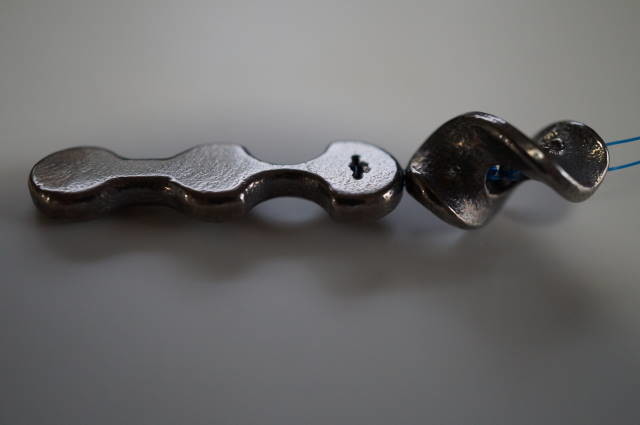
In an entry published in May 2024, Mr. Okada compared linked chips supported by shape-memory wire (a spring-like connection). He favored flat curved chips at both the prostate and bulbar sections, reporting greater stability and less seminal-vesicle stimulation. Reversing the lower curved chip produced stimulation he considered too strong for extended wear.
The published connection charges were ¥3,000 (about $19 at ¥156 = $1, rate as of 2026-09-04) excluding tax for bare wire and ¥4,000 (about $26 at ¥156 = $1, rate as of 2026-09-04) excluding tax for a tube-covered connection. Both charges were additional to the prices of the 2 chips. For the lower support, Mr. Okada recommended the short ceramic chip as a flat option.
(Source: ok-lab's diary, published May 2024)
https://ok-lab.hatenablog.com/entry/2024/05/04/122911
Softer petal wire was chosen to reduce stimulation during long-term wear
In an entry published in April 2025, Mr. Okada introduced a petal-shaped stopper intended to resist passage through the sphincter. The design used 3 petals of 0.2mm wire. Published prices were ¥1,000 (about $6 at ¥156 = $1, rate as of 2026-09-04) per petal or ¥3,000 (about $19 at ¥156 = $1, rate as of 2026-09-04) for 3 petals, excluding tax.
He reported no strong sphincter stimulation after about 5 days. He also acknowledged that excessive force could reverse the petals and defeat the stopper. Mr. Okada favored the thinner wire because stronger spring pressure was unsuitable for extended wear.
(Source: ok-lab's diary, published April 2025)
https://ok-lab.hatenablog.com/entry/2025/04/26/122909
If you see blood in your urine, even a small amount or for the first time, do not wait and see. See a urologist right away. If you suddenly cannot urinate, or the device cannot be removed, do not try to fix it yourself. Go to a medical facility, including emergency care, immediately.
How long-term wear changed over time
| Published | What the diary said then |
|---|---|
| Oct 2019 | Planned twin-chip spacing was approximately 2mm, 5mm, or 8mm. |
| Nov 2020 | The 90-degree rubber-coated connection was priced at ¥1,000 (about $6 at ¥156 = $1, rate as of 2026-09-04) excluding tax. |
| Mar 2022 | Earlier fixed-shape stopper prototypes raised concerns about strain and unwanted displacement. |
| Jun 2024 | Twin-chip connecting wire was offered in 2cm, 3cm, 4cm, and 5cm lengths. |
| Dec 2024 | A customer reported stable chipless (wire-loop) retention without an additional anti-migration stopper. |
| Apr 2025 | The maker rejected 0.3mm petal wire as too stimulating for prolonged wear. |
| Dec 2025 | Extra tube fasteners tethered the shaft and stopper after concerns about disconnected parts. |
The diary does not say what the current state is.
OK Prostate Chip products related to long-term wear
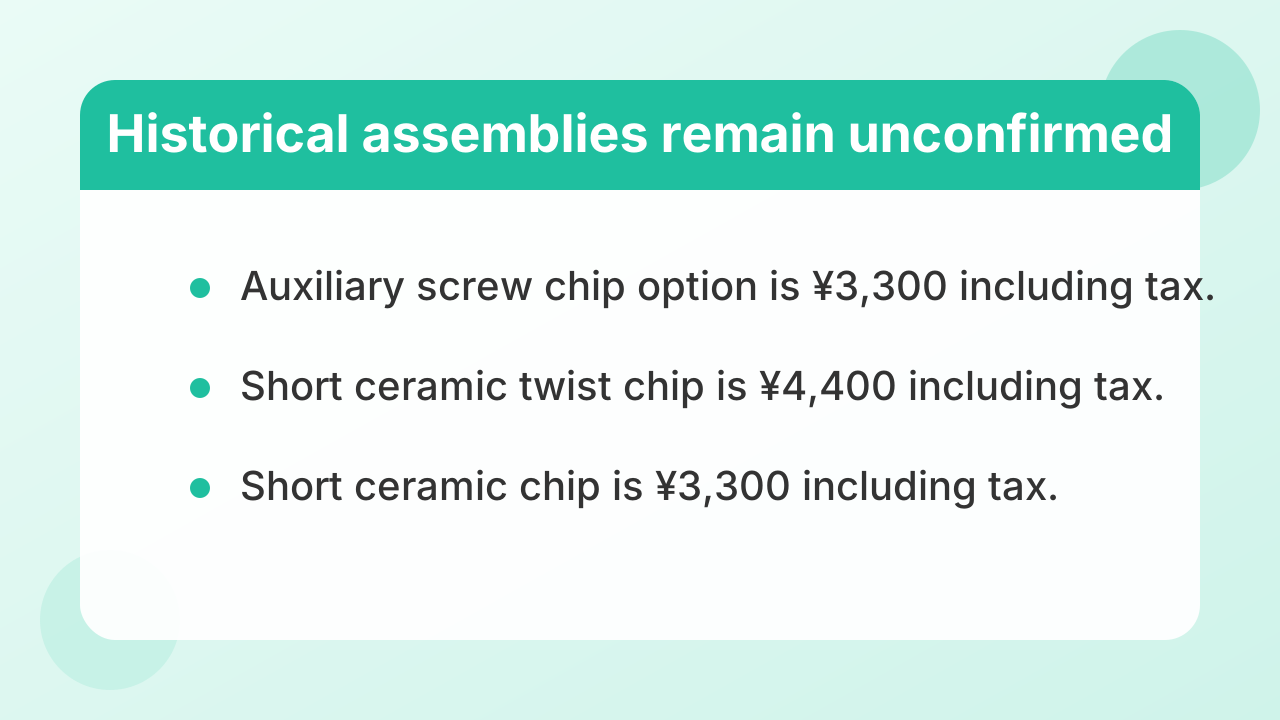
The current list includes named chips and supports from these discussions, without confirming the custom configurations.
Products that appear in these entries
| Product (official name) | Price incl. tax | Relation to this topic |
|---|---|---|
| Auxiliary screw chip option (スクリュー型補助チップ追加オプション) | ¥3,300 (about $21 at ¥156 = $1, rate as of 2026-09-04) | In November 2019, Mr. Okada reported little sphincter stimulation with this support approximately 6mm from the front chip. |
| Short ceramic twist chip (OKプロステートチップ 陶器素材ショートタイプ ツイスト) | ¥4,400 (about $28 at ¥156 = $1, rate as of 2026-09-04) | In June 2021, a customer reported discomfort with this chip joined closely to an auxiliary screw support. |
(Source: ok-lab's diary, published November 2019)
https://ok-lab.hatenablog.com/entry/2019/11/16/154802
(Source: ok-lab's diary, published June 2021)
https://ok-lab.hatenablog.com/entry/2021/06/26/125926
Products the diary mentioned as alternatives
| Product (official name) | Price incl. tax | Relation to this topic |
|---|---|---|
| Short ceramic chip (OKプロステートチップ 陶器素材ショートタイプ) | ¥3,300 (about $21 at ¥156 = $1, rate as of 2026-09-04) | In May 2024, Mr. Okada recommended this flat lower support as an alternative to curved supports in linked configurations. |
(Source: ok-lab's diary, published May 2024)
https://ok-lab.hatenablog.com/entry/2024/05/04/122911
Historical configurations include the resin twin-motor chip, coated twin assembly, rubber-connected prototype, titanium test piece, flexible cable, and balanced twin-chip setup. They also include paired motors, petal stoppers, six-wire support, tube support, flexible tails, shape-memory holders, chipless designs, and modular assemblies. No matching product can be confirmed on the current list.
Common worries about long-term wear
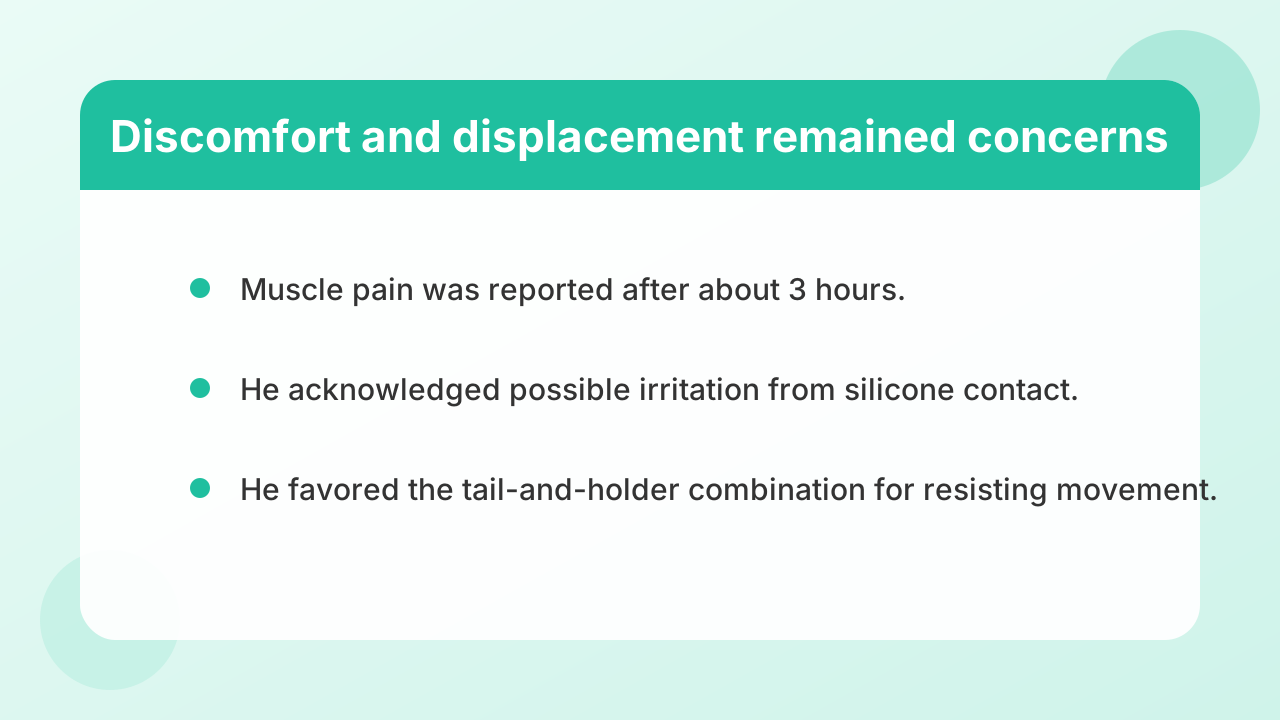
The reader questions show that stability, discomfort, and component choice remained separate concerns.
"Why did all-day wear hurt with a closely linked screw support?"
In an entry published in June 2021, a customer wanted several days of wear but reported muscle pain after about 3 hours. Their short ceramic twist chip had an auxiliary screw chip (an extra supporting chip) at 0mm spacing.
Mr. Okada said this tightly gripped a sphincter he described as 5-6mm thick, potentially causing excessive stimulation. The diary does not record whether a different configuration relieved this customer's pain. Mr. Okada cautioned that this close-clamping arrangement might be tolerable for only a few hours.
(Source: ok-lab's diary, published June 2021)
https://ok-lab.hatenablog.com/entry/2021/06/26/125926
"Is silicone-tube support better than six-wire construction for long-term wear?"
In an entry published in August 2022, a customer asked which support would remain stable over several days. Mr. Okada said downward wear with six-wire support became uncomfortable after about half a day, requiring readjustment; he considered continuous wear impractical. He preferred the flexible silicone-tube support for movement in all directions, while acknowledging possible irritation where silicone contacted the urethral lining.
The diary does not record which support the customer chose. His recommendation for prolonged wear excluded the silicone tube crossing the sphincter or remaining pressed against it.
(Source: ok-lab's diary, published August 2022)
https://ok-lab.hatenablog.com/entry/2022/08/20/122920
"Can long-term wear work without an auxiliary chip?"
In an entry published in July 2025, a customer wanted less displacement and discomfort with a medium semi-long chip. Mr. Okada proposed a flexible tail containing nylon thread and shape-memory wire inside a 1mm tube. He paired it with a shape-memory holder (a support against displacement), saying auxiliary chips generally were unnecessary with these tails or chipless designs.
He did not answer which chip shape or size would reduce this customer's prostate discomfort. The diary does not record the customer's later experience. Mr. Okada favored the tail-and-holder combination for resisting movement in both directions.
(Source: ok-lab's diary, published July 2025)
https://ok-lab.hatenablog.com/entry/2025/07/26/122909
Buying from outside Japan
OK Lab ships internationally to countries covered by Japan Post's EMS courier service. Overseas orders are paid in advance by PayPal. Each order carries a ¥400 (about $3 at ¥156 = $1, rate as of 2026-09-04) handling fee, and EMS shipping is charged on top. These terms come from OK Lab's official sales-terms page (written here as plain text, not a link: ok-lab.net/docs/law), checked on September 7, 2026; confirm them on the official store before you order, because they can change.
Summary of this article
| What you wanted to know | The answer |
|---|---|
| In short: what mattered? | The maker repeatedly focused on pressure, flexibility, and stimulation strength. |
| About the product: who makes it? | OK Lab makes the urethral device in Japan and sells it in Japanese yen. |
| Key terms: what do the parts do? | Chips provide stimulation; connecting parts and supports affect retention. |
| What happens during extended wear? | The maker reported both comfortable tests and configurations limited by discomfort or bleeding. |
| What measures did the maker propose? | Narrower contact sections, flatter supports, and softer wire, depending on the design. |
| What changed over time? | The diary moved through coated connections, flexible cables, wire loops, and modular assemblies. |
| Which current products are related? | The listed ceramic chips and screw support appear here; historical assemblies remain unconfirmed. |
| What worried customers? | Muscle pain, displacement, and whether an auxiliary chip was necessary. |
| How do overseas orders work? | Advance PayPal payment, a ¥400 (about $3 at ¥156 = $1, rate as of 2026-09-04) handling fee, and additional EMS shipping. |
Source: ok-lab's diary (Okada Comfortable Life Laboratory). The original entries are in Japanese; quotations on this page are translated. Photos and videos are on the original entries.
This article is a summary of the maker's development diary. The product is not a medical device and no result is guaranteed. If anything feels wrong or worries you, see a doctor. Prices, specifications and cautions change, so confirm the latest information on the official blog and the official site. Questions about ordering and shipping go to the seller.