![How long should I rest between chip uses? | The diary gives no single recovery period [OK Prostate Chip]](/img/a/T0165/eyecatch.svg)
This page is based on entries from "ok-lab's diary" (https://ok-lab.hatenablog.com/), the Japanese development diary written by Mr. Okada, founder of OK Lab, a small company in Japan (Okada Comfortable Life Laboratory). Only the entries about taking breaks from chip use are summarized here, in order of publication. Past prices and sizes are as written at the time. Current prices come from the official product list (retrieved September 4, 2026). Quotations are translated from Japanese.
Note: This page is a personal reading log by someone with no connection to the maker or the seller. It reflects the source entries as of their publication dates and makes no guarantee of accuracy or safety. The product is not a medical device; talk to a doctor about any health decision. Check the official site for current information. This page contains advertising.
In short
- The diary records breaks after discomfort, bleeding, inflammation, and changes in urination.
- Mr. Okada advises pauses, but some replies acknowledge that rest alone may not resolve the problem.
- The latest entry advises avoiding use during pain and stopping if prolonged pain recurs.
If you see blood in your urine, even a small amount or for the first time, do not wait and see. See a urologist right away.
If you suddenly cannot urinate, or the device cannot be removed, do not try to fix it yourself. Go to a medical facility, including emergency care, immediately.
About this product

The OK Prostate Chip is a small device that is placed in the urethra (the urine passage) so that it acts on the prostate; the maker sells it in several shapes, sizes and materials. It is made and sold by OK Lab (Okada Comfortable Life Laboratory), a small company in Japan, through its own online store, and prices are in Japanese yen (JPY). The maker's development diary, "ok-lab's diary", is written in Japanese. This page is an English summary of it, and every quotation is translated. OK Lab ships internationally, so readers outside Japan can order (see "Buying from outside Japan" below). Product names on this page are plain-English descriptions. The official Japanese product name is shown once in the product table so you can find the same item in the store.
Before you read: key terms
| Term | Plain-English meaning |
|---|---|
| Urethra | The urine passage; it carries urine out of the body and is where the chip is placed. |
| Urethritis | Inflammation of the urethra; this is the diagnosis reported in several entries about interrupted use. |
| Sphincter | A muscle involved in controlling urine flow; the diary discusses strain around this muscle during chip wear. |
| Resin | Plastic used to make chips and components; the entries compare its behavior with glass. |
| Receiving component | The hollow resin half of the separate-chip design; the diary says it can serve as a stopper. |
| White blood cells | The diary does not explain this. |
| Antibiotics | Medicines used to treat infection; Mr. Okada discusses them when questioning whether rest alone will be enough. |
What happens: breaks between chip uses

The OK Prostate Chip is a small device placed in the urethra to stimulate the prostate. Here, rest means a pause in that stimulation while the urine passage has time without it. The entries discuss breaks during ordinary use and interruptions after pain, bleeding, or signs of inflammation. These accounts concern tissue inside the body, including the muscles around the urine passage that Mr. Okada discusses.
Continuous chip use prompted an early warning about excessive stimulation
In an entry published in October 2017, Mr. Okada described continuous wear as excessively stimulating. He proposed periodic breaks from stimulation around the prostate, without specifying a fixed recovery period. His closing advice was to discuss further use with a doctor.
(Source: ok-lab's diary, published October 2017)
https://ok-lab.hatenablog.com/entry/20171013/1507858434
A doctor's advice tied chip breaks to recovery in November 2017
In an entry published in November 2017, Mr. Okada described a diagnosis of urethritis (inflammation of the urethra). According to his account, the doctor could not establish whether the chip had caused it. Mr. Okada reported receiving treatment and being told at a later appointment that the inflammation had cleared.
He subsequently reported a normal urine test after about 20 days of daily chip use. That result concerned his own follow-up after treatment. His doctor's instruction during the illness had been to avoid the chip until fully recovered.
(Source: ok-lab's diary, published November 2017)
https://ok-lab.hatenablog.com/entry/20171129/1511963864
Bleeding after use prompted a question about recognizing excessive wear
In an entry published in March 2018, a customer using a resin (plastic) chip assembly asked how to recognize its wear limit. They described continuous use from lunchtime until after lunch the following day, when blood appeared in their urine. The customer stopped using it.
Mr. Okada replied that the limit could not be judged externally, adding that customers commonly recognized injury through bleeding. The diary does not record whether this customer's symptoms resolved. Mr. Okada proposed regular breaks to reduce sustained exposure.
(Source: ok-lab's diary, published March 2018)
https://ok-lab.hatenablog.com/entry/20180324/1521875816
Consecutive chip use drew a doctor's objection in June 2018
In an entry published in June 2018, Mr. Okada reported a 5-day break during treatment for urethritis. He said his fever had settled earlier, but he continued the pause and received reassuring results at a follow-up visit. He also asked about strain from a deeply indented chip.
The discussion concerned the sphincter (a muscle that helps control urine flow). According to Mr. Okada, the doctor initially suggested that this muscle could relax in response to strain. After hearing about soreness following 2 consecutive days of wear, the doctor said that continuous duration was itself excessive.
(Source: ok-lab's diary, published June 2018)
https://ok-lab.hatenablog.com/entry/20180630/1530342059
Pain after chip use brought a recovery warning for an overseas customer
In an entry published in July 2023, a customer outside Japan sought help after a 40-minute unsuccessful attempt. They reported burning during urination, a urethritis diagnosis, and prescribed medicine after using an item from the online marketplace Amazon. Unable to identify the item, staff suspected an unsuitable size and suggested canceling a separate vibrating-product order.
They discouraged using the same item again and mentioned a smaller option after full recovery. After the customer clarified the purchase, staff acknowledged their limited medical knowledge and deferred questions about the cause to the treating doctor. The diary does not record recovery or cancellation; staff advised following the hospital's instructions until fully recovered.
(Source: ok-lab's diary, published July 2023)
https://ok-lab.hatenablog.com/entry/2023/07/08/122632
Symptoms after continuous chip use made Mr. Okada reconsider restarting
In an entry published in January 2025, Mr. Okada described sudden fatigue and frequent urination after 6 days with a staggered parallel test assembly. He suspected urethritis, although the account does not establish a confirmed diagnosis. He interrupted use, then tried another test assembly despite having intended a longer pause.
An added note changed that account: he felt incompletely recovered and had stopped again by bedtime. At publication, he reported that he was still taking a break. His conclusion was that suspected urethritis called for at least several days without chip wear.
(Source: ok-lab's diary, published January 2025)
https://ok-lab.hatenablog.com/entry/2025/01/25/122940
The maker's answer to breaks between chip uses
The maker described routine pauses, material-specific limits, and interruptions after symptoms, without establishing one recovery period for everyone.
Nightly chip breaks were Mr. Okada's personal routine with glass
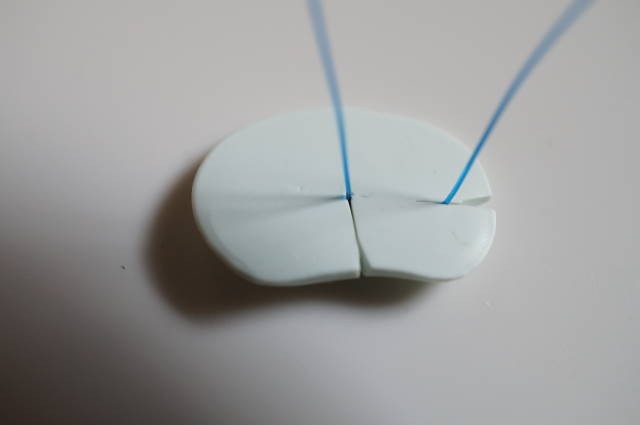
In an entry published in March 2018, Mr. Okada described leaving the chip out during sleep. He reported about half a year of daily glass-chip use without bleeding while allowing 8 hours of rest each day. He presented this as his own experience.
He also acknowledged that he lacked comparable experience with prolonged resin use. He suspected resin could need more time off because it moved less readily and might keep stimulating the same area. His general advice was to allow regular periods of rest.
(Source: ok-lab's diary, published March 2018)
https://ok-lab.hatenablog.com/entry/20180324/1521875816
Continuous chip use led Mr. Okada to distinguish glass from resin
In an entry published in March 2018, Mr. Okada described testing a resin receiving component (the hollow half of a separate-chip design). This part could also serve as a stopper. He reported discomfort after about 10 days of wear and paused for 1 day, without reporting bleeding.
In an entry published later that month, he favored glass when discussing prolonged wear. That preference did not eliminate his earlier report of bleeding with long glass chips that remained fixed in position. He advised limiting resin and the separate-chip receiving component to shorter sessions.
(Source: ok-lab's diary, published March 2018)
https://ok-lab.hatenablog.com/entry/20180324/1521875816
(Source: ok-lab's diary, published March 2018)
https://ok-lab.hatenablog.com/entry/20180331/1522485734
Written advice on chip breaks included time limits in July 2021
An entry published in July 2021 reproduced a draft instruction sheet that separated massage use from continuous wear. It listed 3 hours as the limit for massage use. For continuous wear, it specified a weekly interruption for inspection of the device and its thread.
The draft also specified at least 3 days off after bleeding and a doctor's consultation if bleeding continued. These were the maker's historical instructions; the draft explicitly said it did not guarantee effects. The same draft advised stopping promptly when discomfort differed from the person's usual experience.
(Source: ok-lab's diary, published July 2021)
https://ok-lab.hatenablog.com/entry/2021/07/24/125923
If you see blood in your urine, even a small amount or for the first time, do not wait and see. See a urologist right away.
If you suddenly cannot urinate, or the device cannot be removed, do not try to fix it yourself. Go to a medical facility, including emergency care, immediately.
How breaks between chip uses changed over time

| Published | What the diary said then |
|---|---|
| Apr 2018 | A customer's pain after prolonged wear led to breaks lasting about half a day. |
| Feb 2019 | A customer reported better positioning and stability after a 1–2-month break. |
| Nov 2019 | Mr. Okada paused because discomfort persisted after inflammation seemed to have cleared. |
| Feb 2022 | Chills prompted a 3-day pause; Mr. Okada said the diagnosis remained uncertain. |
| Aug 2022 | Unexplained fever halted Mr. Okada's tube testing after about 3 weeks of continuous wear. |
| Dec 2022 | A customer reported trouble-free use after a hospital visit and a 1-week break. |
| Oct 2023 | Mr. Okada paused use because he associated constant stimulation with frequent urination. |
| Dec 2025 | Mr. Okada stopped extension experiments after reporting fatigue and strain on the urethral lining. |
OK Prostate Chip products related to breaks between chip uses
The current list includes products involved in these reports of discomfort and interrupted use.
Products that appear in these entries
| Product (official name) | Price incl. tax | Relation to this topic |
|---|---|---|
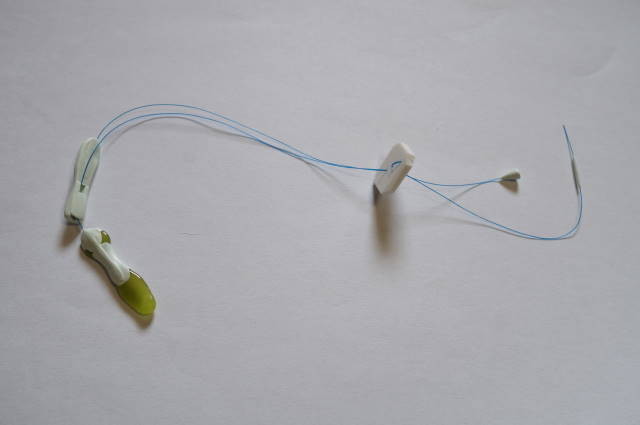
| Resin receiving component (OKプロステートチップ 樹脂素材セパレートタイプ♀チップ) | ¥2,750 (about $18 at ¥156 = $1, rate as of 2026-09-04) | In March 2018, Mr. Okada reported discomfort and a pause during his own test of this component. |
| Twisted semi-long ceramic chip (OKプロステートチップ 陶器素材セミロングタイプ コブラツイスト) | ¥5,500 (about $35 at ¥156 = $1, rate as of 2026-09-04) | In October 2020, a customer using this chip with a homemade stopper reported a blood clot and abnormal urine results. |
(Source: ok-lab's diary, published March 2018)
https://ok-lab.hatenablog.com/entry/20180324/1521875816
(Source: ok-lab's diary, published October 2020)
https://ok-lab.hatenablog.com/entry/2020/10/17/121023
Products the diary mentioned as alternatives
The diary names no alternative.
The June 2019 report concerns a triple-motor build. No matching product can be confirmed on the current list.
The staggered parallel test assembly appears in January 2025. No matching product can be confirmed on the current list.
Common worries about breaks between chip uses

Readers asked about urine control, abnormal tests, narrowing, and pain that returned after use.
"Can chip breaks reverse new problems holding urine?"
In an entry published in June 2019, a triple-motor-chip customer wondered whether further use would improve or worsen new urinary problems. They reported being able to resist an urge for only 10–20 seconds. They separately described about 14 days as their personal interval for renewed sensitivity.
Mr. Okada suggested that prolonged strain on a urine-control muscle might contribute to urinary trouble, explicitly presenting this as his inference. The diary does not record whether the customer's urine control improved. His reply raised prolonged stretching as a concern, without supplying a recovery interval.
(Source: ok-lab's diary, published June 2019)
https://ok-lab.hatenablog.com/entry/2019/06/08/144200
"Are chip breaks enough after an abnormal urine test?"
In an entry published in October 2020, a customer asked how long to rest before repeat urine testing. They had experienced a blood clot while using a twisted semi-long ceramic chip with a homemade stopper. A test 1 week later detected blood and white blood cells (reported in the urine test).
Mr. Okada said he could not judge the clot from previous experience and raised the possibility of another illness. He warned that infection-related results might require antibiotics (medicines used to treat infection), with rest alone potentially insufficient. He suggested consulting a urologist about the clot.
(Source: ok-lab's diary, published October 2020)
https://ok-lab.hatenablog.com/entry/2020/10/17/121023
"Will short chip breaks resolve increasing tightness?"
In an entry published in June 2022, a reader commented on an earlier customer's report that previously usable chips had become difficult to fit. The reader raised possible narrowing after injury, without establishing a diagnosis for that customer. Mr. Okada said 3 days or 1 week off did not seem enough to resolve the problem.
He was waiting for a report from the affected customer after a pause. The diary does not record whether that customer's symptoms improved. Mr. Okada also suggested seeing a doctor.
(Source: ok-lab's diary, published June 2022)
https://ok-lab.hatenablog.com/entry/2022/06/04/123036
"Will pain after chip use disappear with experience?"
In an entry published in July 2026, a customer asked whether painful urination after first use would disappear with experience. The pain lasted about 2–3 days, starting the following day. Mr. Okada considered pain lasting more than 1 day a sign of trouble, possibly injury or worsening pre-existing inflammation.
He also mentioned fit, compatibility with the chip, or another urinary problem as possible explanations for recurring episodes. The diary does not record whether this customer's pain recurred. He advised avoiding use during pain, stopping if subsequent use again caused days of pain, and considering a urologist.
(Source: ok-lab's diary, published July 2026)
https://ok-lab.hatenablog.com/entry/2026/07/25/123012
Buying from outside Japan

OK Lab ships internationally to countries covered by Japan Post's EMS courier service. Overseas orders are paid in advance by PayPal. Each order carries a ¥400 (about $3 at ¥156 = $1, rate as of 2026-09-04) handling fee, and EMS shipping is charged on top. These terms come from OK Lab's official sales-terms page (written here as plain text, not a link: ok-lab.net/docs/law), checked on September 7, 2026; confirm them on the official store before you order, because they can change.
Summary of this article
| What you wanted to know | The answer |
|---|---|
| In short: Is there one rest period? | The diary describes different pauses for different problems. |
| About this product: Who makes it? | OK Lab in Japan makes the urethral device; prices are in Japanese yen. |
| Key terms: What is being rested? | The accounts concern the urine passage and muscles involved in controlling urine flow. |
| What happens: Why do people pause? | Reported reasons include discomfort, bleeding, inflammation, and urinary changes. |
| The maker's answer: What did he propose? | Routine breaks, shorter wear for some materials, and stopping after unusual symptoms. |
| Changes over time: Did every break have the same result? | Some accounts reported improvement; others left the cause or outcome unresolved. |
| Related products: What do the listed examples cost? | The resin receiving component is ¥2,750 (about $18 at ¥156 = $1, rate as of 2026-09-04); the twisted semi-long ceramic chip is ¥5,500, (about $35 at ¥156 = $1, rate as of 2026-09-04) including tax. |
| Common worries: Is waiting always enough? | The maker raised cases where medical assessment or treatment might be needed. |
| Buying abroad: What are the stated terms? | Advance PayPal payment, EMS shipping, and a ¥400 (about $3 at ¥156 = $1, rate as of 2026-09-04) handling fee. |
Source: ok-lab's diary (Okada Comfortable Life Laboratory). The original entries are in Japanese; quotations on this page are translated. Photos and videos are on the original entries.
This article is a summary of the maker's development diary. The product is not a medical device and no result is guaranteed. If anything feels wrong or worries you, see a doctor. Prices, specifications and cautions change, so confirm the latest information on the official blog and the official site. Questions about ordering and shipping go to the seller.