![Can I leave a prostate chip in for a week? | No guaranteed safe duration [OK Prostate Chip]](/img/a/T0161/eyecatch.svg)
This page is based on entries from "ok-lab's diary" (https://ok-lab.hatenablog.com/), the Japanese development diary written by Mr. Okada, founder of OK Lab, a small company in Japan (Okada Comfortable Life Laboratory). Only the entries about "leaving a prostate chip in for a week or longer" are summarized here, in order of publication. Past prices and sizes are as written at the time. Current prices come from the official product list (retrieved September 4, 2026). Quotations are translated from Japanese.
Note: This page is a personal reading log by someone with no connection to the maker or the seller. It reflects the source entries as of their publication dates and makes no guarantee of accuracy or safety. The product is not a medical device; talk to a doctor about any health decision. Check the official site for current information. This page contains advertising.
In short
The diary reports comfortable extended wear alongside failures, including cracks, broken cables, and a stuck chip.
Mr. Okada gives no scientifically guaranteed duration; his May 2021 benchmark was about one week.
Related products remain listed, but the current list does not confirm the later wire-loop prototypes.
If you see blood in your urine, even a small amount or for the first time, do not wait and see. See a urologist right away.
If you suddenly cannot urinate, or the device cannot be removed, do not try to fix it yourself. Go to a medical facility, including emergency care, immediately.
About this product
The OK Prostate Chip is a small device that is placed in the urethra (the urine passage) so that it acts on the prostate; the maker sells it in several shapes, sizes and materials. It is made and sold by OK Lab (Okada Comfortable Life Laboratory), a small company in Japan, through its own online store, and prices are in Japanese yen (JPY). The maker's development diary, "ok-lab's diary", is written in Japanese. This page is an English summary of it, and every quotation is translated. OK Lab ships internationally, so readers outside Japan can order (see "Buying from outside Japan" below). Product names on this page are plain-English descriptions. The official Japanese product name is shown once in the product table so you can find the same item in the store.
Before you read: key terms
| Term | Plain-English meaning |
|---|---|
| Urethra | The urine passage; the device occupies part of it to act on the prostate. |
| Continuous wear | Leaving a device in place without breaks, to maintain its position and stimulation. |
| Retrieval thread | Thread attached to a device to help retrieve it. |
| Sphincter | A closing muscle around the urine passage; the maker uses nearby chip contours to help hold position. |
| Chipless design | Wire covered with tubing, formed into loops instead of a solid chip, to provide flexible support and stimulation. |
| Bladder loop | A loop extending into the bladder, intended to provide stimulation there. |
| Nitinol | Shape-memory metal thread used to provide flexible support in later devices. |
| Mesh stopper | An added barrier intended to restrict movement toward the bladder. |
What happens: leaving a prostate chip in
The OK Prostate Chip is a small device placed in the urethra to act on the prostate. Continuous wear means leaving it there between daily activities, sometimes including sleep, rather than limiting it to a single session. These entries discuss keeping the device near the prostate for sustained stimulation, with designs intended to resist movement during urination. They record individual experiences with solid chips and later flexible loops, including failures after apparently stable wear.
Continuous prostate chip use exposed glass cracking after about one week
An entry published in September 2018 reports a customer's glass chip developing a crack after about one week inside. A surface offset of about 0.2mm reportedly caused shallow scratches inside the urethra, without bleeding. The customer described improving discomfort after changing devices.
Mr. Okada said there was no certain way to prevent glass from cracking unexpectedly. His advice was inspection before every use and avoiding any chip with a crack.
(Source: ok-lab's diary, published September 2018)
https://ok-lab.hatenablog.com/entry/20180922/1537592180
Continuous prostate chip use ended in cable failure after three months
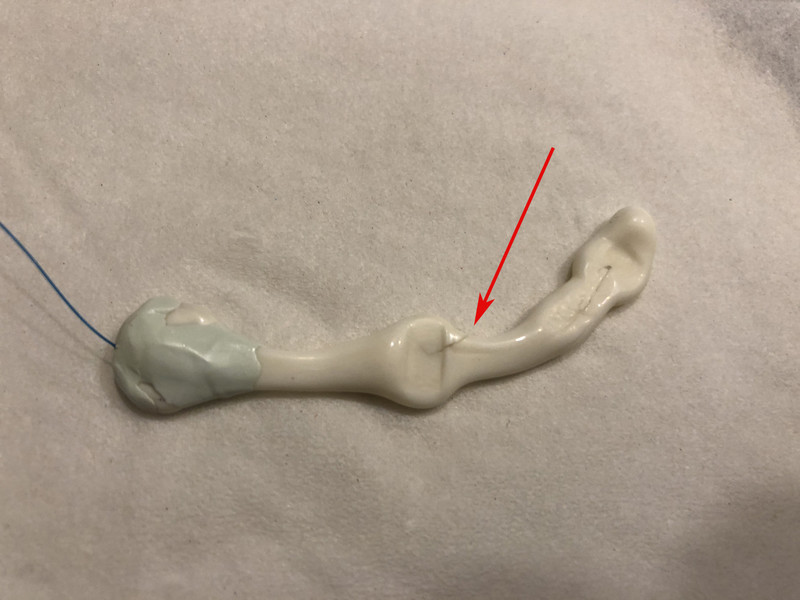
An entry published in April 2023 describes a customer's jointed device with parallel cable failing after 3 months of daily, fully internal wear. The break was about 5cm from the rear, where the assembly bent approximately 90 degrees.
He attributed the failure to strain at the bend, compounded by this customer's thicker custom construction and restrained movement. The customer requested another device; the diary does not record whether that replacement was completed.
(Source: ok-lab's diary, published April 2023)
https://ok-lab.hatenablog.com/entry/2023/04/29/123107
Continuous prostate chip use left deposits with M but not L
An entry published in May 2023 describes a customer investigating hard urinary deposits on a flat curved chip. The M size developed deposits within 3 days, while the L size remained clean after 10 days. The customer also reported smoother urination with L.
The customer suspected the shorter device had caused urine to remain around it. Mr. Okada considered that explanation possible, while noting that urine composition could also matter. Mr. Okada raised fit as a possible explanation, not a confirmed cause.
(Source: ok-lab's diary, published May 2023)
https://ok-lab.hatenablog.com/entry/2023/05/06/123024
Continuous prostate chip use felt different with the correct tube
In November 2024, Mr. Okada attributed prickling during chipless wear (covered wire loops replacing a solid chip) to old tubing with a 2mm outer diameter. With the specified 2.5mm tubing, he reported no prickling and almost no discomfort from the outset.
His earlier test lasting about 10 days had also used the thicker tubing. The specified construction used 0.3mm wire and had a published price of ¥6,000, (about $38 at ¥156 = $1, rate as of 2026-09-04) tax excluded, in November 2024.
(Source: ok-lab's diary, published November 2024)
https://ok-lab.hatenablog.com/entry/2024/11/30/122919
(Source: ok-lab's diary, published November 2024)
https://ok-lab.hatenablog.com/entry/2024/11/23/123015
Overnight prostate chip use exposed a broken wire's lost support
In an entry published in December 2024, Mr. Okada describes testing a deliberately broken chipless prototype overnight. It initially stayed in place without continuing discomfort. During urination the next morning, however, it slipped out.
He attributed this to the broken wire's inability to maintain the device's bend under urine pressure. He abandoned further wear of that broken test device.
(Source: ok-lab's diary, published December 2024)
https://ok-lab.hatenablog.com/entry/2024/12/14/122948
Continuous prostate chip use proved uncomfortable with excessive bladder reach
An entry published in December 2024 describes Mr. Okada testing a prototype prompted by a customer's custom request. About 8cm extended into his bladder; strong urinary urgency led him to abandon the test after 5 hours. Mild pain persisted for about 1 hour afterward.
He subsequently chose a more flexible connection for the bladder loop (the loop intended to sit inside the bladder). The customer's final specifications remained unresolved in that entry. Mr. Okada cautioned that the requested design could be difficult to tolerate for several days.
(Source: ok-lab's diary, published December 2024)
https://ok-lab.hatenablog.com/entry/2024/12/21/122903
Overnight prostate chip use brought reservations about thicker metal thread
An entry published in October 2025 discusses a bristled design using nitinol (shape-memory metal thread). Mr. Okada found 0.15mm thread too demanding for more than half a day or for sleeping. He believed 0.1mm thread could permit almost permanent wear.
The diary does not record a completed lifetime test. His recommendation reserved the thicker thread for stronger stimulation or for people who did not want prolonged continuous wear.
(Source: ok-lab's diary, published October 2025)
https://ok-lab.hatenablog.com/entry/2025/10/18/122911
The maker's answer to leaving a prostate chip in
Mr. Okada's replies address specific designs and failures, without establishing a scientifically guaranteed period of continuous wear.
Continuous prostate chip use without external thread carried a specific warning
In an entry published in January 2021, Mr. Okada reports a week testing an entirely internal assembly. He described its auxiliary piece returning to a position 3cm from the leading chip during urination. His proposed safeguards included an extended retrieval thread (thread attached to help retrieve the device).
He recommended keeping that safeguard until reliable retention was established. He advised against fully internal wear for people whose devices readily slipped into the bladder.
(Source: ok-lab's diary, published January 2021)
https://ok-lab.hatenablog.com/entry/2021/01/16/124800
Continuous prostate chip use had no scientifically guaranteed duration
An entry published in May 2021 answers a customer hoping for one month of uninterrupted wear without pain, bleeding, or other abnormalities. Mr. Okada described about one week as his own upper limit before a break. He said the existing construction lacked scientific assurance for prolonged residence inside the body.
His concern included the resin used at thread connections, which he said was not recognized as suitable for that purpose. The diary does not record whether this customer attempted a month. Mr. Okada left duration to individual judgment and responsibility rather than offering a guaranteed limit.
(Source: ok-lab's diary, published May 2021)
https://ok-lab.hatenablog.com/entry/2021/05/01/130245
Continuous prostate chip use prompted a plan for two supporting wires
An entry published in March 2025 says 4 customers had reported chipless wire breakage. Mr. Okada acknowledged that changing how the wire was formed could not guarantee it would never break. He announced a move toward two wires, intended to preserve the shape if one failed.
This was a response to failure reports, not a recorded guarantee that both wires could never break. His proposed safeguard included replacement after one wire failed.
(Source: ok-lab's diary, published March 2025)
https://ok-lab.hatenablog.com/entry/2025/03/08/123016
A chip stuck after thread failure remained unresolved in March 2026
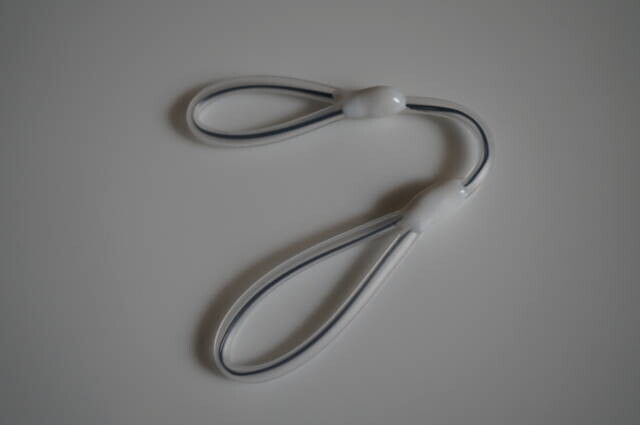
An entry published in March 2026 reports a blue resin chip remaining near the prostate after its thread broke. Mr. Okada speculated that its shape was holding it between closing muscles. He initially suggested that remaining there might not be a problem, mentioning medical consultation if it persisted for months.
The diary does not record how the chip was recovered. That delayed-consultation suggestion was the maker's response; the immediate safety guidance below applies to a device that cannot be removed.
(Source: ok-lab's diary, published March 2026)
https://ok-lab.hatenablog.com/entry/2026/03/28/122908
If you see blood in your urine, even a small amount or for the first time, do not wait and see. See a urologist right away.
If you suddenly cannot urinate, or the device cannot be removed, do not try to fix it yourself. Go to a medical facility, including emergency care, immediately.
How leaving a prostate chip in changed over time
| Published | What the diary said then |
|---|---|
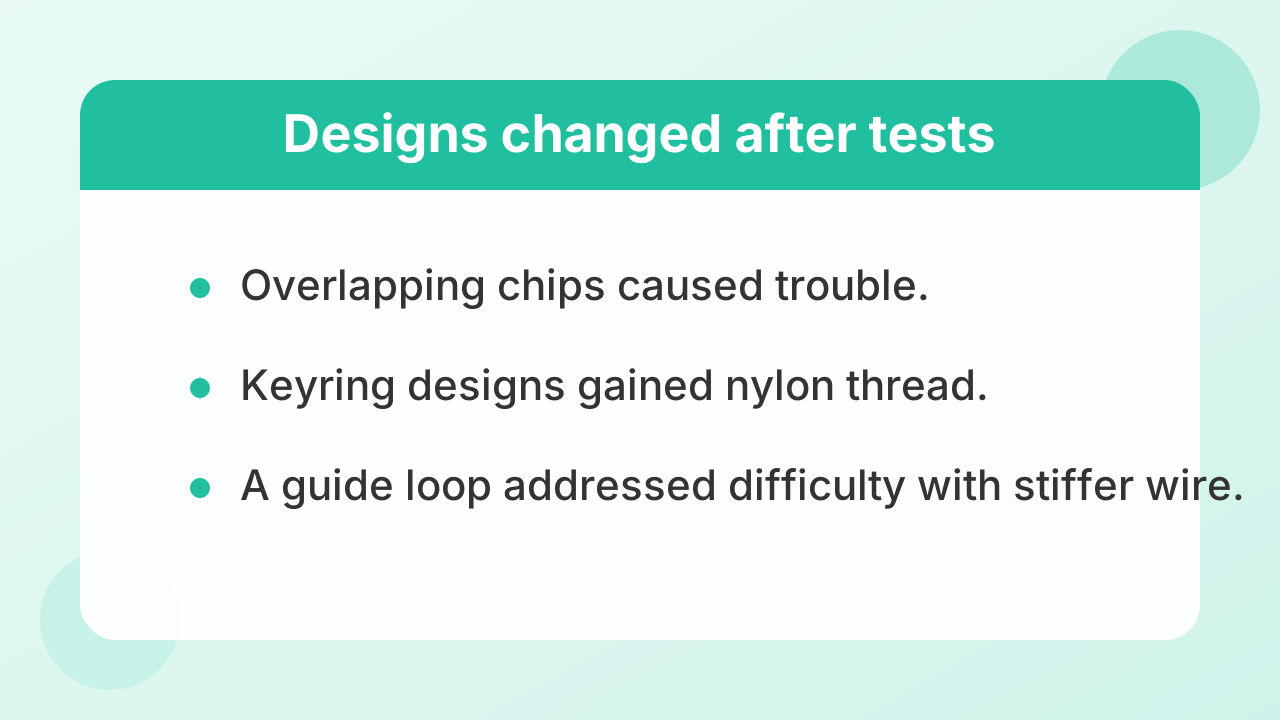
| Oct 2017 | Mr. Okada proposed week-long wear with an entirely internal design. |
| Jul 2018 | His screw-shaped resin test reportedly avoided earlier problems with flat resin surfaces. |
| Oct 2020 | He recalled withdrawing an earlier linked-glass design after overlapping chips caused trouble. |
| Jan 2021 | He clarified that permanent integration with tissue was a dream, not an observed outcome. |
| May 2021 | A different resin prototype reportedly remained comfortable for nearly two weeks. |
| Aug 2024 | Keyring designs gained nylon thread extending from the loop tip. |
| Jan 2025 | A ceramic-centered prototype shifted outward, unlike the all-loop comparison. |
| Feb 2025 | A guide loop addressed difficulty with the stiffer wire model. |
OK Prostate Chip products related to leaving a prostate chip in
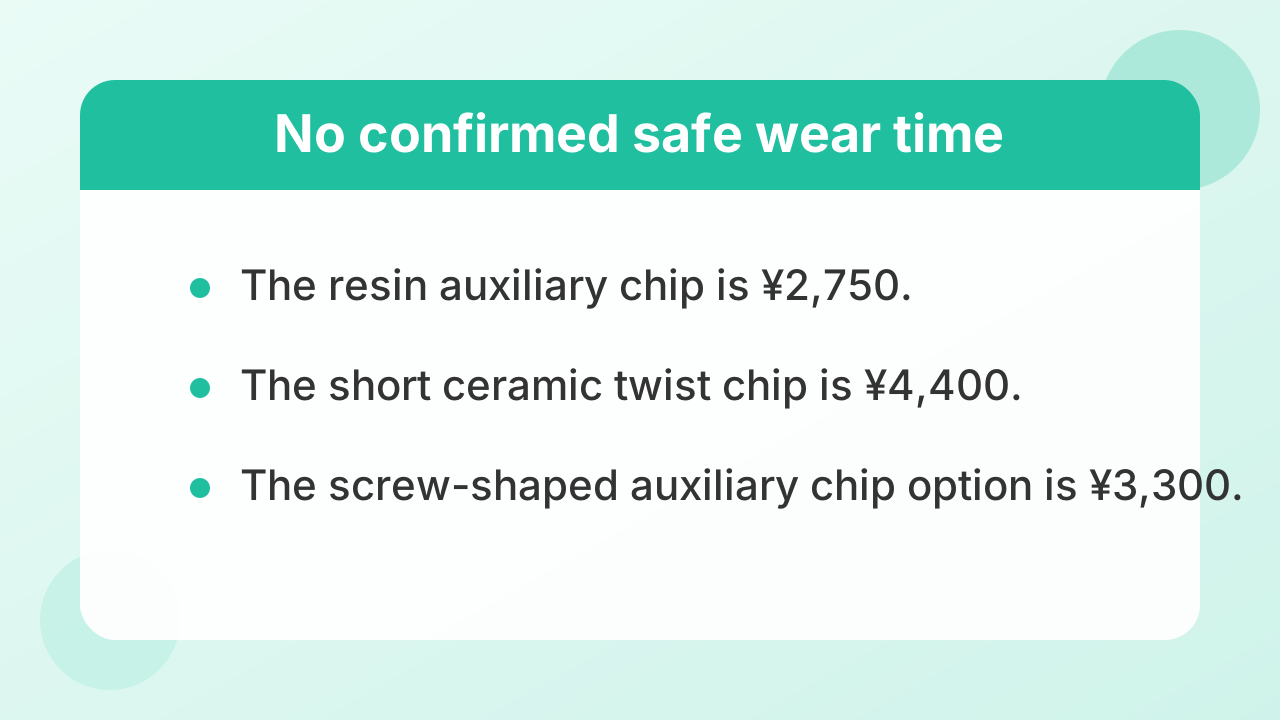
The current list contains products discussed in duration questions, but listing them does not establish a safe wear time.
Products that appear in these entries
| Product (official name) | Price incl. tax | Relation to this topic |
|---|---|---|
| Resin auxiliary chip (OKプロステートチップ 樹脂素材セパレートタイプ♀チップ) | ¥2,750 (about $18 at ¥156 = $1, rate as of 2026-09-04) | In February 2020, a customer proposed extended wear with this chip and asked about duration. |
| Short ceramic twist chip (OKプロステートチップ 陶器素材ショートタイプ ツイスト) | ¥4,400 (about $28 at ¥156 = $1, rate as of 2026-09-04) | In September 2020, its customer asked what the diary meant by long periods of wear. |
| Screw-shaped auxiliary chip option (スクリュー型補助チップ追加オプション) | ¥3,300 (about $21 at ¥156 = $1, rate as of 2026-09-04) | In September 2020, this attachment accompanied the ceramic twist chip in that customer's duration question. |
(Source: ok-lab's diary, published February 2020)
https://ok-lab.hatenablog.com/entry/2020/02/29/155031
(Source: ok-lab's diary, published September 2020)
https://ok-lab.hatenablog.com/entry/2020/09/19/123115
Products the diary mentioned as alternatives
| Product (official name) | Price incl. tax | Relation to this topic |
|---|---|---|
| Nylon thread with loops at both ends (両端ループナイロン糸) | ¥550 (about $4 at ¥156 = $1, rate as of 2026-09-04) | In January 2021, Mr. Okada recommended this extension as a safeguard before fully internal wear without an external thread. |
(Source: ok-lab's diary, published January 2021)
https://ok-lab.hatenablog.com/entry/2021/01/16/124800
Historical glass, jointed, flat curved, chipless, bristled, titanium, and blue resin versions: No matching product can be confirmed on the current list.
Common worries about leaving a prostate chip in
The replies distinguish material, spacing, and movement; none supplies a universal wear schedule.
"Is continuous prostate chip use different with resin?"
An entry published in February 2020 records a customer proposing 6–24 hours with the resin auxiliary chip. Mr. Okada did not recommend 24-hour continuous resin use. He nevertheless allowed individual judgment when there was no discomfort, citing reports of longer wear.
In his own resin prototype tests, he described discomfort after about 10 hours without vibration. The diary does not record successful extended use of the ordered resin auxiliary chip. For ceramic and glass, he thought there was no fixed limit, but favored roughly daily condition checks.
(Source: ok-lab's diary, published February 2020)
https://ok-lab.hatenablog.com/entry/2020/02/29/155031
"Can tight spacing limit continuous prostate chip use?"
An entry published in June 2021 describes a customer wanting several days of wear with a short ceramic twist chip and screw-shaped auxiliary piece. The customer instead reported muscle pain after about 3 hours. Mr. Okada thought the 0mm gap could pinch the sphincter (the closing muscle) too strongly, limiting this arrangement to a few hours.
He contrasted this with his titanium prototype, whose 2mm narrowing felt comfortable for nearly one week. The diary does not record whether a different configuration resolved this customer's pain. His advice distinguished comfortable extended wear from the pursuit of stronger stimulation.
(Source: ok-lab's diary, published June 2021)
https://ok-lab.hatenablog.com/entry/2021/06/26/125926
"Does a bend prevent movement during continuous prostate chip use?"
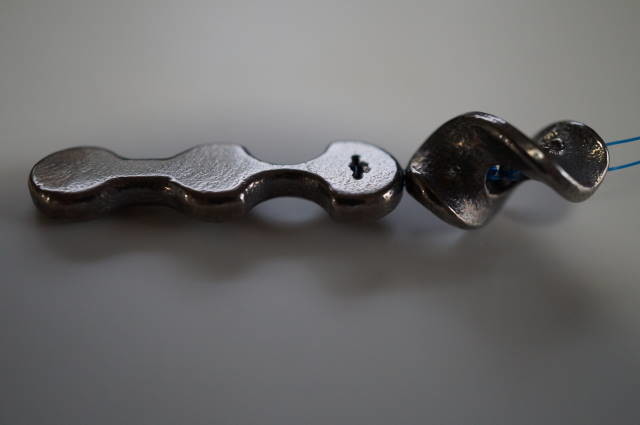
An entry published in December 2024 records a customer asking whether a 90-degree bend made a stopper unnecessary. Mr. Okada said no angle guaranteed safety; even a 120-degree bend could straighten under modest force. He thought a mesh stopper (an added barrier against inward movement) could prevent excessive travel toward the bladder.
He still offered no guarantee against the device coming out. The diary does not record the customer's final choice. His reservation was that the stopper would sacrifice the chipless device's gentler feel.
(Source: ok-lab's diary, published December 2024)
https://ok-lab.hatenablog.com/entry/2024/12/14/122948
Buying from outside Japan
OK Lab ships internationally to countries covered by Japan Post's EMS courier service. Overseas orders are paid in advance by PayPal. Each order carries a ¥400 (about $3 at ¥156 = $1, rate as of 2026-09-04) handling fee, and EMS shipping is charged on top. These terms come from OK Lab's official sales-terms page (written here as plain text, not a link: ok-lab.net/docs/law), checked on September 7, 2026; confirm them on the official store before you order, because they can change.
Summary of this article
| What you wanted to know | The answer |
|---|---|
| In short: is a week assured? | No scientifically guaranteed duration is established in these entries. |
| About this product: what is it? | A urethral device made by OK Lab in Japan, sold in Japanese yen. |
| Key terms: what does continuous wear mean? | Leaving the device in place without breaks. |
| What happens during extended wear? | Reports include comfort, deposits, structural failures, and unresolved retention. |
| What is the maker's answer? | His replies vary by construction and include safeguards and substantial reservations. |
| What changed over time? | Shapes, materials, and supporting structures changed in response to tests and problems. |
| Which current products relate? | The tables identify listed chips and parts discussed in duration questions. |
| What do common questions reveal? | Material, fit, and movement affected the maker's answers. |
| How does overseas buying work? | Advance PayPal payment, a handling fee, and additional EMS shipping. |
Source: ok-lab's diary (Okada Comfortable Life Laboratory). The original entries are in Japanese; quotations on this page are translated. Photos and videos are on the original entries.
This article is a summary of the maker's development diary. The product is not a medical device and no result is guaranteed. If anything feels wrong or worries you, see a doctor. Prices, specifications and cautions change, so confirm the latest information on the official blog and the official site. Questions about ordering and shipping go to the seller.