![How long can a prostate chip stay in? | No single safe time is established [OK Prostate Chip]](/img/a/T0160/eyecatch.svg)
This page is based on entries from "ok-lab's diary" (https://ok-lab.hatenablog.com/), the Japanese development diary written by Mr. Okada, founder of OK Lab, a small company in Japan, formally named Okada Comfortable Life Laboratory. Only the entries about "prostate chip wear time" are summarized here, in order of publication. Past prices and sizes are as written at the time. Current prices come from the official product list (retrieved September 4, 2026). Quotations are translated from Japanese.
Note: This page is a personal reading log by someone with no connection to the maker or the seller. It reflects the source entries as of their publication dates and makes no guarantee of accuracy or safety. The product is not a medical device; talk to a doctor about any health decision. Check the official site for current information. This page contains advertising.
In short
- The diary reports problems during prolonged wear and does not establish one safe time for everyone.
- The maker’s July 2021 draft suggested three hours or less for prostate massage.
- Later designs still carried specific cautions about overnight use, prolonged wear, and where pressure falls.
If you see blood in your urine, even a small amount or for the first time, do not wait and see. See a urologist right away. If you suddenly cannot urinate, or the device cannot be removed, do not try to fix it yourself. Go to a medical facility, including emergency care, immediately.
About this product
The OK Prostate Chip is a small device that is placed in the urethra (the urine passage) so that it acts on the prostate; the maker sells it in several shapes, sizes and materials. It is made and sold by OK Lab (Okada Comfortable Life Laboratory), a small company in Japan, through its own online store, and prices are in Japanese yen (JPY). The maker's development diary, "ok-lab's diary", is written in Japanese. This page is an English summary of it, and every quotation is translated. OK Lab ships internationally, so readers outside Japan can order (see "Buying from outside Japan" below). Product names on this page are plain-English descriptions. The official Japanese product name is shown once in the product table so you can find the same item in the store.
Before you read: key terms
| Term | Plain-English meaning |
|---|---|
| Urethra | The urine passage; the chip occupies part of this passage for the maker’s intended prostate stimulation. |
| Sphincter | A muscle surrounding the passage; the diary describes its grip as helping hold certain chips in place. |
| Bulbar urethra | A wider section outside the sphincter, accommodating supporting parts in the designs described. |
| Epoxy | Resin used to attach the retrieval thread to a chip. |
| Biocompatible material | Material the maker describes as suitable for continued bodily contact; this concerns material suitability, not a proven wear time. |
What happens: prostate chip wear time
The OK Prostate Chip is a small device placed in the urethra, intended by the maker to stimulate the prostate internally. Wear time means how long it remains there during a session or across ordinary daily activities. The diary discusses both brief prostate stimulation and longer periods with the chip left inside the urine passage. Its accounts connect those periods with shape, material, and pressure around the prostate and nearby muscle.
Long-term wear brought an injury report despite the maker’s earlier experience
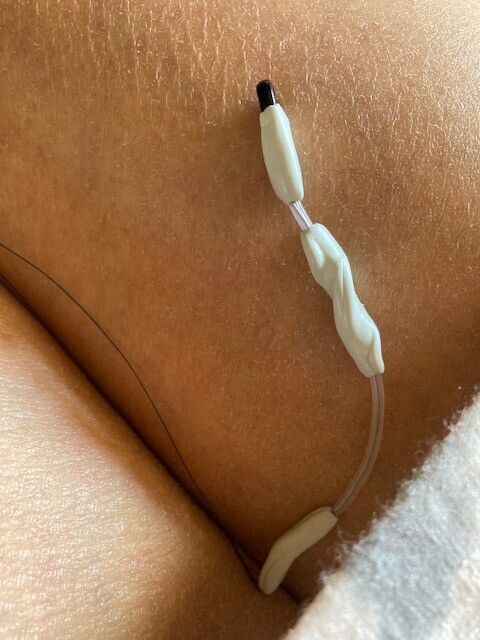
In an entry published in December 2017, Mr. Okada relayed a tester’s report of muscle injury with the long chip. The tester had maintained 24-hour continuous wear, with trouble appearing after several days. Mr. Okada’s own roughly week-long trial had included nights without the chip.
He suspected excessive force on the sphincter (a muscle surrounding the urine passage), particularly when the long chip shifted. The diary does not record the tester’s recovery. Mr. Okada consequently restricted that long design to short sessions.
(Source: ok-lab's diary, published December 2017)
https://ok-lab.hatenablog.com/entry/20171231/1514712104
January 2018 advice ruled out 24-hour use of long chips
An entry published in January 2018 reported trouble associated with prolonged use of long chips after sales began. It did not describe those reports closely enough to establish individual injuries or recovery outcomes. Mr. Okada’s published boundary was explicit: he advised against continuous wear lasting 1 day or longer.
(Source: ok-lab's diary, published January 2018)
https://ok-lab.hatenablog.com/entry/20180130/1517311002
Sharply narrowed semi-long chips received a half-day limit for long-term wear
In an entry published in May 2018, a customer wanted a glass semi-long chip to remain in position more reliably. Mr. Okada described glass as more slippery than resin and discussed a sharply narrowed waist as one way a design could resist slipping.
He also said that shape placed excessive strain on the sphincter during extended wear. The diary does not record whether this customer obtained that variant or how it felt. Mr. Okada’s estimated limit for the sharply narrowed design was about half a day of continuous wear.
(Source: ok-lab's diary, published May 2018)
https://ok-lab.hatenablog.com/entry/20180519/1526708081
A beginner’s prolonged wear question received reassurance without an hourly limit
In an entry published in January 2020, a first-time buyer asked about extended wear of the ceramic semi-long chip with a curved end. Mr. Okada considered that choice comparatively stable and thought its small size would impose relatively little strain.
The customer subsequently confirmed payment, but the diary does not record their experience using the purchased chip. His reply supported that initial choice without specifying a maximum number of hours or guaranteeing freedom from pain.
(Source: ok-lab's diary, published January 2020)
https://ok-lab.hatenablog.com/entry/2020/01/25/150127
Resin and ceramic drew different prostate chip wear time answers
In an entry published in February 2020, a customer asked about 6–24 hours with the separate resin support chip. Mr. Okada discouraged 24-hour resin use while acknowledging a report of one week with a resin screw-shaped chip. The diary does not record how the ordered resin chip felt in use.
The customer then asked whether ceramic or glass changed the answer. Mr. Okada said he thought those materials had no time limit, without establishing a clinically supported maximum. His accompanying advice was a break for a condition check about once a day.
(Source: ok-lab's diary, published February 2020)
https://ok-lab.hatenablog.com/entry/2020/02/29/155031
Overnight use remained outside the maker’s comfort zone for his bladder-stimulating design
In an entry published in May 2024, Mr. Okada discussed his bladder-stimulating design, nicknamed Prostate Alien. His initial sessions lasted a few hours, followed later by longer trials. He described substantial physical demands and said he still did not fully understand the experience.
He had not felt comfortable testing it during sleep. Mr. Okada advised against overnight or multi-day wear until a user felt sufficiently familiar and confident, without providing a validated threshold.
(Source: ok-lab's diary, published May 2024)
https://ok-lab.hatenablog.com/entry/2024/05/18/122913
Stronger fixation did not make overnight use comfortable for the maker
An entry published in August 2024 described Mr. Okada’s lock-on cable arrangement with 16-hour wear and nights without the chip. Across one week, he reported unchanged positioning and a daily condition check. The entry also records relocating the safety thread to the loop tip before shipment following concerns about inward movement.
He associated placement of the whole chip beyond the sphincter with greater strain on the bulbar urethra (the wider passage outside that muscle). Mr. Okada favored the design’s intended resting position for prolonged wear, rather than that deeper arrangement.
(Source: ok-lab's diary, published August 2024)
https://ok-lab.hatenablog.com/entry/2024/08/31/122909
Later thin-wire trials left long-term wear uncertain despite their small dimensions
In an entry published in May 2026, Mr. Okada described a prototype combining 0.075mm and 0.05mm wire. He reported fatigue after several hours in the penile portion of the urine passage. He had not tested extended wear at the sphincter or prostate because the stimulation concerned him.
Product development remained conditional on further trials, and the entry does not establish a finished product’s wear limit. Mr. Okada contemplated offering the design only for short sessions if his further testing revealed no problems.
(Source: ok-lab's diary, published May 2026)
https://ok-lab.hatenablog.com/entry/2026/05/02/122917
The maker's answer to prostate chip wear time
The maker distinguished purpose, material, and shape, while acknowledging limits to what his experience could establish.
Prostate chip wear time guidance specified three hours for massage
In an entry published in July 2021, Mr. Okada presented a draft manual recommending 3 hours or less for prostate massage. Its separate discussion of multi-day wear applied only to chips made from biocompatible material (material described as suitable for continued bodily contact).
The draft did not guarantee the stated effects or benefits. Even within its multi-day category, the manual called for a chip and thread condition check once a week.
(Source: ok-lab's diary, published July 2021)
https://ok-lab.hatenablog.com/entry/2021/07/24/125923
Bleeding interrupted the draft manual’s prostate chip wear time schedule
The draft in the entry published in July 2021 specified at least 3 days without use after bleeding. It also called for medical consultation if bleeding continued, recognizing possible causes other than the chip.
The entry supplied no clinical evidence establishing a safe waiting period. The draft also advised stopping use when unusual discomfort appeared.
(Source: ok-lab's diary, published July 2021)
https://ok-lab.hatenablog.com/entry/2021/07/24/125923
Longer prostate chip wear time drew smaller-size advice after bleeding
In an entry published in May 2022, a customer reported 5–10 drops of blood after longer chips, with almost no pain. They reported no bleeding after changing to a semi-long chip; the diary records no subsequent medical assessment. Mr. Okada described larger chips as short-session choices and smaller chips as longer-use choices.
For 1 day or longer, his personal range stopped around semi-long M or the smaller variant nicknamed Apocalypse B. He suspected bladder bleeding might not resolve through familiarity, but did not establish where this customer’s bleeding originated. Mr. Okada advised medical assessment if bleeding continued.
(Source: ok-lab's diary, published May 2022)
https://ok-lab.hatenablog.com/entry/2022/05/14/123043
If you see blood in your urine, even a small amount or for the first time, do not wait and see. See a urologist right away. If you suddenly cannot urinate, or the device cannot be removed, do not try to fix it yourself. Go to a medical facility, including emergency care, immediately.
How prostate chip wear time changed over time
| Published | What the diary said then |
|---|---|
| Dec 2017 | A tester reported sphincter injury after several days of uninterrupted long-chip wear. |
| Jan 2018 | Long-chip advice explicitly excluded continuous wear lasting a day or longer. |
| May 2018 | A sharply narrowed semi-long design received a half-day estimate. |
| Aug 2019 | Mr. Okada supported overnight use in principle and smaller sizes for longer wear. |
| Feb 2020 | Resin reservations accompanied ceramic and glass advice involving daily checks. |
| May 2021 | Epoxy connections prompted an explicit admission that continuous-use duration lacked scientific assurance. |
| Jul 2021 | The draft distinguished brief massage from multi-day wear limited to biocompatible materials. |
| May 2022 | A bleeding discussion added personal size limits and a call for medical assessment. |
| May 2024 | The bladder-stimulating design brought renewed caution about sleeping and multi-day wear. |
| May 2026 | Thin-wire prototypes remained conditional short-session prospects following fatigue during testing. |
OK Prostate Chip products related to prostate chip wear time
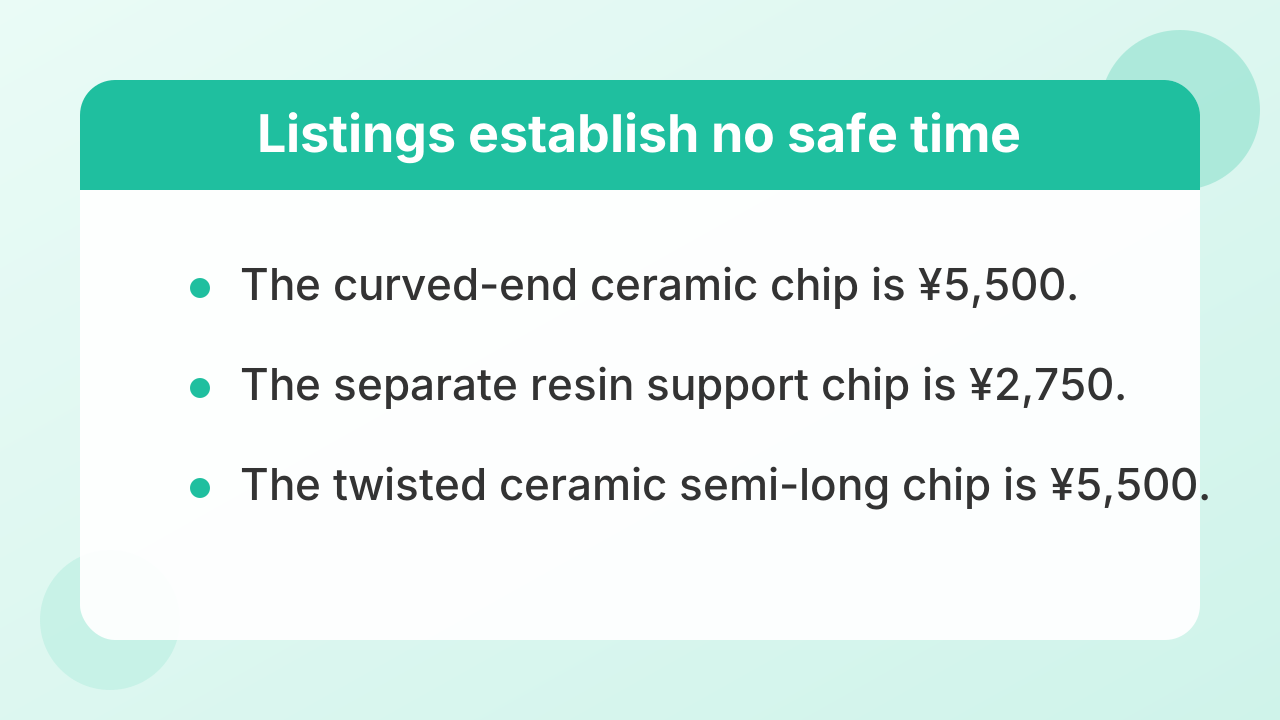
These current listings appear in duration-related questions; their inclusion does not establish a safe wear time.
Products that appear in these entries
| Product (official name) | Price incl. tax | Relation to this topic |
|---|---|---|
| Ceramic semi-long chip with a curved end (OKプロステートチップ 陶器素材セミロング勾玉タイプ) | ¥5,500 (about $35 at ¥156 = $1, rate as of 2026-09-04) | A January 2020 beginner asked about prolonged wear, received size-specific reassurance, and subsequently confirmed payment. |
| Separate resin support chip (OKプロステートチップ 樹脂素材セパレートタイプ♀チップ) | ¥2,750 (about $18 at ¥156 = $1, rate as of 2026-09-04) | A February 2020 question about prolonged use prompted Mr. Okada’s reservation about continuous resin wear. |
| Twisted ceramic semi-long chip (OKプロステートチップ 陶器素材セミロングタイプ コブラツイスト) | ¥5,500 (about $35 at ¥156 = $1, rate as of 2026-09-04) | A February 2020 customer ordered this model while asking about several days of continuous wear. |
(Source: ok-lab's diary, published January 2020)
https://ok-lab.hatenablog.com/entry/2020/01/25/150127
(Source: ok-lab's diary, published February 2020)
https://ok-lab.hatenablog.com/entry/2020/02/29/155031
(Source: ok-lab's diary, published February 2020)
https://ok-lab.hatenablog.com/entry/2020/02/15/144151
Products the diary mentioned as alternatives
The diary names no alternative.
Historical long chips, the custom narrowed design, Apocalypse B, Prostate Alien, and experimental builds: No matching product can be confirmed on the current list.
Common worries about prostate chip wear time
The questions distinguish sleeping, several days, and a full month; the replies do not establish universally safe limits.
"Is overnight use acceptable if the chip feels comfortable?"

In an entry published in August 2019, a customer said their ceramic chip disturbed sleep during a nap. They wondered whether overnight wear should be avoided altogether or whether a suitable size could remain for a week. Mr. Okada said he personally slept without a chip.
He expressed the view that overnight wear was acceptable for other users, without supplying clinical evidence. The diary does not record whether this customer’s sleep improved. Mr. Okada suggested larger chips for brief sessions and smaller ones for longer wear.
(Source: ok-lab's diary, published August 2019)
https://ok-lab.hatenablog.com/entry/2019/08/24/125858
"What about prostate chip wear time over several days?"
An entry published in February 2020 recorded a customer’s wish for 2–3 days of wear, with fairly strong stimulation. They were considering the twisted ceramic semi-long chip, and Mr. Okada tentatively supported an M size. The customer placed an order, then asked about other choices and revised a request concerning stopper size.
Mr. Okada said he could not name a best shape because preferences and individual fit varied. The diary does not record how the purchased chip felt during prolonged wear. His suggested measure was a separate stopper accessory to address unintended movement toward the bladder.
(Source: ok-lab's diary, published February 2020)
https://ok-lab.hatenablog.com/entry/2020/02/15/144151
"Can prostate chip wear time reach a month without symptoms?"
In an entry published in May 2021, a customer wanted roughly 1 month of uninterrupted wear if no pain, bleeding, or abnormalities appeared. Mr. Okada identified epoxy (the resin attaching the retrieval thread) as a limitation: it was not recognized as biocompatible resin. He explicitly said continuous-wear duration therefore had no scientific guarantee.
The diary does not record a month-long outcome for this customer. Titanium and alternative resin development were still being discussed as ways to address material concerns. Mr. Okada’s own stated upper boundary was about one week, followed by a break.
(Source: ok-lab's diary, published May 2021)
https://ok-lab.hatenablog.com/entry/2021/05/01/130245
Buying from outside Japan
OK Lab ships internationally to countries covered by Japan Post's EMS courier service. Overseas orders are paid in advance by PayPal. Each order carries a ¥400 (about $3 at ¥156 = $1, rate as of 2026-09-04) handling fee, and EMS shipping is charged on top. These terms come from OK Lab's official sales-terms page (written here as plain text, not a link: ok-lab.net/docs/law), checked on September 7, 2026; confirm them on the official store before you order, because they can change.
Summary of this article
| What you wanted to know | The answer |
|---|---|
| What is the short answer? | The diary establishes no universally safe duration. |
| What is this product? | A urethral device made by OK Lab in Japan, priced in JPY. |
| Which terms matter? | Material suitability, the thread connection, and surrounding anatomy all appear in the duration discussions. |
| What happened in the reports? | Extended wear sometimes brought injury or discomfort; experiences depended on the particular design and person. |
| What did the maker advise? | His guidance distinguished massage, longer wear, material checks, and symptoms requiring attention. |
| How did the advice develop? | Early long-chip warnings were followed by material restrictions and further cautions for newer designs. |
| Which current products appear here? | The curved-end ceramic, separate resin support, and twisted ceramic semi-long models have matching listings. |
| What did readers ask? | Whether overnight, multi-day, or month-long use was acceptable; no reply established a universal safe maximum. |
| How are overseas purchases handled? | Advance PayPal payment, a ¥400 (about $3 at ¥156 = $1, rate as of 2026-09-04) handling fee, and additional EMS shipping charges. |
Source: ok-lab's diary (Okada Comfortable Life Laboratory). The original entries are in Japanese; quotations on this page are translated. Photos and videos are on the original entries.
This article is a summary of the maker's development diary. The product is not a medical device and no result is guaranteed. If anything feels wrong or worries you, see a doctor. Prices, specifications and cautions change, so confirm the latest information on the official blog and the official site. Questions about ordering and shipping go to the seller.