![Does a thicker chip feel stronger? | Shape mattered in the diary reports [OK Prostate Chip]](/img/a/T0157/eyecatch.svg)
This page is based on entries from "ok-lab's diary" (https://ok-lab.hatenablog.com/), the Japanese development diary written by Mr. Okada, founder of OK Lab, a small company in Japan (Okada Comfortable Life Laboratory). Only entries about “chip shape and stimulation” are summarized here, in order of publication. Past prices and sizes are as written at the time. Current prices come from the official product list (retrieved September 4, 2026). Quotations are translated from Japanese.
Note: This page is a personal reading log by someone with no connection to the maker or the seller. It reflects the source entries as of their publication dates and makes no guarantee of accuracy or safety. The product is not a medical device; talk to a doctor about any health decision. Check the official site for current information. This page contains advertising.
In short
Customers reported that chip contours could change stimulation more than overall thickness.
Mr. Okada distinguished stronger stimulation from comfortable, stable wear.
Related products remain listed, but historical custom shapes and specifications cannot automatically be matched to them.
If you see blood in your urine, even a small amount or for the first time, do not wait and see. See a urologist right away.
If you suddenly cannot urinate, or the device cannot be removed, do not try to fix it yourself. Go to a medical facility, including emergency care, immediately.
About this product
The OK Prostate Chip is a small device that is placed in the urethra (the urine passage) so that it acts on the prostate; the maker sells it in several shapes, sizes and materials. It is made and sold by OK Lab (Okada Comfortable Life Laboratory), a small company in Japan, through its own online store, and prices are in Japanese yen (JPY). The maker's development diary, "ok-lab's diary", is written in Japanese. This page is an English summary of it, and every quotation is translated. OK Lab ships internationally, so readers outside Japan can order (see "Buying from outside Japan" below). Product names on this page are plain-English descriptions. The official Japanese product name is shown once in the product table so you can find the same item in the store.
Before you read: key terms
| Term | Plain-English meaning |
|---|---|
| Urethra | The urine passage, where this device is placed to act on the prostate. |
| Urinary sphincter | The muscle discussed in urine control; chip contours are intended to interact with it. |
| Recess | An indentation or narrowed area between bulges, intended to accommodate the sphincter. |
| Stopper chip | An additional part intended to limit unwanted movement of the main chip. |
| Screw-shaped auxiliary chip | A spiral-shaped support behind the main chip, discussed in relation to position and stimulation. |
What happens: chip shape and stimulation
The OK Prostate Chip is a small device placed in the urethra to stimulate the prostate. This topic concerns its outline rather than width alone. The diary compares bulges, tips, curves, and recesses (narrowed areas between bulges). These features are intended to affect contact around the prostate and urinary sphincter (the muscle discussed in urine control). Customers and Mr. Okada describe different sensations from these shapes, including discomfort as well as pleasure.
An early glass chip shape felt more comfortable to Mr. Okada
In an entry published in May 2018, Mr. Okada described testing a small glass prototype with pronounced bulges and recesses. He found it substantially more comfortable than a deeply recessed resin chip.
However, he reported that it shifted during urination. He proposed that a larger rear bulge and stronger contours might help limit upward movement.
(Source: ok-lab's diary, published May 2018)
https://ok-lab.hatenablog.com/entry/20180505/1525509161
A 48 mm chip shape brought strong pressure and slight bleeding
In an entry published in June 2018, a tester described a 48 mm prototype with 10 mm bulges and a 4 mm waist. They reported sustained pressure rather than a poking sensation, but considered the stimulation excessive for prolonged wear.
Slight bleeding was observed after 30 minutes. The diary does not record medical follow-up.
(Source: ok-lab's diary, published June 2018)
https://ok-lab.hatenablog.com/entry/20180609/1528523953
A flat stopper chip shape caused difficulty despite its smooth surface
In an entry published in June 2018, a tester reported difficulties with a stopper chip (an additional part intended to limit movement). The flat stopper was 2 mm thick, and attempts with 9 mm and 13 mm spacing were unsuccessful.
The tester suspected it slipped between the main chip and urethral wall; pain and bleeding occurred during testing. Mr. Okada said the reports did not clearly separate stopper-related problems from those involving the large main chip.
(Source: ok-lab's diary, published June 2018)
https://ok-lab.hatenablog.com/entry/20180616/1529136608
A pointed chip shape felt closer to pain than pleasure
In a separate test published in June 2018, a customer evaluated a 43 mm medium-length prototype with a slightly pointed tip. They described persistent poking that felt close to pain and less pleasurable than other medium-length shapes. Slight bleeding also occurred, but the customer could not establish whether contact or resistance during removal caused it.
(Source: ok-lab's diary, published June 2018)
https://ok-lab.hatenablog.com/entry/20180616/1529136608
A smaller chip shape reportedly outperformed an earlier thick model
In an entry published in August 2018, a customer reported unexpectedly strong sensations from a medium-length sample with 3 spaced bulges. They described stimulation several times stronger than their earlier thick, long chip.
Mr. Okada explained that the sample was an imperfect prototype approximately 50 mm long. Following that report, he announced a 50 mm version and an S size selection in the company's online store.
(Source: ok-lab's diary, published August 2018)
https://ok-lab.hatenablog.com/entry/20180811/1533969999
A narrower waist changed one customer's expectations of stronger stimulation
In an entry published in September 2018, a customer requested a revised shape after reconsidering what felt strongest. They now preferred a narrow sphincter section with distinctly wider areas before and after it.
Mr. Okada made examples, but some were longer than requested, and the diary does not record how they felt in use. He offered cancellation if the customer considered them too long.
(Source: ok-lab's diary, published September 2018)
https://ok-lab.hatenablog.com/entry/20180929/1538197876
A twisted chip shape brought stronger contact and bleeding reports
In an entry published in December 2019, a customer described a glass twist chip with a 90-degree turn. They associated its shape with stronger contact and sideways stimulation. They also reported 2 bleeding episodes after rough handling, suspecting the tip's contact angle contributed.
(Source: ok-lab's diary, published December 2019)
https://ok-lab.hatenablog.com/entry/2019/12/21/150646
Angular chip shapes felt stronger than rounded ceramic to one customer
In an entry published in March 2021, a customer compared familiar glass, resin, and ceramic designs before requesting a glass screw-shaped chip. They found angular glass and custom resin shapes more stimulating than fuller, rounded ceramic profiles.
Mr. Okada declined the glass request, explaining that rapid hardening prevented him from making the gradual screw curve. He pointed to digitally designed titanium as a possible future route; the diary does not record a completed replacement.
(Source: ok-lab's diary, published March 2021)
https://ok-lab.hatenablog.com/entry/2021/03/27/130138
A reversed chip shape surprised Mr. Okada despite its appearance
In an entry published in July 2021, Mr. Okada described initially rejecting a heart-shaped design because he disliked its appearance. The designer nevertheless supplied a prototype, which he subsequently tested. He reported that its subtly reversed point stimulated the sphincter pleasantly, prompting a request for further design changes.
(Source: ok-lab's diary, published July 2021)
https://ok-lab.hatenablog.com/entry/2021/07/17/125832
The maker's answer to chip shape and stimulation
Mr. Okada's replies treat intensity, comfort, stability, and construction problems as separate considerations.
A narrow recess felt stronger without guaranteeing that chips stayed put
In an entry published in May 2021, Mr. Okada compared recess lengths in resin prototypes. He reported that none provided completely reliable positioning, and that forceful urination displaced every shape he tested. Although shorter recesses felt better to him, his stated preference did not establish that they prevented movement.
(Source: ok-lab's diary, published May 2021)
https://ok-lab.hatenablog.com/entry/2021/05/22/125847
Stronger stimulation and comfortable wear called for different design choices
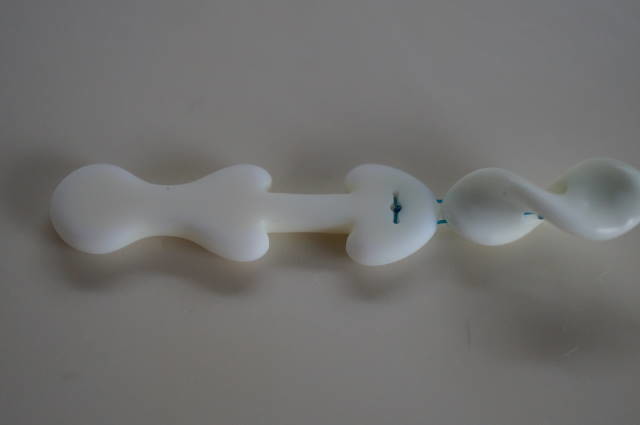
In an entry published in June 2021, a customer wanted longer wear after discomfort with a short ceramic twist and screw-shaped auxiliary chip. Mr. Okada linked the 0 mm gap to strong compression of a sphincter he described as 5–6 mm thick. He said this arrangement might be tolerable for only a few hours.
His own titanium prototype, with a 2 mm narrowed section, reportedly produced little fatigue. Separately, he preferred recess-opening widths around 4 mm for sensation and 6–7 mm for stable positioning. Mr. Okada advised considering comfortable wear and stronger pleasure as different design goals.
(Source: ok-lab's diary, published June 2021)
https://ok-lab.hatenablog.com/entry/2021/06/26/125926
A painful chip shape prompted an inspection offer and thread warning
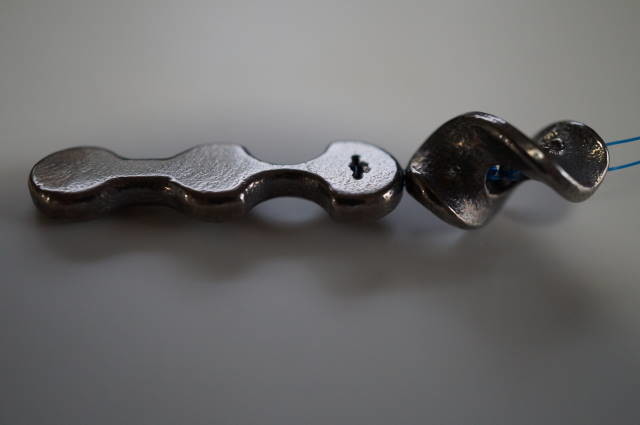
In an entry published in October 2021, a customer reported pain with a custom sea-slug-shaped chip, version 4. They suspected raised resin near its rear end.
Staff thought the main shape was the likelier explanation, while acknowledging that photographs could not settle the issue. They warned that abrasive work could damage nearby thread and contribute to breakage. They offered inspection, followed by thread replacement for a quality fault or a refund if no fault was found.
(Source: ok-lab's diary, published October 2021)
https://ok-lab.hatenablog.com/entry/2021/10/09/125823
A sharply curved chip shape raised concerns about possible removal failure
In an entry published in June 2023, Mr. Okada discussed a bendable bead chip on a metal shaft. He reported little movement during urination with curves around 90 degrees to 110 degrees.
However, he warned that entry into the bladder could leave it impossible to retrieve by its thread. He explicitly raised the possibility of needing hospital care.
(Source: ok-lab's diary, published June 2023)
https://ok-lab.hatenablog.com/entry/2023/06/24/123110
If you see blood in your urine, even a small amount or for the first time, do not wait and see. See a urologist right away.
If you suddenly cannot urinate, or the device cannot be removed, do not try to fix it yourself. Go to a medical facility, including emergency care, immediately.
How chip shape and stimulation changed over time
| Published | What the diary said then |
|---|---|
| Jun 2018 | Mr. Okada reported slightly stronger sensations from thicker rear resin and the thread's raised outline. |
| Apr 2019 | An uneven button projection felt stronger than a standard short chip to Mr. Okada. |
| Mar 2020 | A rear screw increased a short prototype's recess count from 2 to 3. |
| Jul 2021 | Mr. Okada preferred a 6.5 mm recess opening to 9 mm. |
| Jan 2022 | Mr. Okada found a pointed ceramic design's long straight section difficult to accommodate. |
| Sep 2024 | Resin-wrapping options cost ¥1,000 (about $6 at ¥156 = $1, rate as of 2026-09-04) or ¥2,000, (about $13 at ¥156 = $1, rate as of 2026-09-04) tax excluded; destructive testing remained incomplete. |
| Apr 2026 | A customer requested uniform 10 mm spacing after comparing differently spaced prototype projections. |
OK Prostate Chip products related to chip shape and stimulation
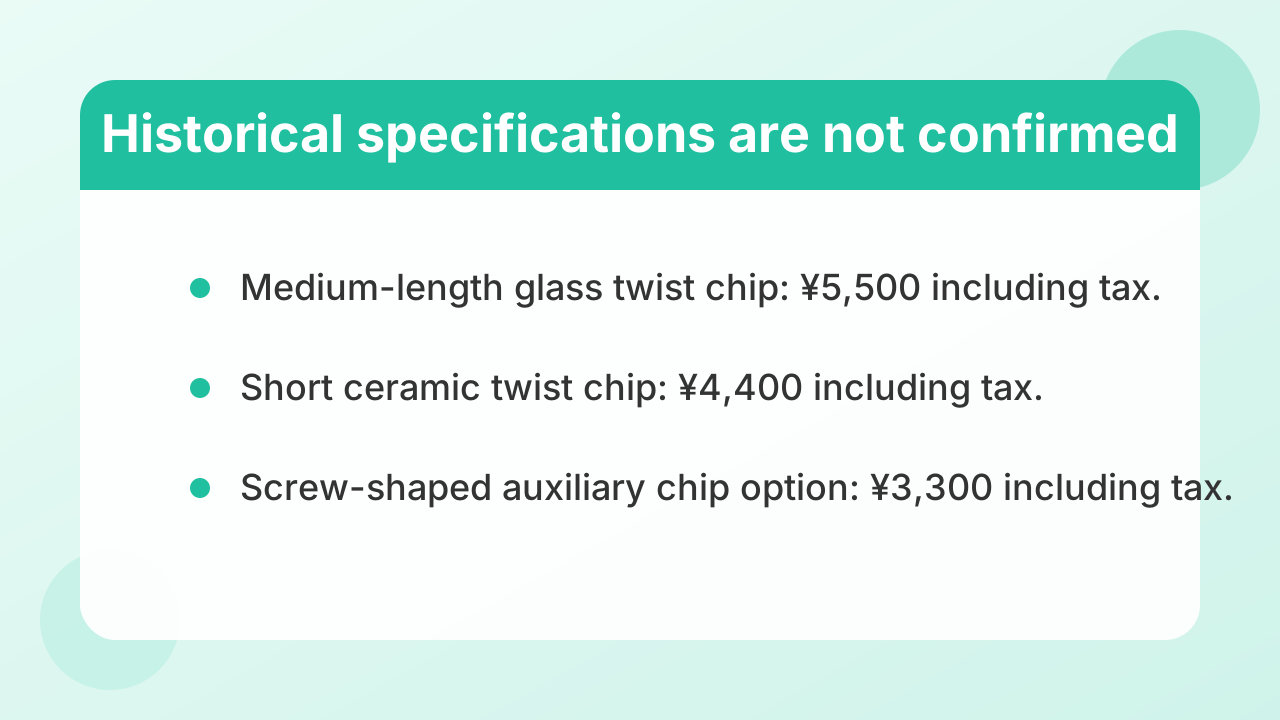
The current list includes products involved in these reports, but does not confirm the historical custom specifications.
Products that appear in these entries
| Product (official name) | Price incl. tax | Relation to this topic |
|---|---|---|
| Medium-length glass twist chip (OKプロステートチップ ガラス素材セミロングタイプ コブラツイスト) | ¥5,500 (about $35 at ¥156 = $1, rate as of 2026-09-04) | A December 2019 customer reported distinctive sideways stimulation and bleeding episodes with this glass design. |
| Short ceramic twist chip (OKプロステートチップ 陶器素材ショートタイプ ツイスト) | ¥4,400 (about $28 at ¥156 = $1, rate as of 2026-09-04) | The June 2021 customer reported discomfort with this chip combined with an auxiliary screw. |
| Screw-shaped auxiliary chip option (スクリュー型補助チップ追加オプション) | ¥3,300 (about $21 at ¥156 = $1, rate as of 2026-09-04) | The June 2021 reply discussed compression associated with this additional part and the customer's specified gap. |
(Source: ok-lab's diary, published December 2019)
https://ok-lab.hatenablog.com/entry/2019/12/21/150646
(Source: ok-lab's diary, published June 2021)
https://ok-lab.hatenablog.com/entry/2021/06/26/125926
Products the diary mentioned as alternatives
The diary names no alternative.
The entries also describe custom glass shapes, early stoppers, a custom resin screw, and heart-shaped and titanium prototypes. No matching product can be confirmed on the current list.
Other historical examples include button-terminal, screw-extended, pointed ceramic, sea-slug-shaped, and bendable bead designs. No matching product can be confirmed on the current list.
The resin-wrapped versions, raised-dot finishes, and multi-projection prototype also appear in this history. No matching product can be confirmed on the current list.
Common worries about chip shape and stimulation
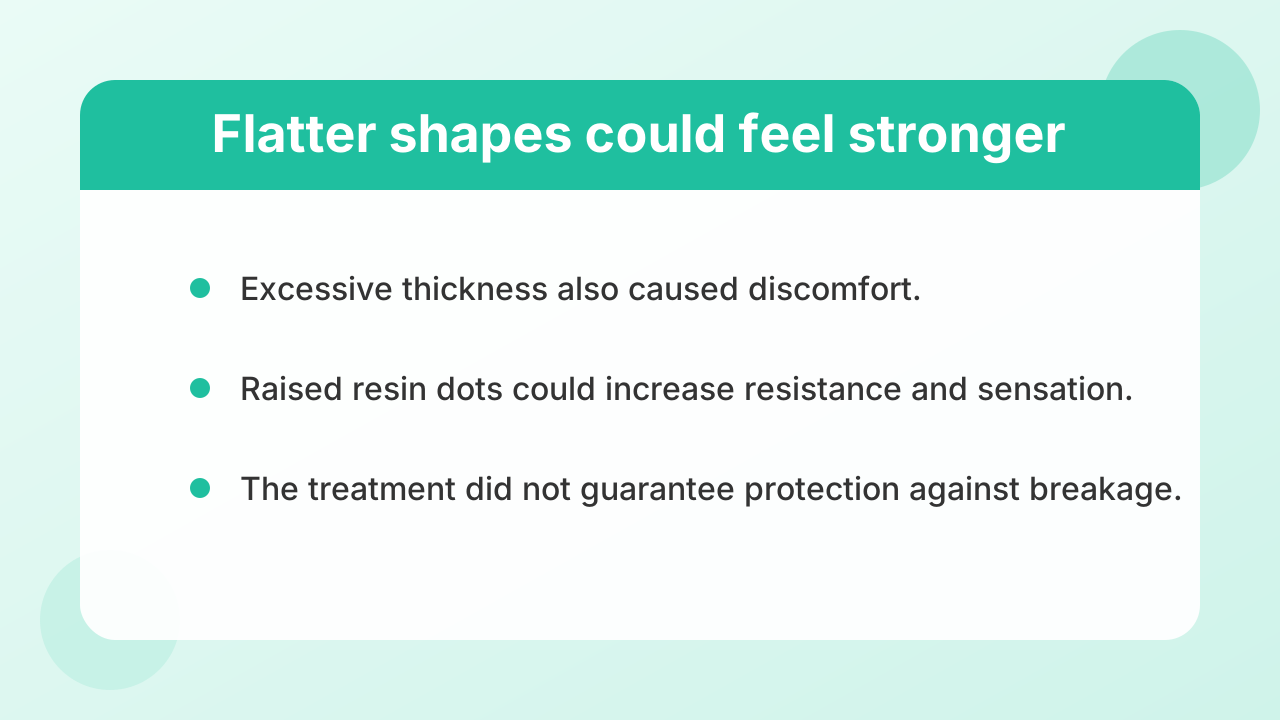
Customer questions concerned discomfort, flat profiles, and stronger sensations from smaller devices.
"Could a thicker chip solve pain from a narrow tip?"
In an entry published in June 2018, a customer requested a revised medium-length shape after comparing several versions. They reported that short overall length with a narrow tip felt close to pain, while excessive thickness also caused discomfort.
Mr. Okada prepared prototypes, then remade a selected piece after it broke during production. The diary does not record the customer's experience with the replacement.
(Source: ok-lab's diary, published June 2018)
https://ok-lab.hatenablog.com/entry/20180616/1529136608
"Would a flat chip shape feel weaker than rounded ceramic?"
In an entry published in October 2021, a prospective customer questioned whether flat resin profiles would stimulate less effectively than rounded ceramic. Mr. Okada replied that some people considered flatter shapes more stimulating, but said he could not explain the comparison theoretically.
The customer had postponed buying while waiting for improvements in materials. Mr. Okada endorsed their emphasis on safety and advised careful consideration.
(Source: ok-lab's diary, published October 2021)
https://ok-lab.hatenablog.com/entry/2021/10/02/125825
"Can a smaller chip produce stronger stimulation?"
In an entry published in October 2024, Mr. Okada addressed requests from customers whose larger chips did not fit. He proposed small ceramic chips with raised resin dots, reporting that projections just under 1 mm could increase resistance and sensation.
The finish cost ¥1,000, (about $6 at ¥156 = $1, rate as of 2026-09-04) tax excluded, as published in October 2024. He described approximately 5–7 dots per side and 10–14 overall. Mr. Okada cautioned that the treatment did not guarantee protection against breakage.
(Source: ok-lab's diary, published October 2024)
https://ok-lab.hatenablog.com/entry/2024/10/05/122923
Buying from outside Japan
OK Lab ships internationally to countries covered by Japan Post's EMS courier service. Overseas orders are paid in advance by PayPal. Each order carries a ¥400 (about $3 at ¥156 = $1, rate as of 2026-09-04) handling fee, and EMS shipping is charged on top. These terms come from OK Lab's official sales-terms page (written here as plain text, not a link: ok-lab.net/docs/law), checked on September 7, 2026; confirm them on the official store before you order, because they can change.
Summary of this article
| What you wanted to know | The answer |
|---|---|
| What is the short answer? | Diary reports associate different contours with different sensations; thickness alone did not predict them. |
| What is this product? | A urethral device made and sold by OK Lab in Japan. |
| What do the terms mean? | Recesses, stoppers, and auxiliary chips describe different features affecting contact or position. |
| What happened in the reports? | Some shapes felt stronger or more comfortable; others accompanied pain and bleeding. |
| What was the maker's answer? | Consider intensity, comfort, positioning, and construction separately. |
| What changed over time? | Experiments expanded from bulges and recesses to surface textures and spaced projections. |
| Which related products are listed today? | Glass and ceramic twist models and a screw-shaped auxiliary option. |
| What did customers ask? | Whether thickness, flatness, or added texture could change their experience. |
| How does overseas buying work? | Advance PayPal payment, EMS delivery, a handling fee, and additional shipping charges. |
Source: ok-lab's diary (Okada Comfortable Life Laboratory). The original entries are in Japanese; quotations on this page are translated. Photos and videos are on the original entries.
This article is a summary of the maker's development diary. The product is not a medical device and no result is guaranteed. If anything feels wrong or worries you, see a doctor. Prices, specifications and cautions change, so confirm the latest information on the official blog and the official site. Questions about ordering and shipping go to the seller.