![Which chip length fits? | The maker’s guide depends on the design [OK Prostate Chip]](/img/a/T0151/eyecatch.svg)
This page is based on entries from "ok-lab's diary" (https://ok-lab.hatenablog.com/), the Japanese development diary written by Mr. Okada, founder of OK Lab, a small company in Japan (Okada Comfortable Life Laboratory). Only the entries about "prostate chip sizing" are summarized here, in order of publication. Past prices and sizes are as written at the time. Current prices come from the official product list (retrieved September 4, 2026). Quotations are translated from Japanese.
Note: This page is a personal reading log by someone with no connection to the maker or the seller. It reflects the source entries as of their publication dates and makes no guarantee of accuracy or safety. The product is not a medical device; talk to a doctor about any health decision. Check the official site for current information. This page contains advertising.
In short
The diary links fit to length, shape, and the passage involved.
The maker’s sizing answers depend on the particular model and individual anatomy.
Current listings give prices without confirming historical size options.
If you see blood in your urine, even a small amount or for the first time, do not wait and see. See a urologist right away. If you suddenly cannot urinate, or the device cannot be removed, do not try to fix it yourself. Go to a medical facility, including emergency care, immediately.
About this product
The OK Prostate Chip is a small device that is placed in the urethra (the urine passage) so that it acts on the prostate; the maker sells it in several shapes, sizes and materials. It is made and sold by OK Lab (Okada Comfortable Life Laboratory), a small company in Japan, through its own online store, and prices are in Japanese yen (JPY). The maker's development diary, "ok-lab's diary", is written in Japanese. This page is an English summary of it, and every quotation is translated. OK Lab ships internationally, so readers outside Japan can order (see "Buying from outside Japan" below). Product names on this page are plain-English descriptions. The official Japanese product name is shown once in the product table so you can find the same item in the store.
Before you read: key terms
| Term | Plain-English meaning |
|---|---|
| Urethra | The urine passage; the chip and its attachments occupy parts of it. |
| Prostatic urethra | The passage through the prostate; Mr. Okada uses its length as a chip-sizing reference. |
| External urinary sphincter | The outer muscle boundary in the diary’s prostate descriptions; a reference for chip position. |
| Urethral sound | An instrument used inside the urine passage; customers cite its diameter as a sizing reference. |
| Electrode chip | A chip serving as an electrical contact; positioning affected one customer’s sizing choice. |
| Biocompatible resin | A resin used for chip bodies. The diary does not explain this. |
| Dilation | Widening the urine passage; staff discussed it when explaining larger sizes. |
| Glans | The penis head; a reference point for tube and stopper position. |
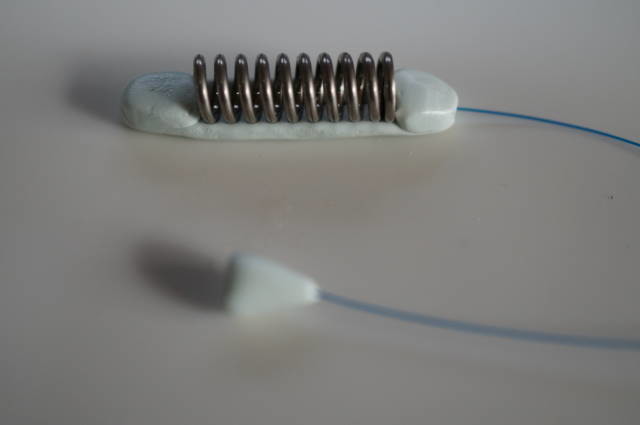
| Tail tube | Silicone covering nylon thread; intended to accommodate changing length. |
| Shaft | A modular assembly’s straight middle section; it sets the span between units. |
| Heart-shaped stopper | A shaped end piece intended to support the modular assembly near the glans. |
What happens: prostate chip sizing
The OK Prostate Chip is a small device placed in the urethra (urine passage) to act on the prostate. Chip length describes the main body, while other entries discuss a connected tube or shaft. These parts occupy different stretches of the urine passage, and the diary gives them separate sizing rules. Mr. Okada relates fit to the prostate section, neighboring bends, or changing penile length, depending on the design.
Semi-long chip length already depended on anatomy at its launch
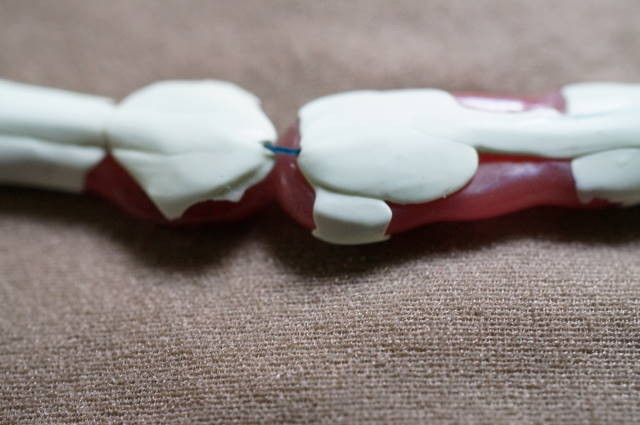
An entry published in April 2018 announced 4 semi-long lengths: 38 mm, 40 mm, 42 mm, and 44 mm. Mr. Okada explained that the external urinary sphincter (the outer muscle boundary used as a position reference) affected how far the chip reached. With the rear end before that boundary, he thought 38 mm might not reach the bladder in someone with an enlarged prostate. His general length recommendations were 40 mm or 42 mm, with individual differences affecting the choice.
(Source: ok-lab's diary, published April 2018)
https://ok-lab.hatenablog.com/entry/20180428/1524898558
Vibrating chip length followed the prostate section rather than penis size
In an entry published in February 2019, a customer asked how to choose M or L for a vibrating chip. Mr. Okada acknowledged that his size labels had lacked a clear explanation. His outline used a prostate length around 30 mm, 10 mm beyond each end, and another 5 mm for the sphincter.
He called approximately 55 mm M and 60 mm L for that model. The diary does not record the customer’s eventual size choice. Mr. Okada advised basing chip length on the prostatic urethra (the passage through the prostate), independently of penis length.
(Source: ok-lab's diary, published February 2019)
https://ok-lab.hatenablog.com/entry/2019/02/16/171153
A flat-curved chip seemed too short in one customer’s deposit report
In an entry published in May 2023, a customer wanted to keep using a flat-curved chip despite hard deposits forming on it. They reported deposits after 3 days with M, but smooth urination and a clean L after 10 days. Mr. Okada had seen the affected chip, but treated the customer’s proposed explanation as a possibility.
He suspected a flat-curved chip shorter than the prostate could obstruct urine flow and leave urine around the device. His reply suggested that greater length might address a lingering feeling of incomplete emptying.
(Source: ok-lab's diary, published May 2023)
https://ok-lab.hatenablog.com/entry/2023/05/06/123024
Matching chip size did not settle questions about bladder movement
In an entry published in January 2024, a flat-curved L user asked about an expanded-profile resin chip for prolonged use. Mr. Okada thought L might fit based on their existing flat-curved L. He could not say from experience whether a stopper would hold the entire chip beyond the sphincter.
No subsequent fit is recorded. For prolonged use, Mr. Okada cautioned that having the whole chip beyond the sphincter was the arrangement most likely to slip into the bladder.
(Source: ok-lab's diary, published January 2024)
https://ok-lab.hatenablog.com/entry/2024/01/27/123012
Second-chip length became a concern after pain and bleeding
In an entry published in December 2024, a customer reassessed a tandem electrode build (two linked electrical-contact chips) after pain and bleeding. They reported 38 mm through the prostate and 23 mm from the outer sphincter to the neighboring bend. The next straight section measured 32 mm, leading them to favor a second chip no longer than 32 mm.
They also thought the gap between chips should have been at least 10 mm, allowing for the resin ends. The diary does not record Mr. Okada’s reply or the outcome of a shorter replacement.
(Source: ok-lab's diary, published December 2024)
https://ok-lab.hatenablog.com/entry/2024/12/07/122832
Beginner chip sizing did not simply mean choosing the smallest model
In an entry published in April 2025, a newcomer asked whether short, narrow chips were easiest. Staff initially requested fewer questions, then answered a narrower follow-up. They believed almost anyone could use semi-long S in ceramic or biocompatible resin (a chip-body material), while acknowledging individual differences.
They said sizes larger than M could require dilation (widening the urine passage) for some people. No eventual purchase is recorded. Staff described short chips as beginner-oriented, but warned that difficulty locating them means smaller does not always mean easier.
(Source: ok-lab's diary, published April 2025)
https://ok-lab.hatenablog.com/entry/2025/04/05/122932
A short chip proved difficult for an experienced customer outside Japan
In an entry published in July 2025, a customer outside Japan wanted a replacement for a short resin chip in S. They described losing track of it near a bend, despite being able to accommodate a 9 mm instrument. Mr. Okada considered short S a poor size choice for that customer.
No replacement purchase or outcome is recorded. For someone with that experience, Mr. Okada suggested semi-long M or L, or long S, as sizes he thought would fit.
(Source: ok-lab's diary, published July 2025)
https://ok-lab.hatenablog.com/entry/2025/07/26/122909
The maker's answer to prostate chip sizing
The maker uses different length references for the chip body, flexible attachments, and modular assemblies.
Gourd-shaped sound sizing used an erect-length estimate for a flaccid design
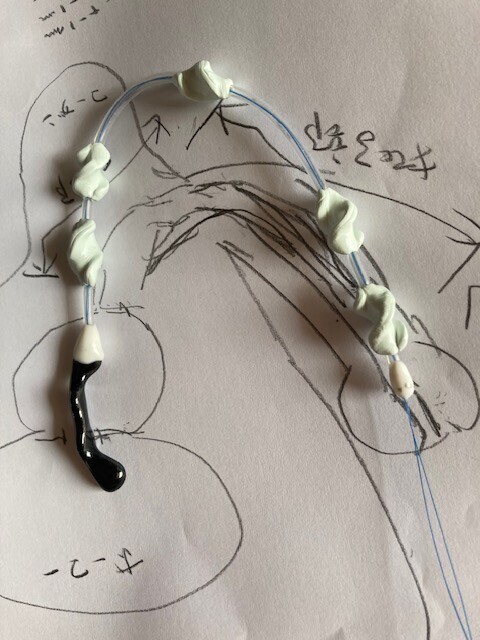
In an entry published in November 2023, Mr. Okada described a gourd-shaped urethral sound (an instrument used inside the urine passage). Its sections were intended for the deeper passage, penile shaft, and glans (penis head), with part extending outside. Although intended for the flaccid state, he suggested 80–90% of erect length as the sizing reference.
He acknowledged that his standards reflected his own fit, without an objective basis. His sizing advice assumed the lower end stopped before the sphincter, rather than reaching the prostate.
(Source: ok-lab's diary, published November 2023)
https://ok-lab.hatenablog.com/entry/2023/11/04/122744
Tail length depended on the tube and its end supports
In an entry published in December 2023, Mr. Okada tested a 2.5 mm tail tube (silicone covering part of a nylon thread). With screw-shaped supports at both ends, he thought an erect-length design could accommodate shortening without protruding. He therefore proposed using erect length, without allowing separately for the variable flaccid length.
He limited that observation by noting that urination could still push the end support outward. He also said his multiple-support experiment was unsuitable as a general recommendation. His closing advice favored a simpler tail arrangement.
(Source: ok-lab's diary, published December 2023)
https://ok-lab.hatenablog.com/entry/2023/12/09/123055
Modular chip sizing allowed space for the heart-shaped stopper
In an entry published in December 2025, Mr. Okada introduced separate chip, shaft (straight middle section), and stopper units. The heart-shaped stopper (a supporting end piece) occupied space near the glans. He allowed 50–60 mm near the glans entrance for that part of the assembly.
His shaft-length rule subtracted that allowance from the penile-shaft passage length, allowing length changes without replacing the entire device. The revised design included links to keep separated parts connected to the thread. Mr. Okada suggested different shaft lengths for erect and flaccid conditions.
(Source: ok-lab's diary, published December 2025)
https://ok-lab.hatenablog.com/entry/2025/12/13/122917
If you see blood in your urine, even a small amount or for the first time, do not wait and see. See a urologist right away. If you suddenly cannot urinate, or the device cannot be removed, do not try to fix it yourself. Go to a medical facility, including emergency care, immediately.
How prostate chip sizing changed over time
| Published | What the diary said then |
|---|---|
| Oct 2017 | Mr. Okada began with smaller designs intended to suit most customers. |
| Apr 2018 | Launch pricing: ¥3,000 (about $19 at ¥156 = $1, rate as of 2026-09-04) excluding tax; ¥4,000 (about $26 at ¥156 = $1, rate as of 2026-09-04) excluding tax with thread. |
| Jan 2020 | A semi-long four-point twist could not be offered because its proportions did not work. |
| Dec 2020 | Stainless-ring short chips: under 30 mm standard, custom lengths through 39 mm. |
| Nov 2023 | SS/S/M/L gourd-shaped sounds measured 14/16/18/20 cm. |
| Dec 2023 | Tail pricing: through 15 cm, ¥2,000 (about $13 at ¥156 = $1, rate as of 2026-09-04); 16–25 cm, ¥3,000, (about $19 at ¥156 = $1, rate as of 2026-09-04) excluding tax. |
| Dec 2025 | Modular safeguards were added without changing the announced prices. |
OK Prostate Chip products related to prostate chip sizing
Current listings confirm these products and prices, but contain no size options.
Products that appear in these entries
| Product (official name) | Price incl. tax | Relation to this topic |
|---|---|---|
| Vibrating chip, trial listing (OKプロステート核振チップ(仮販売)) | ¥6,600 (about $42 at ¥156 = $1, rate as of 2026-09-04) | The February 2019 M/L question named this listing. |
| Twisted ceramic semi-long chip (OKプロステートチップ 陶器素材セミロングタイプ コブラツイスト) | ¥5,500 (about $35 at ¥156 = $1, rate as of 2026-09-04) | The February 2020 customer ordered this model after asking about experience with a 7 mm sound. |
| Stainless-ring short chip (OKプロステートチップ ステンレスリング ショートタイプ) | ¥3,300 (about $21 at ¥156 = $1, rate as of 2026-09-04) | Its December 2020 launch described standard and custom lengths. |
| Expanded-profile resin chip (OKプロステートチップ 覚醒タイプ(生体適合樹脂)) | ¥8,800 (about $56 at ¥156 = $1, rate as of 2026-09-04) | The January 2024 customer asked about its size and movement during prolonged use. |
| Short resin chip (OKプロステートチップ ショートタイプ(生体適合樹脂)) | ¥4,400 (about $28 at ¥156 = $1, rate as of 2026-09-04) | The July 2025 customer identified this product as the short S they struggled with. |
(Source: ok-lab's diary, published February 2019)
https://ok-lab.hatenablog.com/entry/2019/02/16/171153
(Source: ok-lab's diary, published February 2020)
https://ok-lab.hatenablog.com/entry/2020/02/15/144151
(Source: ok-lab's diary, published December 2020)
https://ok-lab.hatenablog.com/entry/2020/12/19/132929
(Source: ok-lab's diary, published January 2024)
https://ok-lab.hatenablog.com/entry/2024/01/27/123012
(Source: ok-lab's diary, published July 2025)
https://ok-lab.hatenablog.com/entry/2025/07/26/122909
Products the diary mentioned as alternatives
| Product (official name) | Price incl. tax | Relation to this topic |
|---|---|---|
| Four-point twisted ceramic long chip (OKプロステートチップ 陶器素材ロングタイプ 4点ツイスト) | ¥7,700 (about $49 at ¥156 = $1, rate as of 2026-09-04) | In January 2020, Mr. Okada proposed S for semi-long L users wanting the unavailable semi-long four-point twist. |
(Source: ok-lab's diary, published January 2020)
https://ok-lab.hatenablog.com/entry/2020/01/25/150127
The early semi-long, lobed glass, unspecified flat-curved, titanium short, long S, electrode, gourd-shaped sound, tail, and modular designs are historical examples. No matching product can be confirmed on the current list.
Common worries about prostate chip sizing
Readers’ questions show why length, width, and shape need separate answers.
"Does chip length alone tell me where it will reach?"

In an entry published in May 2018, a customer requested more pronounced lobes on a 42 mm glass chip. Mr. Okada offered 41 mm and 44 mm prototypes, explaining that a larger rear lobe reduced the length available along the prostate. The customer preferred the longer prototype but remained interested in the shorter one.
The diary does not record how either prototype felt for that customer. Mr. Okada thought the longer version would nearly reach the bladder. For prostate-only sensation, his sizing suggestion favored 41 mm.
(Source: ok-lab's diary, published May 2018)
https://ok-lab.hatenablog.com/entry/20180505/1525509161
"Does a 7 mm sound identify my chip size?"
In an entry published in February 2020, a customer using a 7 mm sound asked about a twisted ceramic semi-long chip. Mr. Okada thought sizes through M might fit, while stressing individual differences. The customer ordered M, listed as approximately 43 mm, for ¥5,500 (about $35 at ¥156 = $1, rate as of 2026-09-04) at the time.
The diary does not record how that order felt in use. Mr. Okada cautioned that semi-long popularity did not make it the best choice for everyone.
(Source: ok-lab's diary, published February 2020)
https://ok-lab.hatenablog.com/entry/2020/02/15/144151
"Can a longer chip stay thin enough?"
In an entry published in September 2021, a customer wanted extra length without exceeding what their narrow opening could accommodate. Mr. Okada described long S as nearly 20 mm longer than their titanium short chip. He put its width around semi-long M and its thickness at 2.7 mm.
The diary does not record the result of that proposed replacement. He favored long S with a small stopper, except for people whose chips readily slipped into the bladder.
(Source: ok-lab's diary, published September 2021)
https://ok-lab.hatenablog.com/entry/2021/09/18/130132
Buying from outside Japan
OK Lab ships internationally to countries covered by Japan Post's EMS courier service. Overseas orders are paid in advance by PayPal. Each order carries a ¥400 (about $3 at ¥156 = $1, rate as of 2026-09-04) handling fee, and EMS shipping is charged on top. These terms come from OK Lab's official sales-terms page (written here as plain text, not a link: ok-lab.net/docs/law), checked on September 7, 2026; confirm them on the official store before you order, because they can change.
Summary of this article
| What you wanted to know | The answer |
|---|---|
| What is the short answer? | Fit depends on the design and passage involved. |
| What is this product? | A urethral device from OK Lab in Japan, priced in JPY. |
| Which terms matter? | The prostate section, sphincter, and attachments identify different sizing references. |
| What can happen with a poor fit? | Reports describe positioning problems, deposits, pain, and bleeding. |
| How does the maker approach sizing? | Chip bodies, tails, and shafts have different length rules. |
| What changed over time? | The diary added model-specific lengths, custom pricing, and modular parts. |
| Which products have current prices? | Resin, ceramic, vibrating, and stainless-ring models are listed; historical sizes remain unconfirmed. |
| What did customers ask? | Whether length predicts reach, sound experience helps, and longer chips remain thin. |
| How do overseas orders work? | Advance PayPal payment, a ¥400 (about $3 at ¥156 = $1, rate as of 2026-09-04) handling fee, and additional Japan Post EMS shipping. |
Source: ok-lab's diary (Okada Comfortable Life Laboratory). The original entries are in Japanese; quotations on this page are translated. Photos and videos are on the original entries.
This article is a summary of the maker's development diary. The product is not a medical device and no result is guaranteed. If anything feels wrong or worries you, see a doctor. Prices, specifications and cautions change, so confirm the latest information on the official blog and the official site. Questions about ordering and shipping go to the seller.