![Are linked prostate chips more comfortable? | The diary reports mixed results [OK Prostate Chip]](/img/a/T0133/eyecatch.svg)
This page is based on entries from "ok-lab's diary" (https://ok-lab.hatenablog.com/), the Japanese development diary written by Mr. Okada, founder of OK Lab, a small company in Japan (Okada Comfortable Life Laboratory). Only the entries about "linked prostate chip comfort" are summarized here, in order of publication. Past prices and sizes are as written at the time. Current prices come from the official product list (retrieved September 4, 2026). Quotations are translated from Japanese.
Note: This page is a personal reading log by someone with no connection to the maker or the seller. It reflects the source entries as of their publication dates and makes no guarantee of accuracy or safety. The product is not a medical device; talk to a doctor about any health decision. Check the official site for current information. This page contains advertising.
In short
Linked chips sometimes felt steadier, but the diary also records bleeding and difficult removal.
Mr. Okada changed connections, spacing, and materials to address handling problems.
Resin pairs appear on the current list; the diary also records an earlier stop to standard glass-pair sales.
If you see blood in your urine, even a small amount or for the first time, do not wait and see. See a urologist right away.
If you suddenly cannot urinate, or the device cannot be removed, do not try to fix it yourself. Go to a medical facility, including emergency care, immediately.
About this product
The OK Prostate Chip is a small device that is placed in the urethra (the urine passage) so that it acts on the prostate; the maker sells it in several shapes, sizes and materials. It is made and sold by OK Lab (Okada Comfortable Life Laboratory), a small company in Japan, through its own online store, and prices are in Japanese yen (JPY). The maker's development diary, "ok-lab's diary", is written in Japanese. This page is an English summary of it, and every quotation is translated. OK Lab ships internationally, so readers outside Japan can order (see "Buying from outside Japan" below). Product names on this page are plain-English descriptions. The official Japanese product name is shown once in the product table so you can find the same item in the store.
Before you read: key terms
| Term | Plain-English meaning |
|---|---|
| Urethra | The urine passage; the chip occupies part of this passage to act on the prostate. |
| Internal urethral sphincter | The muscle at the bladder entrance; the diary describes its role in preventing semen entering the bladder. |
| Auxiliary chip | An additional piece connected to the main chip, intended to help support or stabilize it. |
| Cross joint | An interlocking connection between chips, designed to bend up-down and side-to-side. |
| Nitinol | The shape-memory wire used in later connections to provide flexibility while helping maintain chip spacing. |
| Electrode pair | Two chips carrying electrical stimulation; their positions affect the sensations reported in the diary. |
| Tube cushion | Tubing between connected pieces, used as a yielding connection in the June 2026 screw assembly. |
What happens: linked prostate chip comfort
The OK Prostate Chip is a small device placed in the urethra (the urine passage) to stimulate the prostate. Linked versions connect a leading chip to a second chip or further pieces using thread, wire, cord, or flexible joints. Mr. Okada designs these connections to change bending, comfort, and stability. The leading chip targets the prostate region; the second can occupy the wider passage below it.
An early linked chip test included a report of bleeding
In an entry published in January 2018, Mr. Okada described a linked prototype intended to anchor near the bladder. A tester reported slight bleeding during a test involving passage through a muscle opening. Mr. Okada considered the curved tip capable of placing excessive strain on that area and called this his most difficult linked design.
(Source: ok-lab's diary, published January 2018)
https://ok-lab.hatenablog.com/entry/20180111/1515662782
Linked chips prompted a warning about semen entering the bladder
In an entry published in January 2018, Mr. Okada discussed the internal urethral sphincter (the muscle at the bladder entrance). He warned that linked chips could hold it open, allowing semen into the bladder during ejaculation.
He described closely connected pairs as longer than 5cm, making bladder entry easier despite their relatively easy handling. He specifically cautioned against the leading chip being entirely inside the bladder.
(Source: ok-lab's diary, published January 2018)
https://ok-lab.hatenablog.com/entry/20180114/1515943724
Firmly settled linked chips still took 20 minutes to remove
In an entry published in March 2021, Mr. Okada abandoned a stretching spring design in favor of linked pieces around 10-20mm long. The proposed connection used a single cord alongside nylon thread, covered with rubber.
A later March 2021 entry clarified that the particular 3-piece test assembly actually used wire alongside nylon. Its pieces measured 5.6mm outside and slightly over 20mm long each. Mr. Okada reported no movement during urination over about 3 days, yet removal took around 20 minutes. He said further testing was needed to understand why different connections behaved differently.
(Source: ok-lab's diary, published March 2021)
https://ok-lab.hatenablog.com/entry/2021/03/13/130202
(Source: ok-lab's diary, published March 2021)
https://ok-lab.hatenablog.com/entry/2021/03/20/130148
Linked chips allowed comfortable urination in one customer report
In an entry published in May 2022, a customer reported smooth, painless urination with a customized pair of screw-shaped chips. The customer had requested several changes and expressed satisfaction with the completed device. Mr. Okada did not know its exact position inside the body. He suspected the larger rear screw provided support below the prostate and regarded its size as important to that customer's stable fit.
(Source: ok-lab's diary, published May 2022)
https://ok-lab.hatenablog.com/entry/2022/05/14/123043
Linked chips with electrodes prompted bleeding reports and spacing concerns
In an entry published in December 2024, a customer reported repeated bleeding with an electrode pair (two chips carrying electrical stimulation). An initially painless attempt also ended with pain and bleeding after about 1 hour. The customer suspected the rear chip's curve did not follow their urine passage.
They judged a second chip no longer than 32mm preferable for their own anatomy. They also proposed a gap of at least about 10mm, allowing for resin around the connection. The diary does not record Mr. Okada's reply or the result of a revised design.
(Source: ok-lab's diary, published December 2024)
https://ok-lab.hatenablog.com/entry/2024/12/07/122832
Three joined screws became a flexible alternative to linked chips
An entry published in June 2026 answered a customer's question about how much three connected screws could bend. The completed build used zero spacing and tube cushions (yielding tubing connections), measuring about 45mm overall. Mr. Okada reported that it bent flexibly and compared its length to a medium-length chip. He suggested that the joined screws could serve as the main chip without another leading piece.
(Source: ok-lab's diary, published June 2026)
https://ok-lab.hatenablog.com/entry/2026/06/13/122909
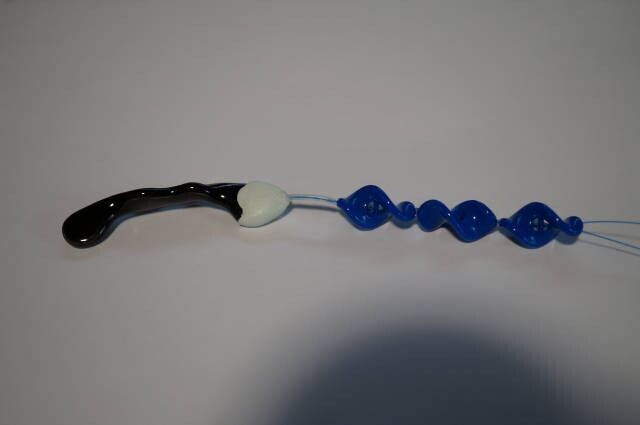
The maker's answer to linked prostate chip comfort
Mr. Okada repeatedly redesigned the connections to balance flexibility, stable positioning, and the bulk between chips.
Linked resin chips gained an interlocking joint for greater stability
In an entry published in September 2018, Mr. Okada changed the connection on resin pairs. He adopted a cross joint (an interlocking connection) that bends in 2 directions, up-down and side-to-side. He expected improved urine flow and less outward movement, while also describing stronger local stimulation. He made it standard for plain resin and resin screw pairs, inviting interested customers to consider it.
(Source: ok-lab's diary, published September 2018)
https://ok-lab.hatenablog.com/entry/20180908/1536384939
Linked ceramic chips returned to testing with steel between them
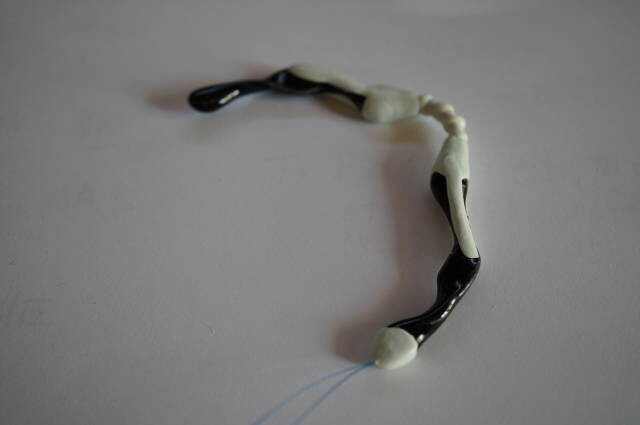
An entry published in September 2019 revisited linked pairs whose sales Mr. Okada had suspended. His ceramic prototypes used stainless-steel thread only between the chips, creating what he described as a flexible, single-piece feel. He thought this might resolve most earlier problems and began tests aimed at bringing linked pairs back. For the portion outside the body, he favored nylon because exposed steel had proved awkward during longer use.
(Source: ok-lab's diary, published September 2019)
https://ok-lab.hatenablog.com/entry/2019/09/21/131939
Discomfort led Mr. Okada to favor gentler angles between linked chips
In an entry published in November 2020, Mr. Okada reported lingering discomfort after testing a short front chip with a 90-degree connection. An unusual prostate sensation persisted for about 1 day after removal. He suspected excessive stimulation from the connector's spring force. For short front chips, he suggested 45-60 degrees instead.
(Source: ok-lab's diary, published November 2020)
https://ok-lab.hatenablog.com/entry/2020/11/28/121505
Linked chips gained mixed materials to preserve spacing and external comfort
In an entry published in September 2025, Mr. Okada proposed nitinol (shape-memory wire) internally, joined to nylon outside the body. He reported more consistent chip spacing with nitinol, while nylon was easier to accommodate outside.
For lengths up to 20cm, the published surcharge was ¥2,000 (about $13 at ¥156 = $1, rate as of 2026-09-04) for 2 strands or ¥2,500 (about $16 at ¥156 = $1, rate as of 2026-09-04) for 4, excluding tax. These published amounts covered the added connection. He recommended the mixed construction to keep each material where he found it most useful.
(Source: ok-lab's diary, published September 2025)
https://ok-lab.hatenablog.com/entry/2025/09/13/122925
Four flexible joints offered linked ceramic chips a smoother connection
An entry published in January 2026 introduced ceramic dual chips linked by 4 flexible joints. Mr. Okada described a smoother feel and less bulky connections than earlier constructions. The joints contained nitinol wire, with resin covering and rubber at the bending points.
Published pricing was the two chip prices plus ¥6,000 (about $38 at ¥156 = $1, rate as of 2026-09-04), excluding tax; the shortest stated delivery time was about 2 weeks. Mr. Okada allowed different ceramic chips in the pair and suggested smaller combinations for easier handling.
(Source: ok-lab's diary, published January 2026)
https://ok-lab.hatenablog.com/entry/2026/01/10/122922
If you see blood in your urine, even a small amount or for the first time, do not wait and see. See a urologist right away.
If you suddenly cannot urinate, or the device cannot be removed, do not try to fix it yourself. Go to a medical facility, including emergency care, immediately.
How linked prostate chip comfort changed over time
| Published | What the diary said then |
|---|---|
| Jan 2018 | Short pairs 1-3: ¥6,000 (about $38 at ¥156 = $1, rate as of 2026-09-04) excluding tax planned; larger and bladder-anchoring designs held for testing. |
| Jul 2018 | Closely joined screw pairs were presented as bending long chips with easier handling. |
| May 2019 | Two parallel cords improved stability in Mr. Okada's ceramic-pair tests. |
| Oct 2019 | Doubled 0.55mm wire produced an adjustable connection that resisted bending under pushing force. |
| Jan 2020 | Ceramic pairs adopted parallel cords with an added nylon connection as backup. |
| Apr 2021 | Softer ceramic-and-screw connections felt gentler to Mr. Okada but shifted with posture. |
| Jul 2022 | A tube measuring 5mm outside and 3mm inside joined the connector options. |
| Oct 2025 | Rear-only integrated stoppers cost ¥2,000 (about $13 at ¥156 = $1, rate as of 2026-09-04) excluding tax without additional chip reinforcement. |
OK Prostate Chip products related to linked prostate chip comfort
The current list includes resin pairs and a glass-pair price, but these entries do not confirm a restart of standard glass-pair sales.
Products that appear in these entries
| Product (official name) | Price incl. tax | Relation to this topic |
|---|---|---|
| Linked glass pair (OKプロステートチップ ガラス素材2連結タイプ) | ¥6,600 (about $42 at ¥156 = $1, rate as of 2026-09-04) | October 2021: a customer's preferred pair, whose earlier removal problems had prompted a stop to standard sales. |
| Resin pair with an interlocking joint (OKプロステートチップ 樹脂素材クロスジョイント連結タイプ) | ¥4,400 (about $28 at ¥156 = $1, rate as of 2026-09-04) | September 2018: its revised joint addressed unstable contact between the chips. |
| Resin screw pair with an interlocking joint (OKプロステートチップ 樹脂素材クロスジョイント連結タイプ スクリュー) | ¥8,800 (about $56 at ¥156 = $1, rate as of 2026-09-04) | September 2018: the revised connection also became standard for linked resin screw chips. |
(Source: ok-lab's diary, published October 2021)
https://ok-lab.hatenablog.com/entry/2021/10/16/125843
(Source: ok-lab's diary, published September 2018)
https://ok-lab.hatenablog.com/entry/20180908/1536384939
Products the diary mentioned as alternatives
| Product (official name) | Price incl. tax | Relation to this topic |
|---|---|---|
| Linked resin pair (OKプロステートチップ 樹脂素材2連結タイプ) | ¥4,400 (about $28 at ¥156 = $1, rate as of 2026-09-04) | January 2018: offered for concerns about glass breakage, particularly for shorter use. |
| Resin screw auxiliary (スクリュー型補助チップ追加オプション(生体適合樹脂)) | ¥3,300 (about $21 at ¥156 = $1, rate as of 2026-09-04) | October 2021: Mr. Okada favored screw chains when asked about glass-pair movement, without promising the same sensation. |
(Source: ok-lab's diary, published January 2018)
https://ok-lab.hatenablog.com/entry/20180121/1516504265
(Source: ok-lab's diary, published October 2021)
https://ok-lab.hatenablog.com/entry/2021/10/16/125843
Historical prototypes and custom assemblies discussed above, including the steel chains, electrode pairs, mixed-thread connections, ceramic dual builds, and joined screws: No matching product can be confirmed on the current list.
Common worries about linked prostate chip comfort
Questions centered on breakage, movement during urination, and difficulty retrieving long or overlapping chips.
"Can linked glass chips break against each other?"
In an entry published in January 2018, a customer asked whether contact between linked glass chips could cause breakage and injury. Mr. Okada could not guarantee that the glass would not break.
He proposed a resin pair restricted to 2mm spacing, with a planned price of ¥4,000 (about $26 at ¥156 = $1, rate as of 2026-09-04) excluding tax. He approved its release after a personal prototype test without lotion. He offered the resin alternative particularly for people considering shorter use.
(Source: ok-lab's diary, published January 2018)
https://ok-lab.hatenablog.com/entry/20180121/1516504265
"Can linked chips come out during urination?"
In an entry published in January 2018, a customer asked how to keep linked chips from coming out during urination. The customer previously used a short chip with an auxiliary chip (an additional supporting piece). Mr. Okada replied about controlling movement, and the customer later reported urinating without the chips coming out. Elsewhere in that entry, Mr. Okada favored 0mm or 2mm gaps for easier handling.
(Source: ok-lab's diary, published January 2018)
https://ok-lab.hatenablog.com/entry/20180130/1517311002
"Why did standard sales of linked glass chips stop?"
In an entry published in October 2021, a customer who preferred glass pairs asked about reducing movement during urination. Mr. Okada said standard glass-pair sales had stopped about 3 years earlier because overlapping chips could become impossible to remove.
He could still consider custom ceramic pairs but could not predict whether they would feel as good. The diary does not record a completed order or a later comfort report. He favored chains of resin screw auxiliaries as a possible alternative.
(Source: ok-lab's diary, published October 2021)
https://ok-lab.hatenablog.com/entry/2021/10/16/125843
"Could flexible linked chips address problems with rigid curved designs?"
In an entry published in May 2023, a customer asked about preventing another removal problem with a long, rigid curved chip. The diary records eventual removal the next morning, after earlier attempts had failed. Staff explained that its curved, rigid shape was designed to resist slipping out.
Mr. Okada warned that greater depth could complicate retrieval when a long chip could not bend. He pointed instead to auxiliary-chip extensions, partly flexible connections, or fully jointed designs. He advised against long, rigid chips reaching depths from which they could not be retrieved.
(Source: ok-lab's diary, published May 2023)
https://ok-lab.hatenablog.com/entry/2023/05/06/123024
Buying from outside Japan
OK Lab ships internationally to countries covered by Japan Post's EMS courier service. Overseas orders are paid in advance by PayPal. Each order carries a ¥400 (about $3 at ¥156 = $1, rate as of 2026-09-04) handling fee, and EMS shipping is charged on top. These terms come from OK Lab's official sales-terms page (written here as plain text, not a link: ok-lab.net/docs/law), checked on September 7, 2026; confirm them on the official store before you order, because they can change.
Summary of this article
| What you wanted to know | The answer |
|---|---|
| What is the short answer? | Some linked designs felt comfortable and stable; others brought bleeding or difficult removal. |
| What is this product? | A device from Japan placed in the urine passage to act on the prostate. |
| What do the connection terms mean? | They describe additional pieces, flexible joints, and materials intended to influence bending and positioning. |
| What happened in actual reports? | Experiences included painless urination, lingering discomfort, repeated bleeding, and slow removal. |
| What did the maker change? | Joint shapes, connection materials, angles, spacing, and the bulk around attachment points. |
| How did development change over time? | Experiments moved through thread, cords, wire, softer connections, and jointed ceramic pairs. |
| What prices appear on the current list? | Listed resin pairs include ¥4,400 (about $28 at ¥156 = $1, rate as of 2026-09-04) and ¥8,800 (about $56 at ¥156 = $1, rate as of 2026-09-04) models, including tax. |
| What concerned customers? | Glass breakage, outward movement during urination, and retrieval difficulties. |
| How does overseas buying work? | Advance PayPal payment, a ¥400 (about $3 at ¥156 = $1, rate as of 2026-09-04) handling fee, and separate EMS shipping charges. |
| What does the overall account establish? | The diary records design-specific experiences; its favorable reports coexist with problems and cautions. |
Source: ok-lab's diary (Okada Comfortable Life Laboratory). The original entries are in Japanese; quotations on this page are translated. Photos and videos are on the original entries.
This article is a summary of the maker's development diary. The product is not a medical device and no result is guaranteed. If anything feels wrong or worries you, see a doctor. Prices, specifications and cautions change, so confirm the latest information on the official blog and the official site. Questions about ordering and shipping go to the seller.