![Can a prostate chip stay inside without a thread? | Removal can still be difficult [OK Prostate Chip]](/img/a/T0118/eyecatch.svg)
This page is based on entries from "ok-lab's diary" (https://ok-lab.hatenablog.com/), the Japanese development diary written by Mr. Okada, founder of OK Lab, a small company in Japan (Okada Comfortable Life Laboratory). Only the entries about "fully internal placement without an external thread" are summarized here, in order of publication. Past prices and sizes are as written at the time. Current prices come from the official product list (retrieved September 4, 2026). Quotations are translated from Japanese.
Note: This page is a personal reading log by someone with no connection to the maker or the seller. It reflects the source entries as of their publication dates and makes no guarantee of accuracy or safety. The product is not a medical device; talk to a doctor about any health decision. Check the official site for current information. This page contains advertising.
In short
- A fully internal chip leaves no external retrieval thread, and removal can become difficult.
- Mr. Okada explored internal loops and covered wire, while warning that some people could still struggle with removal.
- The current list includes a nylon extension thread, but the complete custom threadless builds cannot be matched.
If you see blood in your urine, even a small amount or for the first time, do not wait and see. See a urologist right away. If you suddenly cannot urinate, or the device cannot be removed, do not try to fix it yourself. Go to a medical facility, including emergency care, immediately.
About this product
The OK Prostate Chip is a small device that is placed in the urethra (the urine passage) so that it acts on the prostate; the maker sells it in several shapes, sizes and materials. It is made and sold by OK Lab (Okada Comfortable Life Laboratory), a small company in Japan, through its own online store, and prices are in Japanese yen (JPY).
The maker's development diary, "ok-lab's diary", is written in Japanese. This page is an English summary of it, and every quotation is translated.
OK Lab ships internationally, so readers outside Japan can order (see "Buying from outside Japan" below). Product names on this page are plain-English descriptions. The official Japanese product name is shown once in the product table so you can find the same item in the store.
Before you read: key terms
| Term | Plain-English meaning |
|---|---|
| Fully internal placement | The device and its retrieval parts remain inside the urethra, intended to avoid an exposed thread catching on clothing. |
| Retrieval loop | A loop of thread or wire intended to provide a retrieval point; it can remain inside the body. |
| Auxiliary chip | A supporting part connected to the main chip; some designs used it as a retrieval point. |
| Milking | The diary’s name for manually moving a chip; its purpose in these entries was retrieval. |
| Resin junction | A connection formed with resin, a bonding material, to secure parts such as nylon thread. |
| Sphincters | Muscles that the diary describes gripping the chip and helping hold it in position. |
| Shape-memory wire | Wire designed to return toward its set shape; the maker used it to create loops that resisted folding. |
| Chipless device | A wire-and-silicone design without a solid main chip, intended to provide stimulation and remain in position. |
| Nylon cage | A three-dimensional nylon structure intended to form an internal support or retrieval point. |
What happens: threadless prostate chips
The OK Prostate Chip is a small device placed in the urethra (the urine passage) to act on the prostate. Fully internal versions keep both the device and its retrieval parts inside, leaving no thread outside the penis. Mr. Okada explored this arrangement because exposed thread could catch on clothing and shift the chip. Early designs hid nylon loops (internal retrieval points); later designs used flexible wire structures instead.
Fully internal chips lacked an exposed thread for urgent retrieval
In an entry published in October 2017, Mr. Okada described a device whose auxiliary chip (a supporting part) also remained deep inside. He claimed that separation from outside air could permit a week of continuous placement.
The only retrieval method described was milking (manual movement of the auxiliary chip). Mr. Okada flagged the drawback: someone wanting urgent removal would have no external thread available.
(Source: ok-lab's diary, published October 2017)
https://ok-lab.hatenablog.com/entry/20171011/1507687119
Fully internal chips still shifted outward during Mr. Okada’s urination tests
In an entry published in December 2020, Mr. Okada reported that urine pushed the screw-shaped auxiliary part toward the opening. He described the prototype as needing manual restraint during urination to prevent that movement.
A replacement ring-shaped support moved less readily, but still advanced until it stopped near the penis tip. A little nylon loop then protruded, so he acknowledged that this arrangement was no longer entirely internal. His caution was that changing the support had reduced outward movement without eliminating it.
(Source: ok-lab's diary, published December 2020)
https://ok-lab.hatenablog.com/entry/2020/12/12/124126
Threadless chip retrieval proved harder than Mr. Okada initially expected
In an entry published in January 2021, a custom request prompted Mr. Okada to test a retrieval idea he had previously proposed without testing. His personal test assembly was more than 20% shorter than the requested build. Initially, he reported catching the nylon loop about 10% of the time.
He then reported a 2:1 ratio of catches on the resin junction (a connection made with bonding material) versus the thread loop. These were his prototype observations, with no number of attempts recorded. Mr. Okada warned that the retrieval tool could push the resin and thread farther inward.
(Source: ok-lab's diary, published January 2021)
https://ok-lab.hatenablog.com/entry/2021/01/09/130022
A fully internal chip’s cable broke after three months
In an entry published in April 2023, a customer reported a broken cable after 3 months of daily use of an articulated design. The break was about 5cm from the rear end, at a reported 90-degree bend. The customer described fully internal placement with an additional part preventing outward movement.
The customer requested another build, but the diary does not record whether that replacement was delivered. Mr. Okada attributed the failure to the cable’s durability limits and extra bending stress in this thicker custom assembly.
(Source: ok-lab's diary, published April 2023)
https://ok-lab.hatenablog.com/entry/2023/04/29/123107
The threadless chip example cost ¥9,000 (about $58 at ¥156 = $1, rate as of 2026-09-04) before tax in March 2025
In an entry published in March 2025, Mr. Okada priced a loop-ended extension for a chipless device (a wire-and-silicone design without a solid chip). The extension cost ¥4,000 (about $26 at ¥156 = $1, rate as of 2026-09-04) excluding tax, with a ¥1,000 (about $6 at ¥156 = $1, rate as of 2026-09-04) reduction because the device no longer included nylon thread. His published example came to ¥9,000 (about $58 at ¥156 = $1, rate as of 2026-09-04) excluding tax.
He also offered a free 20cm nylon attachment for people wanting a thread during initial safety checks. Mr. Okada cautioned that this temporary attachment was not fixed with resin.
(Source: ok-lab's diary, published March 2025)
https://ok-lab.hatenablog.com/entry/2025/03/29/122912
A fully internal ceramic chip still proved difficult to remove
In an entry published in August 2025, a customer described receiving a custom short ceramic twist chip attached to a curved wire assembly. The customer reported comfortable placement with all the thread inside, but also difficulty removing it whenever desired.
The customer’s question concerned pale areas showing through the ceramic glaze. Staff replied that glaze could be thinner at projecting edges, and Mr. Okada agreed that the color variation was not a problem. That reassurance concerned the glaze; the diary does not record how this customer later removed the assembly.
(Source: ok-lab's diary, published August 2025)
https://ok-lab.hatenablog.com/entry/2025/08/23/122935
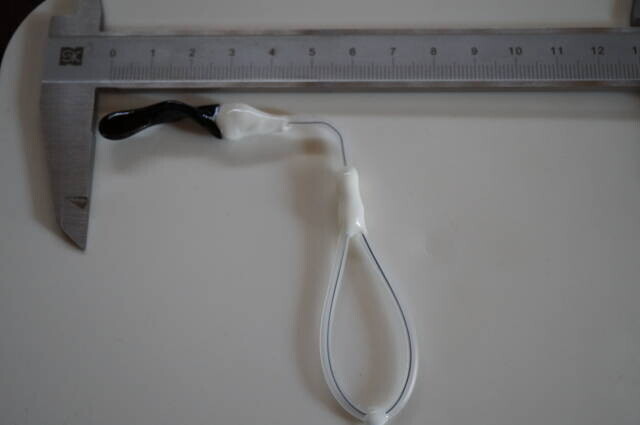
The maker's answer to threadless prostate chips
Mr. Okada’s proposals changed, but his diary repeatedly acknowledged uncertainty about prompt removal.
Threadless chips addressed an infection concern in Mr. Okada’s reasoning
In an entry published in February 2018, Mr. Okada said he believed an external thread increased the possibility of infection. He considered threadless placement the best arrangement specifically from that perspective.
He also explained that the products he sold then had threads to provide reassurance about retrieval. Despite his preference concerning infection, his closing advice was to avoid threadless use as far as possible.
(Source: ok-lab's diary, published February 2018)
https://ok-lab.hatenablog.com/entry/20180214/1518601774
Fully internal chips prompted nylon extensions with important reservations
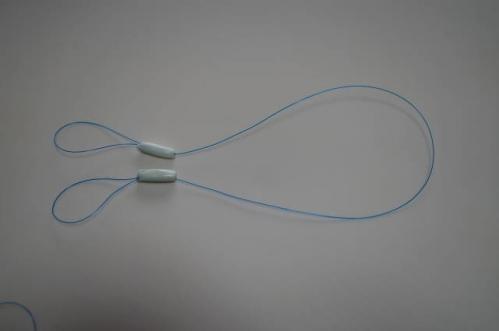
In an entry published in January 2021, Mr. Okada introduced an extension thread for people uneasy about fully internal placement. Its specification was 20cm of nylon with loops about 2cm across at both ends.
He also proposed about 3cm between the main and auxiliary chips, believing this placed the support in a wider urethral section. In his week-long test, he reported that a displaced support returned to that spacing during urination. He advised against fully internal placement for people whose chips readily moved into the bladder, and recommended an external extension while retrieval remained uncertain.
(Source: ok-lab's diary, published January 2021)
https://ok-lab.hatenablog.com/entry/2021/01/16/124800
Threadless chip testing ended the bare wire plan after pain developed
In an entry published in October 2024, Mr. Okada reported outward movement and pain during a fully internal bare-wire test. He abandoned bare 0.3mm wire as the standard replacement for thread, suspecting that its thinness concentrated pressure against the urethral lining.
He changed the formal design to fully covered wire and increased the silicone tubing from 1mm to 2mm for strength and cushioning. The same entry says previously requested bare-wire builds were still made, so this was not an unqualified withdrawal of every custom order. Mr. Okada also acknowledged that he did not know whether the wire’s expanding action was safe.
(Source: ok-lab's diary, published October 2024)
https://ok-lab.hatenablog.com/entry/2024/10/19/122847
Threadless chip designs replaced folding nylon with shape-memory wire
In an entry published in March 2025, Mr. Okada warned that short nylon thread could fold and migrate beyond the chip. He said retrieval became difficult when it reached the wider section near the prostate or the sphincters (muscles that grip the chip).
His alternative used shape-memory wire (wire designed to return toward its set shape), ending in a loop about 20mm long and 8mm wide. The extension was at least 4cm long. He found the proposed straw-based retrieval approach difficult and preferred the multipurpose wire’s J-shaped end for speed. For people concerned about deeper migration, he suggested a version with a bladder loop.
(Source: ok-lab's diary, published March 2025)
https://ok-lab.hatenablog.com/entry/2025/03/29/122912
If you see blood in your urine, even a small amount or for the first time, do not wait and see. See a urologist right away. If you suddenly cannot urinate, or the device cannot be removed, do not try to fix it yourself. Go to a medical facility, including emergency care, immediately.
How threadless prostate chips changed over time
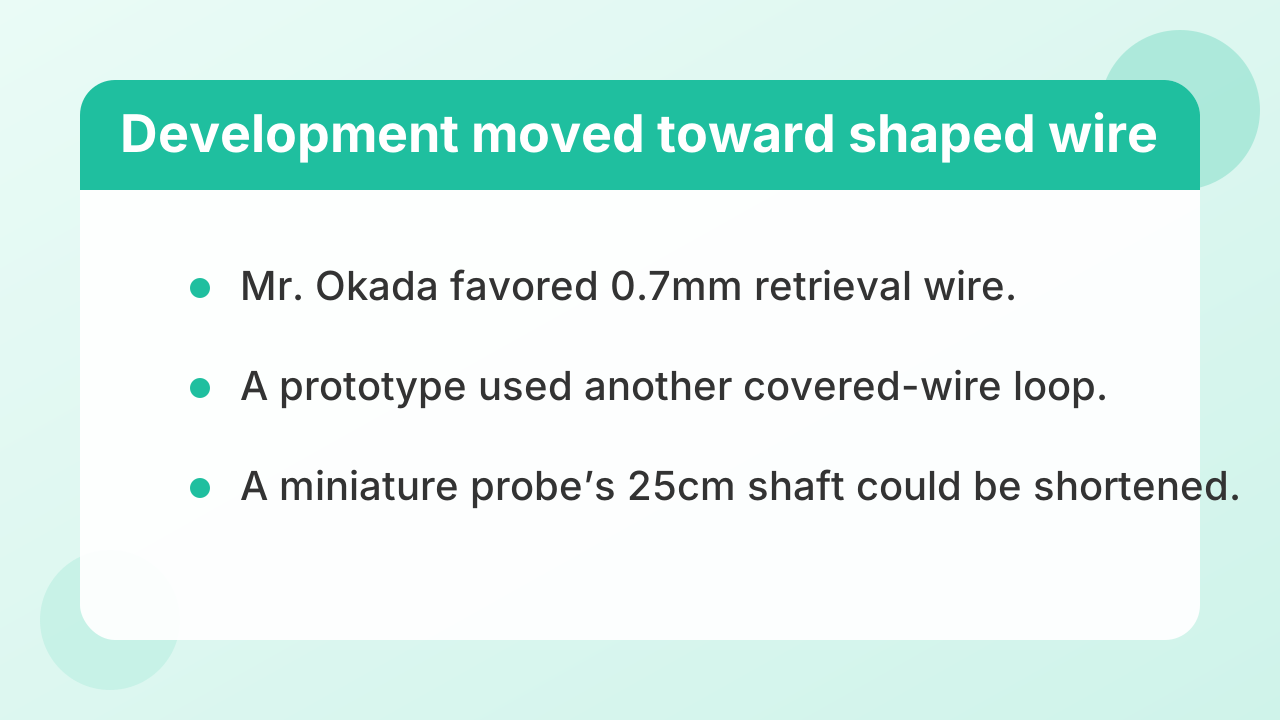
| Published | What the diary said then |
|---|---|
| Apr 2019 | A custom internal connector allowed the external controller to be detached. |
| Jan 2021 | Mr. Okada favored 0.7mm retrieval wire after testing 0.5mm and 1mm alternatives. |
| Mar 2021 | A new connection used a 0.5mm steel core inside cable insulation. |
| Aug 2021 | Mr. Okada reported little nylon-cage shape change after five days inside. |
| Aug 2022 | A sliding holder allowed adjustment of silicone-loop position and size. |
| Oct 2024 | A prototype replaced the solid chip with another covered-wire loop. |
| Feb 2025 | A customer’s figure-eight loop proposal remained unresolved. |
| Apr 2025 | Mr. Okada reported retrieval tests after six days with his threadless device. |
| May 2026 | A miniature probe’s standard 25cm shaft could be shortened for fully internal placement. |
OK Prostate Chip products related to threadless prostate chips
The current list confirms the nylon extension thread, while complete custom threadless assemblies cannot be matched.
Products that appear in these entries
| Product (official name) | Price incl. tax | Relation to this topic |
|---|---|---|
| Nylon extension thread with loops at both ends (両端ループナイロン糸) | ¥550 (about $4 at ¥156 = $1, rate as of 2026-09-04) | In January 2021, Mr. Okada introduced this external extension for people not ready for fully internal placement. |
(Source: ok-lab's diary, published January 2021)
https://ok-lab.hatenablog.com/entry/2021/01/16/124800
The nylon extension thread is sold through OK Lab’s own online store.
Products the diary mentioned as alternatives
The diary names no alternative.
The entries also describe custom auxiliary-chip assemblies, an articulated cable build, covered-wire and chipless designs, a custom ceramic assembly, and a miniature probe. No matching product can be confirmed on the current list.
Common worries about threadless prostate chips
Reader questions focused on reliable removal, inward movement, and whether an internal support could help.
"Can a threadless prostate chip come out whenever needed?"
In an entry published in February 2018, a customer asked about a threadless long chip after a short chip passed after 2 hours. Mr. Okada thought short, straight chips could pass more readily with small amounts of urine or during ejaculation. He believed the long chip’s curve and 2 sphincters could prevent this.
The same customer later reported that the short chip would not come out, although it passed the following morning. Mr. Okada also warned that excessive stimulation could make delayed removal distressing. He therefore advised against threadless use of the long chip’s then-current design.
(Source: ok-lab's diary, published February 2018)
https://ok-lab.hatenablog.com/entry/20180214/1518601774
"Could fully internal chips enter the bladder or feel too strong?"
In an entry published in January 2021, a customer wanted the thread hidden to avoid snagging and displacement. The customer asked about bladder migration and stimulation from a fully internal stainless-ring assembly.
Mr. Okada said he could not predict size suitability or stimulation because experiences differed between people. He offered to publish feedback from a similar custom request if it arrived. The diary does not record a specific result for this questioner.
(Source: ok-lab's diary, published January 2021)
https://ok-lab.hatenablog.com/entry/2021/01/09/130022
"Can fully internal chips include supports inside nylon cages?"
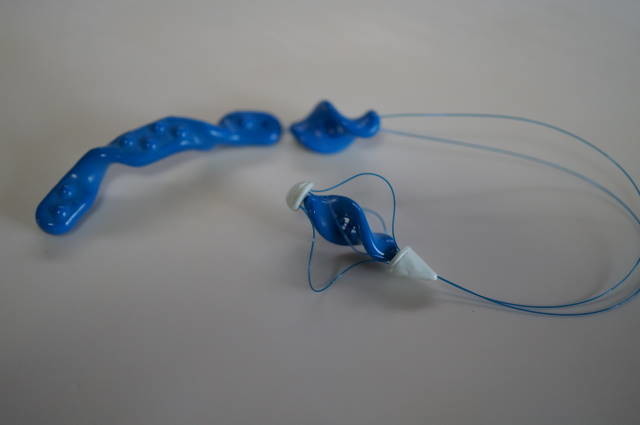
In an entry published in August 2021, a customer asked whether a chip could sit inside a nylon cage (a three-dimensional support structure). Mr. Okada built a prototype containing a screw-shaped auxiliary chip and described it as providing two possible retrieval routes.
The published costs were ¥3,000 (about $19 at ¥156 = $1, rate as of 2026-09-04) for the support, ¥2,000 (about $13 at ¥156 = $1, rate as of 2026-09-04) for the cage, and ¥1,000 (about $6 at ¥156 = $1, rate as of 2026-09-04) for assembly, all excluding tax. He specified that the design required two nylon threads.
(Source: ok-lab's diary, published August 2021)
https://ok-lab.hatenablog.com/entry/2021/08/28/125823
"Could a threadless prostate chip still require hospital removal?"
In an entry published in April 2025, a newcomer asked about thread failure, inward movement, and hospital removal. Mr. Okada offered the newer chipless design as an alternative to solid chips, while acknowledging that someone with limited dexterity might struggle with removal. He thought clinicians could locate the metal using ultrasound or X-rays and retrieve it with medical gripping tools.
The diary does not record whether this reader bought or tried the device. Mr. Okada presented the chipless design as an option, while expressly declining to call it a perfect device.
(Source: ok-lab's diary, published April 2025)
https://ok-lab.hatenablog.com/entry/2025/04/05/122932
Buying from outside Japan
OK Lab ships internationally to countries covered by Japan Post's EMS courier service. Overseas orders are paid in advance by PayPal. Each order carries a ¥400 (about $3 at ¥156 = $1, rate as of 2026-09-04) handling fee, and EMS shipping is charged on top. These terms come from OK Lab's official sales-terms page (written here as plain text, not a link: ok-lab.net/docs/law), checked on September 7, 2026; confirm them on the official store before you order, because they can change.
Summary of this article
| What you wanted to know | The answer |
|---|---|
| In short: can everything stay inside? | The diary describes fully internal designs, but prompt removal remained a concern. |
| What is the product? | A urethral device made by OK Lab in Japan to act on the prostate. |
| What does “threadless” mean here? | Sometimes no external thread; sometimes a design with no nylon thread at all. |
| What happened in practice? | Reports included outward movement, difficult retrieval, cable failure, and pain during bare-wire testing. |
| What did the maker propose? | External extensions, internal loops, and covered wire, with reservations about removal and inward movement. |
| What changed over time? | Development moved from hidden threads toward shaped wire; a shorter probe option appeared in May 2026. |
| What current product is confirmed? | The nylon extension thread is listed at ¥550 (about $4 at ¥156 = $1, rate as of 2026-09-04) including tax; complete custom builds cannot be matched. |
| Could hospital removal still be necessary? | Mr. Okada acknowledged that some people might not manage removal themselves. |
| How do overseas purchases work? | Advance PayPal payment, a ¥400 (about $3 at ¥156 = $1, rate as of 2026-09-04) handling fee, and additional EMS shipping charges. |
Source: ok-lab's diary (Okada Comfortable Life Laboratory). The original entries are in Japanese; quotations on this page are translated. Photos and videos are on the original entries.
This article is a summary of the maker's development diary. The product is not a medical device and no result is guaranteed. If anything feels wrong or worries you, see a doctor. Prices, specifications and cautions change, so confirm the latest information on the official blog and the official site. Questions about ordering and shipping go to the seller.