![Can the chip slip into my bladder? | Stoppers can fail [OK Prostate Chip]](/img/a/T0125/eyecatch.svg)
This page is based on entries from "ok-lab's diary" (https://ok-lab.hatenablog.com/), the Japanese development diary written by Mr. Okada, founder of OK Lab, a small company in Japan (Okada Comfortable Life Laboratory). Only the entries about "preventing a chip from slipping into the bladder" are summarized here, in order of publication. Past prices and sizes are as written at the time. Current prices come from the official product list (retrieved September 4, 2026). Quotations are translated from Japanese.
Note: This page is a personal reading log by someone with no connection to the maker or the seller. It reflects the source entries as of their publication dates and makes no guarantee of accuracy or safety. The product is not a medical device; talk to a doctor about any health decision. Check the official site for current information. This page contains advertising.
In short
- Customers reported chips moving inward despite stoppers, sometimes with pain.
- Mr. Okada proposed internal barriers, external restraints, and wire designs, while acknowledging limitations.
- The current list includes related chips and accessories; it does not confirm every historical custom build.
If you see blood in your urine, even a small amount or for the first time, do not wait and see. See a urologist right away. If you suddenly cannot urinate, or the device cannot be removed, do not try to fix it yourself. Go to a medical facility, including emergency care, immediately.
About this product

The OK Prostate Chip is a small device that is placed in the urethra (the urine passage) so that it acts on the prostate; the maker sells it in several shapes, sizes and materials. It is made and sold by OK Lab (Okada Comfortable Life Laboratory), a small company in Japan, through its own online store, and prices are in Japanese yen (JPY). The maker's development diary, "ok-lab's diary", is written in Japanese. This page is an English summary of it, and every quotation is translated. OK Lab ships internationally, so readers outside Japan can order (see "Buying from outside Japan" below). Product names on this page are plain-English descriptions. The official Japanese product name is shown once in the product table so you can find the same item in the store.
Before you read: key terms
| Term | Plain-English meaning |
|---|---|
| Bladder migration | A chip moving into the bladder; the term names the problem these restraints aim to prevent. |
| Sphincter stopper | An extra component intended to block inward travel at the muscle boundary before the prostate. |
| External stopper | A restraint outside the head of the penis, intended to limit inward movement. |
| Bulbar urethra | The section before the sphincter where the maker locates support parts to limit inward travel. |
| Screw helper | A screw-shaped auxiliary chip proposed as a support or barrier against movement. |
| Shape-memory wire | Flexible wire that tends to recover its preset shape, used to connect and support components. |
| Mesh stopper | A mesh component intended to resist passage across the sphincter. |
| S-shaped urethral sound | A curved shaft carrying a chip; the maker tested it with an external holding plate. |
| Chipless frame | A looped wire device without a separate main chip, designed for retained placement. |
| Hybrid locking attachment | A loop-and-wire support proposed to resist inward travel by widening when straightened. |
| Bladder endoscope | An instrument for seeing inside the bladder, mentioned in the diary's discussion of hospital retrieval. |
What happens: chip migration into the bladder
The OK Prostate Chip is a small urethral device intended to act on the prostate from inside the urine passage. Bladder migration means the chip moves farther inward into the bladder, a problem customers describe in the diary. The maker discusses sphincter stoppers (auxiliary barriers near the muscle boundary before the prostate) and external stoppers (restraints outside the penis head). These parts aim to limit movement, but the entries also describe failures.
An early bladder migration restraint joined flexible silicone and an external ring
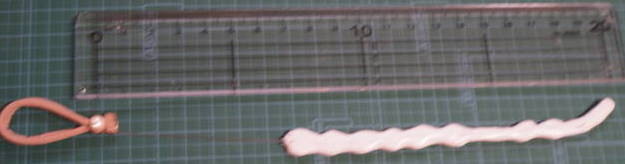
In an entry published in October 2017, Mr. Okada described a silicone prototype approximately 13cm long, connected to a stocking ring. He said the connection reduced accidental loss and offered some control over excessive inward travel. For a device of this length, Mr. Okada favored bendable silicone because he considered rigid material dangerous.
(Source: ok-lab's diary, published October 2017)
https://ok-lab.hatenablog.com/entry/20171022/1508644866
A customer seeking bladder migration protection also reported painful resin snags
In a June 2018 entry, a customer requesting a custom chip with a stopper also reported painful snagging with a long chip. They reported occasional bleeding that prevented repeated insertion and removal. Mr. Okada suspected thicker resin coatings contributed, but had no reliable solution.
The diary does not record whether the discomfort resolved. The maker's July 2021 manual advises against self-repair or modification.
(Source: ok-lab's diary, published June 2018)
https://ok-lab.hatenablog.com/entry/20180630/1530342059
(Source: ok-lab's diary, published July 2021)
https://ok-lab.hatenablog.com/entry/2021/07/24/125923
A longer chip did not necessarily solve complete bladder migration
In an October 2019 entry, a customer using ceramic and glass chips asked why their position changed despite stoppers. Mr. Okada distinguished losing that position from the entire chip entering the bladder. Extra length would not prevent the latter, he said.
The diary does not record whether positioning improved. Mr. Okada suggested an external stopper might be the only remaining measure if the internal stopper failed.
(Source: ok-lab's diary, published October 2019)
https://ok-lab.hatenablog.com/entry/2019/10/26/145539
A cable used for bladder migration control developed exposed wire
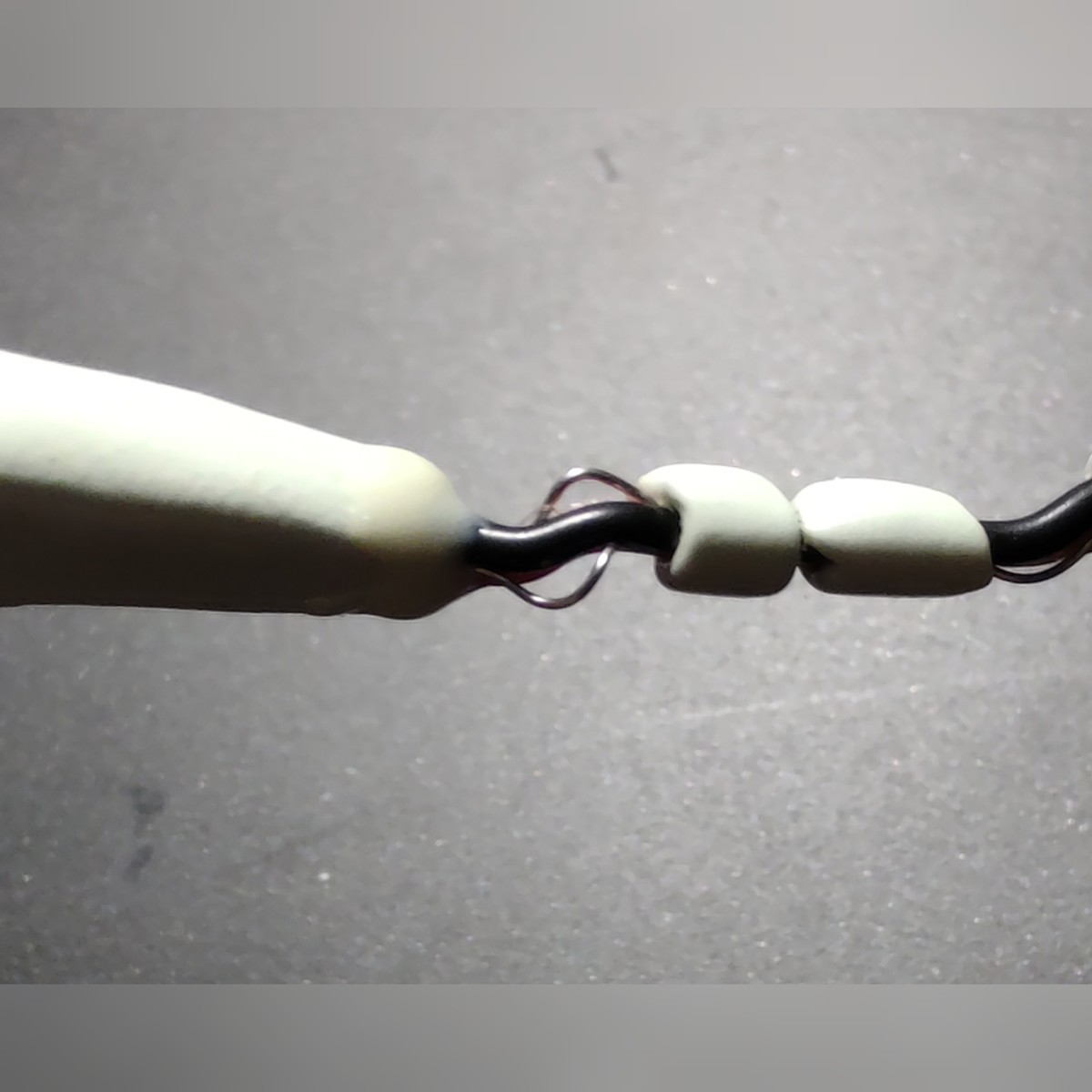
In a July 2022 entry, a customer reported pain and protruding wire on a 4-wire cable, then asked about replacement. Mr. Okada suspected repeated force against a blocked tip could cause extreme buckling and exposed wire. He warned that repeated bending and straightening could eventually break it.
He offered cable replacement rather than wire repair; vibrating versions also required motor replacement. The diary does not record whether replacement occurred. Mr. Okada cautioned against force when the body resisted the device.
(Source: ok-lab's diary, published July 2022)
https://ok-lab.hatenablog.com/entry/2022/07/09/123142
Mr. Okada reported no bladder migration with his external holding plate
In a May 2023 entry, Mr. Okada reported testing an S-shaped urethral sound (a curved shaft carrying the chip) with an external holding plate. He described 3 days of stable placement, without bladder migration or expulsion during urination.
He nevertheless reported small movements within the prostate area as erections developed and subsided. Mr. Okada considered it unnecessary for brief use when movement was not a concern.
(Source: ok-lab's diary, published May 2023)
https://ok-lab.hatenablog.com/entry/2023/05/27/122912
Shape-memory bladder migration accessories carried separate proposed prices in April 2024
In an April 2024 entry, the proposed shape-memory wire (wire that recovers its preset curve) connection and support chip cost ¥3,000, (about $19 at ¥156 = $1, rate as of 2026-09-04) tax excluded. A tube cover added ¥1,000 (about $6 at ¥156 = $1, rate as of 2026-09-04), tax excluded. A screw helper (screw-shaped support) cost ¥3,000 (about $19 at ¥156 = $1, rate as of 2026-09-04) and a mesh stopper (mesh barrier) ¥2,000 (about $13 at ¥156 = $1, rate as of 2026-09-04), both tax excluded. These were proposed additions to the ordinary chip price.
The connection also extended the main chip by approximately 5-7mm. Mr. Okada advised stopping use if the outer resin at the connection became damaged.
(Source: ok-lab's diary, published April 2024)
https://ok-lab.hatenablog.com/entry/2024/04/13/123053
Some bladder migration attachments broke, prompting refunds instead of repairs
The February 2025 entry recorded wire failures reported by 2 customers. One sought repairs after a 90-degree locking attachment and bladder-loop connections broke. Staff said the cause remained unknown and offered refunds for recently supplied items.
The customer returned an item and again requested repair or changes. Staff maintained the refund offer for 2 items; completion is not recorded. Mr. Okada suggested waiting for wire with a preset curve before requesting another build.
(Source: ok-lab's diary, published February 2025)
https://ok-lab.hatenablog.com/entry/2025/02/15/122943
A sideways stopper still caused painful bladder migration concerns in August 2026
In an August 2026 entry, a customer said muscle movements drew the chip toward the bladder. They described the stopper crossing the sphincter sideways, causing pain. They requested a wire-shaped device and an adjustable locking attachment on a stainless-steel chip.
The diary does not record how either build felt. Mr. Okada thought these alternatives might hurt less during involuntary inward movement.
(Source: ok-lab's diary, published August 2026)
https://ok-lab.hatenablog.com/entry/2026/08/08/122906
The maker's answer to chip migration into the bladder
Mr. Okada's proposals depended on how each stopper or support resisted inward movement.
Early bladder migration advice depended on both spacing and stopper position
In a July 2018 entry, Mr. Okada's explanation assumed at least 6mm, preferably 10mm or more, between the main chip and stopper. He described a stopper free within the bulbar urethra (the section before the sphincter) as turning across the direction of pull. A partly trapped stopper, he said, could instead travel inward lengthwise. Mr. Okada's prevention advice depended on that spacing and stopper position; he said migration was then rare.
(Source: ok-lab's diary, published July 2018)
https://ok-lab.hatenablog.com/entry/20180707/1530947332
The maker's manual acknowledged bladder migration could require hospital care
In a July 2021 entry, Mr. Okada's draft manual said a sphincter stopper or screw helper was needed when a chip reached the bladder. It also addressed chips that could not be removed, including a July 31 addition. It discussed hospital care involving a bladder endoscope (an instrument for seeing inside the bladder). For hospital removal, the manual directed people toward hospitals with urology and emergency services.
(Source: ok-lab's diary, published July 2021)
https://ok-lab.hatenablog.com/entry/2021/07/24/125923
Mesh bladder migration barriers came with qualifications about pressure and anatomy
In an April 2024 entry, Mr. Okada favored a covered wire with a mesh stopper for simple migration prevention. He considered it safer, but his test was personal; a wider urethra might allow passage. He said a screw helper alone still needed an external restraint.
He also warned that prolonged mesh contact could burden the sphincter. His proposed combination used the screw helper as the first barrier and mesh as backup, reducing routine mesh contact.
(Source: ok-lab's diary, published April 2024)
https://ok-lab.hatenablog.com/entry/2024/04/13/123053
A bladder-loop frame was proposed for worries about complete bladder migration
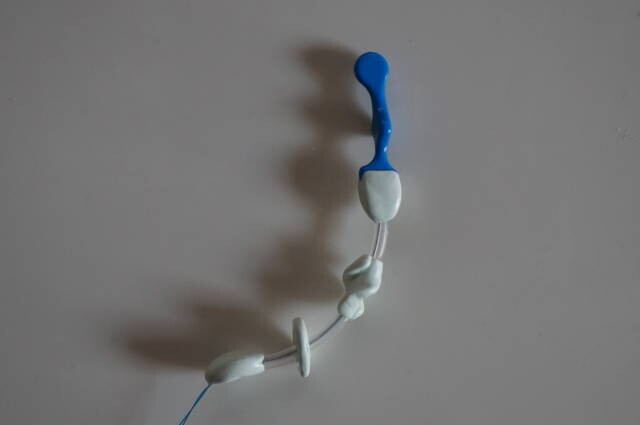
In a March 2025 entry, Mr. Okada described a threadless chipless frame (a looped wire device without a separate main chip). Its published example price was ¥9,000, (about $58 at ¥156 = $1, rate as of 2026-09-04) tax excluded. The entry listed ¥6,000 (about $38 at ¥156 = $1, rate as of 2026-09-04) for the frame, ¥4,000 (about $26 at ¥156 = $1, rate as of 2026-09-04) for its terminal loop, and a ¥1,000 (about $6 at ¥156 = $1, rate as of 2026-09-04) deduction for omitting nylon thread.
For migration concerns, he described a bladder-loop version approaching 20cm overall. He claimed the bladder would stop further travel, making complete migration physically impossible. Mr. Okada suggested that version for people worried about the whole device moving beyond reach.
(Source: ok-lab's diary, published March 2025)
https://ok-lab.hatenablog.com/entry/2025/03/29/122912
If you see blood in your urine, even a small amount or for the first time, do not wait and see. See a urologist right away. If you suddenly cannot urinate, or the device cannot be removed, do not try to fix it yourself. Go to a medical facility, including emergency care, immediately.
How chip migration into the bladder changed over time
| Published | What the diary said then |
|---|---|
| Oct 2019 | Mr. Okada said extra length could not prevent complete migration. |
| Mar 2020 | He favored a flexible screw extension over making one rigid chip excessively long. |
| Jul 2021 | Draft instructions called for a stopper or screw helper when chips reached the bladder. |
| Feb 2025 | Unexplained wire failures prompted refunds for recently supplied items. |
| Aug 2026 | A customer reported painful passage even with the stopper sideways. |
| Aug 2026 | Two-wire tubing was standard; four-wire requests were not accepted then. |
OK Prostate Chip products related to chip migration into the bladder
The current list includes chips involved in migration complaints and the ring used with an early prototype.
Products that appear in these entries
| Product (official name) | Price incl. tax | Relation to this topic |
|---|---|---|
| Stocking ring with cotton pearl (コットンパール・ストッキングリング) | ¥550 (about $4 at ¥156 = $1, rate as of 2026-09-04) | The October 2017 entry connected this ring to a silicone prototype to limit inward travel. |
| Glass medium-length twisted chip (OKプロステートチップ ガラス素材セミロングタイプ コブラツイスト) | ¥5,500 (about $35 at ¥156 = $1, rate as of 2026-09-04) | The October 2019 entry named this among a customer's chips that shifted inward despite stoppers. |
| Ceramic medium-length bead-shaped chip (OKプロステートチップ 陶器素材セミロング勾玉タイプ) | ¥5,500 (about $35 at ¥156 = $1, rate as of 2026-09-04) | The October 2019 entry questioned whether losing track of this chip's rear end meant migration. |
| Ceramic long four-point twisted chip (OKプロステートチップ 陶器素材ロングタイプ 4点ツイスト) | ¥7,700 (about $49 at ¥156 = $1, rate as of 2026-09-04) | The March 2020 entry described apparent bladder migration with this chip. |
| Stainless-steel medium-length chip (OKプロステートチップ セミロングタイプ(サージカルステンレス)) | ¥9,900 (about $63 at ¥156 = $1, rate as of 2026-09-04) | The August 2026 entry specified this chip for a custom build following painful stopper passage. |
(Source: ok-lab's diary, published October 2017)
https://ok-lab.hatenablog.com/entry/20171022/1508644866
(Source: ok-lab's diary, published October 2019)
https://ok-lab.hatenablog.com/entry/2019/10/26/145539
(Source: ok-lab's diary, published March 2020)
https://ok-lab.hatenablog.com/entry/2020/03/07/152901
(Source: ok-lab's diary, published August 2026)
https://ok-lab.hatenablog.com/entry/2026/08/08/122906
Products the diary mentioned as alternatives
The diary names no alternative.
Historical prototypes and custom assemblies:
No matching product can be confirmed on the current list.
Common worries about chip migration into the bladder
The questions concern unconfirmed migration, movement during sleep, and untested external stoppers.
"Does losing track of the chip prove bladder migration?"
In an October 2019 entry, a customer with a ceramic bead-shaped chip asked whether losing touch with its rear end meant bladder migration. Mr. Okada said that did not establish whether it had reached the bladder. He thought the bead-shaped end had passed the sphincter. Mr. Okada's advice concerned its intended position: the bead-shaped end belonged before the sphincter.
(Source: ok-lab's diary, published October 2019)
https://ok-lab.hatenablog.com/entry/2019/10/26/145539
"Can bladder migration happen during sleep?"
In a February 2025 entry, a customer asked about wire failure and several devices repeatedly moving inward. They confirmed a refund; the diary records no outcome for the positioning problem. Mr. Okada suggested that pressure from blood during erections could narrow the urethra and push a chip toward the prostate.
He associated that movement with possible bladder migration during sleep. His proposed hybrid locking attachment (a loop-and-wire support) widened as it straightened, which he said prevented sphincter passage. Mr. Okada favored this attachment when inward movement persisted.
(Source: ok-lab's diary, published February 2025)
https://ok-lab.hatenablog.com/entry/2025/02/15/122943
"Can an external stopper prevent a tube moving deeper?"
In an August 2026 entry, a customer requested a 25cm tube with a terminal stopper. Mr. Okada said 2-wire tubing was standard; 4-wire required a larger tube and was unavailable then. He had not tried the requested stopper connection and could not confirm feasibility.
The diary does not record whether that order was completed. Mr. Okada suggested a larger resin ball as another possible restraint against excessive inward travel.
(Source: ok-lab's diary, published August 2026)
https://ok-lab.hatenablog.com/entry/2026/08/29/122931
Buying from outside Japan

OK Lab ships internationally to countries covered by Japan Post's EMS courier service. Overseas orders are paid in advance by PayPal. Each order carries a ¥400 (about $3 at ¥156 = $1, rate as of 2026-09-04) handling fee, and EMS shipping is charged on top. These terms come from OK Lab's official sales-terms page (written here as plain text, not a link: ok-lab.net/docs/law), checked on September 7, 2026; confirm them on the official store before you order, because they can change.
Summary of this article
| What you wanted to know | The answer |
|---|---|
| In short: can migration happen? | Customers reported inward movement despite stoppers. |
| About this product: who makes it? | OK Lab in Japan makes the urethral device; prices are in yen. |
| Key terms: what are the restraints? | Internal stoppers, external restraints, and wire supports address movement in different ways. |
| What happens: what went wrong? | Reports included pain, resin snags, stopper passage, and wire failures. |
| The maker's answer: what did he propose? | Spacing, barriers, external support, and loop designs, each tied to particular conditions. |
| Changes over time: did concerns end? | August 2026 still included pain and untested attachments. |
| Related products: what is currently listed? | The table gives current names and prices for the listed components and chips. |
| Common worries: is movement proof of migration? | Mr. Okada said losing touch alone did not establish bladder migration. |
| Buying internationally: what terms were supplied? | Advance PayPal payment, a ¥400 (about $3 at ¥156 = $1, rate as of 2026-09-04) handling fee, and additional EMS shipping. |
Source: ok-lab's diary (Okada Comfortable Life Laboratory). The original entries are in Japanese; quotations on this page are translated. Photos and videos are on the original entries.
This article is a summary of the maker's development diary. The product is not a medical device and no result is guaranteed. If anything feels wrong or worries you, see a doctor. Prices, specifications and cautions change, so confirm the latest information on the official blog and the official site. Questions about ordering and shipping go to the seller.