![How far apart should linked chips be? | No single gap fits every design [OK Prostate Chip]](/img/a/T0132/eyecatch.svg)
This page is based on entries from "ok-lab's diary" (https://ok-lab.hatenablog.com/), written by Mr. Okada, founder of OK Lab, a small company in Japan (Okada Comfortable Life Laboratory). Only entries about choosing the distance between linked chips are summarized here, in order of publication. Past prices and sizes are as written at the time. Current prices come from the official product list (retrieved September 4, 2026). Quotations are translated from Japanese.
Note: This page is a personal reading log by someone with no connection to the maker or the seller. It reflects the source entries as of their publication dates and makes no guarantee of accuracy or safety. The product is not a medical device; talk to a doctor about any health decision. Check the official site for current information. This page contains advertising.
In short
Chip spacing affects flexibility and position, but the diary gives no measurement that suits everyone.
Mr. Okada considers the connection design and declines to judge an individual's fit.
The current list includes screw auxiliaries; June 2026 guidance describes zero spacing as a cushioned connection.
If you see blood in your urine, even a small amount or for the first time, do not wait and see. See a urologist right away.
If you suddenly cannot urinate, or the device cannot be removed, do not try to fix it yourself. Go to a medical facility, including emergency care, immediately.
About this product

The OK Prostate Chip is a small device that is placed in the urethra (the urine passage) so that it acts on the prostate; the maker sells it in several shapes, sizes and materials. It is made and sold by OK Lab (Okada Comfortable Life Laboratory), a small company in Japan, through its own online store, and prices are in Japanese yen (JPY).
The maker's development diary, "ok-lab's diary", is written in Japanese. This page is an English summary of it, and every quotation is translated. OK Lab ships internationally, so readers outside Japan can order (see "Buying from outside Japan" below). Product names on this page are plain-English descriptions. The official Japanese product name is shown once in the product table so you can find the same item in the store.
Before you read: key terms
| Term | Plain-English meaning |
|---|---|
| Urethra | The urine passage; it carries urine and is where these devices are placed. |
| Chip spacing | The distance between linked pieces; it leaves room for the connection and affects their positions. |
| Sphincter | The closing structure described in the diary; it can grip a narrow section to help hold the device. |
| Bulbar urethra | The wider area before the sphincter in these accounts; it accommodates a rear chip or loop. |
| Screw auxiliary | A twisted additional chip; the maker uses it to assist placement and support the main chip. |
| Cushioning tube | A sleeve around connecting thread; the maker uses it for cushioning and resistance to folding. |
| Endoscope | Equipment doctors used to remove a trapped chip. The diary does not explain this. |
What happens: chip spacing
The OK Prostate Chip is a small device placed in the urine passage to act on the prostate. Linked versions divide the device into separate pieces, with thread or another connector between them. The gap can lie across the sphincter (the closing structure that can grip the connection), with a rear piece in the bulbar urethra (the wider area before it). Mr. Okada discusses spacing as a compromise involving flexibility, comfort, and support.
A reported injury made chip spacing part of the redesign
In an entry published in December 2017, a tester reported sphincter injury after several days of continuous, 24-hour wear. The device was an advanced long chip.
Mr. Okada suspected that its length restricted movement and placed excessive force on the sphincter at certain positions. His proposed response was a flexible paired design, with about 10 mm of thread separating the main and rear chips.
(Source: ok-lab's diary, published December 2017)
https://ok-lab.hatenablog.com/entry/20171231/1514712104
Chip spacing tests replaced the planned rigid long version
In an entry published in January 2018, Mr. Okada estimated that he had made and tested about 20 prototypes. At roughly 10 mm spacing, he reported no sphincter strain, but later found the sensation less satisfying. A gap around 3 mm restored some sensation, which he described as gentler than before.
Even touching sections, described as 0 mm spacing, could bend at their connection. He cancelled the planned rigid long version. Mr. Okada favored linked short sections and proposed letting customers choose their gaps.
(Source: ok-lab's diary, published January 2018)
https://ok-lab.hatenablog.com/entry/20180106/1515230584

A cracked connection interrupted the jointed ceramic chip spacing discussion
In an entry published in January 2020, Mr. Okada reported a cracked connection on an owner's long jointed ceramic chip. He suspected that longer versions placed greater force on the joint.
He had previously considered cracking possible but had not expected complete breakage. After receiving the actual crack report, his response was to suspend sales of that jointed design for the time being.
(Source: ok-lab's diary, published January 2020)
https://ok-lab.hatenablog.com/entry/2020/01/11/151714
Chip spacing depended on whether the rear part obstructed urine
In an entry published in November 2020, Mr. Okada associated urinary leakage with suspected sphincter injury during testing of a projecting connector. A different, straight-ended connection with approximately 6 mm spacing caused no problem during his 10-hour test.
He said a stopper opposed urine flow differently from a screw auxiliary (a twisted supporting chip) or flat piece. Mr. Okada favored at least 5 mm for a stopper, while considering 4 mm or less acceptable for screw-shaped or flat auxiliaries.
(Source: ok-lab's diary, published November 2020)
https://ok-lab.hatenablog.com/entry/2020/11/14/131426
Chip spacing was not established as the cause of reversal
In an entry published in August 2022, a customer reported that a curved resin chip with a screw auxiliary became trapped. The customer experienced bleeding and increasing pain, and doctors reported that the main chip had turned 180 degrees. Removal with an endoscope (the hospital's removal instrument) cost approximately ¥23,000 (about $147 at ¥156 = $1, rate as of 2026-09-04), the patient's billed share.
The customer subsequently decided to stop using chips. Mr. Okada distinguished the confirmed reversal from speculation about how spacing contributed. His proposed response was to develop a safer screw connection.
(Source: ok-lab's diary, published August 2022)
https://ok-lab.hatenablog.com/entry/2022/08/27/123001
Early cable failure did not establish chip spacing as its cause
In an entry published in August 2024, a customer reported cable failure in a vibrating linked model before 10 uses. The customer suspected that insufficient length had caused strain. Inspection instead located the break about 15 mm away from the resin cover.
OK Lab repaired the device, but Mr. Okada could not establish the cause or assess the customer's internal fit. He suggested a connector longer than the standard 3 cm only if the existing length was insufficient.
(Source: ok-lab's diary, published August 2024)
https://ok-lab.hatenablog.com/entry/2024/08/31/122909
Extra chip spacing displaced a loop in Mr. Okada's prototype
In an entry published in December 2024, Mr. Okada tested a ceramic-and-loop prototype inspired by a customer's custom request. Its rear gap was 25-30 mm, around 20 mm longer than his earlier loop-only arrangement. The rear loop did not fit its intended space and was expelled during urination.
A later configuration stayed in place but produced strong urinary urgency and lingering mild pain, according to his account. The customer's specifications remained unresolved, and the diary does not record a completed order. Mr. Okada proposed shortening his prototype's gap and requested a clearer customer drawing.
(Source: ok-lab's diary, published December 2024)
https://ok-lab.hatenablog.com/entry/2024/12/21/122903
The maker's answer to chip spacing
Mr. Okada's proposed spacing changes depend on the connector, the parts it joins, and the problem being addressed.
Adjustable chip spacing addressed competing needs in the early paired design
In an entry published in March 2018, Mr. Okada described a conflict within fixed-gap paired chips. He wrote that shorter gaps helped placement, while separation from the sphincter could feel more comfortable afterward.
Customer suggestions had prompted a concept allowing the rear chip to move independently. Mr. Okada's proposed answer was an adjustable two-thread connection, which was still being prototyped.
(Source: ok-lab's diary, published March 2018)
https://ok-lab.hatenablog.com/entry/20180312/1520844839
Shorter stopper spacing addressed opposing forces during substantial contraction
In an entry published in November 2025, Mr. Okada described a wire-loop prototype with stoppers near the sphincter and penile opening. During substantial contraction, he reported that the stoppers pushed against each other.
In his account, the opening-side stopper escaped outward rather than the assembly moving farther toward the prostate. Mr. Okada considered shortening the distance between those stoppers the only answer to preventing escape at either end.
(Source: ok-lab's diary, published November 2025)
https://ok-lab.hatenablog.com/entry/2025/11/15/122921
Separated apple-shaped stoppers had manufacturing limits on chip spacing
In an entry published in December 2025, Mr. Okada described separate and integrated versions of an apple-shaped loop stopper. The separated version had approximately 2 mm between parts. He said a shorter gap could not be manufactured, while a longer one made placement unstable.
Both versions cost ¥4,000 (about $26 at ¥156 = $1, rate as of 2026-09-04) excluding tax, as published in December 2025. He reported difficult removal with both designs. Mr. Okada cautioned that the integrated version's fixed relationship between chip and stopper could place strain on the urine passage at certain positions.
(Source: ok-lab's diary, published December 2025)
https://ok-lab.hatenablog.com/entry/2025/12/20/123000
If you see blood in your urine, even a small amount or for the first time, do not wait and see. See a urologist right away.
If you suddenly cannot urinate, or the device cannot be removed, do not try to fix it yourself. Go to a medical facility, including emergency care, immediately.
How chip spacing changed over time
| Published | What the diary said then |
|---|---|
| Jan 2018 | The planned rigid long version was cancelled in favor of linked sections. |
| Mar 2018 | An adjustable two-thread design entered prototyping. |
| Jan 2020 | A cracked joint prompted temporary suspension of jointed ceramic chip sales. |
| Nov 2020 | Stopper connections received different spacing advice from screw-shaped auxiliaries. |
| Dec 2022 | An eight-hole support was introduced to maintain chosen gaps. |
| Jan 2024 | Dedicated position stops cost ¥500 (about $3 at ¥156 = $1, rate as of 2026-09-04) excluding tax each and kept curved parts separated. |
| Apr 2024 | Wire connections offered 3 cm, 4 cm, or 5 cm lengths. |
| Dec 2025 | Separated apple-shaped stoppers had an approximately 2 mm manufacturing gap. |
| Jun 2026 | Connections about 10 mm or shorter received cushioning tubes, including zero-gap requests. |
OK Prostate Chip products related to chip spacing
The current list includes the main chip and screw auxiliary named in the June 2026 spacing question.
Products that appear in these entries
| Product (official name) | Price incl. tax | Relation to this topic |
|---|---|---|
| Longer twisted ceramic chip (OKプロステートチップ 陶器素材セミロングタイプ コブラツイスト) | ¥5,500 (about $35 at ¥156 = $1, rate as of 2026-09-04) | In June 2026, a customer requested this main chip while asking about gaps between several attached auxiliaries. |
| Second-generation resin screw auxiliary (スクリュー型補助チップ追加オプション(第二世代生体適合樹脂)) | ¥3,500 (about $22 at ¥156 = $1, rate as of 2026-09-04) | In June 2026, the customer's proposed order included this auxiliary in a discussion of flexibility and spacing. |
The longer twisted ceramic chip is listed in OK Lab's own online store.
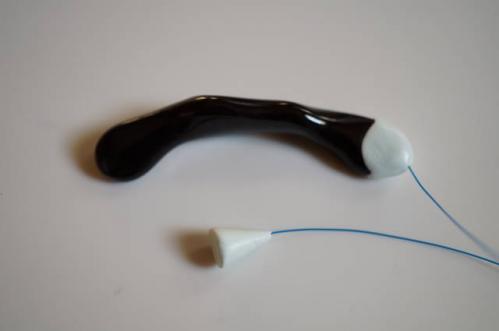
The second-generation resin screw auxiliary is listed in the company's own online store.

(Source: ok-lab's diary, published June 2026)
https://ok-lab.hatenablog.com/entry/2026/06/06/122905
Products the diary mentioned as alternatives
The diary names no alternative.
Historical paired prototypes, the jointed ceramic design, the hospital-case resin build, the vibrating linked build, wire-loop prototypes, eight-hole support, dedicated stops, and custom connector arrangements: No matching product can be confirmed on the current list.
Common worries about chip spacing
Customer questions concern what can be built, whether connections remain flexible, and whether a proposed gap suits the individual.
"Can five linked screws have 3 mm chip spacing?"
In an entry published in June 2023, a customer requested five small screws on reinforced cord with 3 mm gaps. Mr. Okada initially considered the design impractical because the cord resisted holding its shape during manufacture. He said roughly 10 mm would normally be needed, but would consider a trial with at least 5 mm and a different leading piece.
His alternative was a thread-linked resin arrangement, with gaps covered by tubing measuring 2 mm outside and 1 mm inside. The diary does not record whether the proposed order was completed. Mr. Okada preferred that simpler arrangement, while acknowledging that the requested reinforced cord might make placement easier.
(Source: ok-lab's diary, published June 2023)
https://ok-lab.hatenablog.com/entry/2023/06/03/121955
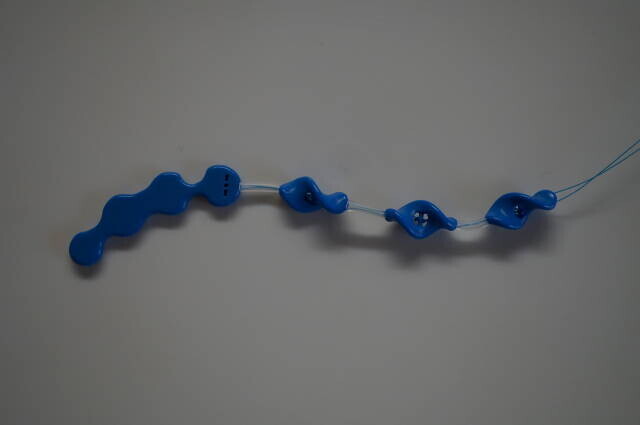
"Would longer tube connections improve chip spacing?"
In an entry published in September 2024, a customer revised a request for a gourd-shaped urethral support, seeking a 3 cm tube connection. Mr. Okada recalled an earlier prototype using 2 mm tubing across approximately 1 cm. He said a longer tube lacked enough stiffness to support that connection.
The revised arrangement combined the main chip, a flat auxiliary, a small resin connector, and the urethral support. He approved the assembled design, but the diary does not record how it felt in use. Mr. Okada favored this revised arrangement over the requested long tube.
(Source: ok-lab's diary, published September 2024)
https://ok-lab.hatenablog.com/entry/2024/09/21/122907
"Does zero chip spacing make several screw auxiliaries rigid?"
In an entry published in June 2026, a customer asked whether closely spaced screw auxiliaries could bend and remain removable. Mr. Okada said connections about 10 mm or shorter automatically received cushioning tubes, so 0 mm did not describe a literal zero gap. He expected flexibility because the connecting thread stretched.
He had received no problem reports involving multiple screw auxiliaries, but could not assess whether the proposed spacing suited this customer's anatomy. The diary does not record whether this order was completed. Mr. Okada advised resolving specifications before payment because production normally began once payment arrived.
(Source: ok-lab's diary, published June 2026)
https://ok-lab.hatenablog.com/entry/2026/06/06/122905
Buying from outside Japan

OK Lab ships internationally to countries covered by Japan Post's EMS courier service. Overseas orders are paid in advance by PayPal. Each order carries a ¥400 (about $3 at ¥156 = $1, rate as of 2026-09-04) handling fee, and EMS shipping is charged on top. These terms come from OK Lab's official sales-terms page (written here as plain text, not a link: ok-lab.net/docs/law), checked on September 7, 2026; confirm them on the official store before you order, because they can change.
Summary of this article
| What you wanted to know | The answer |
|---|---|
| The short answer | The diary provides no gap that fits everyone. |
| What the product is | A urethral device made by OK Lab in Japan. |
| What spacing means | The distance between connected pieces, affecting flexibility and position. |
| What happened in the cases | Reports included injury, reversal, cable failure, and poor positioning. |
| What the maker proposed | Different connections required different spacing decisions. |
| What changed over time | Designs progressed from fixed gaps to adjustable and cushioned connections. |
| Which current products appear | The longer twisted ceramic chip and second-generation resin screw auxiliary. |
| What customer questions establish | Manufacturing limits can be described; individual fit remained unresolved. |
| How overseas buying works | Advance PayPal payment, a ¥400 (about $3 at ¥156 = $1, rate as of 2026-09-04) handling fee, and additional EMS shipping. |
| What to take from the article | Mr. Okada's dated observations do not establish a universal spacing specification. |
Source: ok-lab's diary (Okada Comfortable Life Laboratory). The original entries are in Japanese; quotations on this page are translated. Photos and videos are on the original entries.
This article is a summary of the maker's development diary. The product is not a medical device and no result is guaranteed. If anything feels wrong or worries you, see a doctor. Prices, specifications and cautions change, so confirm the latest information on the official blog and the official site. Questions about ordering and shipping go to the seller.