![Does the prostate chip thread hurt? | Cables and tubes felt gentler in some diary reports [OK Prostate Chip]](/img/a/T0113/eyecatch.svg)
This page is based on entries from "ok-lab's diary" (https://ok-lab.hatenablog.com/), the Japanese development diary written by Mr. Okada, founder of OK Lab, a small company in Japan (Okada Comfortable Life Laboratory). Only the entries about "cable and tube comfort compared with thread" are summarized here, in order of publication. Past prices and sizes are as written at the time. Current prices come from the official product list (retrieved September 4, 2026). Quotations are translated from Japanese.
Note: This page is a personal reading log by someone with no connection to the maker or the seller. It reflects the source entries as of their publication dates and makes no guarantee of accuracy or safety. The product is not a medical device; talk to a doctor about any health decision. Check the official site for current information. This page contains advertising.
In short
- Some customers reported less thread discomfort with cables or covered cords, but these were individual experiences.
- Mr. Okada explored softer coverings while acknowledging friction, broken wiring, and replacement limits.
- The current list includes a chip from these accounts; its historical custom cord is not confirmed today.
If you see blood in your urine, even a small amount or for the first time, do not wait and see. See a urologist right away. If you suddenly cannot urinate, or the device cannot be removed, do not try to fix it yourself. Go to a medical facility, including emergency care, immediately.
About this product
The OK Prostate Chip is a small device that is placed in the urethra (the urine passage) so that it acts on the prostate; the maker sells it in several shapes, sizes and materials. It is made and sold by OK Lab (Okada Comfortable Life Laboratory), a small company in Japan, through its own online store, and prices are in Japanese yen (JPY). The maker's development diary, "ok-lab's diary", is written in Japanese. This page is an English summary of it, and every quotation is translated. OK Lab ships internationally, so readers outside Japan can order (see "Buying from outside Japan" below). Product names on this page are plain-English descriptions. The official Japanese product name is shown once in the product table so you can find the same item in the store.
Before you read: key terms
| Term | Plain-English meaning |
|---|---|
| Urethra | The passage carrying urine, where the device sits. |
| Retrieval thread | Nylon line attached to the chip, intended for removal. |
| Cable | Electrical wires with a protective covering, supplying power to vibrating chips. |
| Silicone tube cover | A soft sleeve around thread or wire, intended to soften contact. |
| Vinyl | A covering material used to protect the wiring in early cables. |
| Supported cable | A cable reinforced with additional wires, intended to help maintain the chip's position. |
| USB connector | An electrical connector used for the powered cable assembly. |
| Tube tail | Covered nylon behind the chip, intended to reduce direct thread contact. |
| Screw-shaped support chip | A twisted part helping hold the main chip's position. |
| Shape-memory wire | Wire returning toward a preset curve, used to connect chip sections. |
What happens: prostate chip thread discomfort
The OK Prostate Chip is a small device placed in the urethra, or urine passage, to act on the prostate. Its retrieval thread (nylon line intended for removal) trails behind it through that passage. A cable (electrical wires with protective covering) also supplies power on vibrating models. A silicone tube cover (a soft sleeve around thread or wire) changes which material touches the passage. The diary explores these coverings as ways to reduce discomfort from the attached line.
Early cable comfort claims prompted a trial of silicone coating
A December 2018 entry records a reader's question about the vibrating chip's wiring. Mr. Okada described very thin vinyl wiring (wires protected by a vinyl covering). He wrote that electrical leakage did not appear to be occurring and that he considered the wiring gentle enough on the urethra.
The diary does not record how the coating felt to that reader. Mr. Okada responded by trying a silicone coating.
(Source: ok-lab's diary, published December 2018)
https://ok-lab.hatenablog.com/entry/20181222/1545459719
Cable comfort improvements also required changes after repeated bending failures
A March 2019 entry reports wiring failures during Mr. Okada's repeated bending tests. The earlier vinyl-covered line had an outside diameter of 1 mm and 6 internal strands. Its replacement used silicone covering, an outside diameter of 1.2 mm, and 24 strands.
He also cautioned that silicone did not necessarily slide well against the urethral lining. He nevertheless favored this cable because he thought its thinness limited strong friction.
(Source: ok-lab's diary, published March 2019)
https://ok-lab.hatenablog.com/entry/2019/03/23/173222
Thread discomfort drove a request after another vibrating chip wiring failure
A February 2020 entry records another partial wiring break at the base of a customer's repaired medium-length vibrating chip. They wanted cable instead of additional nylon thread, explaining that slight continuous tension during 4–5 hours of use made the thin thread painful. Mr. Okada initially questioned the need and rejected part of the proposed wiring layout.
After clarification, he accepted a build with two powered cables and reported making it, although the customer's experience afterward is unrecorded. He suspected the motor's fine wires, rather than the main cable, were the more likely failure point. He considered self-repair difficult and potentially damaging.
(Source: ok-lab's diary, published February 2020)
https://ok-lab.hatenablog.com/entry/2020/02/08/151653
A customer reported better cable comfort after problems with thicker wiring
An entry published in August 2020 records a customer's response to an extremely thin cable. They said they no longer noticed its presence and no longer had the bleeding concern associated with their thicker cord. The dark cable was hard to distinguish from the blue thread.
The diary records no medical assessment of the bleeding. Mr. Okada welcomed the report as encouraging for softness and durability.
(Source: ok-lab's diary, published August 2020)
https://ok-lab.hatenablog.com/entry/2020/08/08/130037
Supported cable comfort improved in Mr. Okada's early personal trial
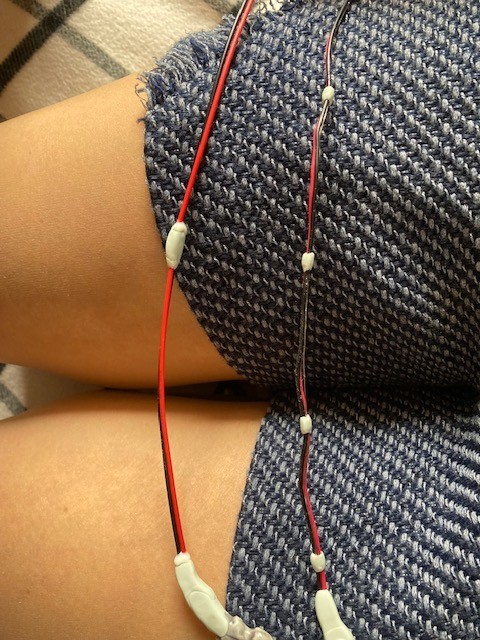
A March 2022 entry describes Mr. Okada's supported cable (an electrical cable reinforced with additional wire). A wire of about 0.4 mm followed the groove between its electrical lines. He reported easier bending and better retention of the bent shape than with the stiff custom cable pictured alongside it.
He described a gentle feel. He planned further wire comparisons before deciding which material was best.
(Source: ok-lab's diary, published March 2022)
https://ok-lab.hatenablog.com/entry/2022/03/12/122940
Reinforced cable comfort came with proposed surcharges and electrical limits
In his August 2023 entry, Mr. Okada proposed thin electrical cords reinforced with nylon thread, judging their feel milder than nylon alone. The powered package included 30 cm of cable, a waterproof USB connector (an electrical connector), 5 cm of thread, and an end piece. Proposed surcharges were ¥4,000, (about $26 at ¥156 = $1, rate as of 2026-09-04) tax excluded, for powered chips, or ¥3,000, (about $19 at ¥156 = $1, rate as of 2026-09-04) tax excluded, for a cord without electrical function.
He warned that electrical failure might occur sooner than with the previous cable, although the nylon would retain its strength. A later August entry described a snap connector for the stainless-steel trial build and deferred sales of the USB configuration. He left the comfort comparison with silicone-covered nylon to users' experience.
(Source: ok-lab's diary, published August 2023)
https://ok-lab.hatenablog.com/entry/2023/08/19/123214
(Source: ok-lab's diary, published August 2023)
https://ok-lab.hatenablog.com/entry/2023/08/26/122534
Tube covers made one wire-linked design thicker and more expensive
In a May 2024 entry, Mr. Okada discussed the two-chip balancing assembly (Yajirobee). It connected chips with shape-memory wire (wire that bends and returns toward a preset curve). A tube cover increased connection thickness by more than 1 mm.
Beyond the two chips' prices, the connection cost ¥3,000, (about $19 at ¥156 = $1, rate as of 2026-09-04) tax excluded, with bare wire or ¥4,000, (about $26 at ¥156 = $1, rate as of 2026-09-04) tax excluded, with a cover. For this design, he favored bare wire when a thinner connection was the priority.
(Source: ok-lab's diary, published May 2024)
https://ok-lab.hatenablog.com/entry/2024/05/04/122911
The maker's answer to prostate chip thread discomfort
Mr. Okada explored softer contact surfaces, while retaining limits on replacement, friction, and individual designs.
Wire-filled tube covers came with firm limits on replacement service
In an August 2022 entry, Mr. Okada described wire-filled tubing as flexible, but regarded a broken internal wire as the product's end of life. He declined replacement of this tubing and 4-line or 6-line supported cables; ordinary replacement service covered standard nylon thread only. He explained that separating the bonded assembly could damage the chip.
Published connection charges were ¥1,000 (about $6 at ¥156 = $1, rate as of 2026-09-04) for ceramic or ¥1,500 (about $10 at ¥156 = $1, rate as of 2026-09-04) for blue resin, plus ¥1,000 (about $6 at ¥156 = $1, rate as of 2026-09-04) for tubing up to 20 cm. Each additional 10 cm cost ¥500 (about $3 at ¥156 = $1, rate as of 2026-09-04); these amounts were tax excluded. For especially treasured or personally modified chips, he invited individual consultation.
(Source: ok-lab's diary, published August 2022)
https://ok-lab.hatenablog.com/entry/2022/08/06/123150
Covered thread combined nylon strength with a softer outer surface
In a September 2022 entry, Mr. Okada introduced nylon enclosed in silicone tubing, intended to combine pulling strength with softer contact. He described a gentler feel, while acknowledging more friction than nylon and a tendency to attract dust. Published pricing was ¥1,000, (about $6 at ¥156 = $1, rate as of 2026-09-04) tax excluded, per 10 cm section, with a maximum of 4 sections.
Adding the loop component cost ¥1,000, (about $6 at ¥156 = $1, rate as of 2026-09-04) tax excluded. He declined conversion from existing ordinary thread. For products originally purchased with this cord, he offered replacement with the same specification.
(Source: ok-lab's diary, published September 2022)
https://ok-lab.hatenablog.com/entry/2022/09/24/122837
Tube tails gained support parts with separately published historical prices
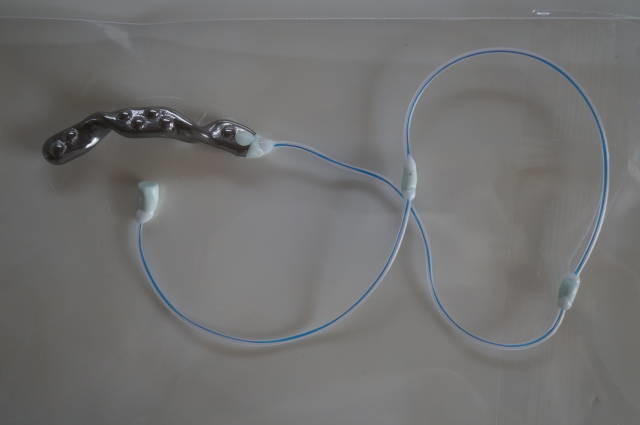
In a December 2023 entry, Mr. Okada described a tube tail (a tube-covered length of nylon behind the chip). He offered a screw-shaped support chip (a twisted part supporting the main chip's position) for it. The tail-specific support cost ¥3,000, (about $19 at ¥156 = $1, rate as of 2026-09-04) tax excluded, and a tail up to 10 cm cost ¥2,000, (about $13 at ¥156 = $1, rate as of 2026-09-04) tax excluded.
He considered the soft section gentler on surrounding tissue than exposed thread. He suggested a tail with this support alone for an ordinary support-chip configuration.
(Source: ok-lab's diary, published December 2023)
https://ok-lab.hatenablog.com/entry/2023/12/02/122648
Tube covers reduced pressure in one assessment but increased friction
In an April 2024 entry, Mr. Okada compared covered and bare shape-memory wire. He thought the cover reduced pressure against the lining, while increasing friction. His own tests did not reveal a large difference in overall comfort, although bare wire offered less resistance.
He left that choice to individual experience of dryness. He advised stopping use if the outer resin connection was damaged.
(Source: ok-lab's diary, published April 2024)
https://ok-lab.hatenablog.com/entry/2024/04/13/123053
Tube covers received a stronger recommendation for the S-shaped design
In a May 2024 entry, Mr. Okada discussed the three-part S-shaped chip (Prostate Alien). Its sections were intended for the bladder, prostate area, and urine passage below. He considered bare wire especially harsh at the sensitive contact area near the bladder.
He allowed that brief use might feel different. For this particular design, he recommended a tube cover over the wire.
(Source: ok-lab's diary, published May 2024)
https://ok-lab.hatenablog.com/entry/2024/05/18/122913
If you see blood in your urine, even a small amount or for the first time, do not wait and see. See a urologist right away. If you suddenly cannot urinate, or the device cannot be removed, do not try to fix it yourself. Go to a medical facility, including emergency care, immediately.
How prostate chip thread discomfort changed over time
| Published | What the diary said then |
|---|---|
| Feb 2019 | Soft silicone formed a gradual cone between chip and cable. |
| Jul 2020 | The newer 10 mm motor ran weakly with extremely thin cable; older motors worked. |
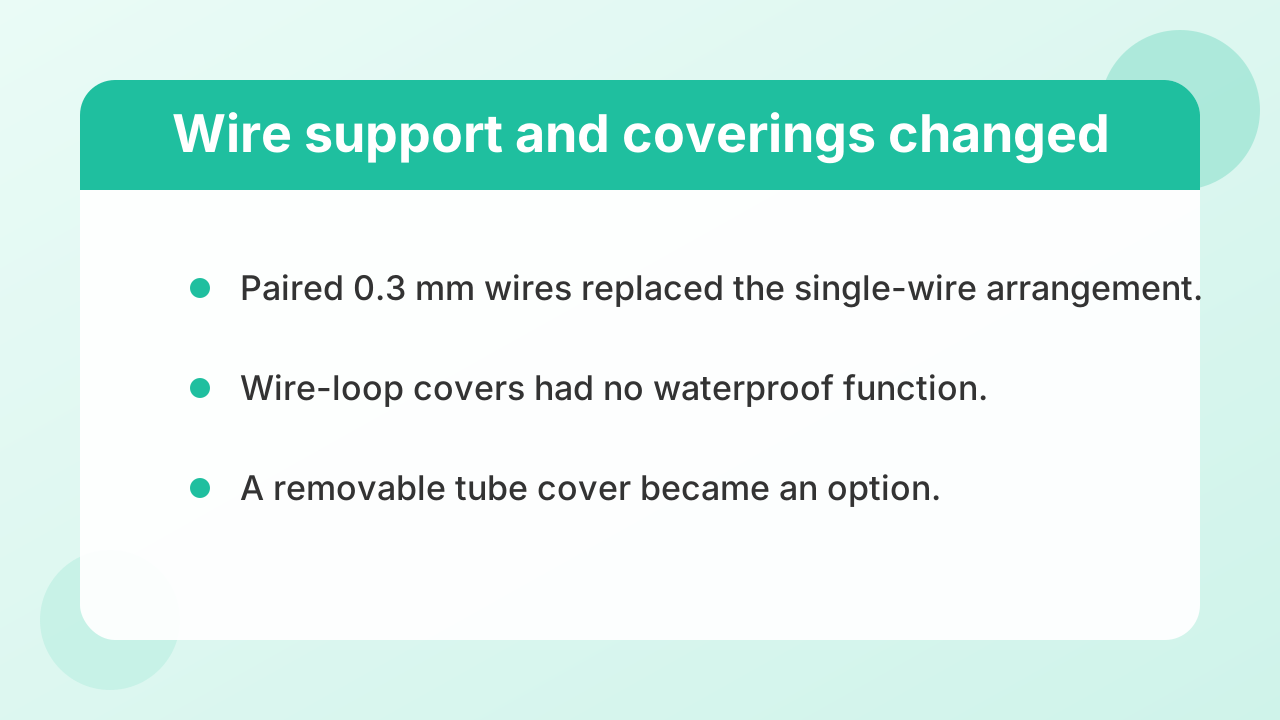
| Mar 2022 | Paired 0.3 mm support wires replaced the less balanced single-wire arrangement. |
| Apr 2022 | Formal supported-cable sales remained on hold; inquiries could receive prototypes. |
| Aug 2022 | Tube-covered connections felt milder to Mr. Okada during roughly three days of testing. |
| Nov 2023 | Mr. Okada delayed tail sales while checking for problems. |
| Aug 2025 | Wire-loop covers were free but had no waterproof function. |
| Nov 2025 | A removable tube cover became an option for the multiple-support loop design. |
| Dec 2025 | One custom build covered only the end loop because tubing hindered support-part sliding. |
OK Prostate Chip products related to prostate chip thread discomfort
The current list confirms this named chip; the diary's comfort report concerns a historical custom build.
Products that appear in these entries
| Product (official name) | Price incl. tax | Relation to this topic |
|---|---|---|
| Flat-faced curved resin chip (OKプロステートチップ フラット面カーブ型 セミロングタイプ(生体適合樹脂)) | ¥6,050 (about $39 at ¥156 = $1, rate as of 2026-09-04) | A December 2022 customer reported improved comfort after choosing this chip with a custom metal-reinforced covered cord. |
(Source: ok-lab's diary, published December 2022)
https://ok-lab.hatenablog.com/entry/2022/12/24/122944
Products the diary mentioned as alternatives
The diary names no alternative.
Historical cable assemblies, covered cords, tube tails, and wire-linked custom builds: No matching product can be confirmed on the current list.
Common worries about prostate chip thread discomfort
Reader questions concerned fragile cables, later alterations, and the support provided by soft tails.
"Does a thinner cable sacrifice strength for greater comfort?"
A June 2020 entry records a customer supplying very fine cable for custom vibrating chips. Mr. Okada initially made acceptance conditional on checking whether a strong connection was possible. After inspection, he considered the cable gentle but almost without durability as a retrieval line.
A completed durability test is not recorded here. He would accept the order only with separate nylon retrieval thread.
(Source: ok-lab's diary, published June 2020)
https://ok-lab.hatenablog.com/entry/2020/06/27/120614
"Can tube covers receive extra parts after the original purchase?"
A November 2022 entry records a customer liking their covered-tube short ceramic chip and reporting less discomfort than with thread. They asked about adding another small support part. Mr. Okada declined, explaining that he did not accept additional work after delivery across the product range.
He thought a used tube would also be difficult to bond reliably. The diary does not record whether the customer accepted his alternative. He offered a replacement tube incorporating the extra part.
(Source: ok-lab's diary, published November 2022)
https://ok-lab.hatenablog.com/entry/2022/11/26/122622
"Does a soft tube tail provide enough support?"
A June 2024 entry records a customer asking whether the S-shaped chip's soft tail had enough stiffness. Staff replied that the existing 2.5 mm tail did not provide the requested support. After a further question about alternatives, Mr. Okada developed a double-tube version.
It had a 2 mm inner tube containing two nylon threads, surrounded by a 4 mm outer tube. He reported improved support and a gentler feel, but the customer's subsequent experience is unrecorded. He proposed this thicker assembly, while acknowledging that dryness could still limit performance.
(Source: ok-lab's diary, published June 2024)
https://ok-lab.hatenablog.com/entry/2024/06/01/123036
Buying from outside Japan
OK Lab ships internationally to countries covered by Japan Post's EMS courier service. Overseas orders are paid in advance by PayPal. Each order carries a ¥400 (about $3 at ¥156 = $1, rate as of 2026-09-04) handling fee, and EMS shipping is charged on top. These terms come from OK Lab's official sales-terms page (written here as plain text, not a link: ok-lab.net/docs/law), checked on September 7, 2026; confirm them on the official store before you order, because they can change.
Summary of this article
| What you wanted to know | The answer |
|---|---|
| What is the short answer? | Some diary reports favor cables or covered thread for comfort. |
| What is the product? | A urethral device made by OK Lab in Japan. |
| What do the terms mean? | Thread, electrical cable, and covered tubing serve different roles. |
| What happened to customers? | Individual reports described thread pain, wiring failures, and better comfort with alternatives. |
| What did the maker change? | Softer coverings, supported cables, and tube tails, with service and friction limits. |
| How did designs develop? | Cable changes led to covered cords and selective wire coverings. |
| What current product appears? | The flat-faced curved resin chip is listed at ¥6,050 (about $39 at ¥156 = $1, rate as of 2026-09-04) including tax. |
| What questions remained? | Cable durability, later additions, and tail stiffness. |
| How does overseas buying work? | Advance PayPal payment, a ¥400 (about $3 at ¥156 = $1, rate as of 2026-09-04) handling fee, and additional EMS shipping charges. |
Source: ok-lab's diary (Okada Comfortable Life Laboratory). The original entries are in Japanese; quotations on this page are translated. Photos and videos are on the original entries.
This article is a summary of the maker's development diary. The product is not a medical device and no result is guaranteed. If anything feels wrong or worries you, see a doctor. Prices, specifications and cautions change, so confirm the latest information on the official blog and the official site. Questions about ordering and shipping go to the seller.