![How far apart should the chip and stopper be? | Spacing depends on the design [OK Prostate Chip]](/img/a/T0103/eyecatch.svg)
This page is based on entries from "ok-lab's diary" (https://ok-lab.hatenablog.com/), the Japanese development diary written by Mr. Okada, founder of OK Lab, a small company in Japan (Okada Comfortable Life Laboratory). Only the entries about "chip stopper spacing" are summarized here, in order of publication. Past prices and sizes are as written at the time. Current prices come from the official product list (retrieved September 4, 2026). Quotations are translated from Japanese.
Note: This page is a personal reading log by someone with no connection to the maker or the seller. It reflects the source entries as of their publication dates and makes no guarantee of accuracy or safety. The product is not a medical device; talk to a doctor about any health decision. Check the official site for current information. This page contains advertising.
In short
- A stopper can follow the chip inward when the gap is too small.
- Mr. Okada's advice changed with the attachment design and its intended position.
- Separate stoppers appear on the current list; later prototypes have no confirmed matching listing.
If you see blood in your urine, even a small amount or for the first time, do not wait and see. See a urologist right away. If you suddenly cannot urinate, or the device cannot be removed, do not try to fix it yourself. Go to a medical facility, including emergency care, immediately.
About this product

The OK Prostate Chip is a small device that is placed in the urethra (the urine passage) so that it acts on the prostate; the maker sells it in several shapes, sizes and materials. It is made and sold by OK Lab (Okada Comfortable Life Laboratory), a small company in Japan, through its own online store, and prices are in Japanese yen (JPY).
The maker's development diary, "ok-lab's diary", is written in Japanese. This page is an English summary of it, and every quotation is translated.
OK Lab ships internationally, so readers outside Japan can order (see "Buying from outside Japan" below). Product names on this page are plain-English descriptions. The official Japanese product name is shown once in the product table so you can find the same item in the store.
Before you read: key terms
| Term | Plain-English meaning |
|---|---|
| Urinary sphincter | The muscle boundary discussed in these entries; a stopper is intended to prevent movement beyond it. |
| Bulbar urethra | The wider urethral section near that boundary, described as providing room for a separate stopper to move. |
| Screw auxiliary chip | A second, screw-shaped chip intended to support positioning; the maker distinguishes this purpose from stopping inward movement. |
| Mesh stopper | A shield-like attachment intended to block passage through the sphincter. |
| Shape-memory wire | Wire described as bending and returning toward its original shape; later stoppers use this flexibility. |
| Petal stopper | Flexible wire loops that form a blocking attachment. |
| Integrated stopper | A stopper attached directly to the main chip, intended to resist unwanted movement. |
| Tail | A tube-covered thread extension intended to reduce direct thread contact near the sphincter. |
What happens: chip stopper spacing
The OK Prostate Chip is a small device placed in the urethra to stimulate the prostate. A sphincter stopper is a blocking attachment intended to prevent movement farther inward toward the bladder. The diary places separate stoppers behind the chip, outside the urinary sphincter (the muscle boundary discussed in these entries). Mr. Okada describes the gap as space for stopper movement; later designs use flexible attachments fixed directly to the chip.
Zero stopper spacing failed with an extra-large long chip
In an entry published in June 2018, a tester reported failure with an extra-large long chip and no gap behind it. Both parts entered the bladder after a slight push, and the tester subsequently recovered them.
Mr. Okada acknowledged that the stopper had failed in this case. He suggested that stopper size and spacing needed further investigation.
(Source: ok-lab's diary, published June 2018)
https://ok-lab.hatenablog.com/entry/20180616/1529136608
Parallel-cable stopper spacing remained experimental while its planned price changed
In July 2019, Mr. Okada introduced a stopper for a powered chip's parallel cable. The proposed price was ¥1,500 (about $10 at ¥156 = $1, rate as of 2026-09-04) excluding tax, with M 9 mm and L 11 mm sizes planned. His advice specified about 15 mm or more from the chip, with the stopper in the bulbar urethra (the wider section near the sphincter).
Later in July 2019, removing a manufacturing step reduced the announced price to ¥1,000 (about $6 at ¥156 = $1, rate as of 2026-09-04) excluding tax, with formal sales expected shortly. He also reported unexpectedly successful close-spacing tests. He cautioned that these tests were insufficient to support a general rule.
(Source: ok-lab's diary, published July 2019)
https://ok-lab.hatenablog.com/entry/2019/07/06/152113
(Source: ok-lab's diary, published July 2019)
https://ok-lab.hatenablog.com/entry/2019/07/20/151609
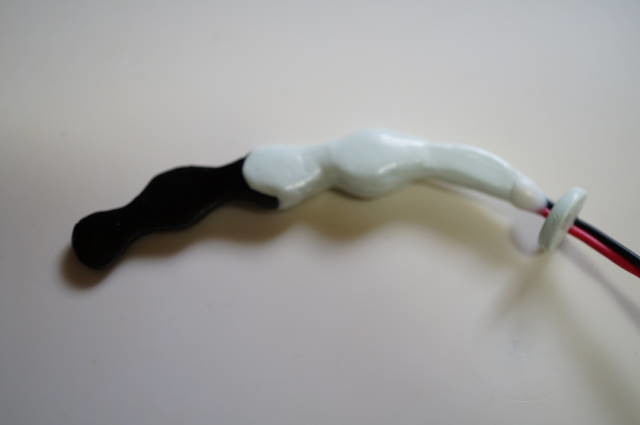
Stopper spacing with a rigid connector raised concerns about injury
In November 2020, Mr. Okada reported urine leakage associated with what he suspected was sphincter damage from a stopper's projecting connector. A subsequent test used a different porcelain chip with about 6 mm of separation.
He reported no problems during 10 hours with that separate assembly. The diary does not record whether the earlier leakage resolved. His guidance for this connector arrangement called for at least 5 mm between the chip and stopper.
(Source: ok-lab's diary, published November 2020)
https://ok-lab.hatenablog.com/entry/2020/11/14/131426
Stopper position mattered when erection drew an auxiliary chip farther inward
In August 2021, a semi-long chip user reported that an erection was followed by the auxiliary chip moving inward too. The customer recovered the device but feared another attempt.
They asked whether a longer retrieval thread could be fitted. Mr. Okada confirmed a replacement service; the diary does not record the customer's later experience. He advised that stoppers and auxiliary chips remain outside the urinary sphincter.
(Source: ok-lab's diary, published August 2021)
https://ok-lab.hatenablog.com/entry/2021/08/28/125823
Mesh stopper spacing reduced strain in Mr. Okada's wire tests
In March 2024, Mr. Okada reported that an elastic-wire chip repeatedly moved toward the bladder during testing. He developed a mesh stopper (a shield-like attachment) for that wire.
He reported slower urine flow when the stopper rested against the muscle. His preference was about 10 mm–12 mm of separation, which he felt placed less strain on the sphincter in this design.
(Source: ok-lab's diary, published March 2024)
https://ok-lab.hatenablog.com/entry/2024/03/30/122958
Petal stopper positioning introduced flexible loops behind a screw auxiliary
In April 2025, Mr. Okada introduced a petal stopper (flexible wire loops forming a blocking attachment). The design used 3 petals, with published pricing of ¥1,000 (about $6 at ¥156 = $1, rate as of 2026-09-04) per petal and ¥3,000 (about $19 at ¥156 = $1, rate as of 2026-09-04) excluding tax for the set. One example placed it behind a screw auxiliary chip (a second chip intended to support positioning).
He reported no strong irritation during about 5 days of testing with 0.2 mm wire. He cautioned that force from an instrument could reverse the petals and defeat the stopper.
(Source: ok-lab's diary, published April 2025)
https://ok-lab.hatenablog.com/entry/2025/04/26/122909
Integrated stopper spacing changed when flexible wire joined the chip directly
In October 2025, Mr. Okada tested an integrated stopper (one attached directly to the chip) on a semi-long S model. It used shape-memory wire (wire that bends and returns toward its original form), and he reported firm retention.
The rear attachment cost ¥3,000 (about $19 at ¥156 = $1, rate as of 2026-09-04) excluding tax, including reinforcement or side attachment work, as published in October 2025. Combined front and rear attachments cost ¥5,000 (about $32 at ¥156 = $1, rate as of 2026-09-04) excluding tax in that entry. Mr. Okada favored direct attachment for this flexible stopper design.
(Source: ok-lab's diary, published October 2025)
https://ok-lab.hatenablog.com/entry/2025/10/04/122910
The maker's answer to chip stopper spacing
Mr. Okada linked spacing to the attachment's structure and its position relative to the muscle.
Thread-mounted stopper spacing allowed room for the attachment to move
In July 2018, Mr. Okada specified at least 6 mm between the main chip and stopper, preferably 10 mm or more. He explained that a stopper partly caught in the sphincter could remain lengthwise and follow the chip inward.
His reply distinguished its temporary pushing role from its intended resting position in the bulbar urethra. He advised against leaving the attachment caught in the muscle after the main chip had passed beyond it.
(Source: ok-lab's diary, published July 2018)
https://ok-lab.hatenablog.com/entry/20180707/1530947332
Stopper spacing behind a screw auxiliary had its own reference point
In May 2020, a beginner feared that an ordered short ceramic twist chip might move into the bladder. The order included a screw auxiliary, and Mr. Okada accepted the requested additional stopper.
The diary does not record how this customer's completed setup felt in use. His stated separation was slightly under 1 cm or more, measured from the screw auxiliary. He warned that excessive closeness could prevent the stopper from working.
(Source: ok-lab's diary, published May 2020)
https://ok-lab.hatenablog.com/entry/2020/05/09/143600
Stopper position outside the muscle mattered alongside any stated distance
In December 2020, Mr. Okada distinguished stopping inward movement from gripping the sphincter tightly between two parts. He described 3 mm to 7 mm spacing as an advanced arrangement outside the stopper's intended purpose.
His alternative was about 8 mm or more, with the stopper resting outside the muscle. He described this as safer because the attachment had room to act as a shield. He cautioned against the close arrangement, where a partly trapped stopper could follow the chip inward.
(Source: ok-lab's diary, published December 2020)
https://ok-lab.hatenablog.com/entry/2020/12/12/124126
If you see blood in your urine, even a small amount or for the first time, do not wait and see. See a urologist right away. If you suddenly cannot urinate, or the device cannot be removed, do not try to fix it yourself. Go to a medical facility, including emergency care, immediately.
How chip stopper spacing changed over time
| Published | What the diary said then |
|---|---|
| Jun 2018 | A separate tester suspected stopper thickness also affected passage. |
| May 2019 | Mr. Okada declined to endorse a two-stopper arrangement crossing the sphincter. |
| Jan 2020 | Gripping the sphincter with a three-hole stopper was outside its intended purpose. |
| Mar 2020 | A two-cable prototype felt steadier than its single-cable counterpart in Mr. Okada's tests. |
| Nov 2020 | A separate coated assembly restricted stopper movement and slowed urine flow. |
| Dec 2020 | A customer reported less inward movement at 1.2 cm than at 1 cm. |
| Nov 2023 | A tube-mounted stopper added adjustable positioning; its intended location remained the bulbar urethra. |
| Apr 2025 | Mr. Okada found 0.3 mm petal wire too firm for prolonged use. |
| Oct 2025 | A short prototype combined front and rear integrated attachments. |
OK Prostate Chip products related to chip stopper spacing
The current list includes separate accessories and the short ceramic twist chip discussed in the May 2020 case.
Products that appear in these entries
| Product (official name) | Price incl. tax | Relation to this topic |
|---|---|---|
| Three-hole sphincter stopper (三穴方式オプションチップ(括約筋ストッパーチップ)) | ¥1,650 (about $11 at ¥156 = $1, rate as of 2026-09-04) | In May 2020, Mr. Okada accepted its addition after a beginner feared inward movement. |
| Screw auxiliary chip (スクリュー型補助チップ追加オプション) | ¥3,300 (about $21 at ¥156 = $1, rate as of 2026-09-04) | In May 2020, this attachment was the reference point for the stated stopper distance. |
| Short ceramic twist chip (OKプロステートチップ 陶器素材ショートタイプ ツイスト) | ¥4,400 (about $28 at ¥156 = $1, rate as of 2026-09-04) | In May 2020, an order for this chip prompted the beginner's request for a stopper. |
The three-hole stopper is listed in OK Lab's own online store.
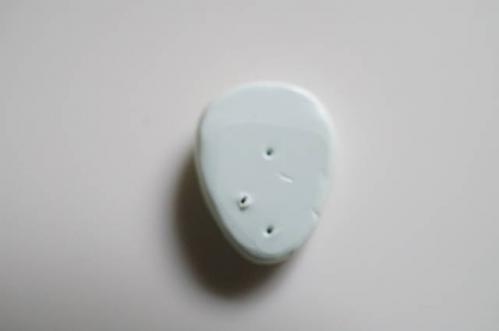
(Source: ok-lab's diary, published May 2020)
https://ok-lab.hatenablog.com/entry/2020/05/09/143600
Products the diary mentioned as alternatives
The diary names no alternative.
Other entries describe custom test chips and early cable, mesh, petal, and integrated prototypes. No matching product can be confirmed on the current list.
Common worries about chip stopper spacing
The reader questions concern lost sensation, uncomfortable positioning, and uncertainty about adding an internal stopper.
"Could closer stopper spacing restore lost sensation?"
In October 2019, a customer described lost sensation after inward movement despite a stopper gap of about 10 mm. Mr. Okada suggested about 5 mm when the stopper held but sensation faded.
He also discussed longer, more curved chips and external stopping as other possibilities. The diary does not record whether the customer tried those options. He warned that closer spacing could increase the chance of the stopper moving inward.
(Source: ok-lab's diary, published October 2019)
https://ok-lab.hatenablog.com/entry/2019/10/26/145539
"Can mesh stopper position affect comfort?"
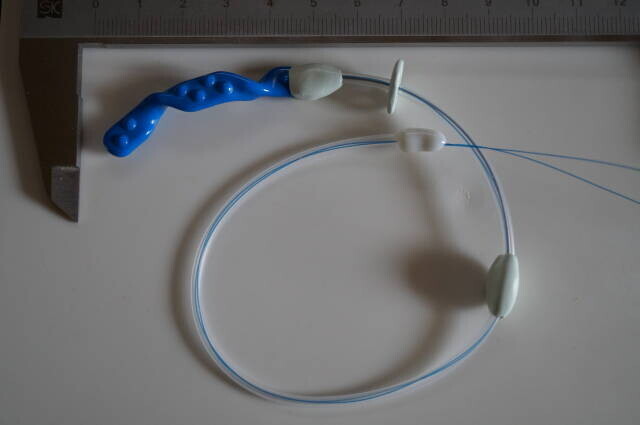
In June 2024, a customer reported soreness and blood on a mesh stopper during an unsuccessful attempt. The assembly combined a main chip, shape-memory wire, and a tail (a tube-covered thread extension).
A later attempt, with the stopper farther rearward, reportedly held position without bleeding or pain during urination. Mr. Okada understood this stopper's role as preventing the rear chip from crossing the sphincter. He favored a position near that rear chip for this configuration.
(Source: ok-lab's diary, published June 2024)
https://ok-lab.hatenablog.com/entry/2024/06/08/123008
"Is internal stopper positioning straightforward for a beginner?"
In December 2024, a first-time buyer asked whether auxiliary parts would make positioning harder. Staff said the choice depended on the individual and offered to pause production while the buyer considered Mr. Okada's explanation.
He described internal stopper positioning as difficult for beginners and considered starting without one an option. The diary does not record the buyer's final choice. He favored an external stopper for clarity, but linked its effectiveness to an accurate understanding of urethral length.
(Source: ok-lab's diary, published December 2024)
https://ok-lab.hatenablog.com/entry/2024/12/28/122907
Buying from outside Japan

OK Lab ships internationally to countries covered by Japan Post's EMS courier service. Overseas orders are paid in advance by PayPal. Each order carries a ¥400 (about $3 at ¥156 = $1, rate as of 2026-09-04) handling fee, and EMS shipping is charged on top. These terms come from OK Lab's official sales-terms page (written here as plain text, not a link: ok-lab.net/docs/law), checked on September 7, 2026; confirm them on the official store before you order, because they can change.
Summary of this article
| What you wanted to know | The answer |
|---|---|
| The short answer | Spacing depends on stopper design and position. |
| About the product | OK Lab makes this urethral device in Japan. |
| Key terms | Separate, mesh, petal, and integrated stoppers have different structures. |
| What happened | Reports included inward movement, suspected injury, and later prototype successes. |
| The maker's answer | Mr. Okada emphasized room for separate stoppers to move. |
| What changed | Later designs introduced adjustable tails and directly attached flexible stoppers. |
| Related products | Current listings include the separate stopper and screw auxiliary discussed above. |
| Common worries | Replies addressed sensation, comfort, and difficulty understanding internal position. |
| Overseas buying | Orders use prepaid PayPal and EMS, with additional fees. |
| Overall takeaway | The diary does not establish one spacing figure for every design. |
Source: ok-lab's diary (Okada Comfortable Life Laboratory). The original entries are in Japanese; quotations on this page are translated. Photos and videos are on the original entries.
This article is a summary of the maker's development diary. The product is not a medical device and no result is guaranteed. If anything feels wrong or worries you, see a doctor. Prices, specifications and cautions change, so confirm the latest information on the official blog and the official site. Questions about ordering and shipping go to the seller.