![Will a gatekeeper keep my prostate chip in place? | Fit and connection type matter [OK Prostate Chip]](/img/a/T0112/eyecatch.svg)
This page is based on entries from "ok-lab's diary" (https://ok-lab.hatenablog.com/), the Japanese development diary written by Mr. Okada, founder of OK Lab, a small company in Japan (Okada Comfortable Life Laboratory). Only the entries about "keeping a prostate chip in place" are summarized here, in order of publication. Past prices and sizes are as written at the time. Current prices come from the official product list (retrieved September 4, 2026). Quotations are translated from Japanese.
Note: This page is a personal reading log by someone with no connection to the maker or the seller. It reflects the source entries as of their publication dates and makes no guarantee of accuracy or safety. The product is not a medical device; talk to a doctor about any health decision. Check the official site for current information. This page contains advertising.
In short
Gatekeepers were designed to limit chip movement, but the diary records discomfort and fit problems.
Mr. Okada's proposed solution depends on the chip's connection and the gatekeeper design.
The current product list includes the slide-lock gatekeeper at ¥6,600 (about $42 at ¥156 = $1, rate as of 2026-09-04) including tax.
If you see blood in your urine, even a small amount or for the first time, do not wait and see. See a urologist right away. If you suddenly cannot urinate, or the device cannot be removed, do not try to fix it yourself. Go to a medical facility, including emergency care, immediately.
About this product

The OK Prostate Chip is a small device that is placed in the urethra (the urine passage) so that it acts on the prostate; the maker sells it in several shapes, sizes and materials. It is made and sold by OK Lab (Okada Comfortable Life Laboratory), a small company in Japan, through its own online store, and prices are in Japanese yen (JPY).
The maker's development diary, "ok-lab's diary", is written in Japanese. This page is an English summary of it, and every quotation is translated. OK Lab ships internationally, so readers outside Japan can order (see "Buying from outside Japan" below).
Product names on this page are plain-English descriptions. The official Japanese product name is shown once in the product table so you can find the same item in the store.
Before you read: key terms
| Term | Plain-English meaning |
|---|---|
| Urethra | The urine passage; it is also where the chip is placed. |
| Gatekeeper | A holder at the opening in the penis head, intended to restrain chip movement. |
| Six-wire support | A wire-based chip connection intended to help maintain position. |
| Flexible silicone support | A flexible chip connection discussed as a way to maintain position. |
| Support lead | A tube containing nylon thread and flexible wire, intended to connect and support a chip. |
| Shape-memory wire | Flexible wire used for support and restraint; the diary describes its ability to yield under pressure. |
| Blue safety stop | An added restraint intended to prevent movement toward the bladder. |
| Pulley | The maker's name for a small tube that guides chip-supporting thread. |
| Wire coupling | A separate connection joining a support lead to a shape-memory gatekeeper. |
| Electrode | A conductive chip component used for electrical stimulation. |
What happens: keeping a prostate chip in place
The OK Prostate Chip is a small device placed in the urethra, the urine passage, to act on the prostate. A gatekeeper is a separate holder at the opening in the penis head. The diary describes versions with a tube extending into the urethra and supports around the head's rim. Mr. Okada developed these holders to resist a chip moving outward, deeper inward, or into the bladder.
The first gatekeeper was developed to restrain movement in both directions
In an entry published in April 2022, Mr. Okada introduced a gatekeeper after reconsidering an earlier idea for restraining cable-based chips. The design retained an opening for urine while restricting the space available for a chip to escape.
The same entry proposed a longer-tube version with a 3mm urine passage; testing had yet to begin. Mr. Okada presented these arrangements as possible protection against both outward escape and movement toward the bladder.
(Source: ok-lab's diary, published April 2022)
https://ok-lab.hatenablog.com/entry/2022/04/16/123037
A customer reported tube discomfort despite stable positioning with an older gatekeeper
In an entry published in July 2022, a customer liked the stable position but suspected the older gatekeeper tube had injured their urethra. Slight discomfort remained 3 days later, although the customer reported no bleeding. Mr. Okada said the newer design's internal section was entirely flexible silicone, but acknowledged possible friction against a dry urethral lining.
A follow-up published in July 2022 reported that the same customer's shorter tube was comfortable and no longer painful. For the customer's proposed connected-chip arrangement, OK Lab's staff said a gatekeeper was optional. Staff nevertheless considered external protection against inward movement necessary when the arrangement included a chip inside the bladder.
(Source: ok-lab's diary, published July 2022)
https://ok-lab.hatenablog.com/entry/2022/07/23/123014
(Source: ok-lab's diary, published July 2022)
https://ok-lab.hatenablog.com/entry/2022/07/30/122933
A side-opening gatekeeper accommodated different cable terminals and lowered the price
An entry published in October 2023 introduced a gatekeeper that could hold tubing at a chosen point along its length. Its side opening accommodated cables with different terminals, allowing one holder to serve several connection types. The design also included urine openings and a closing gate intended to keep the tube from escaping.
A 2mm silicone tube replaced the earlier ring connection around the penis head. This change reduced the published price by ¥1,000 (about $6 at ¥156 = $1, rate as of 2026-09-04) excluding tax, bringing it to ¥4,000 (about $26 at ¥156 = $1, rate as of 2026-09-04) excluding tax. Mr. Okada cautioned that the securing tube could come loose from its connection.
(Source: ok-lab's diary, published October 2023)
https://ok-lab.hatenablog.com/entry/2023/10/21/123054
Mr. Okada reported feeling unwell during his shape-memory gatekeeper trial
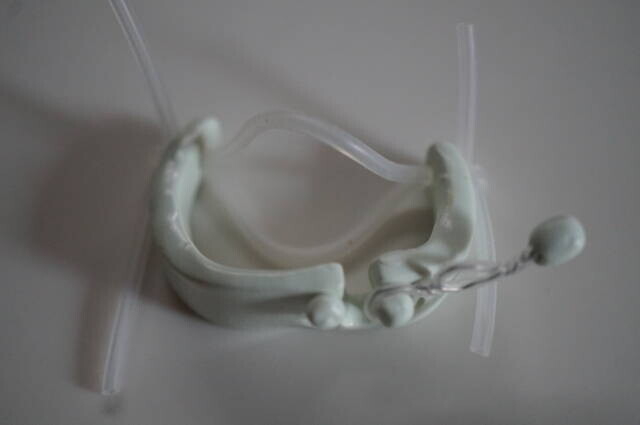
In a July 2025 entry, Mr. Okada described testing a shape-memory gatekeeper with a 10cm support lead (a flexible chip connection). The holder used shape-memory wire (flexible wire providing restraint) and a separate wire coupling. After about 3 days, he reported ending the trial because he felt he was developing heart failure.
He attributed his difficulty to the unusually constant pressure, describing this as his own interpretation. Mr. Okada cautioned that such firm positioning might be too demanding for him, given his poor health.
(Source: ok-lab's diary, published July 2025)
https://ok-lab.hatenablog.com/entry/2025/07/05/122905
Gatekeeper fit depended on anatomy when an overseas customer reconsidered ordering
An entry published in July 2025 described a customer outside Japan seeking protection against both inward and outward chip movement. Mr. Okada suggested a shape-memory gatekeeper with a flexible support lead. In a confirmed follow-up published in August 2025, the customer wanted the lead without a gatekeeper and asked OK Lab to choose the chip.
Mr. Okada declined to choose the chip and size for someone he did not know, and acknowledged that penis-head shape could prevent secure attachment. The diary does not record whether the order was completed. He accepted omitting the gatekeeper and recommended an adjustable support lead.
(Source: ok-lab's diary, published July 2025)
https://ok-lab.hatenablog.com/entry/2025/07/26/122909
(Source: ok-lab's diary, published August 2025)
https://ok-lab.hatenablog.com/entry/2025/08/02/123058
The maker's answer to keeping a prostate chip in place
The diary describes different restraints for nylon thread, cable connections, and flexible support leads.
A six-hole gatekeeper option addressed nylon thread in an early design
In an entry published in May 2022, a reader asked whether the gatekeeper could serve ordinary nylon-thread chips. Mr. Okada replied that those chips should also benefit, and introduced a version with 6 holes acting as a thread stop. The addition cost ¥1,000 (about $6 at ¥156 = $1, rate as of 2026-09-04) excluding tax at that time.
He said the added holes were a manufacturing option, so orders already underway could not be changed to that version. Mr. Okada asked customers to specify the six-hole version when ordering.
(Source: ok-lab's diary, published May 2022)
https://ok-lab.hatenablog.com/entry/2022/05/07/123013
A gatekeeper could prevent escape while still allowing some position changes
In an entry published in October 2023, Mr. Okada discussed chips equipped with a blue safety stop (an added restraint against inward movement). He said this arrangement blocked travel toward the bladder, while still allowing shifts during urination.
The gatekeeper's separate role was to prevent complete outward escape, including a chip falling into a toilet and breaking. Mr. Okada proposed the arrangement for chips already fitted with that stop.
(Source: ok-lab's diary, published October 2023)
https://ok-lab.hatenablog.com/entry/2023/10/28/122832
Shape-memory gatekeeper designs introduced adjustable leads and separate thread guides
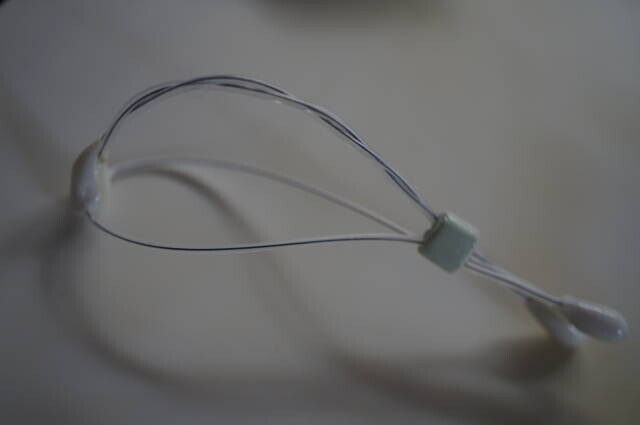
An entry published in July 2025 priced the shape-memory gatekeeper at ¥4,000 (about $26 at ¥156 = $1, rate as of 2026-09-04) excluding tax and its separate wire coupling at ¥2,000 (about $13 at ¥156 = $1, rate as of 2026-09-04) excluding tax. An adjustable support lead cost ¥6,000 (about $38 at ¥156 = $1, rate as of 2026-09-04) excluding tax for lengths up to 20cm. That entry defined M as approximately 12cm around the loop, with L having a circumference 2 centimeters longer.
A later July 2025 entry priced shape-memory gatekeepers with fixed and sliding thread guides at ¥4,000 (about $26 at ¥156 = $1, rate as of 2026-09-04) and ¥5,000 (about $32 at ¥156 = $1, rate as of 2026-09-04), respectively, both excluding tax. The pulley (a small thread guide) used 0.5mm internal-diameter tubing intended for two 0.24mm threads. For a single-chip thread arrangement, Mr. Okada thought an additional safety stop might be necessary.
(Source: ok-lab's diary, published July 2025)
https://ok-lab.hatenablog.com/entry/2025/07/05/122905
(Source: ok-lab's diary, published July 2025)
https://ok-lab.hatenablog.com/entry/2025/07/12/122911
If you see blood in your urine, even a small amount or for the first time, do not wait and see. See a urologist right away. If you suddenly cannot urinate, or the device cannot be removed, do not try to fix it yourself. Go to a medical facility, including emergency care, immediately.
How keeping a prostate chip in place changed over time
| Published | What the diary said then |
|---|---|
| May 2022 | Mr. Okada reported unchanged chip position during a week-long gatekeeper test. |
| Jul 2022 | An older gatekeeper and the newer 4mm version shared a 4mm internal diameter. |
| Dec 2022 | A prototype held tubing through friction alone. |
| Oct 2023 | Center-to-tying-hole distances were S: 3cm, M: 3.5cm, L: 4cm at launch. |
| Jun 2024 | Mr. Okada reported stable placement with a slit-type gatekeeper and shape-memory twin chip. |
| Jul 2025 | The fixed thread guide became standard even for support-lead connections. |
| Nov 2025 | A jointed wire design slipped easily; Mr. Okada suggested gatekeeper support. |
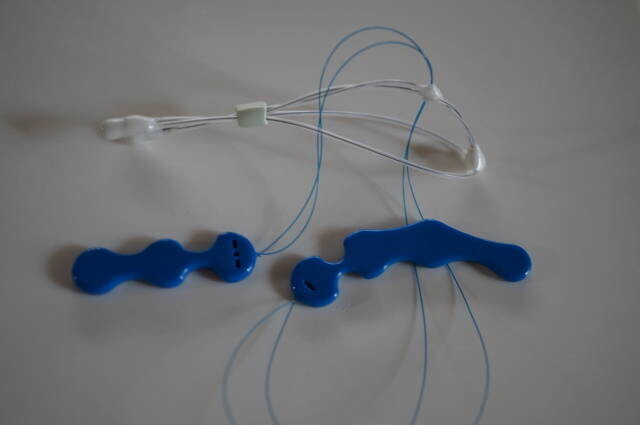
OK Prostate Chip products related to keeping a prostate chip in place
The slide-lock gatekeeper appears on the current list at ¥6,600 (about $42 at ¥156 = $1, rate as of 2026-09-04) including tax.
Products that appear in these entries
| Product (official name) | Price incl. tax | Relation to this topic |
|---|---|---|
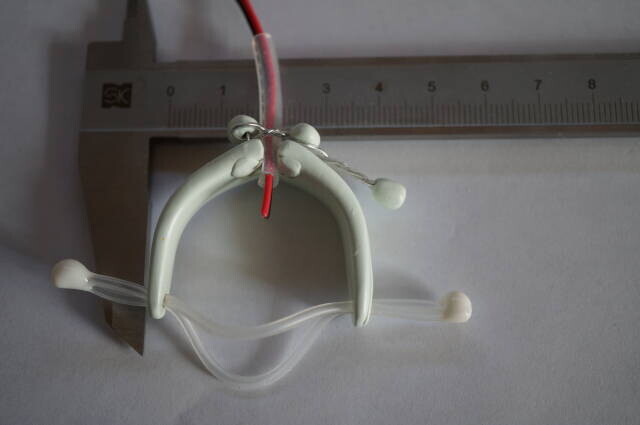
| Slide-lock urethral gatekeeper (スライドロック式尿道ゲートキーパー) | ¥6,600 (about $42 at ¥156 = $1, rate as of 2026-09-04) | In December 2025, an order intended for nylon thread was changed to use with the customer's existing vibrating-chip cable. |
The slide-lock gatekeeper is listed in OK Lab's own online store.

(Source: ok-lab's diary, published December 2025)
https://ok-lab.hatenablog.com/entry/2025/12/20/123000
Products the diary mentioned as alternatives
The diary names no alternative.
Historical configurations here include the original, six-hole, silicone-tube, slit-type, and shape-memory gatekeepers, plus their custom leads and wire coupling. They also include the flexible silicone support, jointed-wire prototype, and resized stainless electrode (an electrically stimulating chip). No matching product can be confirmed on the current list.
Common worries about keeping a prostate chip in place
The replies make connection compatibility and individual fit central to the maker's answers.
"Does every chip need a gatekeeper to stay in place?"
In an entry published in August 2022, a customer sought stable placement without discomfort. They compared six-wire support (a wire-based chip connection) with flexible silicone support (a pliable chip connection). Mr. Okada said he could not declare one option best for every arrangement.
He favored the gatekeeper for six-wire support, but considered the flexible silicone design capable of holding position without one. The diary does not record how either proposed arrangement felt for this customer. Mr. Okada also cautioned that silicone remaining against the same area of urethral lining could cause injury.
(Source: ok-lab's diary, published August 2022)
https://ok-lab.hatenablog.com/entry/2022/08/20/122920
"Can a gatekeeper hold a shorter stainless electrode in position?"
In an entry published in November 2023, a customer wanted a future short stainless electrode held at its chosen position. The customer had found the resized twin electrode comfortable, but wanted firmer positioning for the proposed shorter model.
The diary does not record a trial of the proposed gatekeeper combination by this customer. Mr. Okada suggested a cable containing silicone tubing paired with the slide-lock gatekeeper.
(Source: ok-lab's diary, published November 2023)
https://ok-lab.hatenablog.com/entry/2023/11/04/122744
"Does the slide-lock gatekeeper work with ordinary nylon thread?"
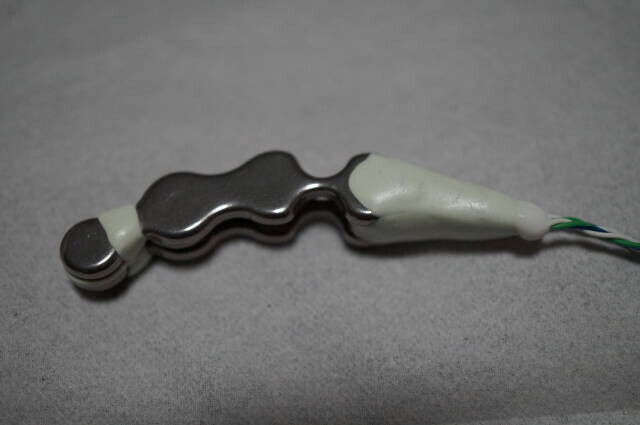
In an entry published in December 2025, a customer ordered the slide-lock gatekeeper as a stopper for an ordinary nylon-thread chip. OK Lab explained that this gatekeeper did not support nylon thread, and the customer changed the intended application.
A slit tube was supplied for the customer's existing vibrating-chip cable. OK Lab directed the customer toward that cable-based application instead.
(Source: ok-lab's diary, published December 2025)
https://ok-lab.hatenablog.com/entry/2025/12/20/123000
Buying from outside Japan

OK Lab ships internationally to countries covered by Japan Post's EMS courier service. Overseas orders are paid in advance by PayPal. Each order carries a ¥400 (about $3 at ¥156 = $1, rate as of 2026-09-04) handling fee, and EMS shipping is charged on top. These terms come from OK Lab's official sales-terms page (written here as plain text, not a link: ok-lab.net/docs/law), checked on September 7, 2026; confirm them on the official store before you order, because they can change.
Summary of this article
| What you wanted to know | The answer |
|---|---|
| In short: will it stay put? | The maker designed gatekeepers to restrain movement, but fit and connection type matter. |
| About the product: who makes it? | OK Lab, a small company in Japan, makes the urethral device and sells it in yen. |
| Key terms: what is the gatekeeper? | A separate holder intended to restrain chip movement at the penis head. |
| What happens: can problems occur? | The diary records discomfort, unsuitable attachment, and an interrupted personal trial. |
| The maker's answer: which restraint? | His proposals differed for nylon thread, cables, and flexible support leads. |
| Changes over time: did the design stay fixed? | The diary records changes in attachment, sizing, materials, and thread guidance. |
| Products: what is listed today? | The slide-lock gatekeeper is ¥6,600 (about $42 at ¥156 = $1, rate as of 2026-09-04) including tax. |
| Common worries: does ordinary thread work? | The December 2025 reply says the slide-lock model does not support ordinary nylon thread. |
| Overseas buying: how are orders paid and shipped? | PayPal in advance, Japan Post EMS shipping, and a ¥400 (about $3 at ¥156 = $1, rate as of 2026-09-04) handling fee. |
| Overall answer: what remains uncertain? | A particular reader's fit and comfort are not established by the diary cases. |
Source: ok-lab's diary (Okada Comfortable Life Laboratory). The original entries are in Japanese; quotations on this page are translated. Photos and videos are on the original entries.
This article is a summary of the maker's development diary. The product is not a medical device and no result is guaranteed. If anything feels wrong or worries you, see a doctor. Prices, specifications and cautions change, so confirm the latest information on the official blog and the official site. Questions about ordering and shipping go to the seller.