![Stopper won't go in, or want to add one? | Compatibility depends on the design [OK Prostate Chip]](/img/a/T0104/eyecatch.svg)
This page is based on entries from "ok-lab's diary" (https://ok-lab.hatenablog.com/), the Japanese development diary written by Mr. Okada, founder of OK Lab, a small company in Japan (Okada Comfortable Life Laboratory). Only the entries about "a stopper that won't go in or needs adding later" are summarized here, in order of publication. Past prices and sizes are as written at the time. Current prices come from the official product list (retrieved September 4, 2026). Quotations are translated from Japanese.
Note: This page is a personal reading log by someone with no connection to the maker or the seller. It reflects the source entries as of their publication dates and makes no guarantee of accuracy or safety. The product is not a medical device; talk to a doctor about any health decision. Check the official site for current information. This page contains advertising.
In short
- A stopper can make fitting harder, and early tests included injuries and failures to prevent bladder entry.
- The maker's answers depend on the attachment: thread, cable, and factory-installed designs have different limits.
- The current list includes related accessories, but it does not confirm every historical build or size.
If you see blood in your urine, even a small amount or for the first time, do not wait and see. See a urologist right away. If you suddenly cannot urinate, or the device cannot be removed, do not try to fix it yourself. Go to a medical facility, including emergency care, immediately.
About this product

The OK Prostate Chip is a small device that is placed in the urethra (the urine passage) so that it acts on the prostate; the maker sells it in several shapes, sizes and materials. It is made and sold by OK Lab (Okada Comfortable Life Laboratory), a small company in Japan, through its own online store, and prices are in Japanese yen (JPY). The maker's development diary, "ok-lab's diary", is written in Japanese. This page is an English summary of it, and every quotation is translated. OK Lab ships internationally, so readers outside Japan can order (see "Buying from outside Japan" below). Product names on this page are plain-English descriptions. The official Japanese product name is shown once in the product table so you can find the same item in the store.
Before you read: key terms
| Term | Plain-English meaning |
|---|---|
| Urethra | The urine passage, where the main chip and some stopper designs sit. |
| Sphincter stopper | An extra part intended to limit chip movement at the muscle boundary described in the diary. |
| Retrieval thread | A line attached to the chip, intended to help retrieve it; some stoppers attach to this line. |
| Auxiliary screw | An additional screw-shaped chip intended to support positioning or limit movement. |
| Parallel cable | The electrical lead used on vibrating chips; it also provides an attachment route for some stoppers. |
| Braided cable | Thin electrical wires twisted with nylon thread, intended to carry power and resist pulling. |
| Waterproof USB connector | The braided cable's electrical connection; its presence affected stopper installation. |
| Mesh stopper | A wire-mounted part intended to prevent the rear chip passing the sphincter. |
| Tube-covered line (Siliconairo) | A connection line with a thin tube covering; the customer wanted it to support a stopper. |
| Shape-memory wire | A metal connection line used to join chip components; the diary also calls it nitinol. |
| Retrofitting | Adding a part to equipment already owned; the diary describes different limits for different connections. |
What happens: the stopper won't go in
The OK Prostate Chip is a small device placed in the urethra so that it acts on the prostate. A sphincter stopper (an extra part intended to limit movement at a muscle boundary) is connected behind the main chip. Depending on the design, it attaches to a retrieval thread (the line intended for retrieving the chip) or an electrical cable. The entries describe both internal stoppers and versions outside the penis opening, with different attachment requirements.
A stopper fit test reported rubbing pain and slight bleeding
An entry published in June 2018 describes a customer's test of a stopper-equipped glass chip. The customer reported rubbing pain and a small amount of bleeding during an unsuccessful attempt, then successful placement in a later attempt. Mr. Okada acknowledged that his production method was not established. He said injury prevention needed attention before formal sales.
(Source: ok-lab's diary, published June 2018)
https://ok-lab.hatenablog.com/entry/20180609/1528523953
Another stopper fit test found a rough edge after bleeding
A separate customer's report in the June 2018 entry initially described comfortable use. After longer use, the customer reported bleeding and found a rough projecting edge on the stopper. Mr. Okada apologized and described a separately finished stopper with a sliding connection for position adjustment. He said the revision would make production easier and quality more consistent.
(Source: ok-lab's diary, published June 2018)
https://ok-lab.hatenablog.com/entry/20180609/1528523953
One stopper fit test failed to prevent bladder entry
In an entry published in June 2018, a customer tested a stopper attached to an oversized long chip. With a 0 mm gap, the main chip and stopper entered the bladder together. The customer reported retrieving the assembly without injury on that occasion. Mr. Okada said this failure called the stopper's intended function into question.
(Source: ok-lab's diary, published June 2018)
https://ok-lab.hatenablog.com/entry/20180616/1529136608
A different stopper fit test nearly lost the retrieval thread
Another test in the June 2018 entry involved a 9 mm gap and a stopper that moved ahead of its intended position. The customer reported pain, slight bleeding, and a 35 cm retrieval thread that almost disappeared inside. A later 13 mm setting failed; 21 mm allowed difficult placement, followed by movement toward the exit. Mr. Okada said the oversized main chip made it difficult to isolate the stopper's contribution.
(Source: ok-lab's diary, published June 2018)
https://ok-lab.hatenablog.com/entry/20180616/1529136608
Adding a detachable stopper still required further strength testing
In an entry published in January 2022, Mr. Okada described a detachable U-shaped stopper prototype for existing vibrating chips. He also reported that a separate six-hole, thread-connected version caught uncomfortably during his brief test. The detachable cable version was not yet a confirmed release. Mr. Okada wanted further strength testing and warned that its slender, long shape could break under strong bending.
(Source: ok-lab's diary, published January 2022)
https://ok-lab.hatenablog.com/entry/2022/01/15/124252
A mesh stopper fit report concerned support near the rear chip
An entry published in June 2024 describes a customer's difficult experience with a wire-connected assembly. The customer reported irritation and blood on the stopper, followed by a later attempt with stable positioning and no bleeding. Mr. Okada distinguished the mesh stopper (a wire-mounted rear-chip restraint) from the thread-mounted design. His reply emphasized preventing the rear chip from crossing the sphincter, rather than holding the main chip across it.
(Source: ok-lab's diary, published June 2024)
https://ok-lab.hatenablog.com/entry/2024/06/08/123008
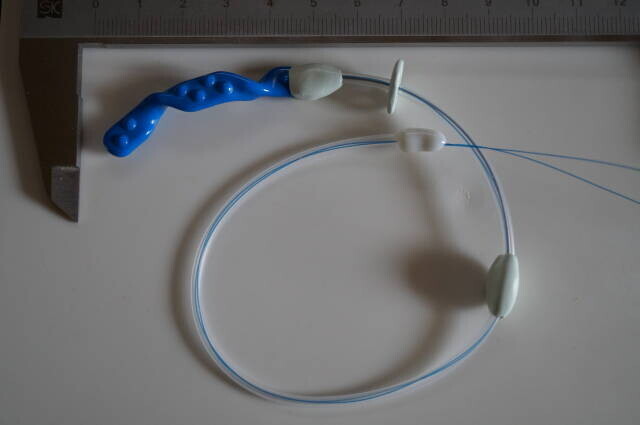
Stopper fit discussions also documented an auxiliary screw remaining inside
An entry published in June 2025 describes an auxiliary screw (an additional screw-shaped supporting chip) on a tube-style tail connection. It remained inside after the main chip came out, and the customer reported blood in the urine. The fragment reportedly passed with urine 2–3 hours later.
The customer also found cracks in other auxiliary screws purchased around the same time. Mr. Okada suspected separation along a joined resin surface. He advised checking these parts for damage and avoiding strong force.
(Source: ok-lab's diary, published June 2025)
https://ok-lab.hatenablog.com/entry/2025/06/07/122954
The maker's answer to a stopper that won't go in
The diary treats fit, attachment compatibility, and factory installation as separate questions.
Adding a stopper to existing cables required electrical alterations
In July 2019, Mr. Okada introduced a stopper for a parallel cable (the electrical lead used on vibrating chips). Retrofitting (adding a part to equipment already owned) involved changes to the cable’s electrical connection. The planned price was ¥1,500 (about $10 at ¥156 = $1, rate as of 2026-09-04) excluding tax, with M at 9 mm and L at approximately 11 mm. Mr. Okada offered delivery with the stopper already fitted when customers ordered a new vibrating chip.
(Source: ok-lab's diary, published July 2019)
https://ok-lab.hatenablog.com/entry/2019/07/06/152113
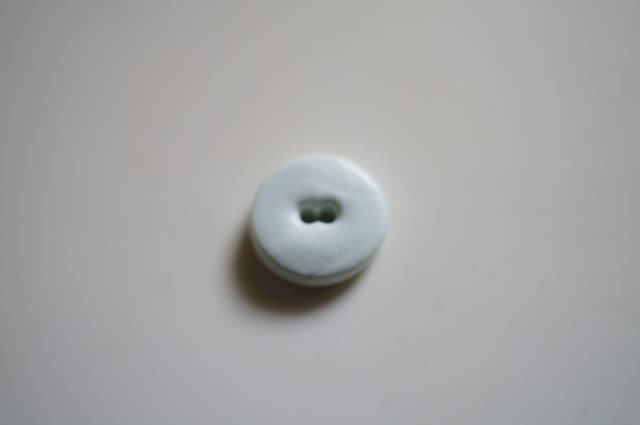
Stopper retrofit limits also applied to screw-shaped auxiliary chips
The November 2019 launch entry said its auxiliary screw could not be retrofitted. Standard dimensions were 15–18 mm long and 8–9 mm wide, at ¥3,000 (about $19 at ¥156 = $1, rate as of 2026-09-04) excluding tax. The custom-order note also ruled out lengths of 15 mm or less. Mr. Okada asked customers to order the auxiliary screw alongside the main product.
(Source: ok-lab's diary, published November 2019)
https://ok-lab.hatenablog.com/entry/2019/11/16/154802
Nylon thread offered another attachment route for adding a stopper
In February 2022, Mr. Okada discussed difficulties involving a parallel-cable stopper and a proposed pushing accessory. His alternative involved additional nylon thread as the stopper's attachment line. The paragraph does not establish which hole-count stopper model this meant. Mr. Okada proposed that arrangement for vibrating-chip users who needed a stopper instead of the parallel-cable version.
(Source: ok-lab's diary, published February 2022)
https://ok-lab.hatenablog.com/entry/2022/02/26/123231
Adding a stopper to braided cable required installation before delivery
In August 2023, Mr. Okada described braided cable (thin electrical wires twisted together with nylon thread). Its dedicated stopper had to be built in before delivery because the cable required a waterproof USB connector (the electrical connection). Position adjustment remained possible, and the dedicated sphincter stopper was listed at ¥2,000 (about $13 at ¥156 = $1, rate as of 2026-09-04) excluding tax. Mr. Okada made order acceptance conditional on further testing.
(Source: ok-lab's diary, published August 2023)
https://ok-lab.hatenablog.com/entry/2023/08/19/123214
If you see blood in your urine, even a small amount or for the first time, do not wait and see. See a urologist right away. If you suddenly cannot urinate, or the device cannot be removed, do not try to fix it yourself. Go to a medical facility, including emergency care, immediately.
How stopper fit and retrofitting changed over time
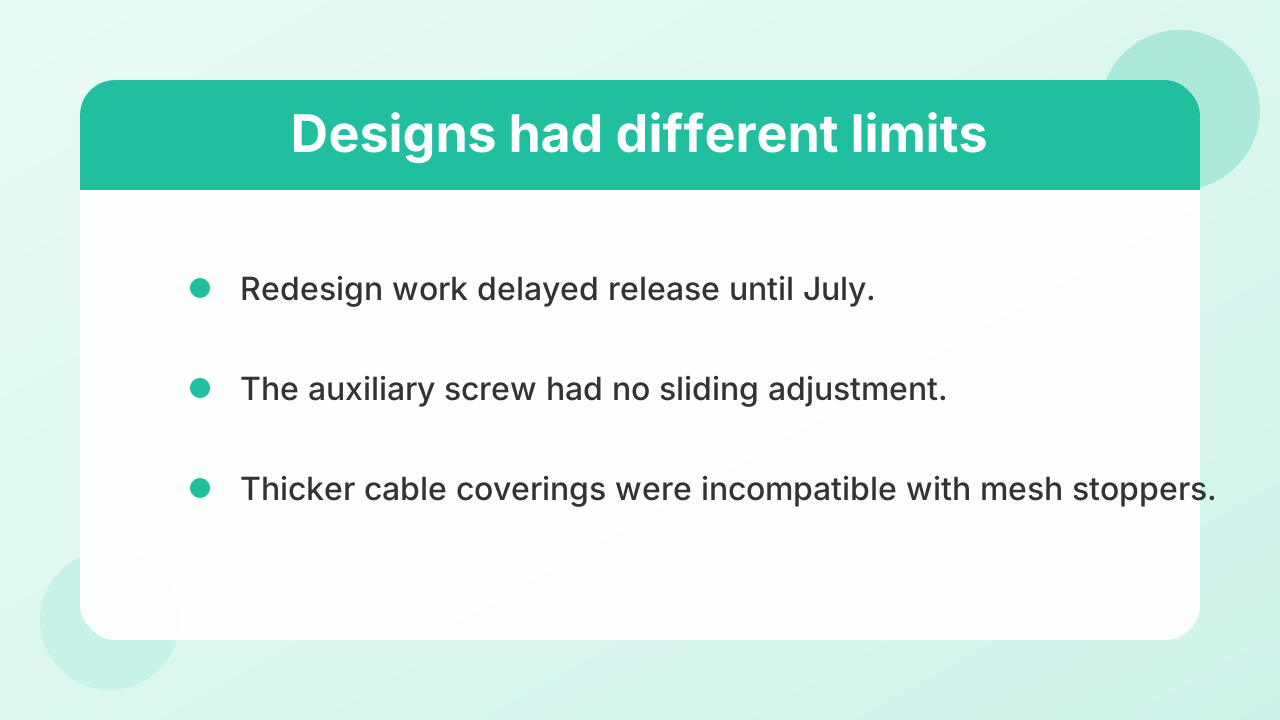
| Published | What the diary said then |
|---|---|
| Jun 2018 | Redesign work delayed the earliest expected release until July. |
| Jul 2018 | One tester favored a roughly triangular stopper, 14 mm long and 2 mm thick. |
| Jul 2019 | The cable stopper was designed to resist movement once positioned. |
| Nov 2019 | The auxiliary screw had no sliding adjustment. |
| Nov 2021 | A customer found the vibrating chip too thick for the cable stopper to follow. |
| Nov 2022 | Mr. Okada said he rarely used stoppers and could not answer from experience. |
| Nov 2023 | Mr. Okada described passage through the penis tip as the main difficulty. |
| Aug 2025 | Mr. Okada reported difficulty fitting an L-size stopper on shape-memory wire (a metal connecting line). |
| Feb 2026 | Thicker coverings on powered-chip cables were also described as incompatible with mesh stoppers. |
OK Prostate Chip products related to adding a stopper
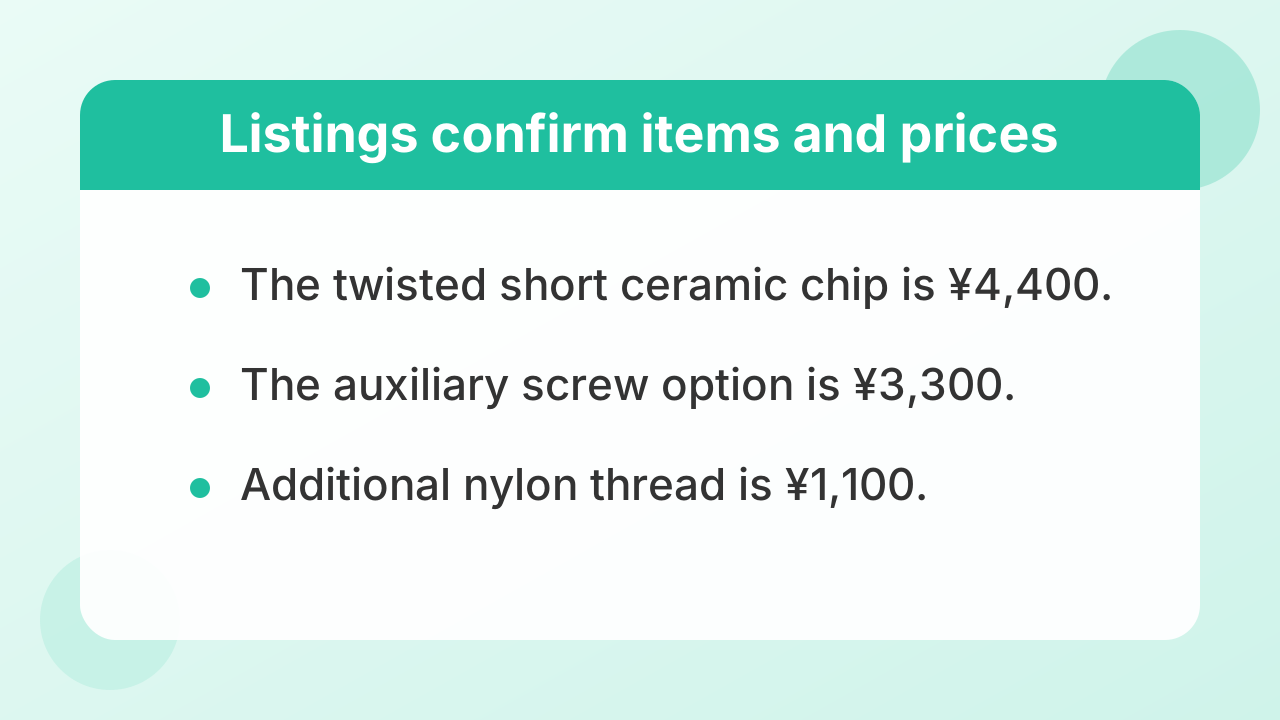
Current listings confirm these items and prices, without confirming every historical attachment arrangement.
Products that appear in these entries
| Product (official name) | Price incl. tax | Relation to this topic |
|---|---|---|
| Twisted short ceramic chip (OKプロステートチップ 陶器素材ショートタイプ ツイスト) | ¥4,400 (about $28 at ¥156 = $1, rate as of 2026-09-04) | In September 2020, its owner asked about adding a stopper after reporting movement toward the bladder. |
| Auxiliary screw option (スクリュー型補助チップ追加オプション) | ¥3,300 (about $21 at ¥156 = $1, rate as of 2026-09-04) | In September 2020, this option was on the customer's twisted ceramic chip in the stopper-retrofit discussion. |
| Plain vibrating chip (OKプロステート核振チップ プレーン(胎児チップ)) | ¥3,300 (about $21 at ¥156 = $1, rate as of 2026-09-04) | In May 2026, a customer proposed this chip with an apple-shaped cable stopper, which staff said would complicate fitting. |
(Source: ok-lab's diary, published September 2020)
https://ok-lab.hatenablog.com/entry/2020/09/19/123115
(Source: ok-lab's diary, published May 2026)
https://ok-lab.hatenablog.com/entry/2026/05/02/122917
Products the diary mentioned as alternatives
| Product (official name) | Price incl. tax | Relation to this topic |
|---|---|---|
| Additional nylon thread (ナイロン糸追加(オプション)) | ¥1,100 (about $7 at ¥156 = $1, rate as of 2026-09-04) | In February 2022, Mr. Okada proposed extra nylon thread for a stopper instead of the parallel-cable arrangement. |
(Source: ok-lab's diary, published February 2022)
https://ok-lab.hatenablog.com/entry/2022/02/26/123231
Other designs discussed here include early test assemblies, the detachable prototype, the braided-cable stopper, and the tail-mounted auxiliary screw. No matching product can be confirmed on the current list.
The tube-covered-line combination and apple-shaped cable proposal were also specific builds discussed in the diary. No matching product can be confirmed on the current list.
Common worries about adding a stopper
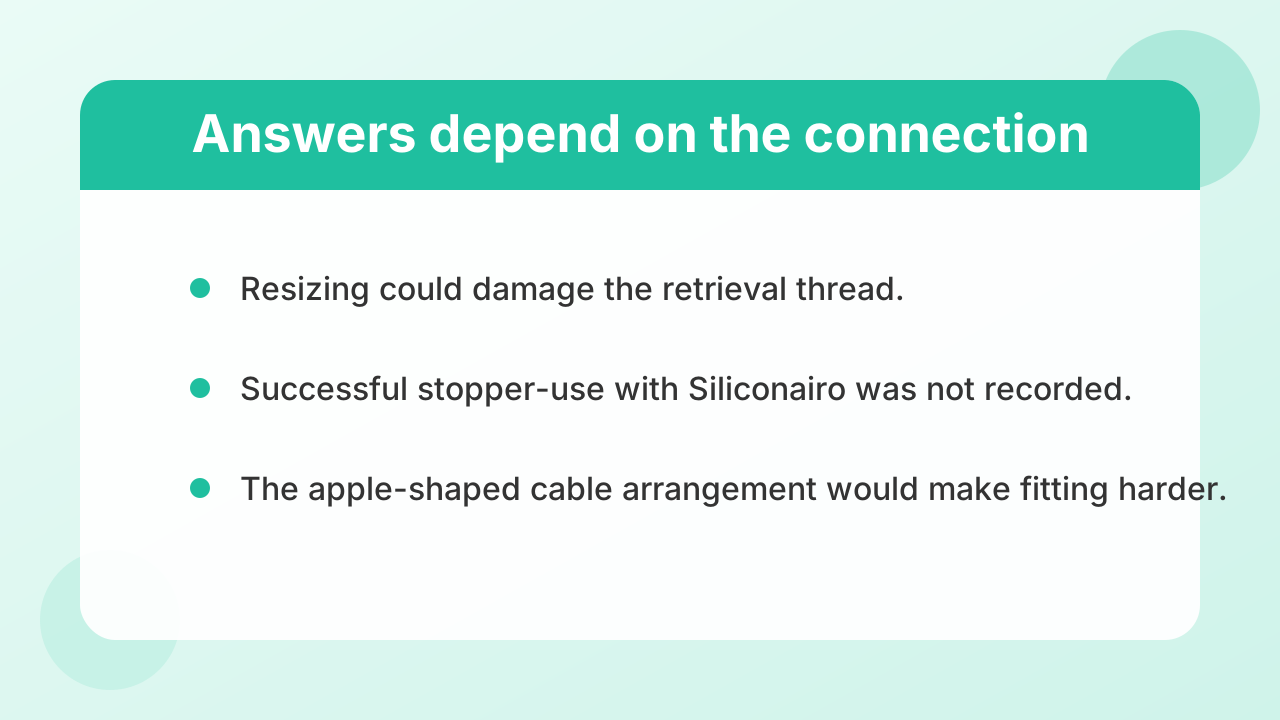
The recorded answers are specific to the customer's connection and problem.
"Can a stopper that won't go in be made smaller?"
In March 2020, a customer asked whether an oversized stopper could be made smaller or whether widening the urethra was necessary. The diary does not record whether the customer altered the part or achieved a comfortable fit. Mr. Okada considered resizing possible but warned that work on the part could damage its retrieval thread.
(Source: ok-lab's diary, published March 2020)
https://ok-lab.hatenablog.com/entry/2020/03/28/144043
"Can someone add a stopper to an already purchased chip?"
In September 2020, a customer asked about retrofitting after reporting apparent bladder entry with a twisted short ceramic chip and auxiliary screw. The diary does not record whether a stopper was subsequently attached. Mr. Okada’s answer was that he thought it possible; he did not identify the stopper model.
(Source: ok-lab's diary, published September 2020)
https://ok-lab.hatenablog.com/entry/2020/09/19/123115
"Could adding a stopper explain difficulty during first use?"
In April 2025, a first-time purchaser asked whether the stopper was making fitting harder. Mr. Okada thought that was quite possible and discussed the stopper separately from the main chip. The customer also raised concerns about a lump and possible inflammation. Mr. Okada advised a urology consultation for that concern.
(Source: ok-lab's diary, published April 2025)
https://ok-lab.hatenablog.com/entry/2025/04/26/122909
"Does adding a stopper work with the tube-covered line?"
In February 2026, a customer asked about a tube-covered connection line (Siliconairo) and the absence of a stopper option. Staff said they did not think a stopper could be attached directly, but offered to explore an additional covering. Mr. Okada subsequently produced a prototype with a 1 mm line inside a 2 mm covering. He thought it felt stiffer, but the entry records no successful stopper-use result for that combination.
(Source: ok-lab's diary, published February 2026)
https://ok-lab.hatenablog.com/entry/2026/02/07/122919
"Does an apple-shaped stopper retrofit make cable fitting harder?"
In May 2026, a customer proposed an apple-shaped stopper on a plain vibrating chip to hold its vibrating section at a chosen position. Staff replied that construction seemed possible, but the cable arrangement would make the central shaft thicker and fitting harder. The diary does not record whether the customer ordered it. Staff asked the customer to consider that difficulty before proceeding.
(Source: ok-lab's diary, published May 2026)
https://ok-lab.hatenablog.com/entry/2026/05/02/122917
Buying from outside Japan

OK Lab ships internationally to countries covered by Japan Post's EMS courier service. Overseas orders are paid in advance by PayPal. Each order carries a ¥400 (about $3 at ¥156 = $1, rate as of 2026-09-04) handling fee, and EMS shipping is charged on top. These terms come from OK Lab's official sales-terms page (written here as plain text, not a link: ok-lab.net/docs/law), checked on September 7, 2026; confirm them on the official store before you order, because they can change.
Summary of this article
| What you wanted to know | The answer |
|---|---|
| In short: what determines the answer? | Stopper design and attachment type affect fitting and retrofit possibilities. |
| About this product: who makes it? | OK Lab in Japan makes the urethral device; prices are in JPY. |
| Key terms: what is a stopper? | An additional part intended to limit movement; several attachment systems appear. |
| What happens when it will not fit? | Reports include difficult placement, bleeding, and failure to prevent bladder entry. |
| What did the maker propose? | Different connection arrangements, manufacturing revisions, and installation with new orders. |
| What changed over time? | Later designs brought different attachment requirements, without one universal retrofit rule. |
| Which current products relate? | The listed ceramic and vibrating chips, auxiliary screw, and nylon thread appear in relevant discussions. |
| What do customer questions establish? | Some combinations were considered possible; others remained incompatible or unconfirmed. |
| How do overseas orders work? | Advance PayPal payment, a ¥400 (about $3 at ¥156 = $1, rate as of 2026-09-04) handling fee, and additional EMS shipping charges. |
Source: ok-lab's diary (Okada Comfortable Life Laboratory). The original entries are in Japanese; quotations on this page are translated. Photos and videos are on the original entries.
This article is a summary of the maker's development diary. The product is not a medical device and no result is guaranteed. If anything feels wrong or worries you, see a doctor. Prices, specifications and cautions change, so confirm the latest information on the official blog and the official site. Questions about ordering and shipping go to the seller.