![Why does my prostate chip keep slipping out? | Shape can help, but no shape guarantees stability [OK Prostate Chip]](/img/a/T0130/eyecatch.svg)
This page summarizes entries from "ok-lab's diary" (https://ok-lab.hatenablog.com/), written by Mr. Okada, founder of OK Lab, a small company in Japan (Okada Comfortable Life Laboratory). Entries about shapes intended to help chips stay in place are presented in publication order. Historical specifications are dated. Current prices come from the official product list retrieved September 4, 2026. Quotations are translated from Japanese.
Note: This page is a personal reading log by someone with no connection to the maker or the seller. It reflects the source entries as of their publication dates and makes no guarantee of accuracy or safety. The product is not a medical device; talk to a doctor about any health decision. Check the official site for current information. This page contains advertising.
In short
Customers report that the same general shape can stay in place for one person and slip for another.
Mr. Okada explores curves, narrower waists, flexible connections, and supporting parts, while acknowledging their limitations.
Current listings include curved and twisted chips, but several newer diary designs have no confirmed matching product.
About this product

The OK Prostate Chip is a small device that is placed in the urethra (the urine passage) so that it acts on the prostate; the maker sells it in several shapes, sizes and materials. It is made and sold by OK Lab (Okada Comfortable Life Laboratory), a small company in Japan, through its own online store, and prices are in Japanese yen (JPY).
The maker's development diary, "ok-lab's diary", is written in Japanese. This page is an English summary of it, and every quotation is translated. OK Lab ships internationally, so readers outside Japan can order (see "Buying from outside Japan" below).
Product names on this page are plain-English descriptions. The official Japanese product name is shown once in the product table so you can find the same item in the store.
Before you read: key terms
| Term | Plain-English meaning |
|---|---|
| Urethra | The urine passage; it is also where the maker describes placing this device. |
| Sphincter | A muscle controlling a passage; the diary discusses its role in gripping parts of a chip. |
| Waist | A narrower section between wider parts, intended to provide a place for the sphincter to grip. |
| Cross joint | A connection between two chips that allows bending in two directions, intended to improve their alignment. |
| Auxiliary chip | An additional chip connected behind the main device, used for support or additional contact. |
| Shape-memory wire | Wire intended to recover a preset shape, used in curved connections and flexible supporting loops. |
| Chipless design | A device using wire loops instead of a solid prostate chip, intended to provide support through their springiness. |
What happens: keeping a prostate chip in place
The OK Prostate Chip is a small device placed in the urethra (the urine passage) to act on the prostate.
If you see blood in your urine, even a small amount or for the first time, do not wait and see. See a urologist right away.
If you suddenly cannot urinate, or the device cannot be removed, do not try to fix it yourself. Go to a medical facility, including emergency care, immediately.
This topic concerns the chip's length, its curves, and the contrast between narrow sections and wider ends or bulges. The diary describes these features as ways to influence where the device rests within the urine passage around the prostate. Supporting parts may also occupy the wider section near the penis base. Mr. Okada reports variable results, including unwanted movement and difficult removal.
A longer chip still shifted during early semi-long testing
In an entry published in April 2018, Mr. Okada described semi-long prototypes whose position remained uncertain. He considered 45 mm unsuitable in those tests and favored 38–42 mm. He reported that a longer prototype could press uncomfortably against the passage after moving downward.
He contrasted this with a long model whose resting position was more predictable. Mr. Okada said further testing was necessary before offering the semi-long design for sale.
(Source: ok-lab's diary, published April 2018)
https://ok-lab.hatenablog.com/entry/20180421/1524299808
A glass chip kept slipping despite its extra length
In an entry published in May 2018, a customer wanted the semi-long glass chip to stay near the prostate. Their previous linked resin chips had stayed there more readily. Mr. Okada replied that glass models were substantially more slippery in his experience.
The diary does not record the outcome. He also cautioned that an extreme waist could place excessive strain on the sphincter (a muscle controlling the passage). Mr. Okada suggested a custom resin version as a potentially less slippery alternative.
(Source: ok-lab's diary, published May 2018)
https://ok-lab.hatenablog.com/entry/20180519/1526708081
A narrow-waisted chip stayed put for one customer, with reservations
In an entry published in September 2021, a customer reported better stability with a short titanium chip. They credited its waist (the narrow section between wider parts), which their sphincter could grip. Earlier chips had shifted inward instead of remaining at the desired location.
Mr. Okada replied that he had not experienced equally reliable stability himself. He cautioned against expecting the same degree of improvement from the narrower waist.
(Source: ok-lab's diary, published September 2021)
https://ok-lab.hatenablog.com/entry/2021/09/11/125735
A sharply curved chip raised concerns about difficult removal
In an entry published in June 2023, Mr. Okada introduced a curved metal-axis bead chip (Cool Beads). Its published bead specifications included widths of 7.5–8 mm and thicknesses of 3.5–4 mm. He reported strong resistance to movement during urination in his own sharply curved examples.
He also said greater curvature made insertion more difficult. Mr. Okada warned that a sharply curved device entering the bladder might require hospital removal.
(Source: ok-lab's diary, published June 2023)
https://ok-lab.hatenablog.com/entry/2023/06/24/123110
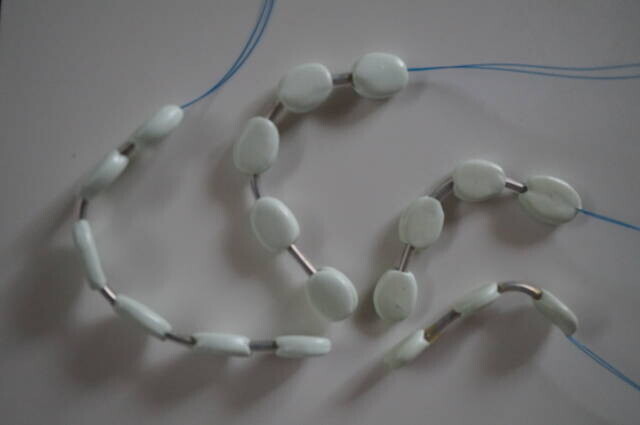
A curved wire device broke despite its intended stable shape
In an entry published in May 2025, a customer reported that a chipless design had broken at its 90° bend during washing. They asked whether a replacement could be made. OK Lab declined an initial-defect replacement because too much time had passed since shipment.
The customer accepted that answer. Staff said newer products used stronger wire bent by its manufacturer. The reply cautioned that even this newer wire could break after prolonged use.
(Source: ok-lab's diary, published May 2025)
https://ok-lab.hatenablog.com/entry/2025/05/31/122940
A chip that stayed put elsewhere slipped for this customer
In an entry published in November 2025, a customer sought stability and stronger sensation from a ceramic four-point twist chip. Their curved central-bulge twist chip had suited them, while a sculpted ceramic chip slipped after about 10 minutes.
Mr. Okada replied that shape preferences and stability differed between customers. The diary does not record the new chip's outcome. He said supporting parts also needed consideration, while acknowledging that a definitive solution remained elusive.
(Source: ok-lab's diary, published November 2025)
https://ok-lab.hatenablog.com/entry/2025/11/01/122937
A smaller spiral chip still needed support against slipping
In an entry published in July 2026, Mr. Okada described a smaller spiral prototype that could still move during urination. Its prostate section measured approximately 40–45 mm, with 0.1 mm spiral wire and a 10–13 mm width.
He then described a version with another spiral section across a curved connection. He thought its stability approached that of earlier chipless designs. Mr. Okada limited the offered connection angles to 90° and 105°, because the sharper versions were too difficult to manufacture.
(Source: ok-lab's diary, published July 2026)
https://ok-lab.hatenablog.com/entry/2026/07/18/122919
The maker's answer to keeping a prostate chip in place
Mr. Okada's proposals address the whole device: its contact surfaces, narrow sections, connections, and ability to follow a bend.
A jointed chip was redesigned to resist being pushed outward
In an entry published in September 2018, Mr. Okada introduced a cross joint (a connection allowing bending in two directions). The resin chips now engaged with each other instead of meeting only at their tips.
He thought the crossed section would allow better urine flow, reducing the force pushing the device outward. The connection became standard for the linked ordinary and screw-shaped resin designs. Mr. Okada offered the revised construction for interested customers to consider.
(Source: ok-lab's diary, published September 2018)
https://ok-lab.hatenablog.com/entry/20180908/1536384939
A narrow-waisted chip also needed enough space around its waist
In an entry published in June 2021, Mr. Okada distinguished a waist's thinness from the opening available around it. He described a titanium example with a 2 mm narrow section.
In his experience, an opening of 6–7 mm favored stability, while approximately 4 mm produced stronger sensation. These were his observations from particular designs and tests. Mr. Okada advised treating comfortable support and stronger sensation as separate design goals.
(Source: ok-lab's diary, published June 2021)
https://ok-lab.hatenablog.com/entry/2021/06/26/125926
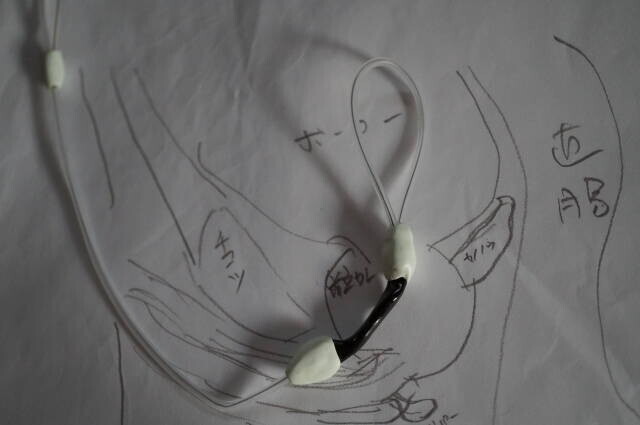
Curved cable support addressed chip slipping after earlier strength problems
In an entry published in June 2023, a customer asked about a previous four-wire support arrangement. Mr. Okada said that construction had been discontinued because its wire-strength problem remained unresolved.
He proposed a different cable assembly with a stronger supporting wire confined to the internal section. He expected its curve to help the vibrating chip remain in position. Mr. Okada also identified possible separation between the cable and wire as a design concern requiring protection.
(Source: ok-lab's diary, published June 2023)
https://ok-lab.hatenablog.com/entry/2023/06/10/123053
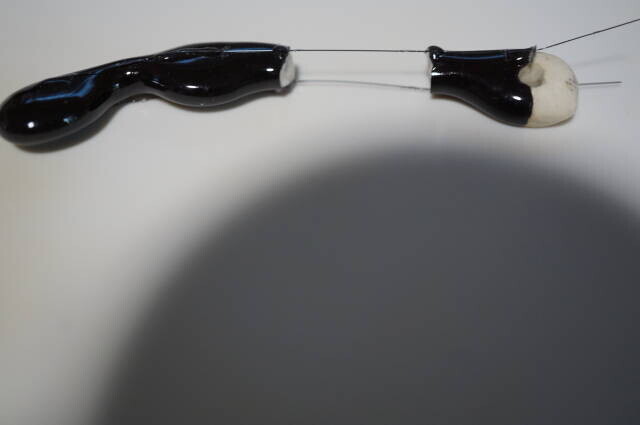
Jointed ceramic chips were developed to help devices stay in place
In an entry published in January 2026, Mr. Okada introduced ceramic prototypes with a flexible connection. The new construction added 15 mm to the original chip, with approximately 5 mm forming the flexible middle.
He reported improved stability from the smallest semi-long prototype compared with its rigid form. The stated standard bend was approximately 30–45°. Mr. Okada cautioned that a sharply curved early prototype with a less flexible connection had been difficult to insert.
(Source: ok-lab's diary, published January 2026)
https://ok-lab.hatenablog.com/entry/2026/01/17/122907
If you see blood in your urine, even a small amount or for the first time, do not wait and see. See a urologist right away.
If you suddenly cannot urinate, or the device cannot be removed, do not try to fix it yourself. Go to a medical facility, including emergency care, immediately.
How keeping a prostate chip in place changed over time
| Published | What the diary said then |
|---|---|
| Apr 2018 | Semi-long testing exposed problems when longer chips changed position. |
| Sep 2018 | Cross joints became standard for linked ordinary and screw-shaped resin chips. |
| Mar 2019 | A curved cable connection was introduced; Mr. Okada reported more stable positioning. |
| Oct 2021 | Earlier linked glass chips were reported withdrawn from standard sales over removal trouble. |
| Dec 2021 | Flat curved chips launched with stability described as the maker's personal impression. |
| Jun 2023 | Four-wire support was discontinued over strength problems; a different reinforced cable was proposed. |
| Apr 2024 | A ceramic pair connected at approximately 90° reportedly resisted movement during urination. |
| Nov 2024 | A roughly 60° wire bend reportedly reduced inward movement from straightening forces. |
| Feb 2026 | Sharply curved ceramic and resin prototypes were presented without plans for immediate sale. |
| Jul 2026 | Smaller spiral sections were priced at ¥4,500 (about $29 at ¥156 = $1, rate as of 2026-09-04) each, excluding tax. |
OK Prostate Chip products related to keeping a prostate chip in place
The current list includes several designs discussed here, but their presence does not establish reliable stability for every customer.
Products that appear in these entries
| Product (official name) | Price incl. tax | Relation to this topic |
|---|---|---|
| Semi-long glass chip (OKプロステートチップ ガラス素材セミロングタイプ) | ¥4,400 (about $28 at ¥156 = $1, rate as of 2026-09-04) | In May 2018, a customer reported that this design slipped more readily than their linked resin chips. |
| Resin cross-jointed pair (OKプロステートチップ 樹脂素材クロスジョイント連結タイプ) | ¥4,400 (about $28 at ¥156 = $1, rate as of 2026-09-04) | In September 2018, Mr. Okada introduced the joint with improved flow and reduced outward movement in mind. |
| Ceramic central-bulge twist chip (OKプロステートチップ 陶器素材覚醒タイプ コブラツイスト) | ¥6,600 (about $42 at ¥156 = $1, rate as of 2026-09-04) | In November 2020, a purchaser reported resistance to outward movement with this chip and an auxiliary. |
| Ceramic long four-point twist chip (OKプロステートチップ 陶器素材ロングタイプ 4点ツイスト) | ¥7,700 (about $49 at ¥156 = $1, rate as of 2026-09-04) | In March 2020, a customer reported inward movement with the M version and asked about alternatives. |
| Flat curved resin chip (OKプロステートチップ フラット面カーブ型 セミロングタイプ(生体適合樹脂)) | ¥6,050 (about $39 at ¥156 = $1, rate as of 2026-09-04) | In December 2021, Mr. Okada launched this design and reported good stability in his own experience. |
| Short resin chip (OKプロステートチップ ショートタイプ(生体適合樹脂)) | ¥4,400 (about $28 at ¥156 = $1, rate as of 2026-09-04) | In July 2025, an overseas customer sought another design after difficulty reaching the intended position with this model. |
(Source: ok-lab's diary, published May 2018)
https://ok-lab.hatenablog.com/entry/20180519/1526708081
(Source: ok-lab's diary, published September 2018)
https://ok-lab.hatenablog.com/entry/20180908/1536384939
(Source: ok-lab's diary, published November 2020)
https://ok-lab.hatenablog.com/entry/2020/11/07/121125
(Source: ok-lab's diary, published March 2020)
https://ok-lab.hatenablog.com/entry/2020/03/07/152901
(Source: ok-lab's diary, published December 2021)
https://ok-lab.hatenablog.com/entry/2021/12/04/124140
(Source: ok-lab's diary, published July 2025)
https://ok-lab.hatenablog.com/entry/2025/07/26/122909
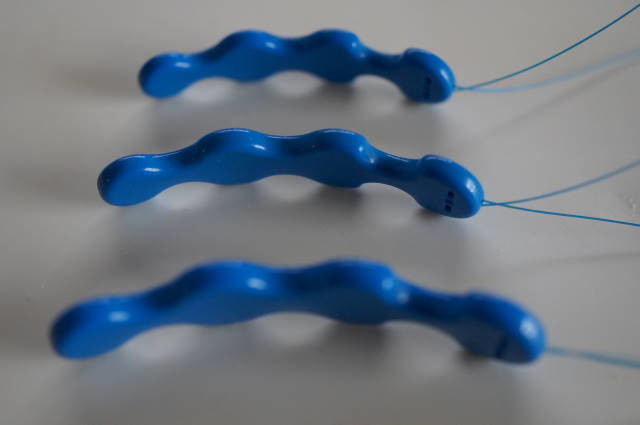
Products the diary mentioned as alternatives
| Product (official name) | Price incl. tax | Relation to this topic |
|---|---|---|
| Screw-shaped auxiliary chip (スクリュー型補助チップ追加オプション) | ¥3,300 (about $21 at ¥156 = $1, rate as of 2026-09-04) | In December 2019, Mr. Okada suggested this support for a customer's concern about expulsion during urination. |
(Source: ok-lab's diary, published December 2019)
https://ok-lab.hatenablog.com/entry/2019/12/14/151232
The entries also describe semi-long prototypes, titanium chips, metal-axis beads, curved cable assemblies, jointed ceramic chips, and wire-loop or spiral designs. No matching product can be confirmed on the current list.
Common worries about keeping a prostate chip in place

The diary's answers repeatedly qualify stronger retention with individual differences, comfort concerns, or limits on what was actually tested.
"Can a longer chip prevent movement toward the bladder?"
In an entry published in March 2020, a customer said their ceramic four-point twist chip appeared to move into the bladder. They asked about a larger version. Mr. Okada acknowledged that a different size might help if the existing fit was wrong.
He also warned that greater length increased constraint. The diary does not record the outcome. Mr. Okada favored a flexible screw-shaped auxiliary chip (an additional supporting chip) over simply making one rigid piece longer.
(Source: ok-lab's diary, published March 2020)
https://ok-lab.hatenablog.com/entry/2020/03/07/152901
"Does a 90° chip bend stop movement in both directions?"
In an entry published in December 2024, a customer asked whether a chipless design needed a stopper at 90°. This design used shape-memory wire (wire intended to recover a preset form) rather than a solid prostate chip.
Mr. Okada said neither outward movement nor movement into the bladder could be ruled out. Even more sharply bent wire could deform under light force. He suggested a mesh stopper for inward movement, while warning that it reduced the loop design's mild feel.
(Source: ok-lab's diary, published December 2024)
https://ok-lab.hatenablog.com/entry/2024/12/14/122948
"Which chip stays in place for customers outside Japan?"
In an entry published in July 2025, a customer outside Japan wanted reliable positioning after difficulty with a small short chip. Their country was not given. Mr. Okada mentioned a flat curved resin design, a sculpted ceramic model, and a chipless device.
He did not identify one best shape for their requested sensation. The diary does not record the outcome. Mr. Okada also suggested external support to address movement in both directions.
(Source: ok-lab's diary, published July 2025)
https://ok-lab.hatenablog.com/entry/2025/07/26/122909
"Does the semi-long twist chip come in other materials?"
In an entry published in May 2026, a customer sought a resin or surgical-stainless version of the ceramic semi-long twist chip. They wanted easier urination and less concern about breakage.
Mr. Okada said those versions were unavailable, with future sales undecided. The diary does not record a subsequent purchase or outcome. In discussing support, he distinguished screw-shaped auxiliaries from stoppers, which he thought could interfere more with urine flow.
(Source: ok-lab's diary, published May 2026)
https://ok-lab.hatenablog.com/entry/2026/05/23/122904
Buying from outside Japan

OK Lab ships internationally to countries covered by Japan Post's EMS courier service. Overseas orders are paid in advance by PayPal. Each order carries a ¥400 (about $3 at ¥156 = $1, rate as of 2026-09-04) handling fee, and EMS shipping is charged on top. These terms come from OK Lab's official sales-terms page (ok-lab.net/docs/law), checked on September 7, 2026; confirm them on the official store before you order, because they can change.
Summary of this article
| What you wanted to know | The answer |
|---|---|
| What is the short answer? | Shape can help particular users, but the maker acknowledges that reliable positioning remains individual. |
| What is this product? | A urethral device made by OK Lab in Japan and priced in Japanese yen. |
| What do the terms mean? | Waists, joints, auxiliaries, and wire loops describe different parts intended to influence support. |
| What happens when chips move? | Reports include outward slipping, inward movement, and difficult removal. |
| What does the maker propose? | Different contact shapes, sufficient space around narrow sections, curved supports, and flexible joints. |
| What changed over time? | Development moved from rigid shapes toward joints, reinforced connections, and springy wire structures. |
| What products are listed today? | The table identifies current listings separately from unmatched historical and experimental designs. |
| Can one size or angle guarantee stability? | Mr. Okada says no; stronger constraint also brings practical limitations. |
| How do overseas orders work? | Advance PayPal payment, a ¥400 (about $3 at ¥156 = $1, rate as of 2026-09-04) handling fee, and additional Japan Post EMS shipping charges. |
Source: ok-lab's diary (Okada Comfortable Life Laboratory). The original entries are in Japanese; quotations on this page are translated. Photos and videos are on the original entries.
This article is a summary of the maker's development diary. The product is not a medical device and no result is guaranteed. If anything feels wrong or worries you, see a doctor. Prices, specifications and cautions change, so confirm the latest information on the official blog and the official site. Questions about ordering and shipping go to the seller.